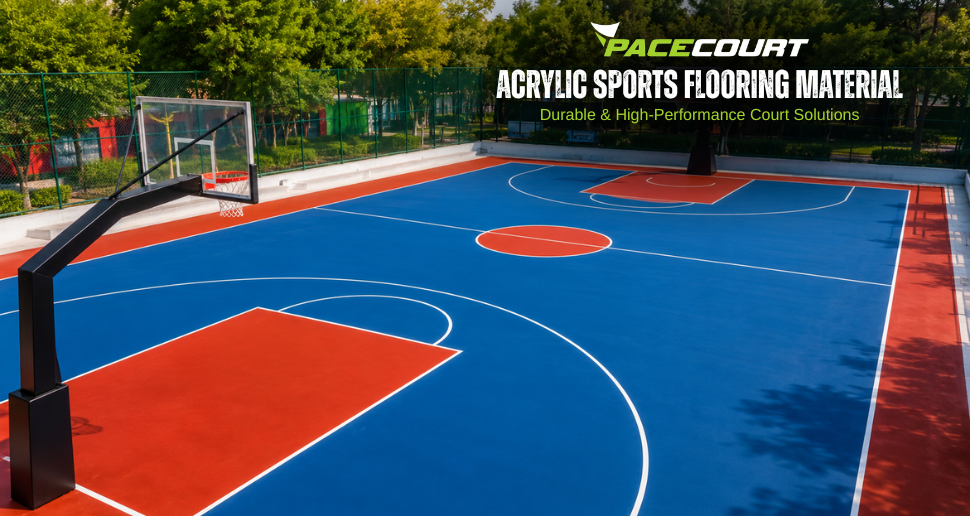
Choosing the right acrylic sports flooring material is one of the most important decisions when building an outdoor sports court. The surface affects grip, ball response, player movement, comfort, maintenance and the overall life of the court.
Acrylic sports flooring is widely used for tennis court flooring, basketball court flooring, badminton court flooring, pickleball courts and multi-purpose outdoor courts. Unlike a simple painted concrete surface, a properly designed acrylic system uses multiple layers, with each layer performing a specific job.
For a sports facility, the goal isn’t simply to make the court look attractive. The flooring needs to work with the base, handle weather exposure, provide a suitable playing feel and remain maintainable over time.
Pacecourt manufactures synthetic acrylic sports flooring systems for different sports and applications. Its published product range includes concrete primer, deep patch, acrylic resurfacer, cushion coat, colour coat, line marking and silica sand, allowing the court surface to be built as a system rather than treated as a single coating.
What Is Acrylic Sports Flooring Material?
Acrylic sports flooring material is a specially formulated surface system used to create hard, durable and playable sports courts over suitable concrete or asphalt bases.
The material is generally applied in layers. Depending on the court design and performance requirement, the system can include:
- Concrete primer
- Crack filler
- Deep patch or repair material
- Acrylic resurfacer
- Cushion coat
- Acrylic colour coat
- Silica sand for texture
- Line-marking paint
The exact system depends on the sport, existing base condition, climate, expected usage and desired playing characteristics.
A good acrylic court should not be treated as ordinary exterior paint. The surface has to be designed and installed as a complete sports flooring system.
Why Acrylic Is Popular for Outdoor Sports Courts
Outdoor courts face conditions that indoor floors don’t. Sunlight, rain, dust, temperature changes and regular foot traffic can gradually affect an unprotected surface.
A properly installed acrylic system offers several practical advantages:
| Feature | Benefit |
| Hard-wearing surface | Suitable for regular sports use |
| Weather-resistant coating system | Helps the surface handle outdoor exposure |
| Textured finish | Can provide controlled traction |
| Colour options | Allows clear court zoning and attractive designs |
| Repairable surface | Local defects can often be repaired before resurfacing |
| Multi-layer construction | Each layer serves a specific purpose |
| Low-profile finish | Maintains a relatively smooth playing surface |
| Custom sports layouts | Can accommodate different court markings |
The quality of the finished court, however, depends on more than the coating itself. Drainage, base preparation, application technique, curing and maintenance all matter.
Acrylic Sports Flooring Material Layers
One of the biggest mistakes in sports court construction is thinking that acrylic flooring means applying one or two coats of colour.
A professional system normally starts with preparing the base and then builds the playing surface through several stages.
1. Concrete Primer
The primer helps establish adhesion between the prepared concrete base and subsequent acrylic layers.
The base must be clean and properly prepared before primer application. Dust, oil, loose material and other contaminants can interfere with bonding.
2. Crack Filler
Small cracks and surface defects need appropriate treatment before the main coating system is installed.
Crack repair isn’t simply about making the surface look smooth. If defects aren’t addressed properly, they can affect the finished surface later.
3. Deep Patch
Deeper depressions, damaged areas and significant surface imperfections may require a suitable patching material.
The purpose is to restore the base before the acrylic layers are applied.
4. Acrylic Resurfacer
The resurfacer helps create a more uniform surface and fills minor imperfections in the prepared base.
This layer is particularly important when converting an existing suitable court into a smoother acrylic playing surface.
5. Cushion Coat
A cushion system can be incorporated when the project calls for additional surface comfort.
Not every acrylic court requires the same cushion configuration. The specification should be based on the sport, playing requirements and project budget.
6. Colour Coat
The colour coat gives the court its finished appearance while forming part of the playing surface system.
Different colours can be used for the playing area and surrounding zones. Colour selection should also consider visibility, maintenance and the environment around the court.
7. Silica Sand
Silica sand may be incorporated into suitable acrylic layers to create controlled surface texture and traction.
The quantity and grade need to match the intended system. Adding sand randomly can change the surface characteristics and produce an inconsistent finish.
8. Line Marking
The final stage includes accurate sports line marking.
The markings need to be sharp, correctly positioned and compatible with the sport being played.
Upgrade Your Sports Court Today
Get premium synthetic acrylic flooring designed for durability, grip, and performance.
Get Free ConsultationPacecourt lists these components individually within its acrylic flooring product range, including crack filler, deep patch, concrete primer, acrylic resurfacer, cushion coat, colour coat, line marking and silica sand.
Acrylic Sports Flooring for Different Sports
The same basic acrylic technology can be adapted for different sports, but the court shouldn’t be specified using a one-size-fits-all approach. The required playing characteristics and markings differ from sport to sport.
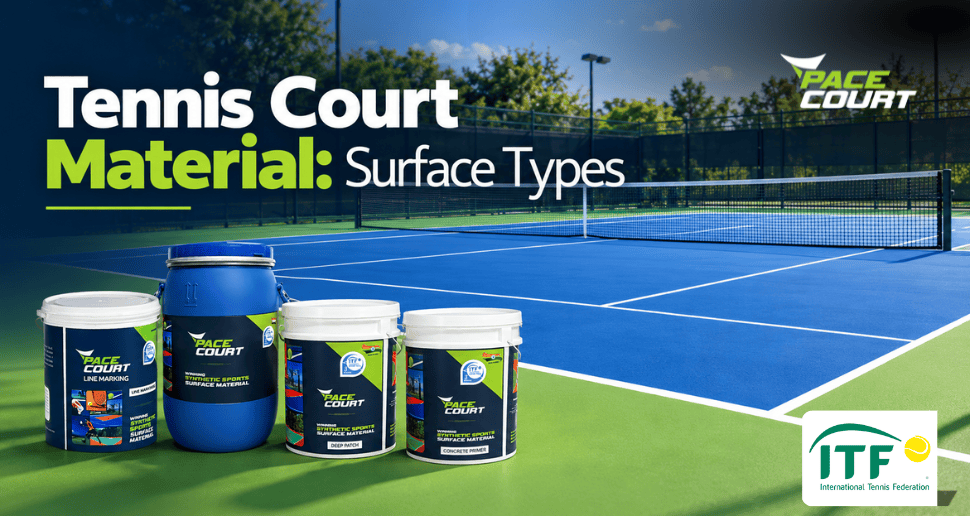
Tennis Court Flooring
Tennis court flooring needs to provide predictable ball response, suitable traction and a playing speed appropriate to the intended use.
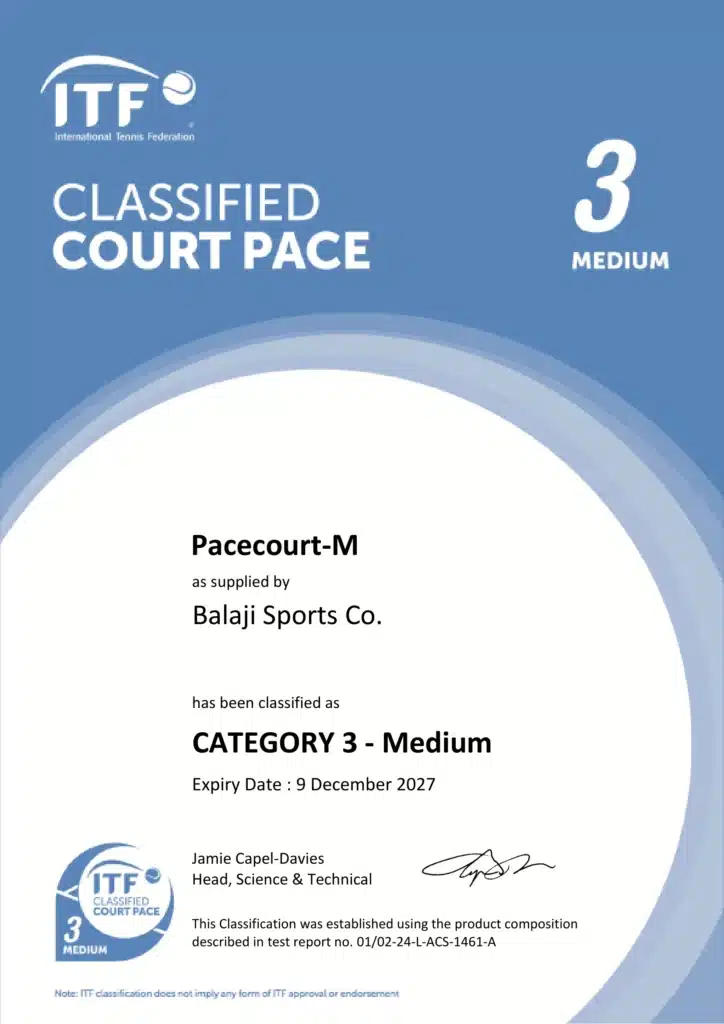
For tennis, surface speed is not simply a matter of choosing a colour or coating. The ITF Court Pace Classification Programme categorises tennis surfaces from slow to fast based on measured court pace.
Acrylic systems are commonly used for hard tennis courts. The final playing characteristics depend on the complete surface system, texture, construction and maintenance.
For a tennis project, ask the flooring supplier:
- What acrylic system is being proposed?
- What base preparation is required?
- Is the product ITF classified?
- What court pace is appropriate for the project?
- Is cushioning required?
- How will cracks and joints be treated?
- What maintenance schedule is recommended?
It’s also worth understanding the difference between ITF classification and ITF court recognition. ITF states that classification is based on Court Pace Rating and does not itself mean ITF approval or endorsement. Court recognition involves additional testing of the installed court.
Basketball Court Flooring
Basketball court flooring needs good traction and a consistent surface for running, stopping and changing direction.
Outdoor basketball courts are commonly constructed with acrylic systems over appropriate concrete or asphalt bases.
The surface specification should consider:
- Traction
- Surface smoothness
- Weather exposure
- Ball response
- Wear from regular play
- Drainage
- Cleaning requirements
For schools, residential communities, clubs and commercial facilities, an acrylic system can also be designed as part of a multi-purpose court.
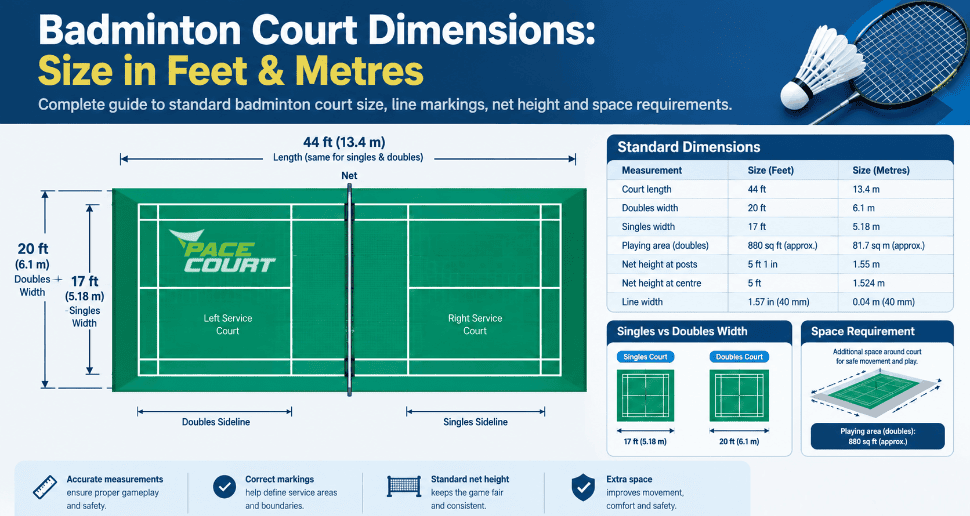
Badminton Court Flooring
Badminton court flooring requires careful consideration because badminton involves rapid footwork and frequent changes of direction.
Outdoor badminton courts need an appropriate acrylic system and a properly prepared base. However, an outdoor acrylic surface shouldn’t automatically be treated as equivalent to a purpose-built indoor badminton floor.
If the facility will host regular competitive badminton, the owner should discuss the intended level of play with the flooring specialist before selecting the system.
For recreational outdoor courts, schools and community facilities, acrylic flooring can provide a practical hard-court surface when the base, drainage and installation are properly handled.
Pickleball Court Flooring
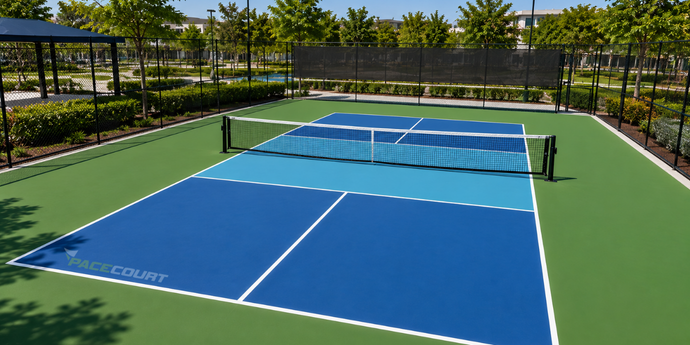
Pickleball has increased demand for outdoor acrylic court surfaces because the sport works well on hard courts.
Acrylic flooring can provide:
- Consistent playing surface
- Good traction
- Clear line marking
- Outdoor weather resistance
- Easy colour zoning
- Compatibility with multi-court facilities
Pacecourt specifically lists pickleball among the sports for which it supplies synthetic acrylic flooring systems.
Acrylic Outdoor Sports Flooring: What Makes It Different?
Acrylic outdoor sports flooring has to cope with environmental conditions throughout the year.
Indian courts may experience intense sunlight, monsoon rain, dust, humidity and large temperature changes. That’s why outdoor court construction needs more attention than simply selecting a surface colour.
The complete installation should consider:
- Existing base condition
- Surface slope and drainage
- Crack treatment
- Primer compatibility
- Acrylic layer selection
- Surface texture
- Colour system
- Curing conditions
- Line marking
- Maintenance requirements
A good coating applied over a poor base won’t solve structural problems.
This is one reason professional court contractors inspect the existing surface before recommending the final acrylic system.
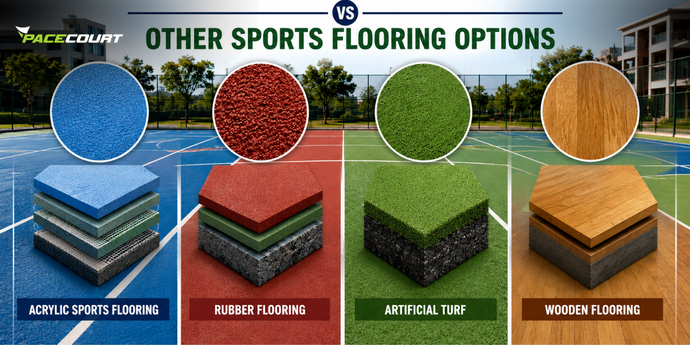
Acrylic Sports Flooring Material vs Other Sports Flooring Options
Acrylic isn’t the only sports flooring option. The right material depends on the sport, location, usage and budget.
| Flooring Type | Typical Application | Outdoor Suitability | Maintenance | Main Consideration |
| Acrylic | Tennis, basketball, pickleball, multi-sport | Excellent | Moderate | Base preparation and coating system |
| PU | Indoor and selected sports applications | Depends on system | Moderate | Product and installation specification |
| PVC/Vinyl | Mainly indoor sports | Limited | Moderate | Better suited to controlled indoor environments |
| Wooden flooring | Indoor basketball and other sports | Poor | Higher | Moisture and environmental control |
| Synthetic rubber | Indoor/outdoor depending on product | Product-dependent | Moderate | Shock absorption and surface specification |
| Artificial turf | Football, hockey and selected sports | Excellent | Regular | Drainage and infill maintenance |
| Concrete only | Basic recreational areas | Excellent | Low | Hard playing feel and limited sport-specific performance |
For outdoor hard courts, acrylic remains a practical choice because it can be installed as a multi-layer surface and maintained through cleaning, repairs and periodic resurfacing.
How to Choose the Right Acrylic Sports Flooring Material
Buying based only on price can create problems later.
A better approach is to compare the complete system.
Check the Base First
Before choosing a coating, inspect the concrete or asphalt base.
Look for:
- Cracks
- Low spots
- Uneven areas
- Weak concrete
- Surface contamination
- Drainage problems
- Existing coating failure
The acrylic system cannot compensate for major structural defects in the base.
Ask for the Complete Layer Specification
Don’t accept a quotation that only says “acrylic flooring.” Ask for the individual layers and their purpose.
A professional quotation should clearly explain:
- Primer
- Crack treatment
- Resurfacer
- Cushion layer, if required
- Colour coat
- Texture system
- Line marking
- Application process
This makes it easier to compare suppliers fairly.
Consider the Sport
A tennis court and a basketball court may both use acrylic, but their design requirements aren’t identical.
The supplier should understand the intended sport instead of supplying the same generic system for every project.
Consider Usage
A court used by a school throughout the day will experience different wear from a private residential court used occasionally.
Tell the supplier:
- Expected daily usage
- Number of players
- Outdoor or indoor location
- Competitive or recreational use
- Expected maintenance level
This information helps determine an appropriate system.
What Should You Ask an Acrylic Sports Flooring Manufacturer?
Before placing an order, ask these questions.
1. Are you a manufacturer or only an installer?
An Acrylic sports flooring material manufacturer should be able to explain the products, specifications and recommended application process.
An installer may purchase materials from another company.
Both can be useful, but knowing who actually manufactures the material helps when comparing technical support and product consistency.
2. Can you provide technical specifications?
Ask for product information covering application, coverage, surface preparation, curing and storage.
3. What is the recommended layer system?
Don’t compare companies only by the number of buckets or total litres supplied.
Compare the complete system.
4. What maintenance is required?
A reliable supplier should explain cleaning, inspection, repair and resurfacing requirements.
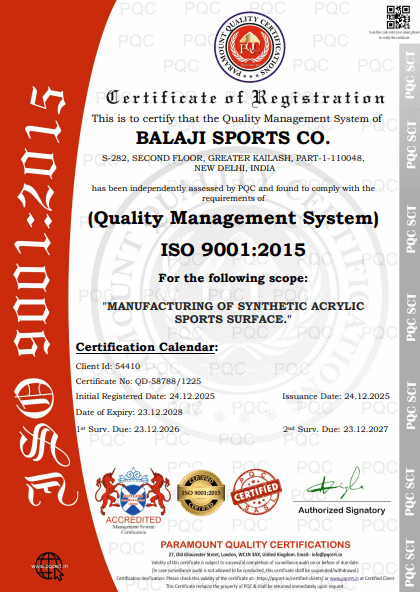
5. Is the product tested or certified?
If a supplier mentions certification, ask exactly what is certified and what the certification applies to.
For tennis, this distinction is particularly important because ITF classification and court recognition are different programmes.
Why Buy Directly From an Acrylic Sports Flooring Supplier?
Working with an Acrylic sports flooring supplier that understands the complete court system can simplify procurement.
A supplier may provide individual materials such as:
- Concrete primer
- Acrylic resurfacer
- Cushion coat
- Colour coat
- Crack filler
- Silica sand
- Line-marking paint
This can help contractors maintain consistency across the project. However, the lowest material price isn’t necessarily the lowest project cost. A cheaper coating may require more preparation, more frequent repairs or earlier resurfacing. Compare the complete installed system, not just the price of one product.
Pacecourt Acrylic Sports Flooring Material
Pacecourt positions itself as an Indian manufacturer of synthetic acrylic sports flooring systems for tennis, basketball, badminton, pickleball, volleyball, skating, walking tracks and multi-purpose courts. Its published product range covers the major components used in its systems.
According to Pacecourt’s published company information, the brand has more than 15 years of experience, states that its systems are ITF certified, and reports more than 12,000 courts built across India. These are company-reported figures, so project owners should request the relevant documentation and certificates for the specific product or project before relying on a particular certification claim.
Pacecourt also publishes information about manufacturing and quality control, including the use of acrylic compounds and UV-stable pigments, product inspection and performance testing.
For buyers, this approach is useful because sports flooring isn’t just about the final colour. The complete system, application process and quality of installation all influence the finished court.
Acrylic Sports Flooring Installation Process
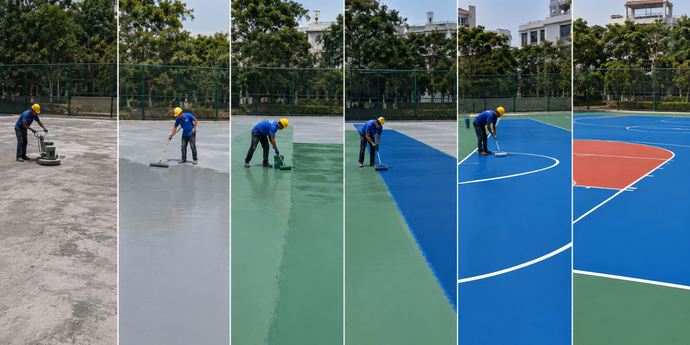
A typical acrylic court project follows a structured sequence.
Step 1: Site Inspection
The contractor checks the existing surface, drainage, cracks, levels and overall condition.
Step 2: Base Preparation
Dust, dirt, loose material and unsuitable coatings are removed.
Any required repairs are completed before coating starts.
Step 3: Crack and Surface Repair
Cracks, holes and damaged areas are treated using appropriate repair materials.
Step 4: Primer Application
The suitable primer is applied to the prepared base.
Step 5: Resurfacing
The resurfacer helps establish a consistent surface for subsequent acrylic layers.
Step 6: Cushion Layer
If the selected system includes cushioning, the required layers are applied according to the manufacturer’s specification.
Step 7: Colour Coating
The playing area and surrounding zones receive the specified colour system.
Step 8: Texture
Where required, texture is created using the specified acrylic and aggregate system.
Step 9: Line Marking
Sport-specific lines are measured and applied accurately.
Step 10: Final Inspection
The finished surface should be checked for appearance, consistency, drainage and line accuracy before opening the court for regular use.
For tennis, proper post-installation testing also matters. ITF documentation notes that acrylic courts require a stabilisation period before certain on-site testing, with conditions and timing agreed with the contractor.
Common Mistakes When Installing Acrylic Sports Flooring
Applying acrylic over an unsuitable base
Acrylic coating isn’t a substitute for structural repairs.
Ignoring drainage
Standing water can shorten the useful life of an outdoor court and create maintenance problems.
Using the same specification for every sport
Different sports have different playing requirements.
Choosing only by price
The cheapest quotation may omit important preparation or system layers.
Skipping surface preparation
Poor preparation can lead to adhesion and finish problems.
Applying coatings in unsuitable weather
Temperature, moisture and site conditions can affect application and curing.
Using unqualified line marking
Incorrect measurements can make the court difficult to use properly.
Ignoring maintenance
Even a high-quality court needs regular cleaning, inspection and timely repairs.
Acrylic Sports Flooring Maintenance
Maintenance doesn’t need to be complicated, but it needs to be regular.
A basic programme should include:
- Remove leaves and dirt regularly.
- Keep drains clear.
- Avoid allowing standing water to remain on the surface.
- Check for cracks or damaged areas.
- Repair defects before they become larger.
- Keep surrounding vegetation under control.
- Avoid dragging heavy equipment across the playing surface.
- Follow the flooring manufacturer’s cleaning recommendations.
- Inspect high-use areas more frequently.
The objective is simple: find small problems before they become expensive repairs.
Acrylic Sports Flooring Material: Manufacturer vs Supplier
The terms “manufacturer” and “supplier” are often used interchangeably, but they aren’t exactly the same.
| Factor | Manufacturer | Supplier |
| Makes the material | Yes | Not always |
| Product formulation knowledge | Usually direct | Depends on relationship |
| Technical support | Usually available directly | Depends on supplier |
| Product selection | Based on own range | May offer multiple brands |
| Custom system support | Often stronger | Depends on capability |
| Best for | Large projects and technical specifications | Procurement and local availability |
For a large sports facility, dealing directly with an Acrylic sports flooring material manufacturer can make technical coordination easier.
For smaller projects, a reliable local Acrylic sports flooring material supplier can also be practical, especially when installation support and product availability are important.
Where Acrylic Sports Flooring Can Be Used
Acrylic systems can be designed for a wide range of sports and recreational facilities, including:
- Tennis courts
- Basketball courts
- Badminton courts
- Pickleball courts
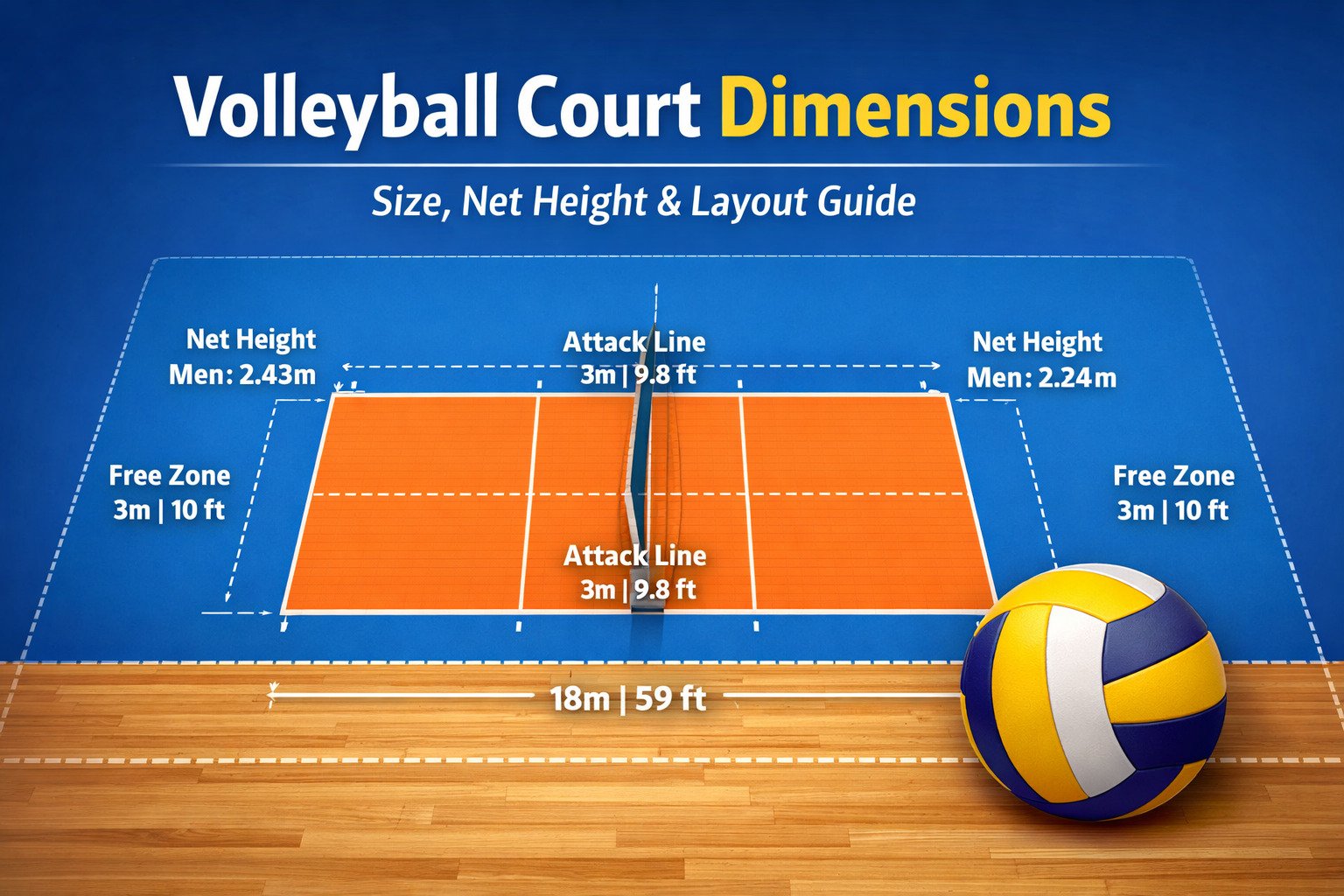
- Volleyball courts
- Multi-purpose courts
- School sports facilities
- Residential community courts
- Sports academies
- Clubs
- Hotels and resorts
- Institutional campuses
- Commercial recreation facilities
Pacecourt lists these types of sports facilities among its synthetic acrylic flooring applications.
How Much Does Acrylic Sports Flooring Material Cost?
There isn’t one universal price for acrylic sports flooring.
The final cost depends on several factors:
- Court size
- Existing base condition
- Number of layers
- Cushioning requirement
- Material specification
- Surface repairs
- Court location
- Transport
- Labour
- Drainage work
- Line marking
- New construction or resurfacing
A material-only quotation should therefore be compared separately from a complete court construction quotation.
For a new court, the base construction can represent a significant part of the project. For an existing court, repair and resurfacing requirements can change the budget substantially.
The best way to obtain a meaningful price is to share the court dimensions, location, existing base condition and intended sport with the manufacturer or contractor.
Quick Comparison: What Matters Most When Buying Acrylic Flooring?
| Buying Factor | Why It Matters |
| Material quality | Affects consistency and durability |
| Base preparation | Directly affects adhesion and finish |
| Layer system | Determines overall surface performance |
| Texture | Influences traction and playing feel |
| Cushioning | Can improve comfort where specified |
| UV/weather resistance | Important for outdoor courts |
| Manufacturer support | Helps with technical questions |
| Installation quality | Critical to the finished result |
| Maintenance support | Helps protect the investment |
| Certification | Useful when independently verified |
Final Buying Checklist
Before selecting an acrylic sports flooring material manufacturer or supplier, check these points:
- Product specification: Know exactly what you’re buying.
- Layer system: Ask for the complete system, not just the colour coat.
- Base condition: Inspect the concrete or asphalt before installation.
- Sport requirement: Specify tennis, basketball, badminton, pickleball or multi-purpose use.
- Outdoor exposure: Consider sun, rain and local weather conditions.
- Drainage: Make sure water can leave the court properly.
- Installation: Use trained and experienced applicators.
- Certification: Verify any certification claims with the issuing organisation.
- Maintenance: Get written cleaning and maintenance recommendations.
- Quotation: Compare complete systems rather than one product price.
Choose the Right Acrylic Sports Flooring Material for Long-Term Court Performance
A sports court should be planned as a complete system, not as a simple paint job. The acrylic sports flooring material, base preparation, layer configuration, texture, drainage, installation and maintenance all work together to determine the finished surface.
For businesses, schools, clubs, builders and sports facility owners, choosing an experienced Acrylic sports flooring manufacturer can make the specification and installation process easier. Pacecourt provides synthetic acrylic flooring systems for tennis, basketball, badminton, pickleball and other sports, with a published range of materials covering the major stages of court surface construction.
If you’re planning a new court or resurfacing an existing one, start with the base condition and intended sport. Then select the acrylic system that fits the performance, usage and maintenance requirements of the project. The right acrylic sports flooring material isn’t simply the one that looks good on day one; it’s the system that is correctly specified, properly installed and maintained throughout its working life.
Frequently Asked Questions
What is acrylic sports flooring material?
Acrylic sports flooring material is a multi-layer coating system designed for sports courts. It is commonly used over suitable concrete or asphalt bases for outdoor courts.
Is acrylic flooring good for outdoor sports courts?
Yes. Acrylic systems are widely used for outdoor hard courts because they can be designed for weather exposure, traction, colour stability and regular sports use.
Which sports use acrylic flooring?
Acrylic flooring is commonly used for tennis, basketball, pickleball, volleyball and other hard-court applications. The exact specification should match the sport.
Is acrylic suitable for tennis court flooring?
Yes. Acrylic is widely used for hard tennis courts. For performance-focused projects, the surface specification and applicable ITF classification or recognition requirements should be checked carefully.
How many layers does an acrylic sports court have?
There is no single universal number. A system may include primer, crack repair, resurfacer, cushion coat, colour coat, texture material and line marking, depending on the project specification.
How long does acrylic sports flooring last?
Its service life depends on the base, climate, usage, installation quality and maintenance. Rather than relying on a fixed number of years, ask the manufacturer for the expected maintenance and resurfacing schedule for the specific system.
Can acrylic flooring be repaired?
Yes. Suitable repairs can be carried out for cracks, damaged areas and surface wear, depending on the condition of the court.
Is acrylic flooring suitable for basketball courts?
Yes. Acrylic systems are widely used for outdoor basketball courts and can provide a hard, textured surface suitable for regular play.
Can one acrylic court be used for multiple sports?
Yes. A multi-purpose acrylic court can be designed with markings for several sports. The final layout should be planned carefully so that the markings don’t create confusion during play.
Stay Updated with Pacecourt
Discover expert insights, practical tips, and the latest industry updates from Pacecourt, covering sports flooring, tennis and multi-sport court construction, resurfacing, maintenance, court performance, and innovative sports infrastructure solutions.
Powered by Google's Preferred Sources feature