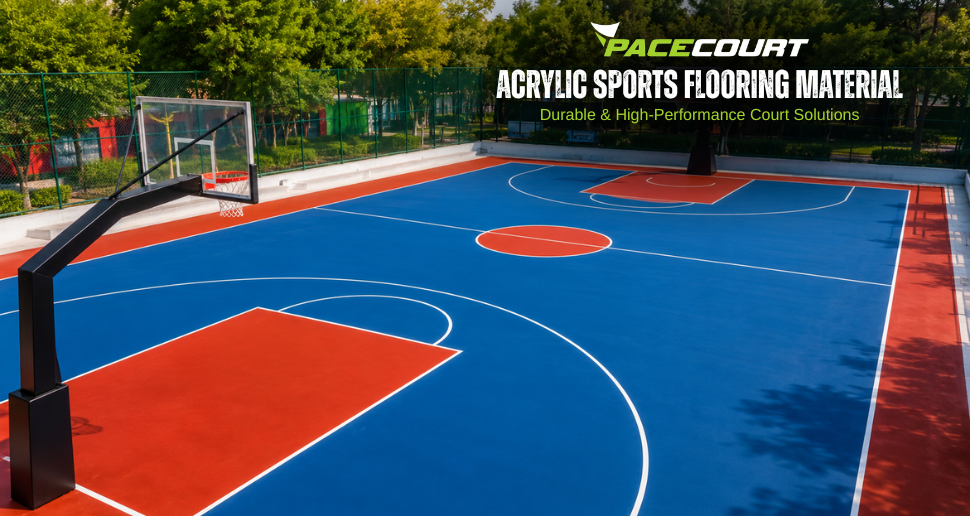
Acrylic Sports Flooring Material | Durable & High-Performance Court Solutions
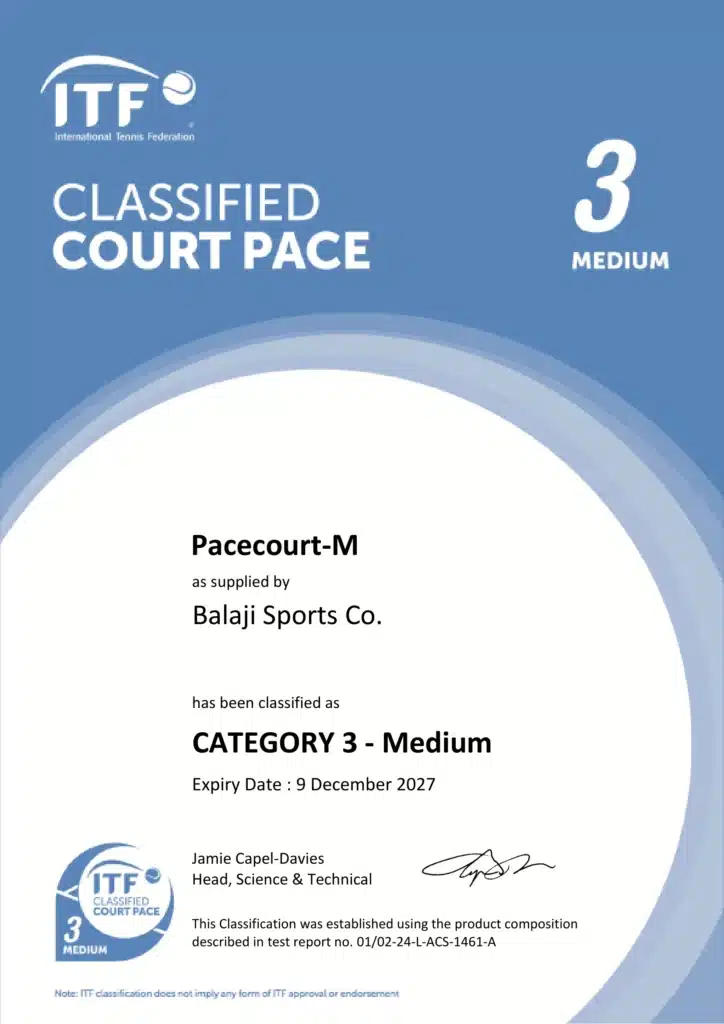
Choosing the right acrylic sports flooring material is one of the most important decisions when building an outdoor sports court. The surface affects grip, ball response, player movement, comfort, maintenance and the overall life of the court. Acrylic sports flooring is widely used for tennis court flooring, basketball court flooring, badminton court flooring, pickleball courts and multi-purpose outdoor courts. Unlike a simple painted concrete surface, a properly designed acrylic system uses multiple layers, with each layer performing a specific job. For a sports facility, the goal isn’t simply to make the court look attractive. The flooring needs to work with the base, handle weather exposure, provide a suitable playing feel and remain maintainable over time. Pacecourt manufactures synthetic acrylic sports flooring systems for different sports and applications. Its published product range includes concrete primer, deep patch, acrylic resurfacer, cushion coat, colour coat, line marking and silica sand, allowing the court surface to be built as a system rather than treated as a single coating. What Is Acrylic Sports Flooring Material? Acrylic sports flooring material is a specially formulated surface system used to create hard, durable and playable sports courts over suitable concrete or asphalt bases. The material is generally applied in layers. Depending on the court design and performance requirement, the system can include: The exact system depends on the sport, existing base condition, climate, expected usage and desired playing characteristics. A good acrylic court should not be treated as ordinary exterior paint. The surface has to be designed and installed as a complete sports flooring system. Why Acrylic Is Popular for Outdoor Sports Courts Outdoor courts face conditions that indoor floors don’t. Sunlight, rain, dust, temperature changes and regular foot traffic can gradually affect an unprotected surface. A properly installed acrylic system offers several practical advantages: Feature Benefit Hard-wearing surface Suitable for regular sports use Weather-resistant coating system Helps the surface handle outdoor exposure Textured finish Can provide controlled traction Colour options Allows clear court zoning and attractive designs Repairable surface Local defects can often be repaired before resurfacing Multi-layer construction Each layer serves a specific purpose Low-profile finish Maintains a relatively smooth playing surface Custom sports layouts Can accommodate different court markings The quality of the finished court, however, depends on more than the coating itself. Drainage, base preparation, application technique, curing and maintenance all matter. Acrylic Sports Flooring Material Layers One of the biggest mistakes in sports court construction is thinking that acrylic flooring means applying one or two coats of colour. A professional system normally starts with preparing the base and then builds the playing surface through several stages. 1. Concrete Primer The primer helps establish adhesion between the prepared concrete base and subsequent acrylic layers. The base must be clean and properly prepared before primer application. Dust, oil, loose material and other contaminants can interfere with bonding. 2. Crack Filler Small cracks and surface defects need appropriate treatment before the main coating system is installed. Crack repair isn’t simply about making the surface look smooth. If defects aren’t addressed properly, they can affect the finished surface later. 3. Deep Patch Deeper depressions, damaged areas and significant surface imperfections may require a suitable patching material. The purpose is to restore the base before the acrylic layers are applied. 4. Acrylic Resurfacer The resurfacer helps create a more uniform surface and fills minor imperfections in the prepared base. This layer is particularly important when converting an existing suitable court into a smoother acrylic playing surface. 5. Cushion Coat A cushion system can be incorporated when the project calls for additional surface comfort. Not every acrylic court requires the same cushion configuration. The specification should be based on the sport, playing requirements and project budget. 6. Colour Coat The colour coat gives the court its finished appearance while forming part of the playing surface system. Different colours can be used for the playing area and surrounding zones. Colour selection should also consider visibility, maintenance and the environment around the court. 7. Silica Sand Silica sand may be incorporated into suitable acrylic layers to create controlled surface texture and traction. The quantity and grade need to match the intended system. Adding sand randomly can change the surface characteristics and produce an inconsistent finish. 8. Line Marking The final stage includes accurate sports line marking. The markings need to be sharp, correctly positioned and compatible with the sport being played. Pacecourt lists these components individually within its acrylic flooring product range, including crack filler, deep patch, concrete primer, acrylic resurfacer, cushion coat, colour coat, line marking and silica sand. Acrylic Sports Flooring for Different Sports The same basic acrylic technology can be adapted for different sports, but the court shouldn’t be specified using a one-size-fits-all approach. The required playing characteristics and markings differ from sport to sport. Tennis Court Flooring Tennis court flooring needs to provide predictable ball response, suitable traction and a playing speed appropriate to the intended use. For tennis, surface speed is not simply a matter of choosing a colour or coating. The ITF Court Pace Classification Programme categorises tennis surfaces from slow to fast based on measured court pace. Acrylic systems are commonly used for hard tennis courts. The final playing characteristics depend on the complete surface system, texture, construction and maintenance. For a tennis project, ask the flooring supplier: It’s also worth understanding the difference between ITF classification and ITF court recognition. ITF states that classification is based on Court Pace Rating and does not itself mean ITF approval or endorsement. Court recognition involves additional testing of the installed court. Basketball Court Flooring Basketball court flooring needs good traction and a consistent surface for running, stopping and changing direction. Outdoor basketball courts are commonly constructed with acrylic systems over appropriate concrete or asphalt bases. The surface specification should consider: For schools, residential communities, clubs and commercial facilities, an acrylic system can also be designed as part of a multi-purpose court. Badminton Court Flooring Badminton court flooring requires careful consideration because badminton involves rapid footwork