Pickleball is spreading fast across Indian gyms, clubs, farmhouses, and residential societies. If you’re reading this, you’re probably weighing up pickleball court construction for your own property, your society, or your sports business. That’s a fair question to ask, because a court is not a small purchase, and getting the design and surface wrong is expensive to fix later.
This guide walks you through everything that goes into building a pickleball court in India: the dimensions, the surface options, realistic cost ranges, and the installation steps. We’ll also tell you why acrylic flooring has become the go-to surface for most builders and what to check before you sign a contract with a construction company.
Why Pickleball Court Construction Is Picking Up in India
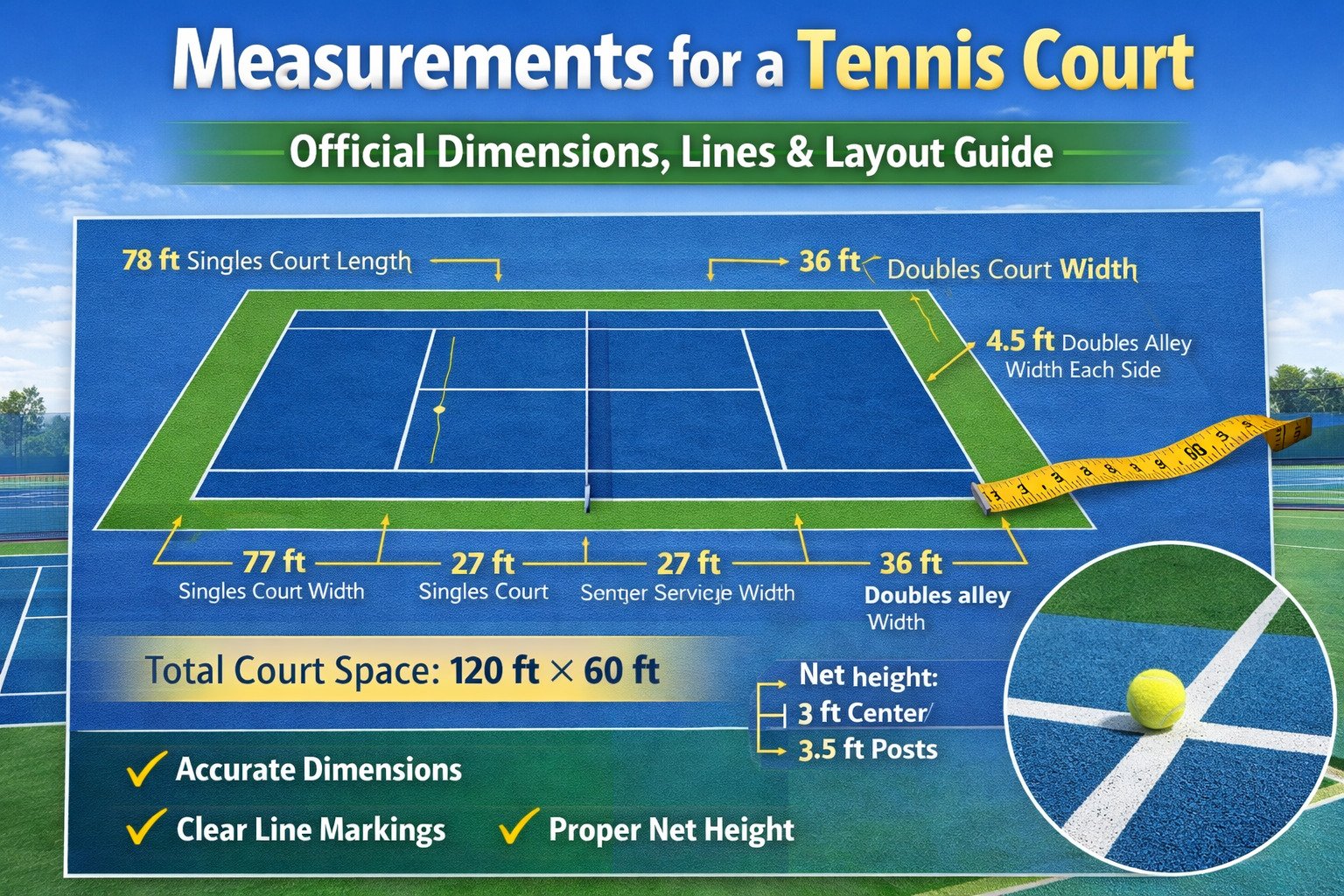
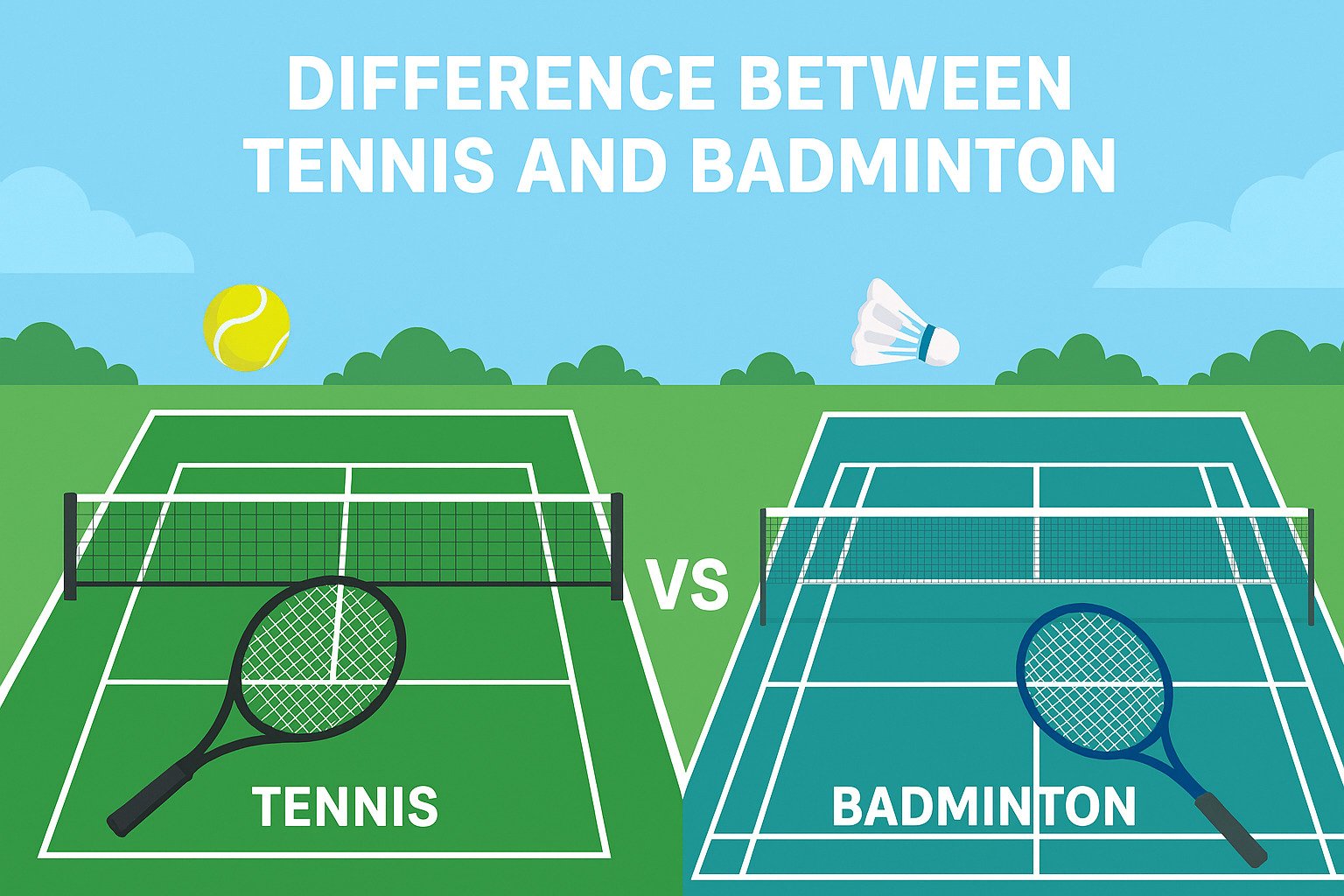
Pickleball needs far less space than tennis and less physical strain than badminton, which makes it easy to pick up at almost any age. A single tennis court can actually be converted to fit four pickleball courts, which is one reason clubs and apartment complexes are retrofitting old courts instead of building fresh ones. For someone starting a sports facility, that space efficiency directly affects how many players you can host and how quickly the investment pays for itself.
Whether you’re building one recreational court at home or planning a multi-court academy, the fundamentals of pickleball court construction stay the same: correct dimensions, a stable base, and a surface that can handle daily play along with Indian weather.
Pickleball Court Design and Dimensions
Good pickleball court design starts with getting the measurements right. Get this wrong, and no amount of good flooring will fix it.
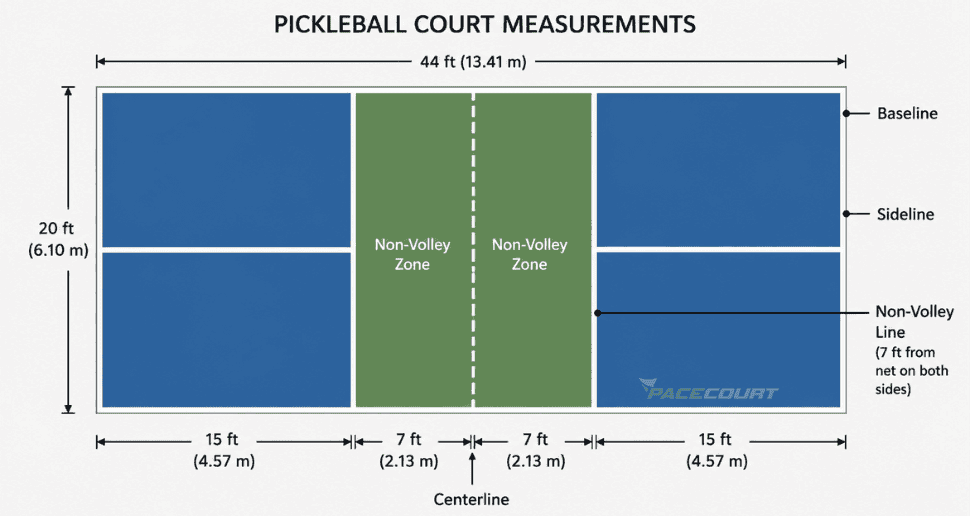
Standard court dimensions:
- Playing court: 20 ft × 44 ft (6.1 m × 13.4 m), same size for singles and doubles
- Non-volley zone (the “kitchen”): 7 ft from the net on each side
- Net height: 36 inches at the sidelines, 34 inches at the centre
Total buildable area:
A court built to exact playing dimensions leaves no room for players to move safely around the edges. Most builders recommend a total footprint of around 30 ft. × 60 ft. (roughly 1,800 sq. ft.) per court, which leaves proper run-off space on all sides. Skimping on this run-off is one of the most common design mistakes we see players end up hitting fences or walls mid-rally, and that’s a safety issue, not just a comfort one.
Orientation and layout
For outdoor courts, align the court north-south where possible. This keeps direct sun out of players’ eyes during peak morning and evening hours, which is when most recreational games happen. If you’re fitting multiple courts on one plot, leave at least 8 to 10 feet between adjacent courts so players and balls don’t cross into each other’s space.
Fencing and lighting
A perimeter fence of 8 to 10 feet keeps balls contained and gives the court a finished, professional look. If you plan on evening play, LED sports lighting fixed at a proper height avoids glare and shadows on the court. This matters more than people expect, since a shadow across the kitchen line can throw off a player’s depth judgment.
Indoor pickleball courts
If you’re building indoors, ceiling height needs attention. A minimum clearance of about 5.5 metres is recommended so that lob shots don’t hit the roof. Indoor courts also need decent ventilation and even lighting across the full playing surface, not just at the centre.
Pickleball Court Construction Materials: Choosing the Right Surface
The surface is the single biggest factor in how a pickleball court performs and how long it lasts. Here’s how the main options compare.
| Surface Type | Ball Bounce | Durability | Best Suited For | Approx. Cost (per sq. ft.) |
| Acrylic (on concrete) | Consistent, true bounce | 5–8 years before resurfacing | Outdoor and indoor, academies, clubs, residential courts | ₹45 – ₹150 |
| Plain concrete | Hard, less shock absorption | Very long-lasting, but rough on joints | Budget builds, temporary setups | Lower than finished acrylic |
| Asphalt | Slightly softer than concrete | Needs more frequent resurfacing | Large outdoor multi-court facilities | Moderate |
| Modular sports tiles | Bouncy, consistent if good quality | Depends heavily on tile thickness | Quick installs, temporary or trial courts | Lower upfront, higher long-term risk if cheap tiles are used |
| Wooden sprung flooring | Best bounce and shock absorption | Long-lasting indoors, needs climate control | Premium indoor academies | Highest among the options |
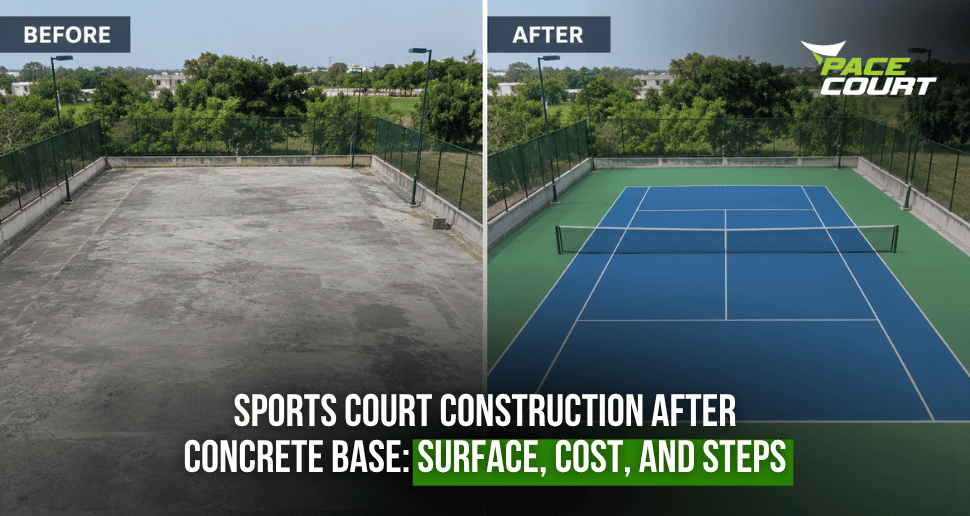
For most builds in India, acrylic flooring over a solid concrete base is the practical choice. It handles both heavy summer heat and monsoon rain reasonably well when it’s specified correctly, and it gives players the grip and shock absorption pickleball needs since the sport involves a lot of quick, short lateral movement.
Concrete alone is durable, but it’s harsh on knees and ankles over long sessions, so most serious builders treat it purely as the base layer, not the final playing surface. Modular tiles are fine if you need a court ready in a day or two, but thin, cheap tiles tend to bow and separate at the joints within a couple of seasons, so it’s worth paying more for tiles rated at 8mm thickness or above if you go that route.
Why Acrylic Flooring Works Best for Pickleball Courts in India
If you ask most experienced court builders which pickleball court surface installation they’d recommend by default, acrylic comes up first and for good reason.
- Weather resistance: Good acrylic systems include a UV stabiliser mixed into the formula itself, not just sprayed on top. This matters a lot in North India, where surface temperatures can climb well past 55–60°C in peak summer. Coatings without built-in UV protection tend to fade and wear within two to three seasons.
- Layered systems for comfort: A standard 2-coat acrylic system (base coat plus finish coat) is the common budget option. Cushioned systems with 4 to 8 coats add slight shock absorption, which reduces strain on players’ knees and is worth considering for academies with heavy daily use.
- Consistent bounce: Because it’s a continuous coating rather than joined pieces, acrylic gives a more predictable, even bounce across the entire court, something competitive players notice quickly.
- Grip and safety: The textured finish on acrylic surfaces gives good traction, which matters because pickleball involves sudden stops and direction changes.
- Lower long-term maintenance: Acrylic courts mainly need periodic cleaning and occasional crack filling. Recoating after several years refreshes the surface at a fraction of the original installation cost.
One thing worth asking your contractor directly: is the UV protection built into the acrylic material, or just a top coat? That single detail affects how long your court will look and perform before it needs redoing.
Pickleball Court Construction Cost in India
This is usually the first question anyone asks, so let’s get into real numbers. Costs vary by city, base condition, and the quality of acrylic system you choose, but here’s a realistic range based on current market pricing.
| Component | Estimated Cost |
| Site preparation and base (if starting from bare ground) | Varies with soil condition; excavation and compaction add to cost on uneven land |
| Concrete base laying | Included in most full-construction quotes |
| Acrylic flooring (2-coat system) | ₹45–₹150 per sq. ft. |
| Acrylic flooring (cushioned, 4–8 coat system) | ₹150–₹300 per sq. ft. |
| Line marking | ₹10,000–₹18,000 per court |
| Net post drilling and installation | ₹25,000–₹40,000 per court |
| Fencing (per court) | Adds a noticeable amount to total budget; varies by height and material |
| LED lighting | Additional cost depending on fixture quality and pole height |
Typical total pickleball court construction cost:
- Standard outdoor acrylic court (1,800 sq. ft., with fencing): roughly ₹1.5 lakh to ₹6 lakh in most metro cities
- Premium cushioned acrylic court with full fencing and lighting: roughly ₹8 lakh to ₹12 lakh
- Resurfacing an existing tennis or badminton court for pickleball: noticeably cheaper than new construction, since the base and fencing are usually already in place
- Indoor courts: ₹10 lakh to ₹25 lakh or more, depending on flooring choice, air conditioning, and roofing work
- Multi-court outdoor facilities (four courts): typically ₹14 lakh to ₹32 lakh, since shared site prep and fencing bring the per-court cost down
Annual maintenance for an acrylic court generally falls somewhere between ₹40,000 and ₹1,50,000, covering cleaning, crack inspection, and touch-up coating. This is a smaller number than most first-time builders expect, but it’s still worth budgeting for from day one rather than treating it as an afterthought.
A word of caution: get itemised quotes from more than one pickleball court construction company before you commit. A number that looks attractive upfront sometimes hides a thinner acrylic system or skips proper base preparation, both of which show up as cracks and bounce problems within a year or two.
Pickleball Court Installation Process, Step by Step
Here’s roughly how a standard outdoor pickleball court installation goes, from bare land to a playable court.
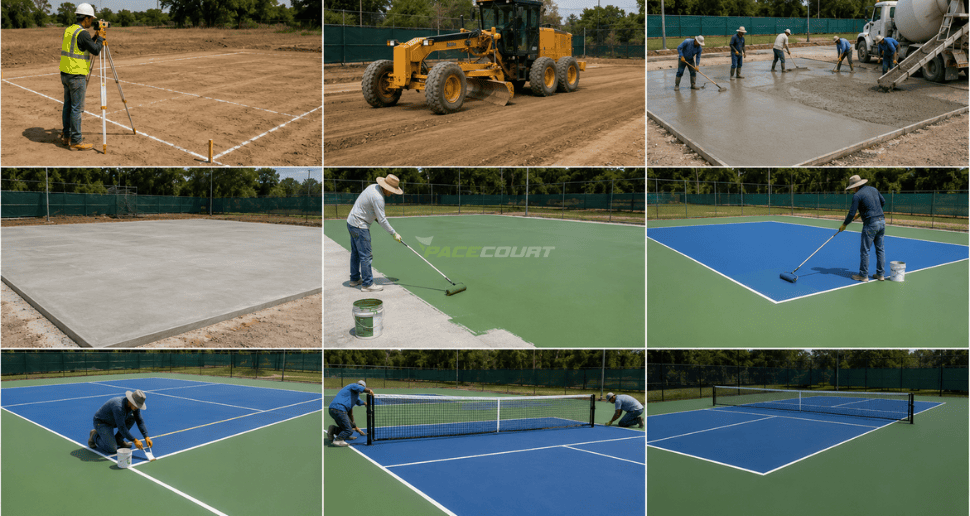
- Site survey and layout marking. The builder checks soil condition, drainage, and sun orientation, then marks out the court and run-off area.
- Excavation and grading. The ground is levelled and compacted to create a stable, even base; this step matters more than people realise, since an uneven base causes cracking later.
- Base laying (concrete or asphalt). A concrete base is generally preferred for permanent courts because it holds up better over the years, even though it costs more upfront than asphalt.
- Curing period. Concrete needs time to cure properly before any coating goes on top. This isn’t a step you can rush, no matter how tight the timeline feels.
- Acrylic coating application. Primer goes down first, followed by the base coat and finish coats, applied in layers with drying time between each one.
- Line marking. Court lines are painted in a contrasting colour once the surface has fully cured, following official pickleball dimensions.
- Net posts and net installation. Posts are drilled and fixed at the correct height, then the net is installed and tensioned.
- Fencing and lighting. Perimeter fencing goes up, followed by lighting if the court will be used after dark.
- Final inspection. A good contractor walks the surface for evenness, checks the bounce, and confirms line accuracy before handover.
A standard outdoor pickleball court installation, from site clearance to a playable surface, usually takes about 5 to 8 weeks. Weather plays a role here too, building during the monsoon can stretch timelines because of the concrete curing period, so many builders prefer starting projects between October and February in most parts of India.
Choosing the Right Pickleball Court Builders
Not every contractor who’s built a badminton or basketball court will get pickleball court construction right on the first try, since the dimensions, non-volley zone, and surface requirements are specific to this sport. Here’s what to check before hiring a pickleball court construction company:
- Ask for past project photos or a site visit, not just a brochure. Seeing a completed court tells you more than any sales pitch.
- Confirm the acrylic system specification in writing number of coats, whether UV stabiliser is built into the material, and expected lifespan before resurfacing.
- Check if the base preparation is included in the quote or billed separately. This is where corners often get cut.
- Ask about the warranty on both the base and the surface coating, and get the terms in writing.
- Get a written timeline that accounts for curing time, so you’re not left guessing why the project is running late.
- Confirm land-use permissions with your local authority before construction starts, especially for commercial or society projects, since zoning rules can affect what you’re allowed to build.
A builder who answers these questions clearly, without vague reassurances, is usually one you can trust with the job.
Common Mistakes to Avoid
A few things trip up first-time builders more often than anything else:
- Skipping proper run-off space to save on land, which creates a genuine safety risk during play
- Choosing the cheapest acrylic quote without checking the number of coats or UV protection
- Ignoring soil testing on uneven or low-lying land, which leads to cracking within the first year or two
- Building without checking local permissions first
- Underestimating ongoing maintenance costs in the initial budget
Final Thoughts
Good pickleball court construction comes down to getting three things right: accurate dimensions with proper run-off space, a solid base, and a surface built to handle daily play and Indian weather. Acrylic flooring checks most of these boxes for the majority of builders, which is why it remains the most common choice across outdoor and indoor courts alike. Before you sign off on any project, get the specifications in writing, compare a few quotes, and ask your builder direct questions about the materials going into your court. A little diligence at the start saves a lot of trouble and money down the line.
Frequently Asked Questions
What is the standard size for pickleball court construction?
The playing court measures 20 ft × 44 ft, but a total buildable area of about 30 ft × 60 ft is recommended to include safe run-off space around the edges.
What is the average pickleball court construction cost in India?
A standard outdoor acrylic court typically costs between ₹1.5 lakh and ₹6 lakh, depending on the acrylic system, fencing, and lighting chosen. Indoor courts cost more, generally starting around ₹8 lakh.
Is acrylic flooring the best choice for pickleball courts?
For most outdoor and indoor builds in India, yes. Acrylic flooring offers good grip, consistent bounce, and weather resistance, and it’s more comfortable on joints than plain concrete.
Can an existing tennis or badminton court be converted for pickleball?
Yes. With resurfacing and new line markings, an existing court can be converted at a lower cost than building from scratch, since the base and often the fencing are already in place.
How long does pickleball court installation take?
A standard outdoor court usually takes 5 to 8 weeks from site clearance to a playable surface, largely due to the concrete curing period.
Upgrade Your Sports Court Today
Get premium synthetic acrylic flooring designed for durability, grip, and performance.
Get Free ConsultationHow often does an acrylic pickleball court need resurfacing?
Most acrylic courts last 5 to 8 years before resurfacing is needed, though a well-specified system with built-in UV protection can last longer.
Stay Updated with Pacecourt
Discover expert insights, practical tips, and the latest industry updates from Pacecourt, covering sports flooring, tennis and multi-sport court construction, resurfacing, maintenance, court performance, and innovative sports infrastructure solutions.
Powered by Google's Preferred Sources feature