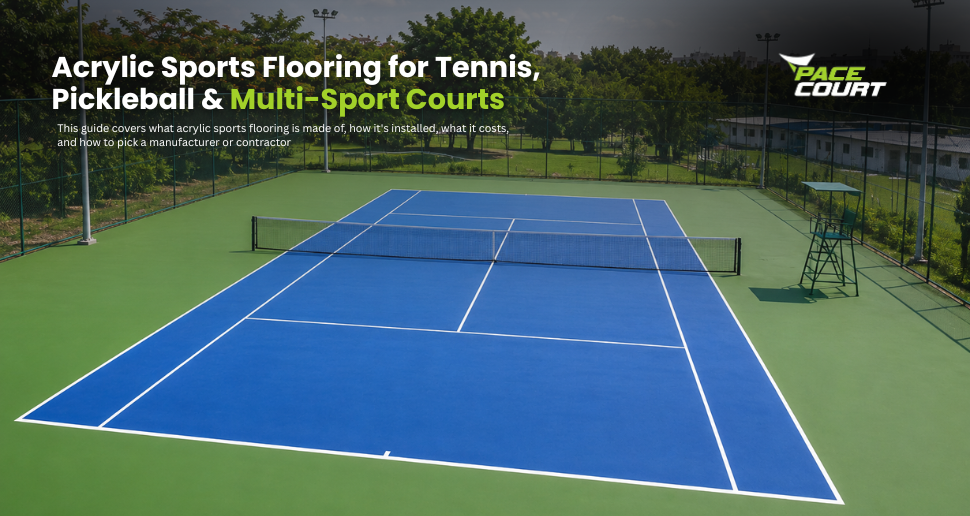
If you’ve ever played on a school tennis court or a housing society’s pickleball setup, you’ve probably stood on acrylic sports flooring without even knowing its name. It’s the coloured, slightly grainy surface under most outdoor courts in India today, and there’s a good reason for that. Acrylic sports flooring holds up against sun, rain, and constant play, and it costs far less than most other surfaces that do the same job.
This guide covers what acrylic sports flooring is made of, how it’s installed, what it costs, and how to pick a manufacturer or contractor. It’s written for schools, societies, academies, and anyone planning a single tennis court or a full multi-sport facility, not as a sales pitch.
What Is Acrylic Sports Flooring?
Acrylic sports flooring is a multi-layer, water-based coating system applied over a concrete or asphalt base. It isn’t paint in the ordinary sense. Each layer has a specific job: sealing the base, cushioning impact, adding grip, and giving the court its final colour and texture.
Once cured, the coating bonds permanently to the base and creates a smooth, even playing surface. That’s why acrylic is the standard choice for tennis, pickleball, basketball, badminton, and volleyball courts across schools, clubs, housing societies, and sports academies in India.
Why Acrylic Works So Well for Tennis, Pickleball & Multi-Sport Courts
Acrylic didn’t become the default outdoor court surface by accident. A few practical reasons explain why it beats most alternatives in Indian conditions.
UV-Resistant Acrylic Sports Court Flooring Handles Indian Weather
UV resistant acrylic sports court flooring is built to take direct sun for years without turning brittle or losing colour. The same coating sheds monsoon rain quickly, so courts dry faster and see less water damage than surfaces like clay or natural grass.
Ball Bounce Stays Consistent
For tennis and pickleball, a predictable bounce matters as much as the surface itself. Acrylic gives a uniform, hard-court response that players can rely on, match after match. That consistency is why it’s often the pick for competitive and academy-level courts.
It’s Genuinely Low Maintenance
Beyond regular sweeping and the occasional wash, acrylic courts don’t ask for much. There’s no mowing, no re-marking clay lines every week, no rolling. That saved upkeep adds up fast for schools and clubs working with tight budgets.
Durable Acrylic Flooring for Sports Courts Costs Less Than Most Alternatives
Compared to PU flooring or timber courts, durable acrylic flooring for sports courts is considerably cheaper to install and maintain, without giving up much in terms of playability.
One Surface, Multiple Sports
Because it’s applied as a coating rather than a fixed material, acrylic can be configured for tennis, pickleball, basketball, badminton, and volleyball on the same base. That flexibility is a big reason multi-purpose courts almost always use acrylic.
The Layers That Make Up an Acrylic Sports Flooring System
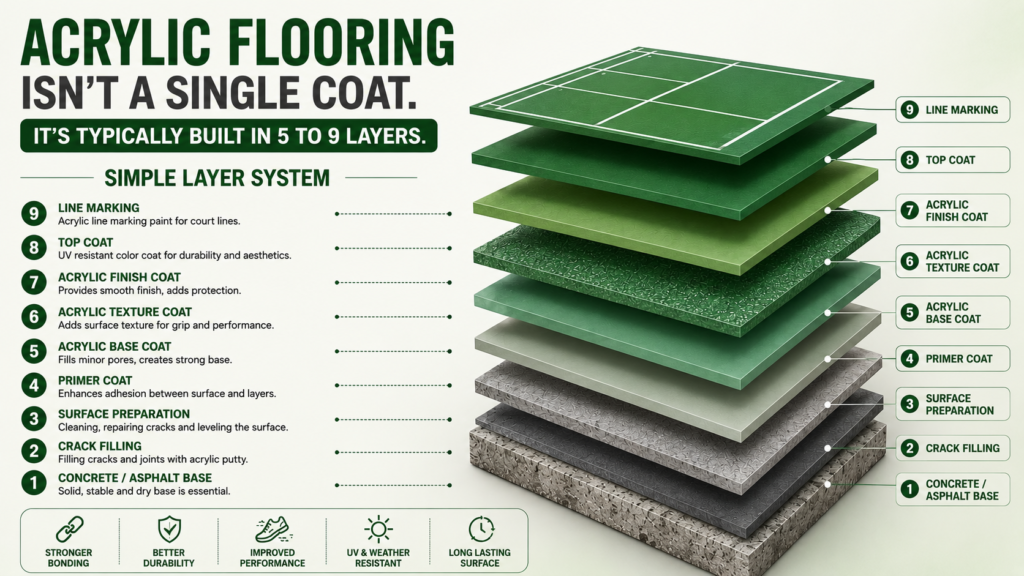
Acrylic flooring isn’t a single coat. It’s typically built in 5 to 9 layers, and the number you choose affects both cost and comfort underfoot.
- Base layer – compacted concrete or asphalt that everything else sits on
- Primer coat – improves adhesion between the base and the acrylic layers
- Resurfacer – a blend of acrylic, sand, and cement that smooths out small imperfections in the base
- Cushion coats (optional) – acrylic mixed with rubber granules for shock absorption; more coats mean a softer, more forgiving surface
- Colour coats – two or more coats that give the court its final colour and texture, usually with fine sand added for grip
- Line markings – acrylic-based line paint applied according to the sport’s official dimensions
Take a housing society converting an old cement courtyard into a shared pickleball and badminton space. A project like this usually works fine with a 5 or 6 layer system, since play is recreational and budgets are tighter than an academy’s. A tennis academy training competitive players, on the other hand, usually goes for 7 to 9 layers, since the extra cushioning reduces strain on players’ joints during long sessions.
How Acrylic Sports Court Flooring Installation Works
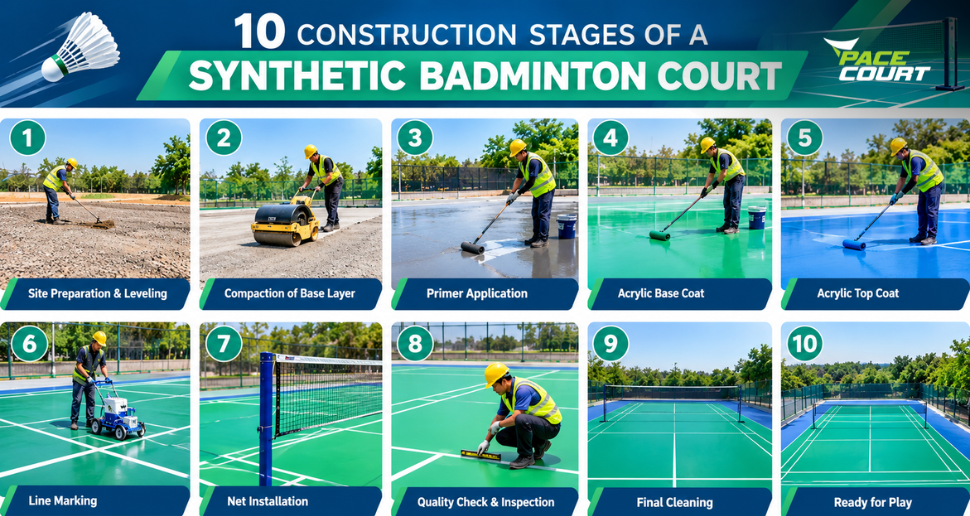
Good acrylic sports flooring installation depends far more on preparation than on the coating itself. Here’s roughly how a professional job goes:
- Site assessment – the contractor checks drainage, existing base condition, and site access before quoting the project.
- Base preparation – the concrete or asphalt base gets cleaned, levelled, and checked for cracks. Repairs happen at this stage, not after.
- Priming – a primer coat goes down to help the acrylic layers bond properly to the base.
- Resurfacing – this layer fills pores and evens out any remaining texture issues.
- Cushion coating – if the design includes cushioning, it’s applied here and left to cure fully.
- Colour coating – two coats of UV-stable acrylic colour go on, usually with fine sand mixed in for traction.
- Line marking – lines get painted to match the exact specifications for tennis, pickleball, or whichever sports the court will host.
- Curing and inspection – the finished surface needs time to cure before it opens for play.
For a standard single court, this process usually takes 7 to 15 days, depending on size, weather, and how many layers are involved. Rushing any stage, especially curing, is the single biggest cause of early surface failure.
Acrylic Sports Flooring Price: What You Can Expect to Pay
This is usually the first question anyone asks, and fair enough. Acrylic sports flooring cost in India generally falls between ₹45 and ₹150 per square foot for standard installations, with premium multi-coat, high-cushion systems going higher. A few things move that number:
| Factor | How It Affects Price |
| Number of layers | More layers, especially cushion coats, raise material and labour cost |
| Base condition | A damaged base needing repair adds to the total |
| Court size | Larger courts usually bring the per-square-foot rate down slightly |
| Location | Transport and labour costs vary by city and region |
| Brand and warranty | Established manufacturers with ITF certification and longer warranties often cost more upfront |
When you’re comparing acrylic sports flooring price quotes, always ask what’s included. Some quotes cover material only, while others include base repair, line marking, and after-sales support. A lower number on paper isn’t always the better deal once you account for that.
Best Acrylic Sports Flooring for Tennis Courts
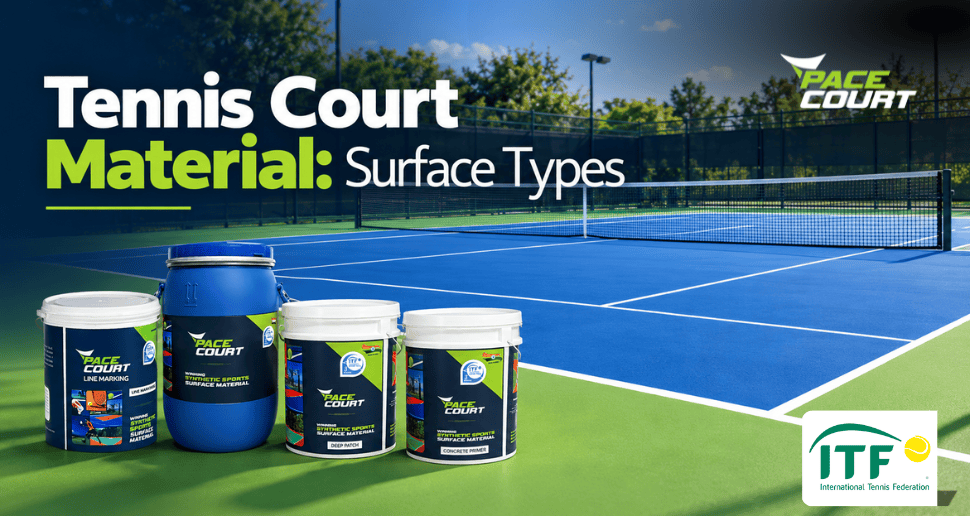
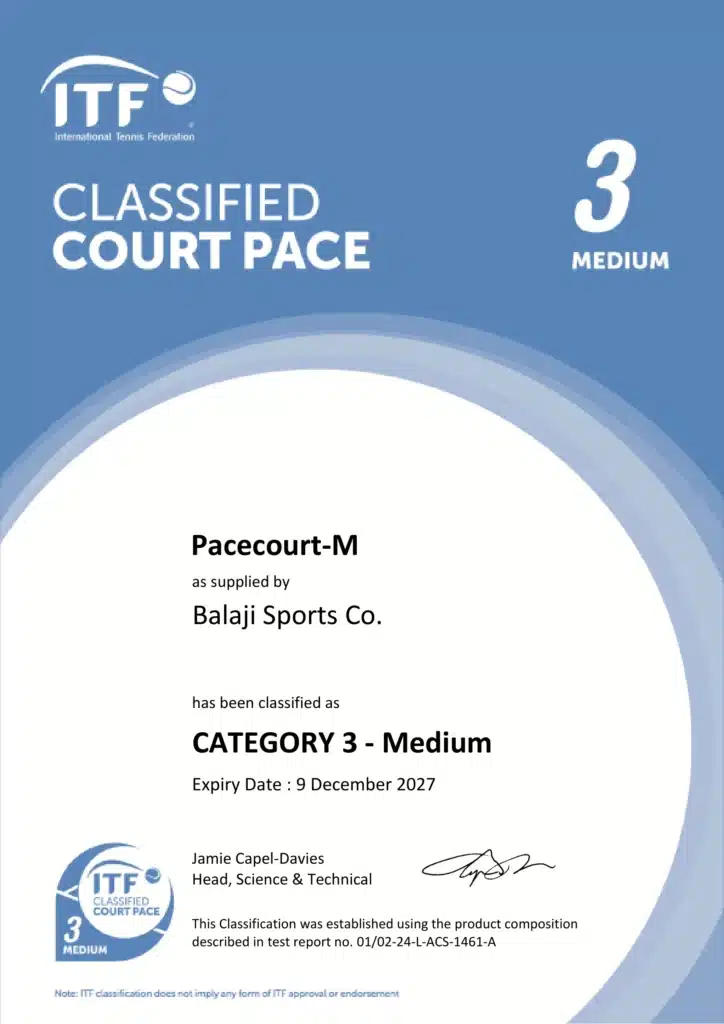
For tennis, court pace and bounce consistency matter more than almost anything else. Look for acrylic systems that carry ITF certification, since the International Tennis Federation’s Court Pace Classification confirms a surface meets a recognised bounce and speed standard. A standard ITF doubles court measures 78 feet by 36 feet, with extra run-off space recommended around the perimeter for player safety.
For most schools and clubs, a 6- to 7-layer acrylic system gives a good balance of playability and cost. Academies training competitive players often prefer 8- or 9-layer systems for the added cushioning.
Best Acrylic Flooring for Pickleball Courts
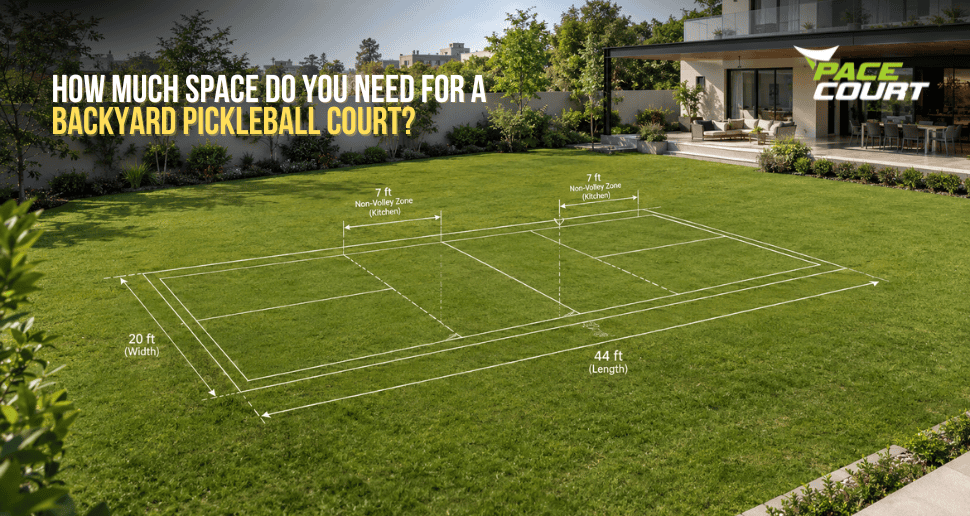
Pickleball has grown fast in Indian housing societies, schools, and clubs over the past couple of years, and acrylic is the flooring of choice for outdoor courts here too. A recreational pickleball court measures 20 feet by 44 feet, with USA Pickleball recommending a minimum surrounding space of 30 by 64 feet for safe play.
Because pickleball involves quick lateral movement and frequent stops, a slightly grippier finish coat helps. Acrylic’s anti-skid texture handles this without slowing the ball down too much, which is part of why it’s become the go-to surface for new pickleball builds.
Acrylic vs Other Sports Flooring Options
| Feature | Acrylic Flooring | PU Flooring | Interlocking PP Tiles |
| Best suited for | Outdoor tennis, pickleball, multi-sport courts | Indoor sports complexes | Temporary or budget courts |
| Typical cost | Moderate | Higher | Lower |
| Maintenance | Low | Low to moderate | Low |
| Weather resistance | Excellent outdoors | Needs a controlled indoor setting | Good, though joints can trap dirt |
| Ball bounce | Consistent, hard-court feel | Softer, more cushioned | Varies by tile quality |
| Typical lifespan | 8-10 years with maintenance | Similar, indoors | Shorter under heavy outdoor use |
There’s no single “best” surface for every situation. Acrylic wins on outdoor durability and cost. PU tends to suit indoor facilities that want extra cushioning. Interlocking tiles work for budget or temporary setups where permanence isn’t the priority.
How to Choose an Acrylic Sports Flooring Manufacturer or Supplier
Not every acrylic court flooring manufacturer in India offers the same quality, and the coating is only as good as the installation behind it. Before you sign off on a supplier, check a few things:
- Certification – ask if their acrylic system carries ITF classification or a similar recognised standard.
- Track record – a manufacturer that’s been building courts for a decade or more has usually worked through problems newer suppliers haven’t seen yet.
- Sample work – ask for references or photos of completed courts, ideally ones you can visit in person.
- Warranty terms – get the warranty period and what it actually covers in writing.
- In-house installation – find out whether the manufacturer installs the flooring directly or subcontracts it, since that affects accountability if something goes wrong.
Pacecourt, for instance, has built more than 4,000 courts across India over 15-plus years and works with ITF-certified acrylic systems for tennis, pickleball, basketball, badminton, and multi-purpose courts. Whichever acrylic sports flooring contractor you shortlist, ask the same questions. If you’re ready to buy acrylic sports flooring for a new build or a resurfacing job, get quotes from more than one acrylic sports flooring supplier and compare exactly what’s included before deciding.
Common Mistakes to Avoid
A handful of mistakes account for most acrylic court failures, and nearly all of them are avoidable.
- Skipping proper base repair. A cracked or uneven base will show through every layer applied on top of it.
- Rushing curing time. Walking or playing on a court before it’s fully cured is the fastest way to shorten its life.
- Choosing the cheapest quote without checking layers. A 5-layer system priced like an 8-layer one is missing something somewhere.
- Ignoring drainage. Standing water after rain damages the surface over time, even with quality acrylic.
- Delaying maintenance. Small cracks or worn patches get expensive fast if they’re left unaddressed for years.
Maintenance Tips to Extend the Life of Your Court
Acrylic sports flooring needs very little upkeep, but a little goes a long way:
- Sweep or blow off dust, leaves, and debris regularly, especially after monsoon season.
- Wash the surface with mild detergent and low-pressure water. Avoid harsh chemicals or high-pressure jets that can strip the coating.
- Check for hairline cracks every few months, particularly near the edges.
- Plan for a recoat roughly every 3 to 5 years, depending on usage and weather exposure.
- Watch the line markings. Faded lines are often one of the first signs a recoat is due.
Final Thoughts
Acrylic sports flooring remains one of the most practical choices for anyone building a tennis, pickleball, or multi-sport court in India. It handles the weather, keeps ball bounce consistent, and doesn’t demand constant upkeep. The real difference between a court that lasts a decade and one that needs early repairs usually comes down to base preparation and installation quality, not the coating brand.
If you’re ready to move forward, get quotes from a couple of established suppliers, ask about their layer systems and certifications, and compare what’s actually included before you decide. A well-installed acrylic court, built by an experienced acrylic sports flooring manufacturer, is an investment that pays off in every match played on it.
Frequently Asked Questions
It’s a multi-layer, water-based coating system made from acrylic resins, sand, and additives, applied over a concrete or asphalt base.
Upgrade Your Sports Court Today
Get premium synthetic acrylic flooring designed for durability, grip, and performance.
Get Free ConsultationMost standard installations range from around ₹40 to ₹150 per square foot, depending on the number of layers, base condition, and location.
A typical single court takes 7 to 15 days from base preparation to final curing, though this varies with size and weather.
Yes. Its UV resistance, anti-skid texture, and weatherproofing make it one of the most reliable options for outdoor pickleball courts in India.
With regular maintenance and a recoat every 3 to 5 years, acrylic courts typically last 8 to 10 years or more.
Acrylic is a hard-court surface best suited to outdoor use. PU is a softer, more cushioned system generally used indoors.
Yes, as long as the base is structurally sound. Cracks or uneven patches need repair before any acrylic layers go on.
Yes. Because it’s applied as a coating, it can be configured and marked for tennis, pickleball, basketball, badminton, and volleyball on a single base.
Stay Updated with Pacecourt
Discover expert insights, practical tips, and the latest industry updates from Pacecourt, covering sports flooring, tennis and multi-sport court construction, resurfacing, maintenance, court performance, and innovative sports infrastructure solutions.
Powered by Google's Preferred Sources feature