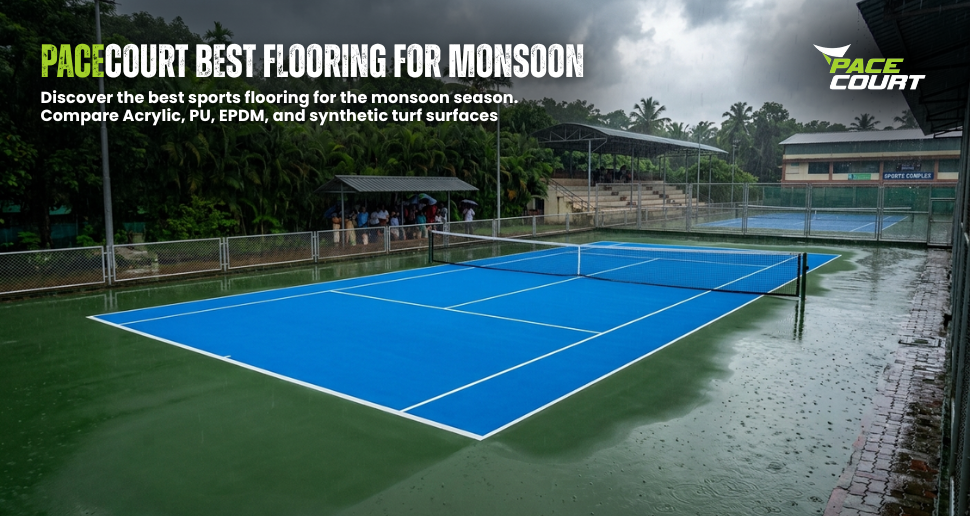
Acrylic sports flooring (outdoor) and PU/PVC flooring (indoor) are the best choices for monsoon season in India because they resist moisture, provide anti-slip grip, and withstand high humidity without warping or cracking.
India’s monsoon season runs from June to September and brings intense rainfall, humidity levels above 80%, and waterlogging risks. Standard concrete or wooden floors fail fast under these conditions. Sports facilities across India – schools, academies, gyms, and clubs – need flooring that handles moisture, retains grip, and keeps athletes safe even in wet conditions.
This 2026 buying guide covers every flooring type, compares their monsoon performance, and helps you choose the right surface for your sport, budget, and location.
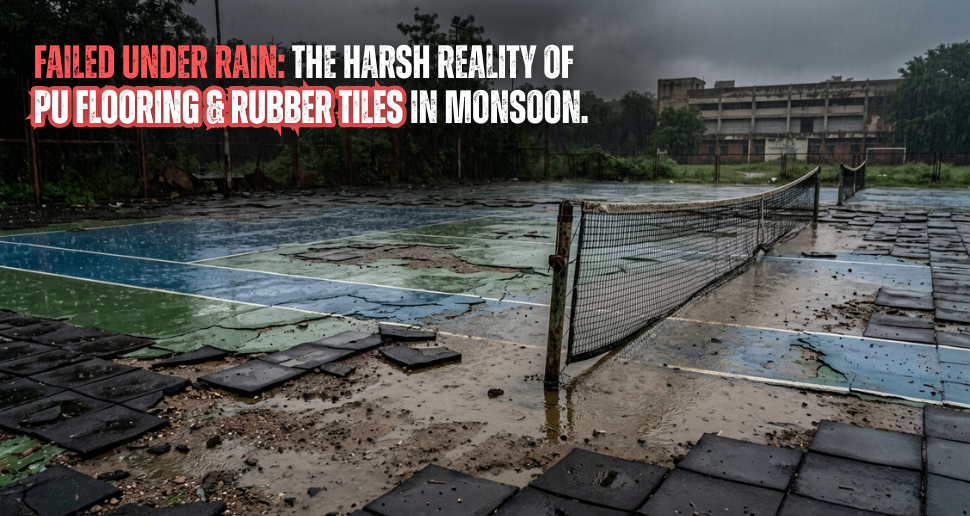
Why Monsoon Season Damages Most Sports Floors
India’s climate is one of the most demanding in the world for sports infrastructure. Outdoor courts face direct rainfall, standing water, and UV exposure. Indoor facilities deal with high ambient humidity and moisture seeping through subfloors.
Common monsoon-related flooring failures include:
- Wooden floors buckle, cup, and develop mold when humidity rises above 60%
- Concrete courts become dangerously slippery with zero grip when wet
- Low-grade PVC tiles peel away from subfloors due to adhesive moisture damage
- Acrylic coatings crack and bubble if the base layer is not properly waterproofed
Choosing sports flooring for monsoon season means selecting materials engineered specifically for moisture resistance, anti-slip performance, and long-term structural stability in India’s humidity conditions.
Top 6 Sports Flooring Types for Monsoon Season in India (2026)
1. Acrylic Sports Flooring – Best for Outdoor Courts
Acrylic sports flooring dominates India’s outdoor courts in 2026 for very good reasons. It bonds directly to a concrete or asphalt base and forms a seamless, waterproof surface layer. UV-resistant pigments prevent colour fading even under direct monsoon sun. The textured acrylic finish creates natural anti-slip grip that remains effective when wet.
Facilities use acrylic for basketball, tennis, volleyball, badminton (outdoor), and multi-purpose courts. The surface requires minimal maintenance during monsoon season – just brush away standing water and it performs reliably.
- Monsoon Performance: Excellent. Water drains off the textured surface rather than pooling. No peeling, no warping.
- Best For: Outdoor basketball, tennis, and multi-sport courts.
- Cost Range: ₹45 – ₹90 per sq. ft. (2026 market prices)
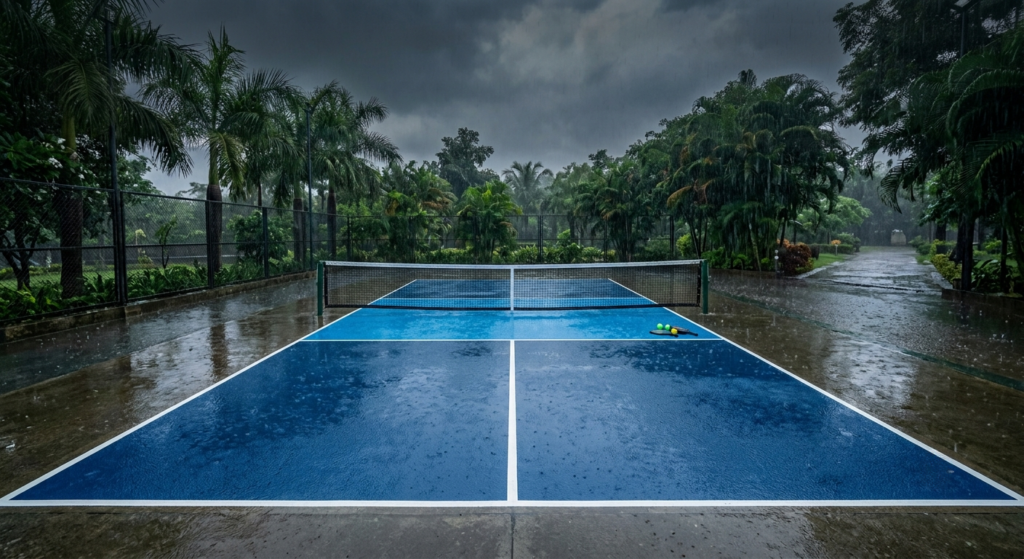
2. PU (Polyurethane) Sports Flooring – Best for Indoor Facilities
PU flooring is a poured or spray-applied surface system that creates a seamless, cushioned playing area indoors. It offers superior shock absorption, excellent traction, and zero water absorption when properly installed with a moisture barrier. Professional sports academies and competitive indoor venues across India prefer PU flooring because it meets international standards and performs consistently through monsoon humidity.
The seamless nature of PU flooring is its biggest monsoon advantage – there are no joints or seams for moisture to penetrate. Combined with a PE moisture barrier layer beneath, PU flooring completely isolates the playing surface from subfloor dampness.
- Monsoon Performance: Excellent. Fully sealed surface blocks moisture ingress from above and below.
- Best For: Indoor basketball, badminton, volleyball, fitness centres, and multi-sport halls.
- Cost Range: ₹80 – ₹180 per sq. ft.
3. PVC/Vinyl Sports Flooring – Best Budget-Friendly Option
PVC (vinyl) sports flooring is the most widely used indoor flooring for schools and community sports halls across India. It comes as rolls or tiles in 4.5mm–8mm thickness and installs directly over a levelled concrete subfloor. PVC is inherently waterproof, non-absorbent, and easy to clean with a damp mop during humid months.
During monsoon season, PVC’s biggest advantage is its closed-cell structure – it does not absorb moisture, does not harbour mold, and dries within minutes after surface water contact. However, quality matters significantly. Low-grade PVC tiles can lift at the edges if cheaper adhesives fail due to subfloor moisture.
- Monsoon Performance: Very Good. 100% waterproof surface; adhesive quality and subfloor prep determine long-term performance.
- Best For: School sports halls, community gymnasiums, indoor badminton courts.
- Cost Range: ₹35 – ₹75 per sq. ft.
4. Rubber Sports Flooring – Best for Gyms and Weight Training Areas
Rubber flooring handles monsoon conditions reliably in gym and fitness settings. Vulcanized rubber tiles are dense, waterproof, and slip-resistant even when moisture is present. They absorb heavy impact from dropped weights and reduce noise effectively.
Rubber flooring performs well in covered semi-outdoor facilities – areas with partial exposure to humidity and splash water. Its textured surface maintains grip, and the interlocking tile format means damaged sections can be replaced individually without full-floor replacement.
- Monsoon Performance: Good. Excellent moisture resistance; not ideal for areas with direct rainfall exposure.
- Best For: Gyms, fitness studios, weight training areas, and semi-covered sports spaces.
- Cost Range: ₹40 – ₹90 per sq. ft.
5. Engineered Wood Sports Flooring – Best for Premium Indoor Courts
Solid wood fails badly during monsoon in India. Engineered wood, however, uses multi-layer cross-grain construction that resists the expansion and contraction caused by humidity swings. For premium badminton academies and professional indoor courts, engineered maple wood with a polyurethane top coat remains the standard choice.
Engineered wood requires proper humidity management – indoor relative humidity should stay between 40%–60% during monsoon months. Facilities must install dehumidifiers and ensure adequate ventilation. When properly managed, engineered wood delivers unmatched playing comfort and aesthetics.
- Monsoon Performance: Moderate. Requires active humidity control; unsuitable for poorly ventilated facilities.
- Best For: Professional badminton halls, premium basketball courts, competition-standard venues.
- Cost Range: ₹150 – ₹350 per sq. ft.
6. Interlocking PP (Polypropylene) Tiles – Best for Portable or Multi-Use Courts
Interlocking polypropylene tiles have gained popularity in India in 2026 for their ease of installation and excellent drainage properties. The open-grid tile design allows water to pass through the surface and drain away naturally – making them one of the few outdoor flooring options that actually function well during active rainfall.
Schools, housing societies, and club facilities use PP tiles for multi-sport courts that experience direct monsoon exposure. They require no adhesive, no special subfloor prep beyond levelling, and individual tiles replace in minutes.
- Monsoon Performance: Very Good. Built-in drainage prevents water pooling; no waterproofing required.
- Best For: Semi-outdoor courts, rooftop sports areas, portable multi-sport setups.
- Cost Range: ₹55 – ₹110 per sq. ft.
Flooring Type Comparison Table – Monsoon Season Performance
| Flooring Type | Moisture Resistance | Anti-Slip (Wet) | Suitable Location | Durability | 2026 Cost (₹/sq. ft.) | Maintenance |
| Acrylic Sports | ★★★★★ | ★★★★☆ | Outdoor | 8–12 years | ₹45–₹90 | Low |
| PU Flooring | ★★★★★ | ★★★★★ | Indoor | 10–15 years | ₹80–₹180 | Very Low |
| PVC/Vinyl | ★★★★☆ | ★★★★☆ | Indoor | 7–10 years | ₹35–₹75 | Low |
| Rubber Tiles | ★★★★☆ | ★★★★☆ | Indoor/Semi-Outdoor | 8–12 years | ₹40–₹90 | Low |
| Engineered Wood | ★★★☆☆ | ★★★☆☆ | Indoor (Climate Controlled) | 12–20 years | ₹150–₹350 | High |
| PP Interlocking | ★★★★★ | ★★★☆☆ | Outdoor/Portable | 5–8 years | ₹55–₹110 | Very Low |
Sport-Wise Flooring Recommendation Table
| Sport | Indoor Recommendation | Outdoor Recommendation | Monsoon Priority |
| Badminton | PVC Mat / Engineered Wood | Not Recommended Outdoors | Anti-slip + shock absorption |
| Basketball | PU Flooring | Acrylic | Water drainage + grip |
| Tennis | PU / Carpet | Acrylic Hard Court | UV + slip resistance |
| Volleyball | PU / PVC | Acrylic | Cushioning + drainage |
| Football/Cricket | PU / Artificial Turf | Artificial Turf | Drainage + durability |
| Gym / Fitness | Rubber Tiles | Rubber Tiles | Moisture seal + impact |
| Multi-Sport | PVC / PU | Acrylic / PP Tiles | Versatility + low maintenance |
Key Features to Look for in Sports Flooring for Monsoon Season
Moisture Barrier Layer
Every quality sports flooring installation for monsoon season must include a PE (polyethylene) moisture barrier between the subfloor and the playing surface. This layer prevents moisture from migrating upward from the concrete base – a common cause of flooring failure in India’s rainy season. Without a moisture barrier, even premium PU or PVC flooring will eventually lift and bubble.
Anti-Slip Surface Texture
Wet surfaces require a measured coefficient of friction. Sports flooring for monsoon season must deliver a wet friction rating above 0.6 to keep athletes safe during play. Acrylic and PU surfaces achieve this through textured coatings applied during installation. Rubber tiles achieve it through their naturally porous surface structure.
Drainage Design
Outdoor sports flooring for monsoon season needs either a textured surface that channels water away or a permeable structure that allows water to pass through. Acrylic courts rely on surface slope (1–2% gradient) for drainage. PP interlocking tiles drain through their open grid. Solid surfaces like sealed concrete collect water and become dangerous.
UV Resistance
India’s monsoon is followed by intense sun exposure. Flooring colour pigments and surface binders must resist UV degradation. Acrylic flooring with UV-stable additives and PU surfaces with UV-cured topcoats maintain their colour and performance through multiple monsoon cycles without fading or chalking.
Common Mistakes to Avoid When Buying Sports Flooring for Monsoon Season
Buyers across India make these critical errors that lead to flooring failure during the rainy season:
- Skipping subfloor preparation. No sports flooring performs well on a damp, uneven, or cracked concrete base. Subfloor preparation accounts for 30–50% of a project’s total budget but determines 80% of the final outcome.
- Choosing price over moisture rating. Cheap PVC tiles and low-grade acrylic coatings save money upfront but fail within one or two monsoon seasons. Always verify the material’s moisture resistance rating before purchasing.
- Installing wood in high-humidity zones. Solid hardwood floors in facilities without humidity control develop cupping, mold, and structural damage during prolonged monsoon humidity. Choose engineered wood or switch to PVC/PU in zones without climate control.
- Ignoring installation expertise. Incorrect installation of adhesives in monsoon humidity, insufficient curing time, and missing expansion joints cause premature flooring failure. Always work with certified installers experienced in Indian climate conditions.
Final Verdict
The right choice depends on your location, sport, budget, and facility type. Here is a clear summary:
- For outdoor courts – Choose acrylic sports flooring. It delivers proven weather resistance, UV stability, and reliable anti-slip performance across all outdoor sports.
- For indoor facilities without climate control – Choose PU flooring or PVC vinyl. Both offer sealed, waterproof surfaces that perform without humidity management systems.
- For professional indoor courts – Choose engineered wood with PU finish, paired with a dehumidifier to maintain 40–60% indoor humidity during monsoon months.
- For budget-conscious buyers – PVC sports flooring at ₹35–₹75 per sq. ft. delivers solid monsoon performance for schools and community halls.
- For portable or rooftop setups – Choose interlocking PP tiles with natural drainage for fast, adhesive-free installation and effective water management.
India’s sports infrastructure is expanding rapidly in 2026. The right sports flooring for monsoon season keeps athletes safe, reduces maintenance costs, and delivers consistent performance through years of Indian weather. Invest in moisture-rated, professionally installed flooring – and your facility will stay court-ready from June to September and beyond.
Frequently Asked Questions
Acrylic sports flooring for outdoor courts and PU flooring for indoor facilities offer the best monsoon performance in India in 2026.
PU flooring and acrylic sports flooring both maintain anti-slip grip when wet, with a wet friction coefficient above 0.6.
Engineered wood with active humidity management can survive monsoons, but solid wood warps and should be avoided in high-humidity zones.
PVC/vinyl sports flooring starts at ₹35 per sq. ft. and delivers excellent moisture resistance for indoor courts.
Quality acrylic sports flooring lasts 8–12 years in India with proper subfloor preparation and UV-resistant coating.
Yes – a PE moisture barrier is essential for all sports flooring installations in India, especially in monsoon-heavy regions.
Interlocking PP tiles with built-in drainage are ideal for rooftop and semi-outdoor sports areas during India’s monsoon season.
Prices range from ₹35/sq. ft. for basic PVC flooring to ₹350/sq. ft. for premium engineered wood, depending on material and installation.