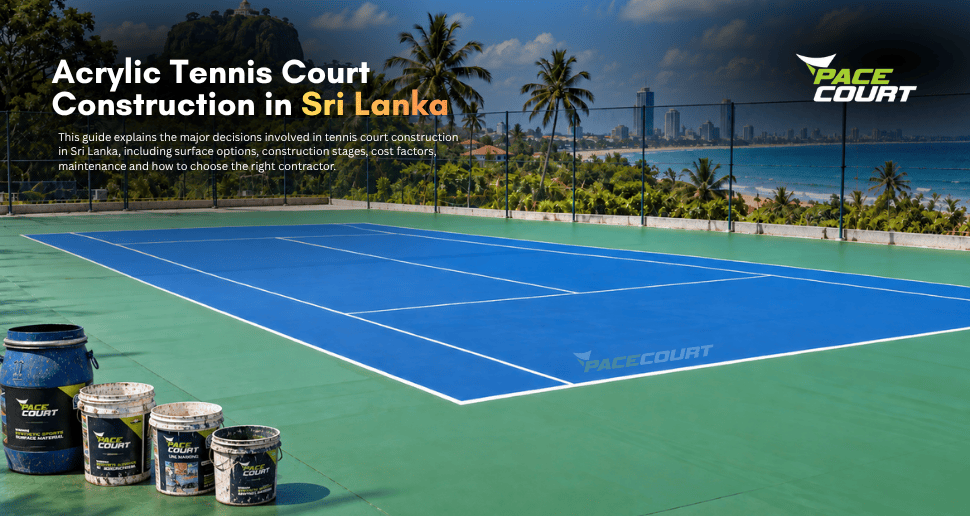
When you are planning to construct a tennis court in Sri Lanka, the quality of the final court relies on a great many factors other than the colour of the surface or the markings on the court. All the aspects such as site preparation, drainage, the construction of the base, the choice of surface, the slope, the fencing, the lighting and maintenance have an effect on the court’s performance over time.
Tennis courts that have been properly planned are capable of providing a dependable playing surface for many years in schools, hotels, resorts, sports clubs, residential communities, academies and commercial establishments; tennis court builders who are experienced in Sri Lanka should therefore consider the entire project rather than regard the flooring as a separate task.
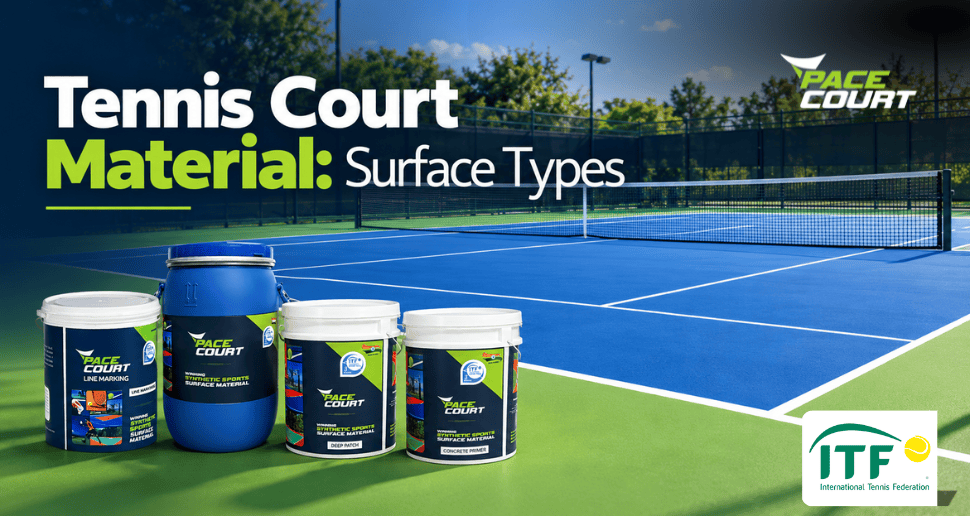
Pacecourt specialises in synthetic acrylic sports flooring and provides court design, installation, repair, resurfacing, and maintenance solutions. Its flooring system is built around multiple layers applied over a prepared concrete or asphalt base.
This guide explains the major decisions involved in tennis court construction in Sri Lanka, including surface options, construction stages, cost factors, maintenance and how to choose the right contractor.
What Does Tennis Court Construction in Sri Lanka Include?
A complete tennis court project normally includes several stages, from site assessment to final line marking.
A professional tennis court construction company in Sri Lanka may need to manage:
- Site inspection and measurements
- Court orientation and layout
- Excavation and earthwork
- Soil and ground preparation
- Drainage planning
- Sub-base preparation
- Concrete or asphalt base construction
- Acrylic or synthetic surface installation
- Court line marking
- Tennis net and posts
- Perimeter fencing
- Sports lighting
- Landscaping or access areas
- Resurfacing and future maintenance
The exact scope depends on the site and the type of facility being developed.
A private residential court may need a simpler setup, while a hotel, tennis academy or sports club may require lighting, spectator areas, multiple courts, player facilities and stronger drainage infrastructure.
Standard Tennis Court Size and Space Requirements
The playing dimensions of a standard tennis court are fixed, but the total land required is larger because players need space around the court.
The court itself measures:
| Full court length | 23.77 m / 78 ft |
| Singles width | 8.23 m / 27 ft |
| Doubles width | 10.97 m / 36 ft |
| Net height at centre | 0.914 m |
| Net height at posts | 1.07 m |
| Service line from net | 6.40 m |
The surrounding clearance is equally important. Players need sufficient run-off space behind the baseline and beside the court for safe movement.
For this reason, don’t buy or prepare land based only on the court playing area. A tennis court design and construction project in Sri Lanka should consider the entire usable footprint, including fencing, access, lighting and drainage.
Choosing the Right Tennis Court Flooring in Sri Lanka
Surface selection is one of the most important decisions in a tennis court project.
Different surfaces create different playing characteristics and maintenance requirements. Base your choice on the expected users, location, budget, climate, maintenance capacity, and desired playing speed.
Acrylic Tennis Court Construction Sri Lanka
Synthetic acrylic is a practical option for outdoor courts because it can be installed as a multi-layer surface over a properly prepared concrete or asphalt base.
Pacecourt’s synthetic acrylic flooring system includes layers such as a primer, cushion coat (where required), acrylic resurfacer, colour coats, and line-marking paint.
Acrylic courts are particularly suitable for facilities looking for:
- Consistent playing characteristics
- A clean and professional appearance
- Custom court colours
- Relatively simple routine maintenance
- Outdoor sports use
- Resurfacing capability
- Options for cushioned systems
The quality of the base underneath the acrylic remains critical. Even an excellent coating system cannot compensate for major structural problems, poor drainage or an unstable base.
Synthetic Tennis Court Sri Lanka
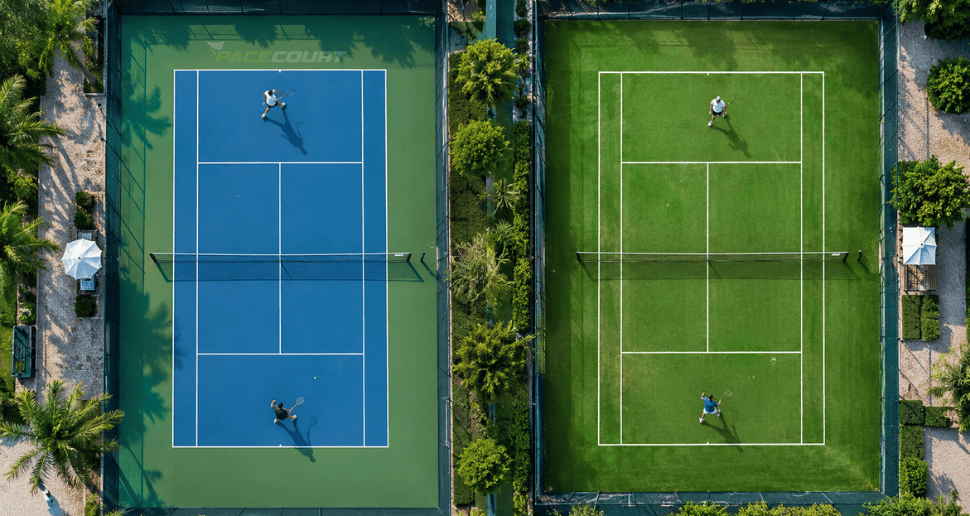
The term synthetic tennis court can cover several surface systems, including synthetic acrylic and synthetic grass.
Synthetic grass can provide a different playing feel and appearance, while acrylic hard courts generally offer a firm, uniform surface.
The decision should therefore be based on how the court will actually be used rather than choosing a surface simply because it looks attractive.
Acrylic vs Synthetic Grass Tennis Court
| Playing feel | Firm and consistent | Softer grass-like feel |
| Maintenance | Generally straightforward | Requires surface-specific care |
| Custom colours | Excellent | More limited |
| Resurfacing | Possible | Surface replacement may be required |
| Outdoor use | Suitable | Suitable |
| Best suited for | Clubs, schools, academies, communities | Recreational and selected club applications |
For many outdoor facilities, acrylic remains an attractive option because the complete system can be tailored around the base, playing requirements and maintenance plan.
Tennis Court Construction Process in Sri Lanka
A professional project should follow a planned sequence. Rushing one stage can create problems later.
1. Site Survey and Planning
The first step is to inspect the proposed site.
The contractor should assess:
- Available land area
- Existing ground levels
- Soil condition
- Water movement
- Existing drainage
- Access for construction equipment
- Sun orientation
- Surrounding structures
- Utility services
- Existing concrete or asphalt, if it’s a renovation
Pacecourt’s own court-development process starts with surveying and inspecting the proposed location before selecting the appropriate product or refurbishment approach.
This stage helps identify problems before construction begins.
2. Court Layout and Orientation
The court should be positioned carefully within the available land.
Upgrade Your Sports Court Today
Get premium synthetic acrylic flooring designed for durability, grip, and performance.
Get Free ConsultationOrientation matters because players shouldn’t regularly have to look directly into low-angle sunlight during normal play. Local surroundings, trees, buildings and wind conditions should also be considered.
A good tennis court development plan for Sri Lanka should show the playing area, run-off space, fencing, access routes, lighting positions and drainage.
3. Excavation and Ground Preparation
For a new court, unsuitable soil and organic material may need to be removed.
The ground is then prepared and compacted to create a stable foundation.
This stage is often underestimated. If the underlying ground moves significantly, cracks and uneven areas can eventually appear in the finished court.
4. Drainage Installation
Water management is one of the most important parts of outdoor tennis court construction in Sri Lanka.
Sri Lankan sites can experience heavy rainfall, so water should have a planned route away from the playing surface.
The drainage solution depends on:
- Site slope
- Soil permeability
- Existing stormwater system
- Groundwater conditions
- Court elevation
- Local rainfall patterns
The objective is simple: water should not remain standing on the court.
5. Base Construction
The playing surface needs a stable and properly prepared base.
Depending on the project, this can involve concrete or asphalt construction.
The base should be:
- Properly compacted
- Smooth and level
- Structurally stable
- Correctly sloped for drainage.
- Free from loose material
- Properly cured before surface application.
This is one area where cutting costs can create expensive problems later.
6. Surface Preparation
Before acrylic flooring is installed, the base needs to be inspected and prepared.
Existing cracks, low spots, surface imperfections and contamination should be addressed before coating begins.
For resurfacing projects, the existing court should first be evaluated to determine whether the base can be retained or needs more extensive repair.
7. Acrylic Surface Installation
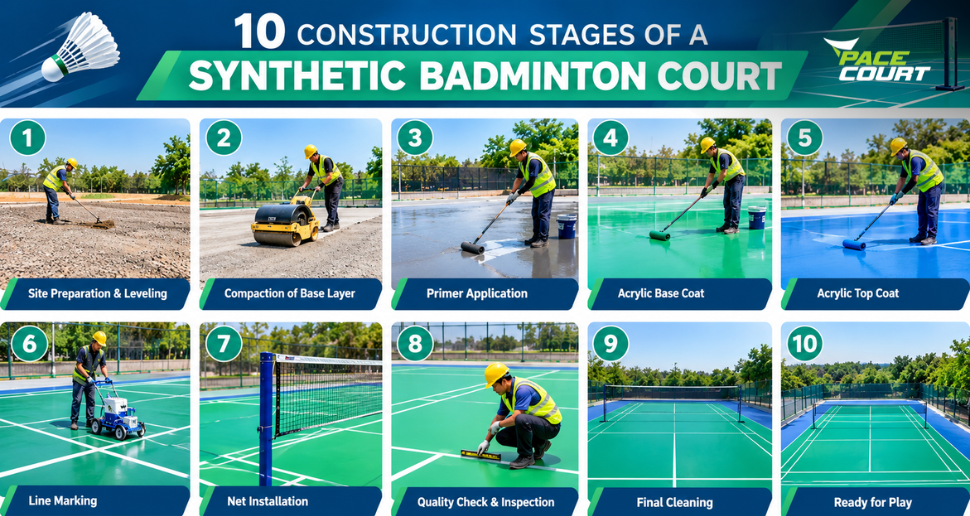
Acrylic systems are installed in multiple stages rather than as one thick layer.
A typical Pacecourt synthetic acrylic system includes:
- Prepared concrete or asphalt base
- Acrylic primer
- Cushion coat, where specified
- Acrylic resurfacer
- Textured colour coats
- Court line marking
The exact system can vary depending on the project requirements.
Each stage needs suitable surface conditions and sufficient curing time.
8. Court Line Marking
Once the surface is ready, tennis lines are marked according to the required dimensions.
Clean and accurate line marking makes a significant difference to the appearance and usability of the finished court.
If the facility will also be used for another sport, additional markings should be planned before painting rather than added without considering the overall layout.
9. Fencing, Net and Lighting
The final construction stage may include:
- Tennis net posts
- Tennis net
- Perimeter fencing
- Gates
- LED sports lighting
- Player seating
- Walkways
- Ball-stop netting
These features should be planned during the design stage because their foundations and electrical requirements may affect the construction process.
How Much Does Tennis Court Construction Cost in Sri Lanka?
There isn’t one reliable price for tennis court construction costs in Sri Lanka.
Giving a single number without inspecting the site can be misleading.
The final cost depends on several variables:
| Land condition | Can significantly affect earthwork |
| Drainage | Higher requirements increase cost |
| Base construction | Major cost component |
| Acrylic flooring | Depends on system and specifications |
| Court size | Larger areas require more materials |
| Fencing | Depends on height and specification |
| Lighting | Adds electrical and equipment costs |
| Site access | Difficult access can increase labour |
| Existing court | Repair may be cheaper than reconstruction |
| Number of courts | Multi-court projects have different economies |
| Seating and amenities | Optional additional investment |
For an accurate quotation, a contractor should first understand the site, court specifications, and surface system.
Pacecourt also notes that tennis court costs vary according to factors such as site conditions, materials and additional facilities.
New Court vs Existing Court Resurfacing
One of the biggest cost decisions is whether to build a new court or renovate an existing one.
| New construction | Groundwork, drainage, base, flooring and accessories |
| Resurfacing | Inspection, repairs, preparation and new surface |
| Renovation | Structural repairs plus surface replacement |
| Surface refresh | Minor repairs, coating and line marking |
If the existing base remains structurally sound, tennis court resurfacing in Sri Lanka can be a practical alternative to complete reconstruction.
However, resurfacing should not be used to hide major drainage or structural problems.
Tennis Court Resurfacing Sri Lanka: When Is It Needed?
A tennis court doesn’t necessarily need complete reconstruction when the playing surface starts to look worn.
Signs that resurfacing may be worth considering include:
- Faded colour
- Worn texture
- Small surface cracks
- Loss of surface consistency
- Damaged line markings
- Minor surface deterioration
- Visible wear in high-use areas
The correct solution depends on the condition underneath the surface.
Pacecourt recommends inspection, repair of cracks and surface preparation before applying a new acrylic resurfacing system.
If the foundation has serious movement, drainage failure or extensive cracking, simply applying another coating may not solve the underlying problem.
Tennis Court Maintenance Sri Lanka
Good maintenance protects the investment made during construction.
A basic maintenance programme should include:
Regular Cleaning
Remove leaves, dirt and other debris from the court. Organic material left on the surface can contribute to staining and surface deterioration.
Drainage Checks
Keep drains and surrounding water channels free from leaves, soil and debris.
A blocked drainage system can allow water to remain around or on the court.
Crack Inspection
Small cracks should be investigated rather than ignored.
Early repairs can prevent minor defects from developing into larger surface problems.
Line Marking Inspection
Court lines should remain clearly visible and accurately positioned.
Avoid Heavy Loads
Heavy equipment should not be placed directly on the finished playing surface unless suitable protection is used.
Professional Inspection
A professional inspection can help identify surface wear, drainage issues and other problems before major repairs become necessary.
Tennis Court Contractors in Sri Lanka: How to Choose the Right One
Choosing between different tennis court contractors in Sri Lanka shouldn’t be based only on the lowest quotation.
Ask each contractor:
- What base system will you use?
- How will drainage be handled?
- Which surface system is proposed?
- What preparation is included?
- Which materials will be used?
- Who will install the acrylic system?
- What fencing and lighting options are available?
- What maintenance is recommended?
- What happens if cracks develop?
- Is the quotation for the complete project or only flooring?
A professional contractor should be able to explain the construction sequence clearly.
Look for a company that understands both tennis court flooring in Sri Lanka and the construction underneath it. A flooring supplier alone may not be the same as a complete court-development contractor.
Tennis Court Builders Colombo and Other Sri Lankan Locations
For clients searching for tennis court contractors Colombo or tennis court builders Colombo, the same principle applies: don’t judge a project only by location.
The contractor should understand the specific site and provide a solution based on its ground conditions, drainage, access and intended use.
For projects outside Colombo, logistics become another consideration. Material supply, equipment movement, local labour and project supervision should be discussed before work begins.
For an international or cross-border project, clients should also clarify who will handle local construction activities and installation supervision.
Why Pacecourt for Acrylic Tennis Court Projects?
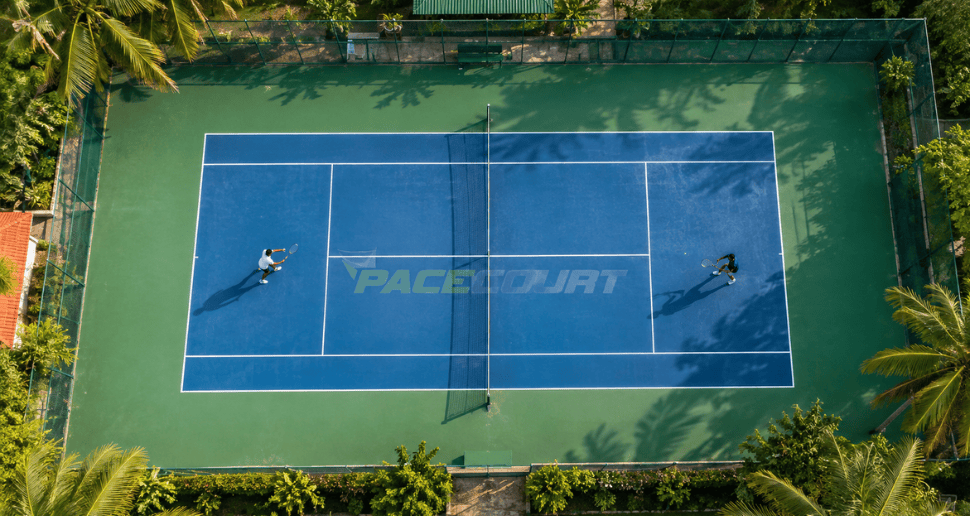
Pacecourt focuses on synthetic acrylic sports flooring and provides solutions covering court design, installation, repair, resurfacing and maintenance. Its published sports flooring system is designed for tennis as well as other sports including basketball, badminton, volleyball and pickleball.
Its tennis flooring range includes components such as:
- Concrete primer
- Deep patch
- Acrylic resurfacer
- Cushion coat
- Colour coat
- Line marking
- Silica sand
- PU binder
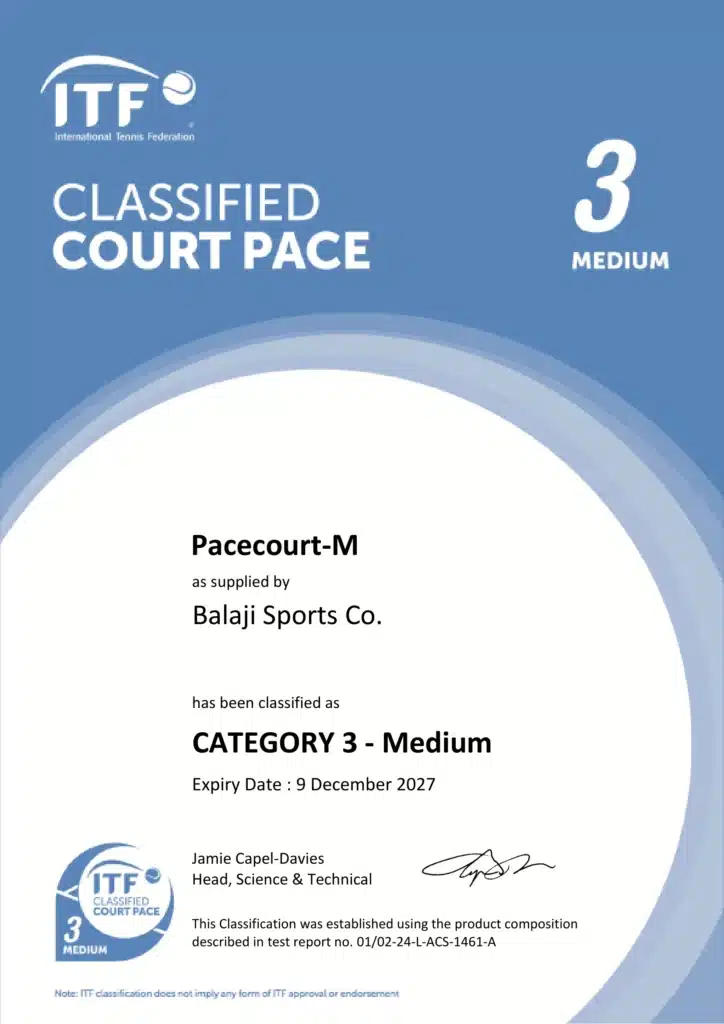
The company states that its synthetic acrylic sports flooring is ITF certified and that its systems have been used across a large number of courts in India.
For a Sri Lankan project, the practical question is not simply which brand is best. The more useful question is whether the proposed system, base preparation, drainage and installation method are appropriate for the actual site.
That’s where proper project assessment matters.
Common Mistakes to Avoid During Tennis Court Construction
Choosing Flooring Before Checking the Site
The surface should be selected after considering the base, drainage, climate, usage and maintenance requirements.
Ignoring Drainage
A beautiful court can still fail early if water isn’t managed properly.
Using an Unstable Base
Surface coatings cannot correct major structural movement underneath them.
Applying Coatings in Poor Conditions
Acrylic installation requires suitable surface and weather conditions. Rushing the application can affect bonding and finish.
Focusing Only on Initial Cost
A cheaper quotation may exclude important items such as drainage, base repairs, fencing or proper surface preparation.
Skipping Maintenance
Even a professionally constructed court needs routine cleaning, inspection and periodic surface care.
New Tennis Court or Tennis Court Renovation?
The right choice depends on the condition of the existing facility.
Choose new tennis court construction when:
- There is no existing court.
- The current base is beyond repair.
- Drainage needs complete redesign.
- The site needs major redevelopment.
- You want a new layout or multi-court facility.
Consider tennis court renovation in Sri Lanka when:
- The existing base is usable.
- Surface wear is the main issue.
- Court markings are faded.
- Minor cracks can be repaired.
- Drainage remains functional
- The layout still suits the facility.
A professional inspection should come before making this decision.
Final Checklist Before Starting Your Tennis Court Project
Before signing a construction contract, make sure the proposal clearly covers:
- Site survey
- Court dimensions
- Court orientation
- Earthwork
- Drainage
- Base construction
- Surface specification
- Acrylic layer system
- Line marking
- Net posts and net
- Fencing
- Lighting, if required
- Project timeline
- Maintenance requirements
- Resurfacing provisions
- Warranty terms
- Complete cost breakdown
This checklist can prevent misunderstandings later.
Final Thoughts
A successful Tennis Court Construction in Sri Lanka project starts with the ground beneath the court and ends with a surface that performs consistently. Drainage, base preparation, acrylic flooring, accurate line marking, fencing and regular maintenance all work together.
For schools, resorts, clubs, academies, communities and private facilities, choosing the right construction approach is more important than simply selecting the cheapest quotation.
If you’re planning a new court or upgrading an existing one, assess the site first, compare surface systems carefully and ask for a detailed scope of work. Pacecourt’s synthetic acrylic flooring and court-development services can be considered as part of the flooring solution, particularly for projects looking for a professional acrylic sports surface.
The goal of Tennis Court Construction in Sri Lanka should be simple: create a court that is safe, practical, visually professional and suitable for the way people will actually use it.
Frequently Asked Questions
What is the best surface for tennis court construction in Sri Lanka?
Synthetic acrylic is a practical option for many outdoor tennis courts because it provides a firm, uniform surface and can be maintained and resurfaced when properly installed.
How much does tennis court construction cost in Sri Lanka?
There is no fixed price. The final tennis court construction cost in Sri Lanka depends on site conditions, drainage, base construction, surface system, fencing, lighting and other project requirements.
How long does tennis court construction take?
The timeline depends on excavation, drainage, base construction, curing, weather and surface installation. A contractor should provide a project-specific schedule after inspecting the site.
Is acrylic tennis court flooring suitable for outdoor use?
Yes. Acrylic systems are widely used for outdoor tennis courts. Their performance depends heavily on correct base preparation, drainage, material selection and installation.
Can an old tennis court be resurfaced?
Yes, if the existing structure and base are suitable. Tennis court resurfacing in Sri Lanka may involve crack repair, surface preparation, acrylic resurfacing and new line marking.
Should I choose a local tennis court contractor?
A local contractor can be useful because they understand local labour, construction conditions and logistics. However, experience with sports-court construction and the proposed flooring system should remain the main selection criteria.
Can Pacecourt help with tennis court flooring?
Pacecourt provides synthetic acrylic sports flooring solutions for tennis and other sports, along with services covering court design, installation, repair, resurfacing and maintenance.
Stay Updated with Pacecourt
Discover expert insights, practical tips, and the latest industry updates from Pacecourt, covering sports flooring, tennis and multi-sport court construction, resurfacing, maintenance, court performance, and innovative sports infrastructure solutions.
Powered by Google's Preferred Sources feature