Tennis Court Construction in Sri Lanka – Expert Court Builders
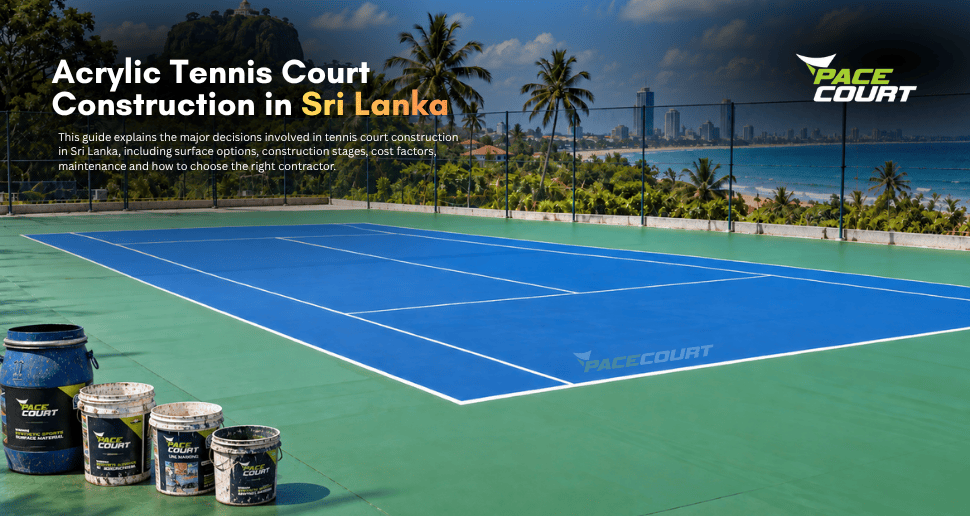
When you are planning to construct a tennis court in Sri Lanka, the quality of the final court relies on a great many factors other than the colour of the surface or the markings on the court. All the aspects such as site preparation, drainage, the construction of the base, the choice of surface, the slope, the fencing, the lighting and maintenance have an effect on the court’s performance over time. Tennis courts that have been properly planned are capable of providing a dependable playing surface for many years in schools, hotels, resorts, sports clubs, residential communities, academies and commercial establishments; tennis court builders who are experienced in Sri Lanka should therefore consider the entire project rather than regard the flooring as a separate task. Pacecourt specialises in synthetic acrylic sports flooring and provides court design, installation, repair, resurfacing, and maintenance solutions. Its flooring system is built around multiple layers applied over a prepared concrete or asphalt base. This guide explains the major decisions involved in tennis court construction in Sri Lanka, including surface options, construction stages, cost factors, maintenance and how to choose the right contractor. What Does Tennis Court Construction in Sri Lanka Include? A complete tennis court project normally includes several stages, from site assessment to final line marking. A professional tennis court construction company in Sri Lanka may need to manage: The exact scope depends on the site and the type of facility being developed. A private residential court may need a simpler setup, while a hotel, tennis academy or sports club may require lighting, spectator areas, multiple courts, player facilities and stronger drainage infrastructure. Standard Tennis Court Size and Space Requirements The playing dimensions of a standard tennis court are fixed, but the total land required is larger because players need space around the court. The court itself measures: Full court length 23.77 m / 78 ft Singles width 8.23 m / 27 ft Doubles width 10.97 m / 36 ft Net height at centre 0.914 m Net height at posts 1.07 m Service line from net 6.40 m The surrounding clearance is equally important. Players need sufficient run-off space behind the baseline and beside the court for safe movement. For this reason, don’t buy or prepare land based only on the court playing area. A tennis court design and construction project in Sri Lanka should consider the entire usable footprint, including fencing, access, lighting and drainage. Choosing the Right Tennis Court Flooring in Sri Lanka Surface selection is one of the most important decisions in a tennis court project. Different surfaces create different playing characteristics and maintenance requirements. Base your choice on the expected users, location, budget, climate, maintenance capacity, and desired playing speed. Acrylic Tennis Court Construction Sri Lanka Synthetic acrylic is a practical option for outdoor courts because it can be installed as a multi-layer surface over a properly prepared concrete or asphalt base. Pacecourt’s synthetic acrylic flooring system includes layers such as a primer, cushion coat (where required), acrylic resurfacer, colour coats, and line-marking paint. Acrylic courts are particularly suitable for facilities looking for: The quality of the base underneath the acrylic remains critical. Even an excellent coating system cannot compensate for major structural problems, poor drainage or an unstable base. Synthetic Tennis Court Sri Lanka The term synthetic tennis court can cover several surface systems, including synthetic acrylic and synthetic grass. Synthetic grass can provide a different playing feel and appearance, while acrylic hard courts generally offer a firm, uniform surface. The decision should therefore be based on how the court will actually be used rather than choosing a surface simply because it looks attractive. Acrylic vs Synthetic Grass Tennis Court Playing feel Firm and consistent Softer grass-like feel Maintenance Generally straightforward Requires surface-specific care Custom colours Excellent More limited Resurfacing Possible Surface replacement may be required Outdoor use Suitable Suitable Best suited for Clubs, schools, academies, communities Recreational and selected club applications For many outdoor facilities, acrylic remains an attractive option because the complete system can be tailored around the base, playing requirements and maintenance plan. Tennis Court Construction Process in Sri Lanka A professional project should follow a planned sequence. Rushing one stage can create problems later. 1. Site Survey and Planning The first step is to inspect the proposed site. The contractor should assess: Pacecourt’s own court-development process starts with surveying and inspecting the proposed location before selecting the appropriate product or refurbishment approach. This stage helps identify problems before construction begins. 2. Court Layout and Orientation The court should be positioned carefully within the available land. Orientation matters because players shouldn’t regularly have to look directly into low-angle sunlight during normal play. Local surroundings, trees, buildings and wind conditions should also be considered. A good tennis court development plan for Sri Lanka should show the playing area, run-off space, fencing, access routes, lighting positions and drainage. 3. Excavation and Ground Preparation For a new court, unsuitable soil and organic material may need to be removed. The ground is then prepared and compacted to create a stable foundation. This stage is often underestimated. If the underlying ground moves significantly, cracks and uneven areas can eventually appear in the finished court. 4. Drainage Installation Water management is one of the most important parts of outdoor tennis court construction in Sri Lanka. Sri Lankan sites can experience heavy rainfall, so water should have a planned route away from the playing surface. The drainage solution depends on: The objective is simple: water should not remain standing on the court. 5. Base Construction The playing surface needs a stable and properly prepared base. Depending on the project, this can involve concrete or asphalt construction. The base should be: This is one area where cutting costs can create expensive problems later. 6. Surface Preparation Before acrylic flooring is installed, the base needs to be inspected and prepared. Existing cracks, low spots, surface imperfections and contamination should be addressed before coating begins. For resurfacing projects, the existing court should first be evaluated