Every champion match begins not with a racket swing – but with the surface beneath the player’s feet. Tennis court flooring is the single most important infrastructure decision you will make for any court project in India. The right flooring directly impacts player safety, ball bounce consistency, injury prevention, long-term maintenance costs, and court lifespan. Whether you are building a court for a school, sports academy, residential society, private villa, or professional club, choosing the correct surface separates a world-class facility from a costly mistake.
India’s sports infrastructure is expanding rapidly in 2026. Government smart-city programs, private academy investments, and rising tennis participation across Tier 1 and Tier 2 cities are driving unprecedented demand for high-quality tennis court surfaces.
Table of contents
- What Is Tennis Court Flooring?
- Types of Tennis Court Flooring in India 2026
- Tennis Court Flooring Information Table (India 2026)
- Tennis Court Flooring Cost in India (2026)
- Comparison Table: Acrylic vs PU vs Synthetic Grass
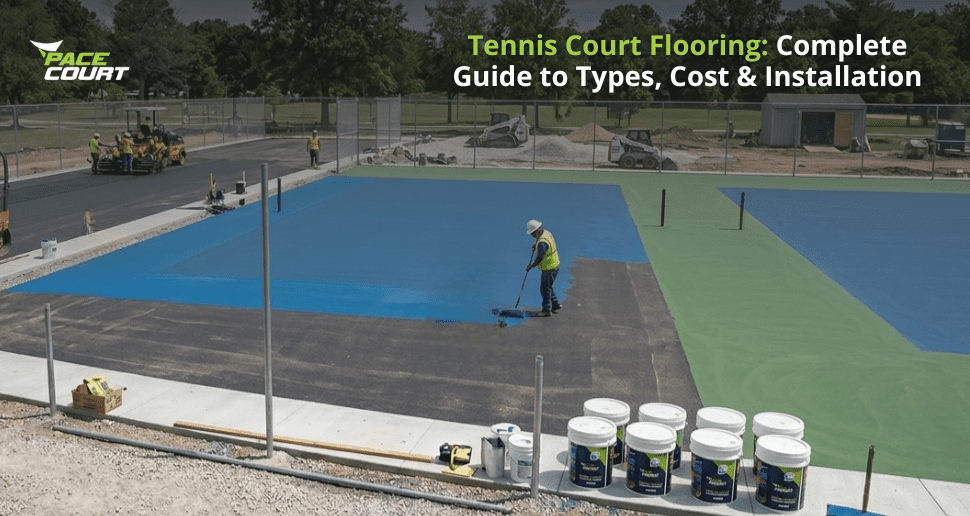
- How Tennis Court Flooring Is Installed in India
- Tennis Court Flooring Maintenance Guide
- Case Study: Tennis Academy in Pune, Maharashtra (2025–2026)
- Factors That Affect Tennis Court Flooring Quality in India
- Top Tennis Court Flooring Brands and Manufacturers in India (2026)
- Tennis Court Flooring for Different Facility Types (India 2026)
- Tennis Court Flooring Trends in India: 2026 Update
- Common Tennis Court Flooring Mistakes to Avoid in India
- Frequently Asked Questions (FAQs)
What Is Tennis Court Flooring?
Tennis court flooring refers to the specialized surface system installed on a prepared base to create a safe, playable, and durable tennis court. It is not simply a floor – it is a performance system engineered for ball speed, grip, shock absorption, and weather durability.
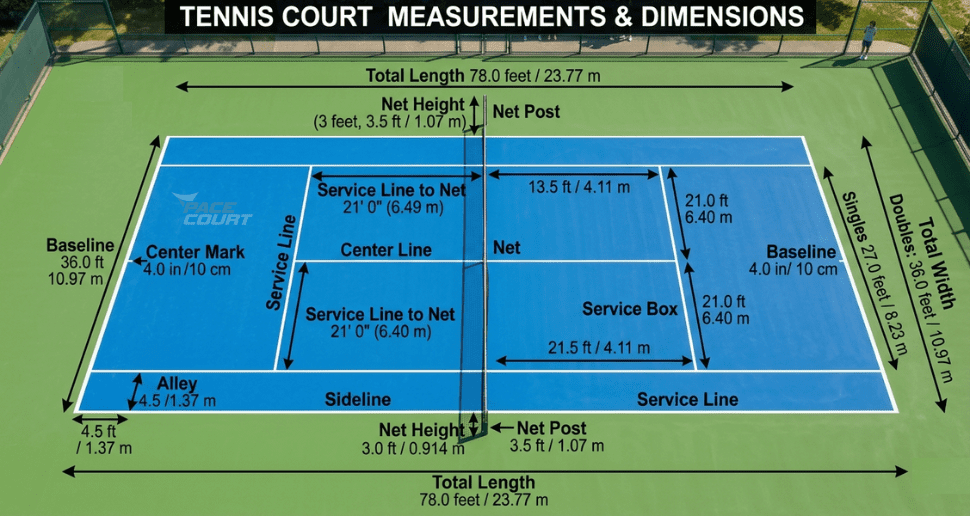
A standard tennis court measures 78 feet × 36 feet (23.77 m × 10.97 m) for doubles play. Including the recommended run-off zone on all sides, the total flooring area covers approximately 7,200 to 8,000 square feet (670–745 sq. m). Every square foot of that surface must perform consistently under intense play, UV exposure, rain, heat, and years of use.
Modern tennis court flooring systems consist of multiple engineered layers applied over a concrete or asphalt base. Each layer serves a specific performance function – from base grip to shock cushioning to UV-resistant color finish. The quality of each layer, the number of layers applied, and the expertise of the installation team together determine how well your court performs over its lifetime.
Types of Tennis Court Flooring in India 2026
India’s diverse climate – from the dry heat of Rajasthan to the coastal humidity of Mumbai and the monsoon-heavy conditions of Kerala – means there is no single “best” surface for every location. Understanding each type helps you select the right match for your geography, budget, and usage intensity.
1. Acrylic Tennis Court Flooring
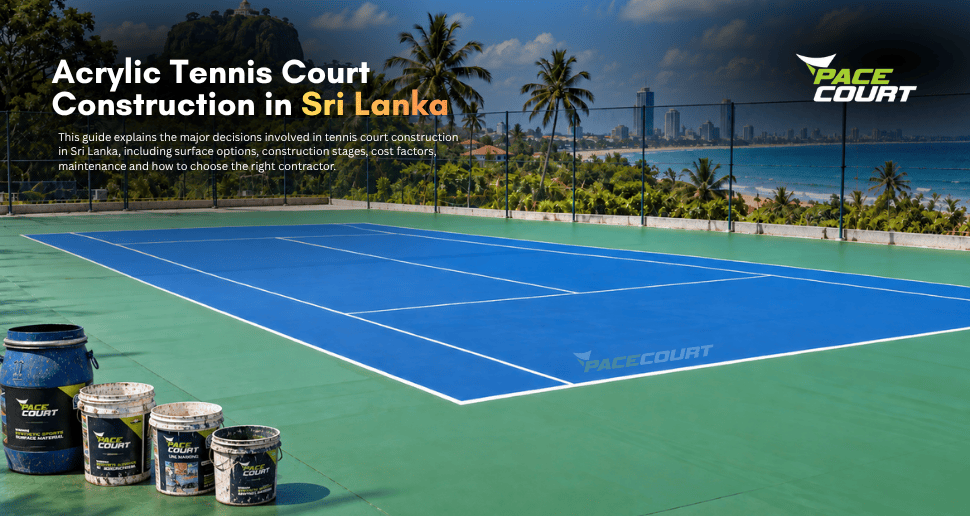
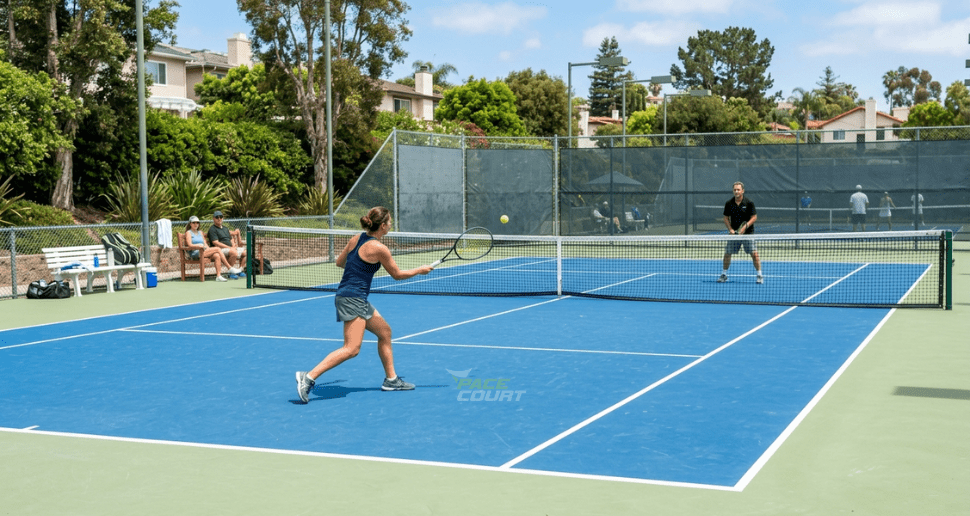
Acrylic tennis court flooring is the most widely used surface in India in 2026. It consists of multiple coats of acrylic resin mixed with silica sand applied over a concrete or asphalt base. The result is a hard, textured, all-weather surface that delivers consistent ball bounce and excellent grip.
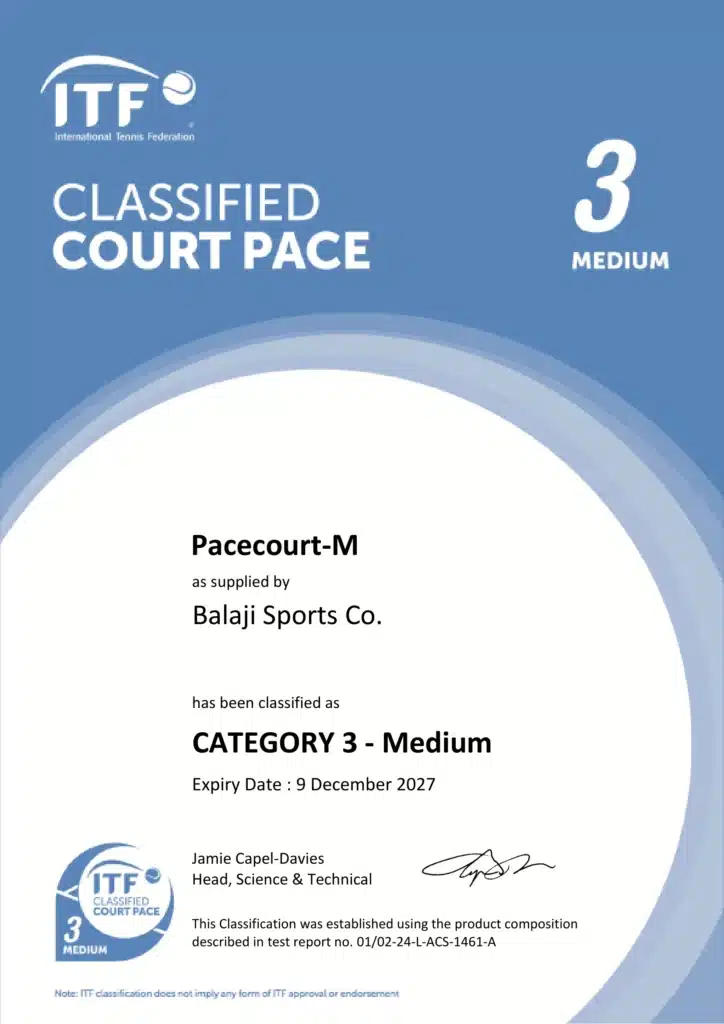
Acrylic courts are ITF (International Tennis Federation) approved and used at international tournaments including the Australian Open. Indian academies, schools, clubs, and government sports complexes widely prefer acrylic due to its proven balance of performance, durability, and cost-effectiveness.
Key Properties of Acrylic Flooring:
- Number of layers: 4 to 8 coats depending on the system
- Ball speed: Medium to fast
- Shock absorption: Moderate (higher in cushioned acrylic systems)
- UV resistance: Excellent with UV-stabilized pigments
- Weather suitability: Outdoor and indoor
- Lifespan: 8 to 12 years with proper maintenance
Acrylic courts come in two sub-types in India: standard acrylic (hard court system) and cushioned acrylic (adds rubber-based cushion layers for higher shock absorption and player comfort).
2. Polyurethane (PU) Tennis Court Flooring
Polyurethane (PU) flooring uses a liquid polymer system applied over a prepared base to create a softer, more cushioned surface. PU systems deliver superior shock absorption, making them ideal for indoor courts, training centers, and multi-sport facilities where joint protection is a priority.
PU flooring is more expensive than standard acrylic but offers a premium playing experience. It reduces stress on knees, ankles, and hips – a significant benefit for daily training facilities. In India, PU courts are gaining popularity in premium private clubs and five-star resort facilities.
Key Properties of PU Flooring:
- Shock absorption: High (reduces joint stress significantly)
- Ball bounce: Consistent and slightly slower than hard acrylic
- Ideal use: Indoor courts, premium clubs, training academies
- Maintenance: Moderate; requires professional cleaning
- Lifespan: 10 to 15 years in indoor conditions
3. Synthetic Grass (Artificial Turf) Tennis Courts
Synthetic grass courts replicate the aesthetics and some playing characteristics of natural grass courts like Wimbledon. They use artificial turf fibers infilled with sand or rubber granules over a base system. In India, synthetic grass courts are popular in private villas, resorts, and facilities that want a premium visual appearance.
Upgrade Your Sports Court Today
Get premium synthetic acrylic flooring designed for durability, grip, and performance.
Get Free ConsultationBall speed on synthetic grass is fast, similar to natural grass. The surface is also softer underfoot compared to hard courts, offering moderate shock absorption. However, synthetic grass requires regular brushing, infill top-up, and UV maintenance to preserve performance.
4. Clay Tennis Court Flooring
Clay courts are the traditional surfaces of French Open-style play. They use crushed brick, stone, or shale on a well-prepared compacted base. Clay surfaces slow the ball and favor baseline players with heavy topspin games. In India, natural clay courts are declining in new construction because they require intensive daily maintenance – watering, rolling, and line-sweeping.
Modern synthetic clay surfaces replicate clay-court playing characteristics with significantly lower maintenance. These are used in some academies that specifically train players for clay-court tournaments.
5. Modular Interlocking Court Tiles
Modular polypropylene interlocking tiles are a quick-install, portable solution for tennis court surfacing. These tiles snap together over any flat surface without adhesives. They are popular for temporary courts, multi-purpose indoor halls, community centers, and residential societies where a permanent court is not feasible.
Modular tiles provide excellent drainage, UV resistance, and moderate shock absorption. They allow rapid installation and can be relocated or replaced section by section without resurfacing the entire court.
Tennis Court Flooring Information Table (India 2026)
| Surface Type | Best Use | Ball Speed | Shock Absorption | Avg. Cost (₹/sq. ft.) | Lifespan |
| Standard Acrylic | Outdoor clubs, schools, academies | Medium-Fast | Moderate | ₹75 – ₹110 | 8–10 years |
| Cushioned Acrylic | Academies, training centers | Medium | Good | ₹120 – ₹180 | 10–12 years |
| Polyurethane (PU) | Indoor premium courts | Medium-Slow | Excellent | ₹150 – ₹220 | 10–15 years |
| Synthetic Grass | Villas, resorts | Fast | Moderate | ₹130 – ₹200 | 8–12 years |
| Natural Clay | Specialty academies | Slow | Good (natural) | ₹60 – ₹100 | 3–5 years (high maintenance) |
| Modular Tiles | Temporary, multi-use indoor | Medium | Moderate | ₹35 – ₹90 | 7–10 years |
Tennis Court Flooring Cost in India (2026)
Understanding tennis court flooring cost in India requires looking at the complete picture – not just the surface material but the entire construction system. The total cost breaks down into three primary components: base preparation, surface flooring system, and accessories.
Base Preparation Cost
A tennis court base is the foundation on which the flooring system performs. A concrete or asphalt base must be properly leveled, graded for drainage, and cured before any surface application. Base preparation typically costs between ₹150 and ₹250 per square foot in India, depending on soil conditions, site location, and drainage requirements. This is the most critical investment – a weak base leads to cracks, surface failures, and expensive repairs within 2–3 years.
Surface Flooring System Cost
The surface system cost varies significantly based on the chosen flooring type. For a standard outdoor tennis court of approximately 7,200 square feet, the flooring material and installation cost in India in 2026 falls within the following ranges:
- Standard Acrylic System: ₹75 – ₹110 per sq. ft.
- Cushioned Acrylic System: ₹120 – ₹180 per sq. ft.
- Premium PU System: ₹150 – ₹220 per sq. ft.
- Synthetic Grass: ₹130 – ₹200 per sq. ft.
Total Tennis Court Construction Cost
A complete outdoor tennis court (including base, surface, line markings, and basic fencing) typically costs between ₹6 lakh and ₹18 lakh or more in India in 2026, depending on the surface type, city, and facility specifications. Lighting, seating, branding, and advanced net posts add to this figure.
Comparison Table: Acrylic vs PU vs Synthetic Grass
| Feature | Acrylic (Standard) | Cushioned Acrylic | Polyurethane (PU) | Synthetic Grass |
| ITF Approved | Yes | Yes | Yes | Yes |
| Weather Resistance | Excellent | Excellent | Good (Indoor preferred) | Good |
| Ball Bounce Consistency | Excellent | Very Good | Good | Moderate |
| Player Comfort | Moderate | Good | Excellent | Good |
| Maintenance Frequency | Low | Low | Moderate | Moderate |
| Installation Time | 5–7 days | 7–10 days | 7–12 days | 5–8 days |
| Upfront Cost | Low | Medium | High | Medium-High |
| Long-Term Value | Excellent | Excellent | Very Good | Good |
| Best For | All outdoor use | Academies, all ages | Premium indoor use | Villas, resorts |
| Color Options | Multiple | Multiple | Multiple | Green, Brown |
How Tennis Court Flooring Is Installed in India
Tennis court installation is a structured multi-stage process. Each stage must be completed correctly before the next begins. Skipping or rushing any stage compromises the entire system’s performance and lifespan.
Upgrade Your Sports Court Today
Get premium synthetic acrylic flooring designed for durability, grip, and performance.
Get Free ConsultationStage 1: Site Assessment and Soil Testing
The installer first evaluates the site’s soil bearing capacity, slope, drainage flow, and proximity to trees or structures. Soil testing determines whether the natural ground requires additional compaction, filling, or drainage modification before the base is laid.
Stage 2: Sub-Base and Base Construction
Workers compact the sub-grade soil and lay a granular sub-base (typically 150–200 mm compacted gravel or crusher dust). Over this, a concrete or dense-graded asphalt base is constructed to the correct thickness – typically 75–100 mm for concrete and 50–75 mm for asphalt. Proper slope (1–1.5% gradient) is built in for drainage.
Stage 3: Crack Repair and Surface Leveling
Any cracks, undulations, or surface imperfections in the base are repaired with specialized acrylic crack filler and leveling compounds. The surface must achieve a tolerance of ±3 mm over 3 meters before any flooring system is applied.
Stage 4: Primer Coat Application
A bonding primer coat is applied over the prepared base to ensure adhesion of the flooring system. The primer penetrates the base surface and creates a chemical bond between the concrete or asphalt and the acrylic coating layers above.
Stage 5: Resurfacing/Flooring System Application
For acrylic courts, multiple coats are applied in sequence using squeegees or spray equipment. Each coat must cure fully before the next is applied. Cushioned acrylic systems include rubber-based cushion layers between the base coats and the finish coats. For PU systems, liquid polyurethane is poured and spread mechanically to the correct depth.
Stage 6: Line Marking
Court lines are painted using specialized polyurethane-based court line paint after the final color coat cures. Lines must be straight, precisely measured, and cleanly edged. ITF-standard line widths (25–50 mm) are applied.
Stage 7: Net Posts, Accessories, and Final Inspection
Net posts are installed at the correct position and tension. A final quality inspection checks surface flatness, drainage flow, line accuracy, and coating adhesion before the court is handed over for play.
Tennis Court Flooring Maintenance Guide
Proper maintenance extends your tennis court’s lifespan and preserves its performance quality. In India’s demanding climate – with intense UV, monsoon rains, and dust – a structured maintenance routine protects your investment.
Daily Maintenance:
- Sweep the court surface with a soft brush or blower to remove dust, leaves, and debris.
- Inspect the net tension and adjust if required.
- Check for any standing water and clear drainage outlets after rain.
Monthly Maintenance:
- Clean the surface with a mild detergent solution and soft brush or pressure washer at low pressure.
- Inspect the surface for early-stage hairline cracks and address them immediately with acrylic crack filler.
- Check line markings for fading or peeling.
Annual Maintenance:
- Apply a maintenance coat (color coat) over the playing surface to restore surface texture and color.
- Inspect net posts and hardware for corrosion or loosening.
- Check the base perimeter for drainage blockages.
Every 5–8 Years:
- Full resurfacing may be required depending on usage intensity and climate exposure.
- Resurfacing costs approximately ₹30–₹60 per sq. ft. in India and restores the court to near-new performance at a fraction of full replacement cost.
Case Study: Tennis Academy in Pune, Maharashtra (2025–2026)
Project: DK Sports Academy, Pune – New outdoor tennis court construction
Requirement: Two ITF-standard outdoor tennis courts for academy training with 6–8 hours of daily usage by students aged 10 to 18.
Challenge: The site had expansive clay soil prone to cracking during summer and water retention during monsoon. The academy required a durable, low-maintenance surface with good shock absorption for young players.
Solution Applied: The project team selected a cushioned acrylic tennis court flooring system – a 7-layer application over a 100 mm reinforced concrete base with a central drainage channel. An additional rubber cushion layer (5 mm) was added between the base coats and the playing surface to enhance shock absorption for younger players’ joints.
Execution:
- Site clearing and soil stabilization: 2 weeks
- Reinforced concrete base construction: 3 weeks with 28-day curing
- Cushioned acrylic system (7 layers): 10 days application with 24-hour inter-coat curing
- Line marking and accessories: 2 days
- Total project duration: Approximately 10 weeks
Cost:
- Base construction: ₹185 per sq. ft.
- Cushioned acrylic system: ₹150 per sq. ft.
- Fencing, net posts, lighting: ₹3.5 lakh additional
- Total project cost (both courts): Approximately ₹28 lakh
Result: Both courts opened in early 2026 and have handled over 2,000 hours of play without any surface cracking, delamination, or drainage issues. The cushioned surface has received positive feedback from coaches and physiotherapists regarding player knee and ankle comfort. The academy plans to install a third court using the same specification in late 2026.
Key Learning: Investing in a reinforced concrete base and a cushioned multi-layer acrylic system added approximately 15% more to the base cost but delivered significantly higher durability, drainage performance, and player comfort – making it the better long-term investment for high-usage academy facilities.
Factors That Affect Tennis Court Flooring Quality in India
Several key factors determine how well your tennis court flooring performs over its lifetime. Understanding these factors helps you ask the right questions and make better purchasing decisions.
Surface Specification and Number of Layers
More layers mean more durability, better shock absorption, and longer lifespan. A standard 4-coat acrylic system performs adequately for low-to-moderate use. Never accept a fewer-layer system to cut cost – it increases long-term repair expenses.
Base Quality
The base is the single most critical factor in tennis court performance. A properly engineered concrete or asphalt base eliminates cracking, ensures drainage, and holds the surface system firmly for 10+ years. A weak or poorly constructed base causes surface failure within 2–3 years regardless of the quality of the flooring applied above.
ITF Certification of Materials
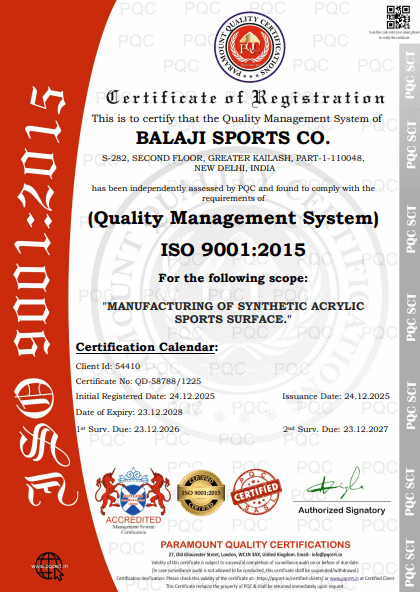
Always insist on ITF-approved materials from certified manufacturers. ITF certification guarantees that ball bounce, surface pace, and friction meet international standards. Non-certified materials may appear similar but fail to deliver consistent gameplay and degrade faster under Indian weather conditions.
Installation Expertise
Professional installation by experienced applicators – not local contractors unfamiliar with sports surfaces – is essential. Incorrect application temperature, insufficient curing time between coats, improper slope, or wrong material mixing ratios all lead to premature surface failure.
Climate and Location Suitability
India’s varied climate zones require location-specific surface choices. Coastal cities like Mumbai and Chennai need moisture-resistant systems with extra primer coats. Hot, dry cities like Jodhpur and Ahmedabad benefit from UV-stabilized acrylic with reflective finishes. High-altitude locations like Shimla need frost-resistant formulations.
Top Tennis Court Flooring Brands and Manufacturers in India (2026)
India’s tennis court flooring market features both domestic manufacturers and authorized dealers of international brands. The following are prominent names serving the Indian market in 2026:
- Pacecourt – Ahmedabad-based manufacturer of acrylic and cushioned court systems; widely used across academies, schools, and clubs.
- Top Flooring – Specialist provider offering acrylic and synthetic systems with nationwide installation capability.
- Indiana Sports Infra – Jaipur-based supplier offering PU and acrylic systems at competitive pricing.
- Sundek Sports – Multi-sport surface specialist with both outdoor and indoor court systems.
- Advanced Quality Solutions – National sports flooring contractor with court construction and resurfacing services.
When selecting a manufacturer or contractor, verify ITF certification, review completed project references, check GST registration and legal standing, and obtain at least three competitive quotes before awarding the project.
Tennis Court Flooring for Different Facility Types (India 2026)
Different facility types have different usage intensities, budget structures, and performance requirements. The correct surface choice must align with the specific facility context.
Schools and Educational Institutions
Schools benefit most from standard or cushioned acrylic systems. These surfaces handle moderate daily use, require low maintenance, meet safety standards for young players, and fit institutional budgets. Courts can also serve as multi-sport surfaces for basketball and badminton with dual-sport line markings.
Sports Academies
High-usage training academies require cushioned acrylic or PU systems with reinforced concrete bases. Player safety, joint comfort, and surface consistency under 6–10 hours of daily use are the top priorities. Investing in a higher-specification surface pays back through reduced player injuries and lower long-term maintenance costs.
Residential Societies and Private Villas
Residential courts benefit from either cushioned acrylic (for dedicated tennis play) or synthetic grass (for aesthetic appeal and leisure use). Modular tiles are also a cost-effective option for residential societies building their first court with a limited initial budget.
Hotels, Resorts, and Clubs
Premium facilities with brand reputation at stake benefit from cushioned acrylic or PU systems with custom color branding. High visual appeal, smooth maintenance, and consistent playing quality are essential for facilities charging guests for court time.
Tennis Court Flooring Trends in India: 2026 Update
India’s tennis court flooring market is evolving rapidly.
- Shift to Cushioned Systems: Awareness of sports injury prevention is driving a clear shift from standard hard acrylic to multi-layer cushioned acrylic systems across academies and clubs. Cushioned systems now account for a growing majority of new court installations at premium facilities.
- Eco-Friendly Materials: Manufacturers are introducing low-VOC acrylic coatings and recycled rubber cushion layers that reduce environmental impact without compromising performance. Green building certification bodies in India are beginning to recognize compliant sports surfaces in their frameworks.
- Multi-Sport Court Design: The trend toward multi-purpose courts – single surfaces accommodating tennis, pickleball, badminton, and basketball with dual-sport line markings – maximizes limited urban space and facility ROI.
- Smart Court Technology: A small but growing number of premium facilities in India are integrating sensor-embedded court surfaces and player tracking systems. These smart courts collect data on ball bounce, player movement, and surface wear to optimize both gameplay analytics and maintenance scheduling.
- Government Investment: Smart city programs and state sports development authority funding are driving construction of new tennis courts in Tier 2 and Tier 3 cities across Uttar Pradesh, Gujarat, Maharashtra, Karnataka, and Tamil Nadu, dramatically expanding the market for quality tennis court flooring in 2026.
Common Tennis Court Flooring Mistakes to Avoid in India
Many first-time court builders make costly mistakes that lead to premature surface failure, player injuries, or expensive rework. Avoid these common errors:
- Skipping proper base construction to save cost – a weak base invalidates any surface investment above it.
- Choosing the cheapest surface per square foot without evaluating total lifecycle cost – lower upfront cost often means higher long-term repair and replacement expense.
- Hiring local general contractors unfamiliar with sports surface application – sports flooring requires specialized skills, equipment, and materials knowledge.
- Ignoring drainage design – inadequate drainage causes water pooling, accelerated surface deterioration, and slip hazards.
- Not insisting on ITF-certified materials – non-certified materials may perform inconsistently and degrade faster under Indian weather.
Delaying annual maintenance – regular maintenance coats cost a fraction of resurfacing and extend court life significantly.
Frequently Asked Questions (FAQs)
Acrylic flooring especially cushioned acrylic is the best choice for India’s climate due to its all-weather durability, UV resistance, and low maintenance requirements across diverse conditions.
Standard acrylic systems cost approximately ₹75–₹110 per sq. ft., while cushioned acrylic ranges from ₹120–₹180 per sq. ft., and PU systems range from ₹150–₹220 per sq. ft., excluding base construction.
A properly installed and maintained acrylic tennis court surface lasts 8 to 12 years in India, while PU systems in indoor settings can last 10 to 15 years.
Yes – resurfacing an existing court with a new acrylic system costs approximately ₹30 – ₹60 per sq. ft. and restores performance, provided the existing base is structurally sound.
Choose acrylic for outdoor courts with moderate to high budgets; choose PU for premium indoor courts where maximum player comfort and shock absorption are the top priorities.
Yes, ITF certification guarantees that the surface meets international standards for ball bounce, pace, and friction, ensuring consistent gameplay and longer surface life.
Stay Updated with Pacecourt
Discover expert insights, practical tips, and the latest industry updates from Pacecourt, covering sports flooring, tennis and multi-sport court construction, resurfacing, maintenance, court performance, and innovative sports infrastructure solutions.
Powered by Google's Preferred Sources feature