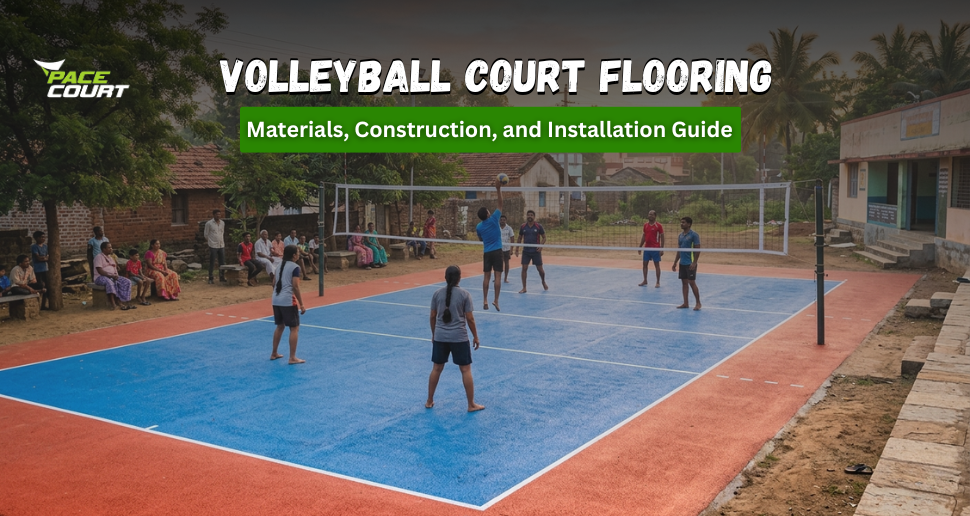
Volleyball is one of the world’s most popular sports, played across schools, colleges, sports clubs, recreational facilities, and professional arenas. While players often focus on skills, strategy, and training, the foundation of every great volleyball game is the court itself. High-quality volleyball court flooring directly impacts player safety, performance, comfort, and long-term facility maintenance.
Whether you’re planning to build an indoor volleyball arena, upgrade a school gymnasium, or construct an outdoor volleyball facility, choosing the right flooring material and installation process is critical.
Why Volleyball Court Flooring Matters
The quality of a volleyball court floor affects:
| Factor | Impact |
|---|---|
| Player Safety | Reduces injuries and falls |
| Shock Absorption | Minimizes stress on joints |
| Ball Response | Ensures consistent bounce |
| Performance | Improves movement and agility |
| Durability | Extends court lifespan |
| Maintenance | Reduces long-term costs |
A poorly constructed court can lead to:
- Knee injuries
- Ankle sprains
- Player fatigue
- Surface cracks
- Uneven ball bounce
- Expensive repairs
Therefore, investing in the right flooring system is essential for both athletes and facility owners.
Official Volleyball Court Dimensions
According to international volleyball standards:
| Specification | Measurement |
| Court Length | 18 meters |
| Court Width | 9 meters |
| Attack Line Distance | 3 meters |
| Free Zone | Minimum 3 meters |
| Net Height (Men) | 2.43 meters |
| Net Height (Women) | 2.24 meters |
For professional facilities, larger safety zones around the court are recommended.
Types of Volleyball Court Flooring Materials
1. Hardwood Volleyball Flooring
Overview
Hardwood flooring is considered the gold standard for professional indoor volleyball courts.
Common Wood Species
- Maple
- Oak
- Beech
Advantages
- Excellent shock absorption
- Professional appearance
- Long lifespan
- Superior ball bounce
- High player comfort
Disadvantages
- Expensive installation
- Requires regular maintenance
- Sensitive to moisture
Best For
- Professional arenas
- Universities
- Sports complexes
- National training centers
2. PVC Sports Flooring
PVC sports flooring has become one of the most popular volleyball flooring solutions worldwide.
Features
- Multi-layer construction
- Cushion backing
- Anti-slip surface
Advantages
- Cost-effective
- Easy installation
- Low maintenance
- Excellent durability
- Suitable for multi-sport facilities
Disadvantages
- Lower prestige than hardwood
- Can wear over time under heavy usage
Best For
- Schools
- Community centers
- Indoor sports halls
3. Polyurethane (PU) Sports Flooring
PU flooring is a seamless flooring system widely used in modern sports facilities.
Advantages
- Seamless finish
- High durability
- Good shock absorption
- Easy cleaning
- Customizable colors
Disadvantages
- Requires professional installation
- Longer curing period
Best For
- Indoor sports complexes
- Multipurpose halls
- Educational institutions
4. Acrylic Sports Flooring
Acrylic flooring is commonly used for outdoor volleyball courts.
Advantages
- UV resistant
- Weather resistant
- Slip-resistant
- Affordable
Disadvantages
- Lower cushioning
- Harder surface
Best For
- Outdoor volleyball courts
- Recreational parks
- Schools
5. Synthetic Sports Flooring
Synthetic flooring combines durability, flexibility, and performance.
Advantages
- Excellent shock absorption
- Weather resistance
- Long service life
- Reduced maintenance
Best For
- Commercial sports facilities
- High-traffic venues
Comparison of Volleyball Court Flooring Materials
| Flooring Type | Durability | Comfort | Cost | Maintenance | Indoor/Outdoor |
| Hardwood | Excellent | Excellent | High | High | Indoor |
| PVC | Very Good | Very Good | Medium | Low | Indoor |
| PU Flooring | Excellent | Excellent | Medium-High | Low | Indoor |
| Acrylic | Good | Moderate | Low | Low | Outdoor |
| Synthetic | Excellent | Excellent | Medium-High | Low | Both |
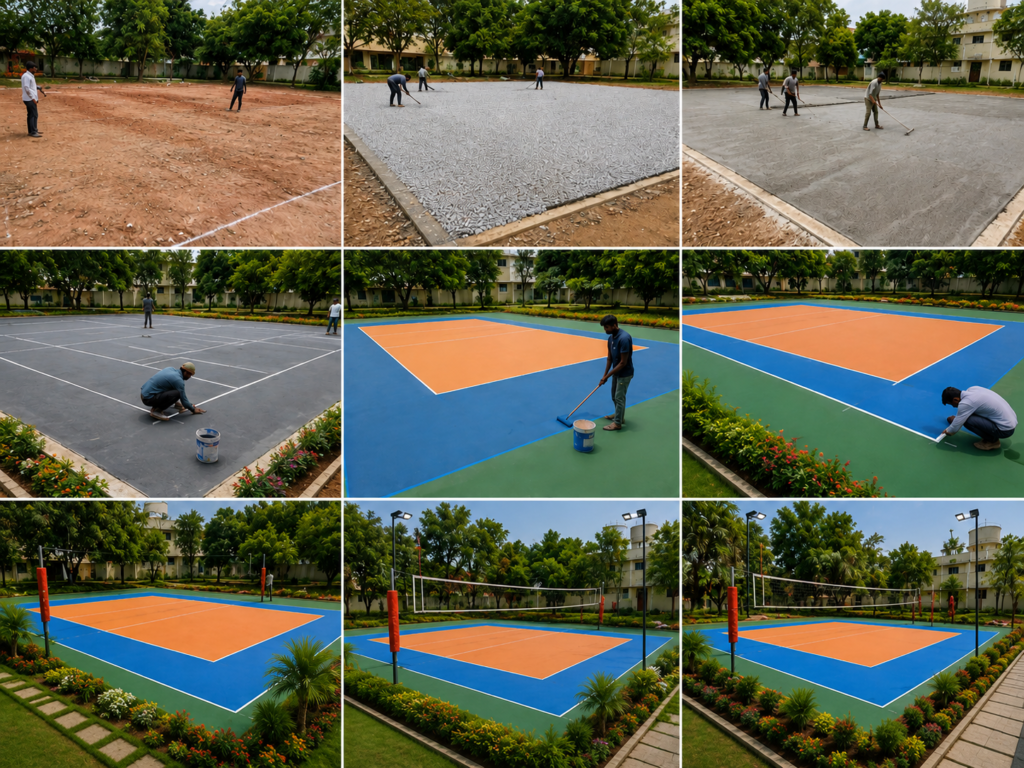
Volleyball Court Construction Process
Building a volleyball court involves much more than laying a surface.
Step 1: Site Assessment
Professionals evaluate:
- Soil conditions
- Drainage
- Existing structures
- Ground stability
Expert Tip
A poor foundation is responsible for over 60% of sports flooring failures.
Step 2: Base Preparation
The sub-base provides structural support.
Typical Layers:
- Compacted soil
- Gravel layer
- Concrete base
- Moisture barrier
- Flooring system
Recommended Concrete Thickness
| Facility Type | Thickness |
| School Court | 100 mm |
| Sports Complex | 125-150 mm |
| Professional Arena | 150 mm+ |
Step 3: Moisture Protection
Moisture is one of the biggest threats to sports flooring.
Protection includes:
- Vapor barriers
- Waterproof membranes
- Drainage systems
Step 4: Surface Installation
Installation varies depending on flooring type.
Hardwood Installation
- Sleeper system
- Shock pads
- Wood panels
- Sanding
- Finishing
PVC Installation
- Surface leveling
- Adhesive application
- Roll installation
- Seam welding
PU Installation
- Primer coat
- Cushion layer
- PU coating
- Line marking
Step 5: Court Marking
Professional court markings ensure compliance with standards.
Common colors:
- White
- Yellow
- Blue
- Red
Line width generally ranges between 5 cm and 8 cm.
Volleyball Court Flooring Installation Guide
Indoor Court Installation Timeline
| Activity | Duration |
| Site Preparation | 2-5 Days |
| Base Construction | 5-10 Days |
| Flooring Installation | 3-7 Days |
| Court Marking | 1 Day |
| Inspection | 1 Day |
Total project duration typically ranges from 2 to 4 weeks.
Shock Absorption Requirements
Shock absorption is critical for volleyball players due to frequent jumping and landing.
Recommended Performance Standards
| Property | Recommended Value |
| Shock Absorption | 25-50% |
| Vertical Deformation | 2-5 mm |
| Ball Rebound | ≥90% |
Higher shock absorption reduces player fatigue and injury risk.
Common Construction Mistakes to Avoid
1. Poor Drainage Design
Can cause:
- Surface damage
- Mold growth
- Flooring failure
2. Low-Quality Materials
Leads to:
- Cracks
- Peeling
- Frequent repairs
3. Improper Installation
Results in:
Upgrade Your Sports Court Today
Get premium synthetic acrylic flooring designed for durability, grip, and performance.
Get Free Consultation- Uneven surfaces
- Air pockets
- Delamination
4. Ignoring Expansion Gaps
Especially problematic for hardwood flooring.
Real Case Study : University Indoor Volleyball Arena
Project Overview
A university planned to renovate its aging gymnasium.
Challenges
- Uneven concrete slab
- Moisture problems
- High athlete usage
Solution
Installed:
- Moisture barrier
- Shock pad system
- Maple hardwood flooring
Results
- Improved athlete comfort
- Reduced injury complaints
- Increased court lifespan
Key Takeaway
Investing in subfloor preparation significantly improves flooring performance.
Real Case Study : School Multipurpose Sports Hall
Project Overview
A school required a budget-friendly volleyball court.
Challenges
- Limited budget
- Multi-sport usage
Solution
Installed PVC sports flooring.
Results
- Lower installation cost
- Easy maintenance
- Suitable for basketball and badminton as well
Key Takeaway
PVC flooring offers an excellent balance between performance and affordability.
Volleyball Court Flooring Maintenance Guide
Daily Maintenance
- Dust removal
- Surface cleaning
- Spill management
Weekly Maintenance
- Deep cleaning
- Surface inspection
Monthly Maintenance
- Joint inspection
- Line marking checks
Annual Maintenance
- Professional assessment
- Surface restoration if required
Estimated Volleyball Court Flooring Costs
| Flooring Type | Approximate Cost Range |
| Acrylic | Low |
| PVC | Medium |
| PU Flooring | Medium-High |
| Hardwood | High |
| Synthetic Sports Flooring | Medium-High |
Actual costs vary based on:
- Location
- Material brand
- Installation complexity
- Site conditions
Expert Recommendations
Choose Hardwood If:
- You need professional-level performance.
- Budget is not a primary concern.
Choose PVC If:
- You need versatility and affordability.
The choose PU Flooring If:
- You want a seamless premium sports surface.
Choose Acrylic If:
- You are constructing an outdoor volleyball court.
Choose Synthetic Flooring If:
- You need long-term durability and multi-sport functionality.
Conclusion
Volleyball court flooring is a long-term investment that directly impacts athlete safety, performance, and facility value. Whether you’re building a professional indoor arena, a school gymnasium, or an outdoor recreational court, selecting the right flooring material and following proper construction and installation practices are essential.
For most professional indoor facilities, hardwood remains the benchmark. For schools and multi-purpose sports halls, PVC and polyurethane flooring provide excellent performance at a lower cost. Outdoor courts benefit greatly from durable acrylic systems.
By combining quality materials, proper construction techniques, and professional installation, facility owners can create volleyball courts that deliver outstanding performance for decades.
Frequently Asked Questions (FAQs)
Acrylic flooring, especially maple, is widely regarded as the best option due to its superior performance, shock absorption, and professional appearance.
Costs vary based on material, court size, and installation requirements.
A standard volleyball court measures 18m × 9m (59ft × 29.5ft).
Depending on the material, it can last anywhere from 10 to 40 years with proper maintenance.
It helps reduce stress on joints and lowers the risk of player injuries.
Stay Updated with Pacecourt
Discover expert insights, practical tips, and the latest industry updates from Pacecourt, covering sports flooring, tennis and multi-sport court construction, resurfacing, maintenance, court performance, and innovative sports infrastructure solutions.
Powered by Google's Preferred Sources feature