Planning a Pickleball Court in India? Don’t Start Until You Read This
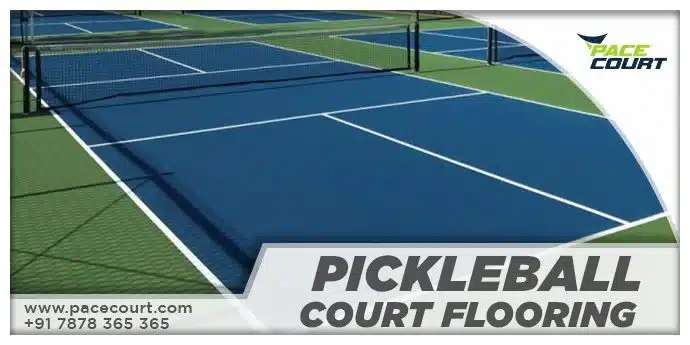
Pickleball – an exciting fast growing game combining tennis, badminton, and ping-pong – is certainly seen in India. With the specialized playing places gaining additional publicity every day. Careful planning while constructing a pickleball court flooring, court size and surface, alongside the design considerations for the Indian weather. Pacecourt provides best acrylic flooring materials to build world-class pickleball courts. To meet international standards of pickleball court dimensions, that are durable and offer top performance to players of every level. The best plan in pickleball court is that, it has a compact court system. And courts are not nearly as large as tennis courts, it is possible within a fit to accommodate more than one pickleball court in tennis facilities. This flexibility has included conversion of unused spaces into lively pickleball centers, thus attaining maximum community utilization and resource allocation. Standard Pickleball Court Dimensions An official pickleball court dimensions is 20 feet wide and 44 feet long. The lines are 2 inches wide. They mark the bounds for the game. You should add space along-the-sides of the court. A 5-foot space is a good reference to add on both sides. For the shorter ends, you should have at least 7 feet. That takes the total area of play to 30 feet wide and 60 feet long. But if you are in for competitive play, a little more space for movement will definitely be a good idea. Then, go for a total area of 34 feet wide by 64 feet long. You will have spent a lot of space in this setup, so that you would be able to enjoy the game, whether enjoying it just for fun or going for that intense competition. Gather your friends and make your way to the courts! PICKLEBALL COURT SURFACES Asphalt An inexpensive and comparatively easy pickleball installation makes asphalt a common choice for outdoor pickleball court dimensions. It provides a stable and hard surface that is important for having a proper bounce for the ball and player movement. Yet, asphalt requires proper maintenance so that issues such as cracking of the surface or wearing down can be rectified, especially in areas with extreme weather. Regular sealing and resurfacing are required for the good performance of the court over time. Concrete Primer The surfaces of concrete primer courts are their durability and low maintenance requirement. A concrete court presents a flat, smooth surface for interfacing, thereby maximizing ball bounce uniformity and improving quality of play. Once set, concrete primer court requires minimal maintenance, which includes cleaning and checking stability for wear. Importantly, these courts must be engineered with proper drainage to avoid water accumulation and further damage. Synthetic Acrylic Flooring Synthetic acrylic flooring is the best outdoor option for a pickleball facility. Because it combines the durable qualities of concrete with a little softness for the good welfare of the players. This type of surface allows all-weather playability while providing a relaxed game that minimizes fatigue and injuries for its players. Pacecourt manufactures high-quality synthetic acrylic flooring for outdoor sports complexes. These are conditioned for higher performance with good traction, consistent ball bounce, and low maintenance. Also, the cushioning quality of the surface adds player comfort by absorbing impact, as typically required during hours of play. Cushion Coat Cushion coats have become the preferred option for pickleball players who want comfort and performance. It reduce this impact not only in stress reduction but also injury prevention, by allowing longevity and enjoy the game. Cushion coat players have stated that it reduced strain on the joints makes more comfortable experience. Make The Right Pickleball flooring Choice Below are considerations to keep in mind while deciding the best surface for building a court for Pickleball: – Budget: Review and evaluate initial installation of pickleball court cost in India , together with maintenance cost that will be incurred through usage. Select the option that will be the most cost-effective for you in the long run. – Climate: Some surfaces are suited to particular weather elements, so consider the normal weather elements of your area. – Time Will You Use It: Courts that will see heavy traffic benefit most from the installation of durable resilient surfaces. – Player Experience: Consider surface qualities like hardness, ball bounce, and comfort to ensure the court gives players what they expect. Pickleball COURT Installation in india Case Study Case Study 1: Building Pickleball Courts to Encourage Community Recreation A community center from a suburban locality increased enthusiasm of the local residents regarding pickleball. And include pickleball courts in the recreational facilities. The center had the available space for the courts: underutilized. And it thought that this could have much more life breathed into it with the building of these courts. Four outdoor pickleball court dimensions are 20 feet wide and 44 feet long each. According to standard pickleball court dimensions suitable for singles as well as doubles play. The surface is designed for maximum traction while keeping the joint impact low to provide comfort while playing at any age. Case Study 2: Redesigning Otherwise Unused Space into Pickleball Facility A privately owned sports club experienced issues concerning having some idle open space awkwardly allocated for tennis but almost never used it. It was then decided to turn the space into purposeful pickleball courts after seeing an increasing number of people interested in pickleball. This included repurposing two existing tennis courts to four pickleball courts by resurfacing and repainting the area while reducing the area into the smaller pickleball court size, a very economical approach that optimally used the existing space to avoid the whole facility being subjected to heavy construction. The new construction of pickleball court was equipped with the best in netting and surface material custom-designed for extreme weather conditions. Conclusion Building pickleball courts comes with a bunch of benefits beyond just giving people a place to play. This fun sport mixes tennis, badminton, and ping-pong. It is really taken off with all sorts of people because it is easy to