What Are the Types of Tennis Courts?
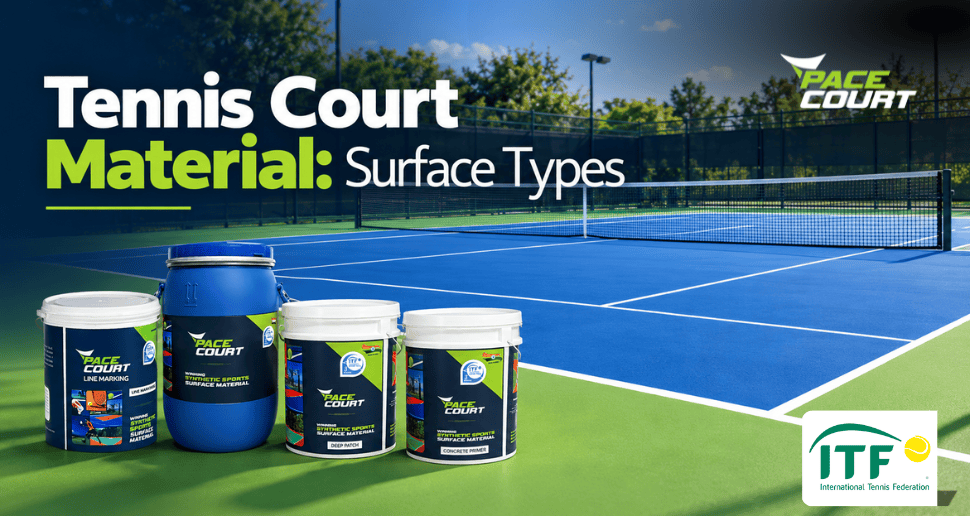
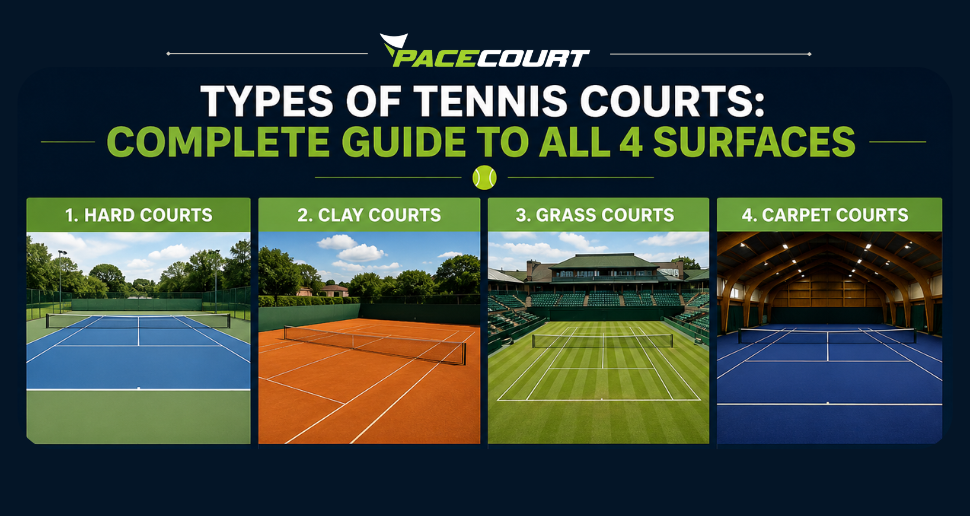
There are four main types of tennis courts: hard courts, clay courts, grass courts, and carpet courts. Each surface plays differently, suits different playing styles, and demands unique maintenance. Whether you play recreationally or competitively, knowing the differences helps you train smarter and perform better.
Tennis Court Surface Information Table
| Surface Type | Speed | Bounce | Maintenance | Best For |
| Hard Court | Medium-Fast | Consistent | Low | All-round players |
| Clay Court | Slow | High & Topspin | High | Baseline players |
| Grass Court | Fast | Low & Skidding | Very High | Serve-and-volley players |
| Carpet Court | Fast | Low | Low–Medium | Indoor play |
1. Hard Courts – The Most Popular Surface Worldwide For Tennis Court Flooring
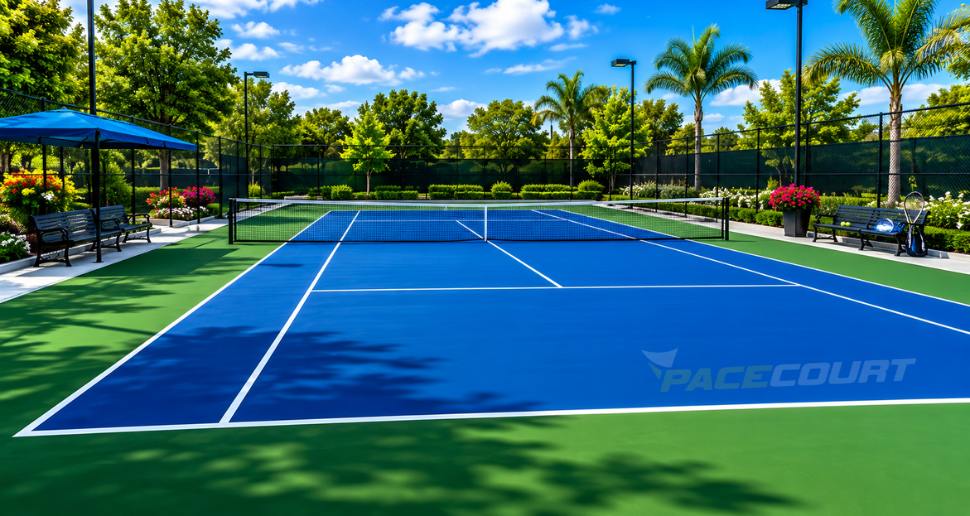
Hard courts are the most widely used tennis surface across the globe and in India. They consist of a rigid base, usually asphalt or concrete, topped with an acrylic coating. Players of all skill levels encounter hard courts most frequently at public parks, clubs, and schools.
The surface offers a predictable and consistent bounce, which makes rallies fair and enjoyable. Hard courts favour all-round players who rely on groundstrokes, footwork, and solid baseline play. The surface sits between clay and grass in terms of speed.
Why Hard Courts Dominate in India
India’s urban tennis infrastructure grew rapidly between 2020 and 2026. Municipal corporations in Delhi, Mumbai, Bengaluru, and Chennai installed hundreds of hard courts in public spaces. The low water requirement and year-round playability make hard courts ideal for India’s diverse climate zones.
Hard courts require minimal maintenance compared to clay or grass. A periodic resurfacing every five to seven years keeps the court in competitive condition. The acrylic layer also reduces joint impact compared to bare concrete.
Hard Court Variants
- DecoTurf – Used at the US Open; medium-fast speed.
- Plexicushion – Used at the Australian Open; slightly cushioned for comfort.
- GreenSet – A popular brand across Indian clubs and academies.
2. Clay Courts – The Classic European Surface
Clay courts use crushed brick, shale, or stone as the playing surface. They produce a slow, high-bouncing game that rewards patience, consistency, and heavy topspin. Roland Garros, home of the French Open, is the world’s most famous clay court venue.
The slow surface allows longer rallies and dramatically reduces the advantage of big servers. Baseliners who construct points methodically thrive on clay. Rafael Nadal’s dominance at Roland Garros across two decades stands as the finest example of a clay-court specialist.
Types of Clay Courts
Red Clay – The most common clay type worldwide. Made from crushed brick. Found across Spain, Italy, France, and increasingly in Indian private clubs. The surface is soft, forgiving on joints, and slides easily.
Green Clay – Known as Har-Tru, green clay is primarily used in the United States. It plays slightly faster than red clay and requires less watering. Some Indian academies import Har-Tru systems for indoor training halls.
Blue Clay – Introduced briefly at the Madrid Open in 2012. Players rejected it due to unpredictable bounce and safety concerns. It is no longer used professionally.
Clay Court Maintenance Requirements
Clay courts demand daily upkeep. Groundskeepers water the surface before each session to prevent cracking and dust. They brush the lines, roll the surface, and add fresh material periodically. This intensive maintenance makes clay courts expensive to operate in India’s hot and dry northern regions.
3. Grass Courts – The Fastest and Most Prestigious Surface
Grass courts are the oldest tennis surfaces and remain the most prestigious. Wimbledon, founded in 1877, hosts the world’s most iconic grass court tournament. The surface consists of natural grass grown on compacted soil. Grass produces a fast, low, and skidding bounce that rewards aggressive serve-and-volley tactics.
The ball stays low after the bounce, giving baseliners less time to set up. Big servers and net-rushing players gain a natural advantage on grass. Pete Sampras, Roger Federer, and Novak Djokovic all won multiple Wimbledon titles by mastering grass court tactics.
Why Grass Courts Are Rare in India
Grass courts are almost entirely absent from Indian tennis infrastructure in 2026. India’s high temperatures, monsoon humidity, and heavy user traffic make grass courts impractical and expensive. Only a handful of elite heritage clubs in Kolkata, Mumbai, and Bengaluru maintain grass courts for ceremonial or legacy purposes.
Growing and maintaining a grass court requires precise irrigation, mowing twice weekly, fertilisation schedules, and recovery periods after heavy use. The cost exceeds clay court maintenance by three to four times in Indian conditions.
4. Carpet Courts – The Indoor All-Rounder
Carpet courts use removable synthetic or textile surfaces laid over a hard indoor floor. They play fast, similar to grass, with a low and skidding bounce. Carpet courts are primarily used in indoor arenas and during colder months in Europe and Asia.
The Association of Tennis Professionals (ATP) removed carpet courts from its official tour calendar after 2009, citing player safety concerns. However, carpet surfaces remain popular for recreational play, club leagues, and training across India’s growing indoor tennis facilities.
Benefits of Carpet Courts for Indian Players
India’s indoor tennis market expanded significantly between 2022 and 2026. Urban academies in Delhi NCR, Pune, and Hyderabad install carpet surfaces inside air-conditioned halls to enable year-round training during monsoon and extreme summer months. Carpet courts are affordable, quick to lay, and easy to replace.
Tennis Court Comparison Table – Detailed Breakdown
| Feature | Hard Court | Clay Court | Grass Court | Carpet Court |
| Ball Speed | Medium–Fast | Slow | Very Fast | Fast |
| Bounce Height | Medium | High | Low | Low |
| Maintenance Cost | Low | High | Very High | Low–Medium |
| Joint Stress | Medium | Low | Medium | Medium |
| Common in India | Very Common | Moderate | Rare | Growing |
| Grand Slam Use | US Open, Aus Open | French Open | Wimbledon | None (removed 2009) |
| Best Player Type | All-round | Baseliner | Serve-volley | All-round |
| Durability | 5–10 years | Seasonal | Annual | 3–5 years |
| Weather Dependence | Low | Medium | High | None (indoor) |
| Player Sliding | No | Yes | Limited | No |
How Surface Type Affects Playing Style
Every surface rewards a different skill set. Players who train exclusively on hard courts develop consistent groundstrokes and quick footwork. Clay court specialists build endurance, heavy topspin, and defensive retrieving skills. Grass court players sharpen serve mechanics, volley reflexes, and low-ball handling.
Coaches at Indian academies increasingly rotate training surfaces to develop well-rounded junior players. The All India Tennis Association (AITA) recommends that players under sixteen train on at least two different surfaces before entering national competitions.
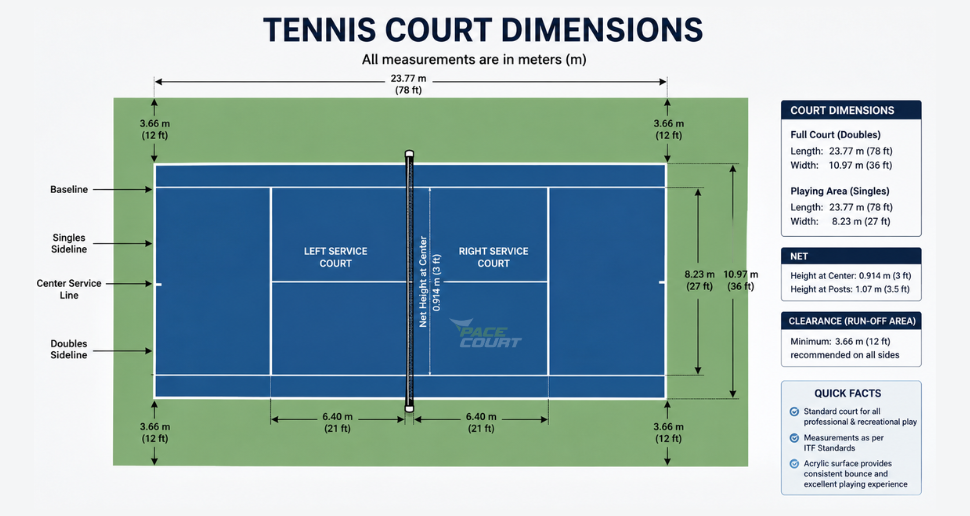
Tennis Court Dimensions – Universal Standard
All four surface types follow the same official court dimensions set by the International Tennis Federation (ITF). Understanding these dimensions helps players, coaches, and facility managers plan courts correctly.
| Measurement | Singles Court | Doubles Court |
| Length | 23.77 metres | 23.77 metres |
| Width | 8.23 metres | 10.97 metres |
| Service Box Length | 6.4 metres | 6.4 metres |
| Net Height (Centre) | 0.914 metres | 0.914 metres |
| Net Height (Posts) | 1.07 metres | 1.07 metres |
Indoor vs Outdoor Tennis Courts in India 2026
India’s tennis infrastructure shifted noticeably toward indoor facilities between 2023 and 2026. Rising temperatures in northern India and unpredictable monsoon patterns pushed clubs and academies to invest in covered courts.
- Outdoor courts remain dominant by volume, with hard courts leading across government sports complexes, residential societies, and public parks.
- Indoor courts now feature in most premium private academies, offering carpet or hard surfaces inside climate-controlled halls.
| Aspect | Outdoor Court | Indoor Court |
| Weather Dependency | High | None |
| Construction Cost | Lower | Higher |
| Maintenance | Moderate | Low |
| Playing Hours | Limited by weather | Year-round, any hour |
| Surfaces Available | Hard, Clay, Grass | Hard, Carpet |
| Common Locations in India | Public parks, clubs | Private academies |
Key Takeaways
- Hard courts are the most practical, affordable, and common surface in India in 2026.
- Clay courts develop superior defensive skills and reduce injury risk over long training periods.
- Grass courts remain rare in India due to extreme maintenance demands and climatic challenges.
- Carpet courts are growing in Indian indoor academies as year-round training solutions.
- Every surface rewards a different playing style, so well-rounded players benefit from training on multiple surfaces.
- ITF court dimensions remain identical across all surface types.
- Choosing the right surface depends on budget, climate, player level, and training goals.
Final Word
Understanding the types of tennis courts gives every player, coach, and facility manager a decisive advantage. Hard courts dominate Indian tennis in 2026, but clay courts continue building elite baseliners and reducing injury risk. Grass remains a prestige surface with global significance despite its absence from Indian infrastructure. Carpet surfaces quietly fill the gap for indoor training programmes nationwide.
Whether you are building a new facility, selecting a training venue, or simply trying to understand why your game changes between tournaments, surface knowledge is essential tennis intelligence.
Frequently Asked Questions
Hard courts, especially pure asphalt without cushioning, place the most stress on knees and ankles.
No – clay court shoes have herringbone soles for sliding, while hard court shoes need extra cushioning and durability.
A standard hard court takes three to six weeks to construct, while a clay court takes six to ten weeks including curing time.
Hard courts produce the highest rate of chronic joint injuries, while clay courts are the most forgiving over long training periods.
Upgrade Your Sports Court Today
Get premium synthetic acrylic flooring designed for durability, grip, and performance.
Get Free ConsultationMost Indian academies use hard courts for their durability, low maintenance, and similarity to international tournament conditions.
Hard courts are better for Indian conditions because they withstand heat, require less water, and stay playable during dry spells.
Stay Updated with Pacecourt
Discover expert insights, practical tips, and the latest industry updates from Pacecourt, covering sports flooring, tennis and multi-sport court construction, resurfacing, maintenance, court performance, and innovative sports infrastructure solutions.
Powered by Google's Preferred Sources feature