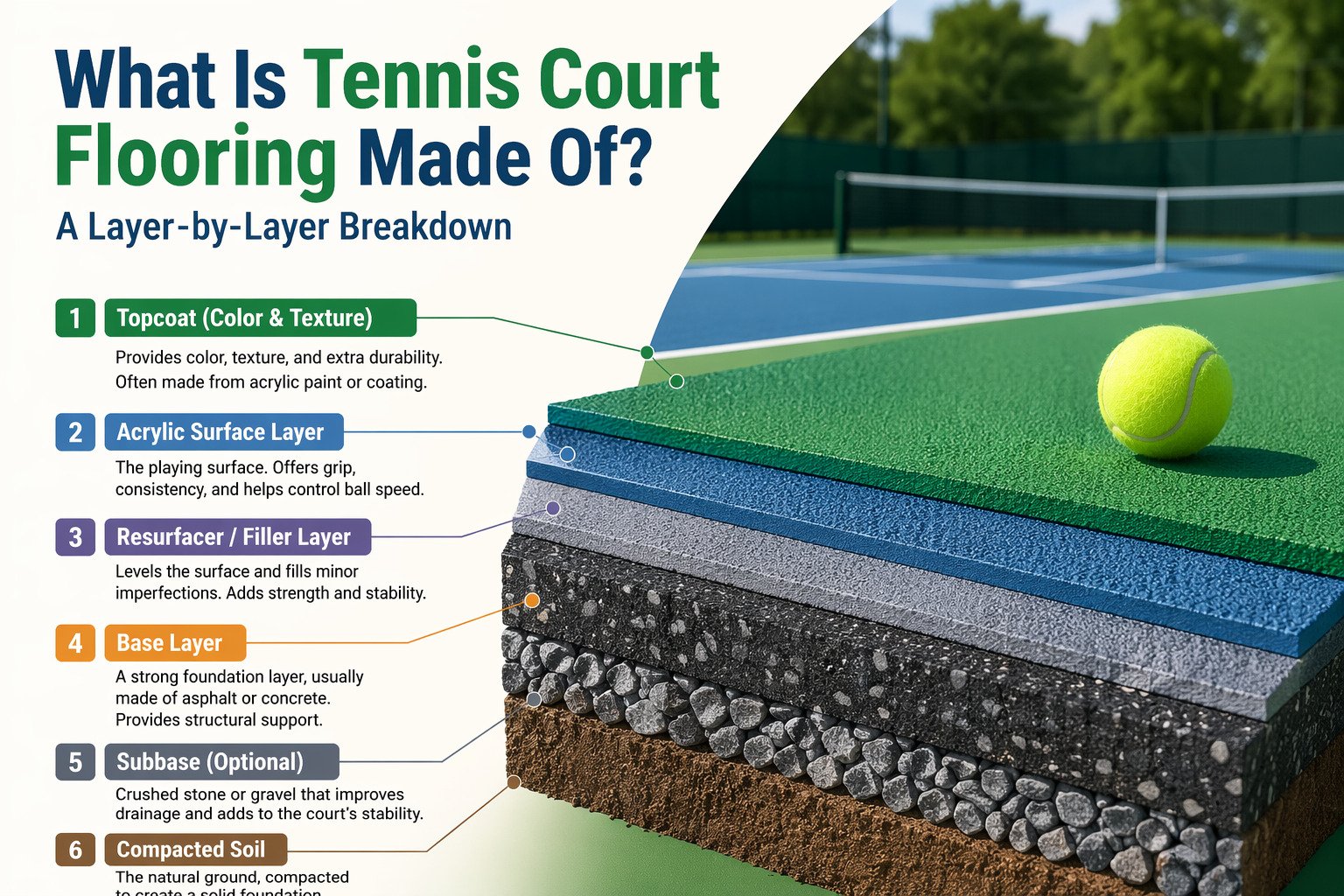
When you step onto a tennis court, it’s easy to focus on the net, the lines, or even the racket in your hand. But what’s beneath your feet is doing far more work than you might imagine. Tennis court flooring isn’t just a flat surface—it’s a carefully engineered system designed to balance performance, durability, and player safety. Think of it like a layered cake, where each tier serves a unique purpose, and removing even one layer would completely change the experience.
Table of contents
The type and quality of flooring directly influence how the ball bounces, how players move, and even how injuries occur. For example, a court with poor shock absorption can put excessive strain on joints, leading to long-term issues for players. On the other hand, a well-constructed surface enhances gameplay, offering consistent bounce and reliable traction. According to sports surface experts, nearly 70% of player performance variability on different courts can be attributed to surface characteristics alone.
What makes tennis court flooring fascinating is how it blends engineering with sport science. Each layer—from the deep subgrade to the colorful topcoat—is designed with precision. These layers collectively manage water drainage, structural stability, and even temperature fluctuations. Without this layered approach, courts would crack, flood, or wear out quickly.
So, when someone asks what tennis court flooring is made of, the real answer isn’t a single material—it’s a system. A system built with intention, where every layer contributes to the overall playing experience. And once you understand this structure, you’ll never look at a tennis court the same way again.
Overview of Tennis Court Surface Types
Hard Courts vs Clay vs Grass vs Synthetic
Before diving into the layers themselves, it’s important to understand that not all tennis courts are built the same way. The materials used—and how those layers are arranged—depend heavily on the type of surface being created. Each surface has its own personality, almost like different terrains in nature, shaping how the game unfolds.
Hard courts are the most common, especially in urban and professional settings. These are typically made using asphalt or concrete bases topped with acrylic coatings. They offer a consistent bounce and are relatively low maintenance, which explains why tournaments like the US Open favor them. Clay courts, on the other hand, are slower and more forgiving. Built with crushed stone and topped with brick dust, they create higher ball bounce and longer rallies. It’s no coincidence that clay specialists often dominate on these surfaces.
Grass courts are the oldest and arguably the most prestigious. Wimbledon is the crown jewel of grass court tennis, where the surface is made from natural grass grown over compacted soil. These courts are fast, with low and unpredictable bounces, demanding quick reflexes and adaptability.
Then there are synthetic courts, which blend elements of different surfaces using artificial materials. These are increasingly popular due to their versatility and lower maintenance requirements. Some even mimic clay or grass characteristics without the associated upkeep.
Here’s a quick comparison:
| Surface Type | Main Materials | Speed | Maintenance |
|---|---|---|---|
| Hard Court | Asphalt, Acrylic | Medium-Fast | Low |
| Clay Court | Crushed Stone, Brick Dust | Slow | High |
| Grass Court | Natural Grass, Soil | Fast | Very High |
| Synthetic | Artificial Turf, Polymer | Variable | Medium |
Understanding these differences is crucial because each surface type uses a slightly different layering system. Still, the core principle remains the same: multiple layers working together to create a playable, durable court.
The Multi-Layer Structure of a Tennis Court
Why Tennis Courts Are Built in Layers
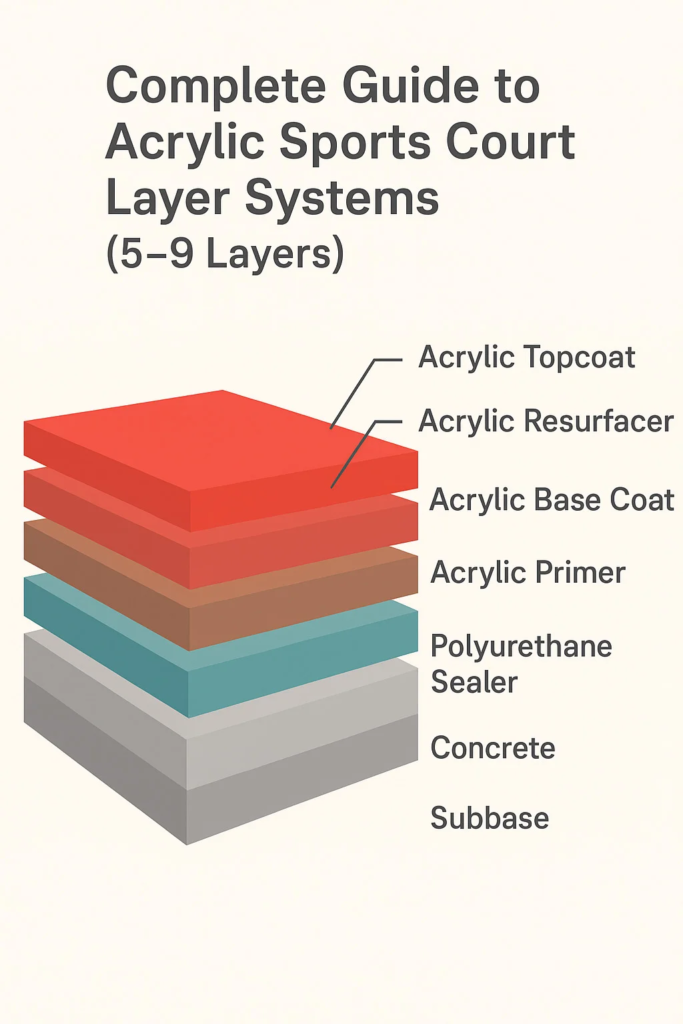
At first glance, a tennis court might seem like a single slab of material, but in reality, it’s more like a high-performance sandwich. Each layer has a distinct role, and removing or poorly constructing one can compromise the entire structure. This layered approach is what allows courts to withstand years of play, weather exposure, and structural stress.
The idea behind layering is simple but powerful: distribute responsibilities. Instead of relying on one material to handle everything—like strength, flexibility, and drainage—engineers assign each function to a specific layer. For example, the bottom layers focus on stability and drainage, while the upper layers prioritize comfort and playability. This division of labor ensures that the court performs consistently over time.
Another reason for layering is environmental adaptation. Tennis courts are exposed to extreme conditions—rain, heat, cold, and even ground movement. Without a proper layering system, these factors would quickly lead to cracks, water pooling, or uneven surfaces. A well-designed court can last 15 to 25 years, largely because of its layered construction.
There’s also a safety component. Modern courts often include cushioning layers that reduce impact stress on players’ joints. This is especially important in professional settings where athletes train for hours daily. According to sports medicine studies, cushioned courts can reduce joint impact by up to 30%, significantly lowering injury risks.
In essence, the layered structure transforms a simple playing surface into a sophisticated system. It’s not just about building a court—it’s about engineering an experience. And once you start peeling back those layers, you’ll see just how much thought goes into every inch beneath your feet.
Subgrade Layer – The Foundation Beneath It All
Materials Used in Subgrade Construction
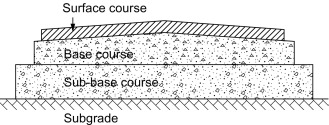
If a tennis court were a building, the subgrade layer would be its bedrock—the unseen but absolutely essential base that determines everything built above it. This is the natural soil or prepared ground on which the entire court rests. It might not look glamorous, but without a properly constructed subgrade, even the most expensive surface materials will fail sooner than expected.
The process begins with excavation and grading. Contractors remove unsuitable soil, debris, and organic matter to create a stable, uniform base. Then comes compaction, which is critical. The soil is compressed using heavy machinery to eliminate air pockets and prevent future shifting. A poorly compacted subgrade can lead to uneven surfaces, cracks, and even structural collapse over time. Experts often emphasize that up to 50% of a court’s longevity depends on proper subgrade preparation, which highlights just how crucial this layer is.
Materials used in subgrade construction vary depending on location and soil conditions. In many cases, existing soil is treated and stabilized using lime or cement to improve its load-bearing capacity. In areas with weak or expansive soils, additional materials like geotextile fabrics may be introduced. These fabrics act as a separator and stabilizer, preventing the mixing of soil with upper layers while improving drainage.
Drainage also starts at this level. A slight slope—typically around 1%—is built into the subgrade to allow water to flow away naturally. Without this, water can accumulate beneath the court, leading to erosion and structural damage. Think of it like laying the foundation for a house in a flood zone without proper drainage—it’s a disaster waiting to happen.
So while players never see the subgrade, it silently supports every serve, sprint, and rally. It’s the quiet hero of tennis court construction, ensuring everything above it performs exactly as intended.
Base Layer – Stability and Drainage
Crushed Stone and Asphalt Base Explained
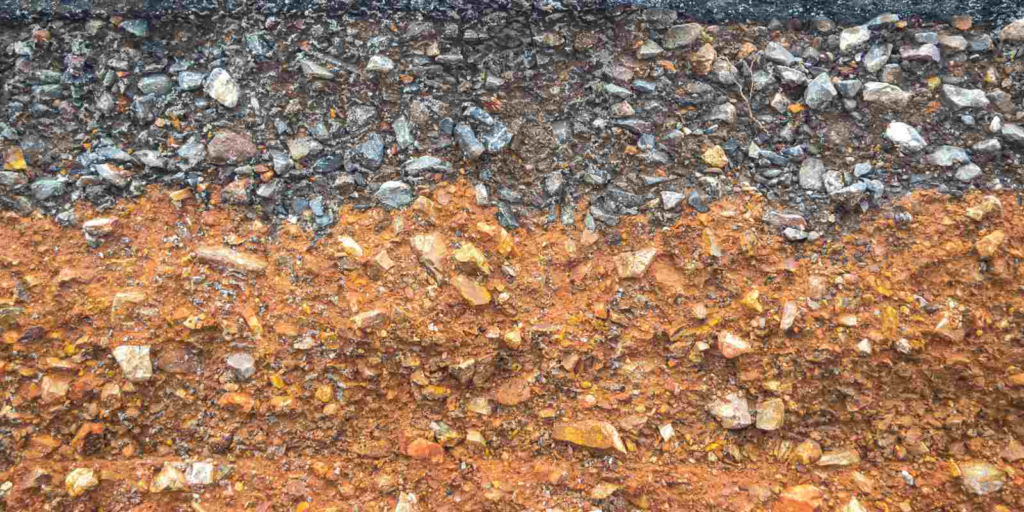
Sitting directly above the subgrade is the base layer, and this is where the court starts to take on real strength and durability. If the subgrade is the foundation, the base layer is the structural platform that distributes loads and provides essential drainage. It’s designed to handle the weight of players, equipment, and even maintenance vehicles without shifting or degrading.
The most common material used here is crushed stone, often referred to as aggregate. This isn’t just any pile of rocks—it’s carefully graded material with a mix of particle sizes. The smaller particles fill the gaps between larger ones, creating a dense yet permeable layer. This structure allows water to pass through while maintaining stability, which is critical for outdoor courts exposed to rain.
In some constructions, especially hard courts, an asphalt base is added on top of the crushed stone. This layer provides a smoother, more uniform surface for the upper layers. Asphalt is preferred because it offers a balance between flexibility and strength, allowing the court to expand and contract with temperature changes without cracking excessively.
Here’s a quick breakdown of typical base layer components:
| Component | Function |
|---|---|
| Crushed Stone | Drainage and load distribution |
| Fine Aggregate | Compaction and surface leveling |
| Asphalt Layer | Smooth, stable platform |
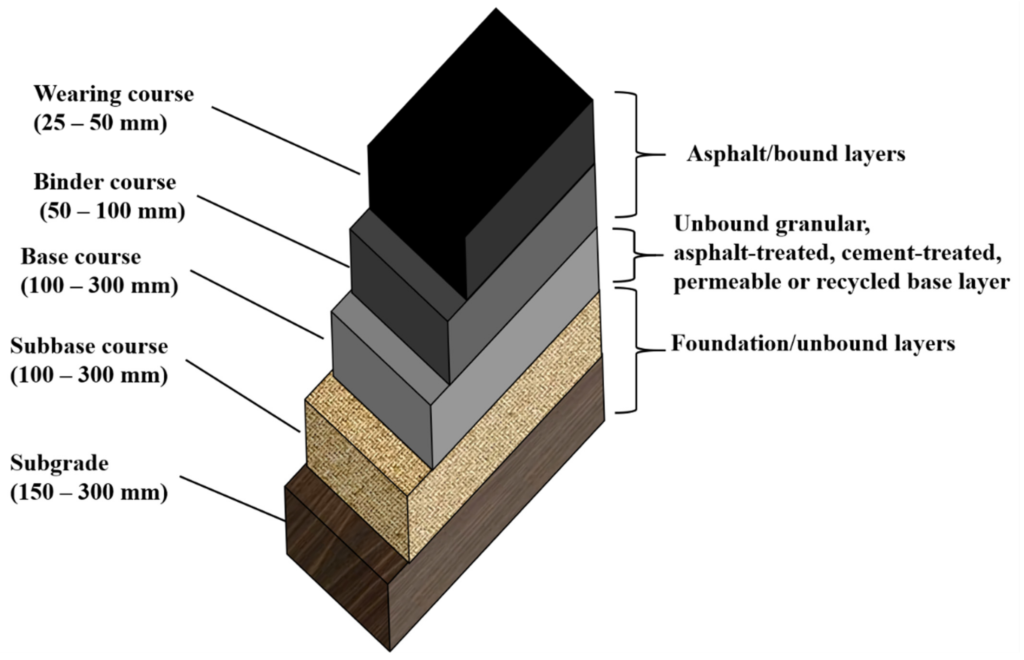
The thickness of this layer can vary, but it’s usually between 4 to 8 inches, depending on the court type and local conditions. In regions with heavy rainfall, thicker base layers are often used to improve drainage capacity.
What makes this layer fascinating is how it balances two opposing needs: strength and permeability. It has to be solid enough to support the court but porous enough to let water escape. That’s not an easy combination to achieve, which is why material selection and installation are so critical.
In many ways, the base layer is like the skeleton of the court. You don’t see it, but it holds everything together, ensuring that the surface above remains smooth, stable, and ready for play.
Binder Layer – The Structural Backbone
Role of Asphalt or Concrete Binder
Now we move into the layer that truly locks everything into place—the binder layer. This is where the court begins to resemble the solid surface most people associate with tennis courts. Typically made from asphalt or concrete, the binder layer acts as a bridge between the base and the playable surface.
Upgrade Your Sports Court Today
Get premium synthetic acrylic flooring designed for durability, grip, and performance.
Get Free ConsultationThink of this layer as the glue that holds the system together. It provides structural integrity, ensuring that the layers above remain stable and uniform. Without a proper binder layer, the surface could shift, crack, or develop inconsistencies that affect gameplay.
Asphalt is the most commonly used material for this layer, especially in hard courts. It’s flexible, cost-effective, and relatively easy to install. Concrete, on the other hand, is more rigid and durable but also more expensive and prone to cracking if not properly managed. Each material has its pros and cons, and the choice often depends on budget, climate, and intended use.
Here’s a comparison:
| Material | Advantages | Disadvantages |
|---|---|---|
| Asphalt | Flexible, cost-effective | Requires maintenance |
| Concrete | Durable, long-lasting | Less flexible, higher cost |
The binder layer is usually applied in one or two coats, with a total thickness of around 2 to 3 inches. It must be perfectly leveled and cured before any additional layers are added. Even minor imperfections at this stage can translate into noticeable issues on the surface.
Temperature plays a big role here as well. Asphalt expands and contracts with heat, which can lead to cracks over time. That’s why expansion joints or flexible coatings are often used in conjunction with this layer to accommodate movement.
What’s interesting is how this layer directly impacts the feel of the court. A well-constructed binder layer provides a consistent, predictable bounce, which is crucial for competitive play. It’s the difference between a court that feels “right” and one that feels slightly off.
Cushion Layer – Comfort and Shock Absorption
Acrylic Cushion Systems and Their Benefits
This is where things start to feel noticeably different underfoot. The cushion layer is designed with player comfort in mind, acting like a shock absorber that reduces the impact on joints and muscles. If you’ve ever played on a court that felt softer or more forgiving, you were likely experiencing a well-designed cushion system.
Cushion layers are typically made from acrylic rubber compounds mixed with fine granules. These materials are applied in multiple coats, building up a flexible, resilient layer that sits between the hard binder and the surface coating. The number of layers can vary, but high-performance courts may have up to 5 or more cushion coats.
Why does this matter? Because tennis is a high-impact sport. Players are constantly running, stopping, and changing direction. Without proper cushioning, this repetitive stress can lead to injuries like shin splints, knee pain, and even stress fractures. Studies suggest that cushioned courts can reduce impact forces by 20–30%, making them a popular choice for both professional and recreational facilities.
Another benefit is improved playability. The cushion layer slightly slows down the ball and provides a more controlled bounce. This can make rallies longer and gameplay more enjoyable, especially for beginners.
What’s fascinating is how customizable this layer is. Court designers can adjust the thickness and composition to achieve specific performance characteristics. Want a faster court? Use fewer cushion layers. Prefer a softer feel? Add more.
In many ways, the cushion layer is the “comfort zone” of the tennis court. It’s where engineering meets human experience, ensuring that the game is not only playable but enjoyable and safe.
Surface Layer – The Playing Finish
Acrylic Coatings and Texture Creation
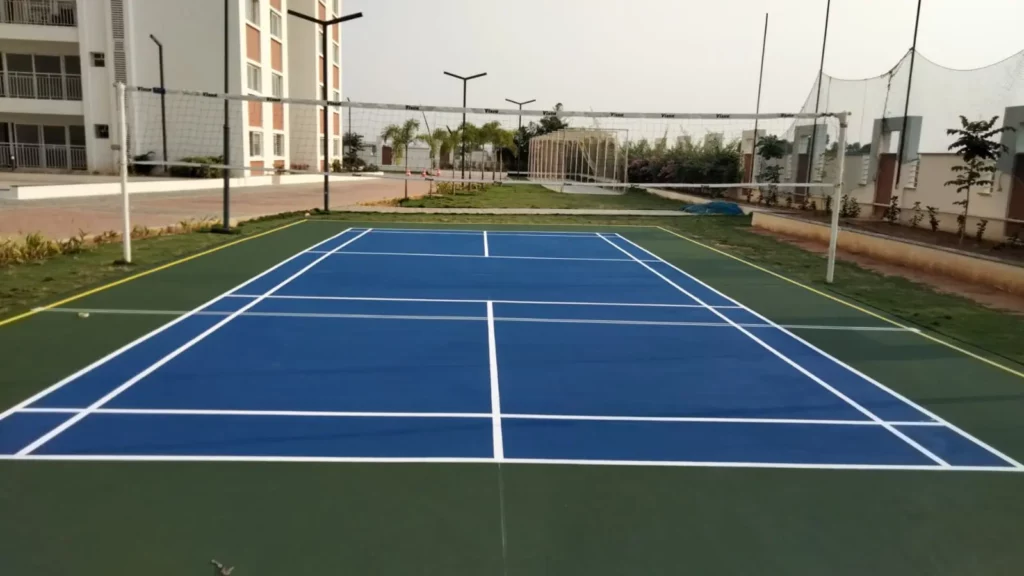
Finally, we arrive at the layer everyone recognizes—the surface layer. This is the visible, colorful coating that defines the court’s appearance and directly influences how the game is played. But it’s more than just paint; it’s a carefully engineered mix of materials designed to deliver the perfect balance of grip, speed, and durability.
The surface layer is typically made from acrylic coatings combined with silica sand. The sand is key here—it creates texture, which affects traction and ball behavior. More sand means more grip and slower play, while less sand results in a faster, slicker surface.
This layer is applied in multiple coats, each serving a specific purpose. The base coats provide coverage and durability, while the top coats fine-tune the texture and color. The entire process requires precision, as even small inconsistencies can affect gameplay.
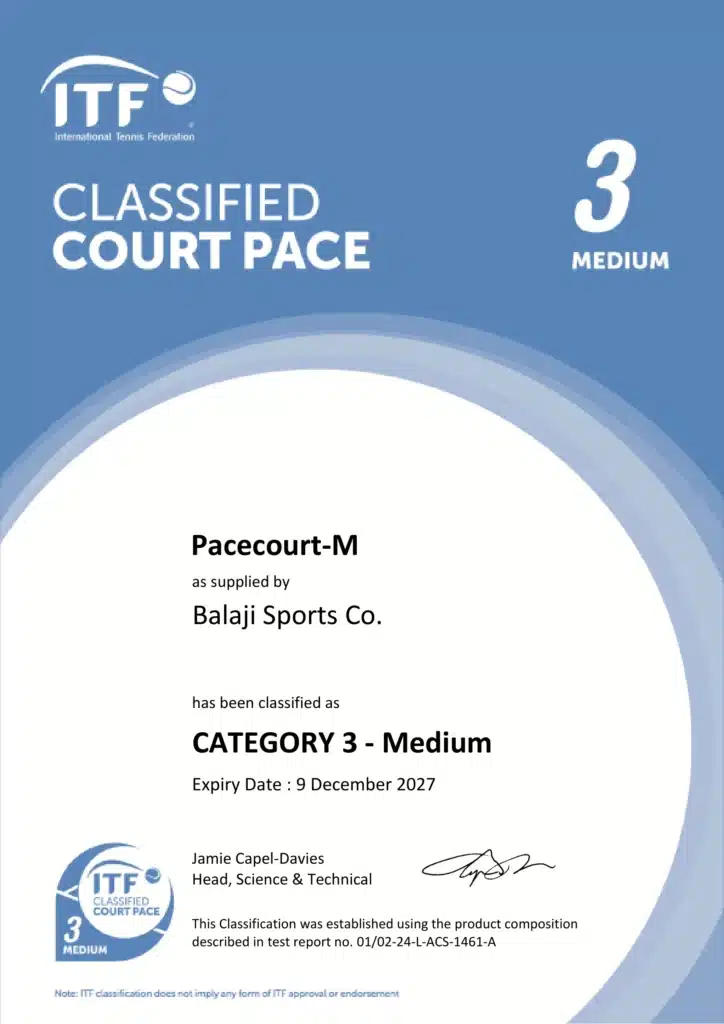
One of the standout features of acrylic surfaces is their versatility. They can be customized to meet different standards, from recreational courts to professional tournament surfaces. Organizations like the ITF (International Tennis Federation) classify courts based on their speed, and much of that classification depends on the surface layer.
Durability is another major factor. High-quality acrylic coatings can last 5 to 10 years with proper maintenance, resisting wear from foot traffic, weather, and UV exposure. They’re also relatively easy to repair, which adds to their popularity.
In essence, the surface layer is where all the underlying work comes together. It’s the final touch that transforms a complex, multi-layered structure into a functional, high-performance tennis court.
Color Coating and Line Marking
UV Protection and Aesthetic Finishing
Once the structural and performance layers are complete, the tennis court gets its visual identity through color coatings and line markings. At first glance, this might seem purely cosmetic—after all, the bright blues, greens, or reds are what catch your eye. But beneath that visual appeal lies a layer that plays a surprisingly functional role in protecting the court and enhancing gameplay.
Color coatings are typically made from pigmented acrylic materials, similar to the surface layer but with added UV-resistant properties. These coatings act like sunscreen for the court, shielding underlying layers from sun damage, oxidation, and fading. Without this protection, constant exposure to sunlight could degrade the materials, leading to cracks and reduced lifespan. In regions with intense sunlight, UV-resistant coatings can extend a court’s life by several years.
Line markings are applied using specialized textured paint to ensure visibility and durability. These lines aren’t just painted on randomly—they’re measured with precision down to millimeters, following strict guidelines set by organizations like the ITF. The paint used must balance two competing needs: it has to be smooth enough not to disrupt ball bounce, yet textured enough to prevent players from slipping.
Interestingly, the choice of color can also influence gameplay. Darker colors tend to absorb more heat, which can slightly affect ball speed and player comfort. That’s why many modern courts use a combination of lighter outer areas and darker inner playing zones. It’s not just about aesthetics—it’s about performance optimization.
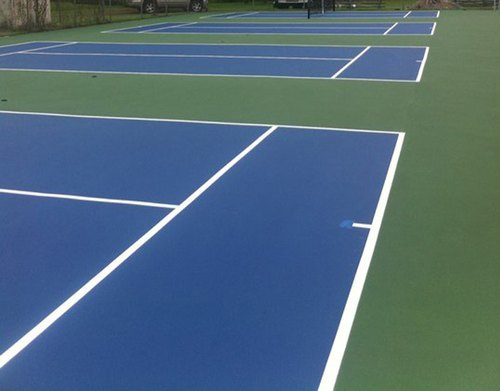
From a psychological perspective, color contrast improves player focus and ball visibility. Ever wondered why so many courts use blue? Studies have shown that blue provides excellent contrast against the yellow tennis ball, making it easier for players to track shots.
So while this layer might look like the finishing touch, it’s actually doing double duty—protecting the court while subtly enhancing the playing experience.
Specialized Layers in Clay Courts
Brick Dust and Crushed Stone Composition
Clay courts are a completely different beast compared to hard courts. Instead of relying heavily on asphalt and acrylic, they use a layered system built around natural materials like crushed stone and brick dust. This gives clay courts their signature slow speed and high bounce, making rallies longer and more strategic.
The base structure still begins with a compacted subgrade and a crushed stone foundation, but the upper layers are where things diverge. On top of the base, multiple layers of finely crushed stone are added, each with decreasing particle size. This creates a stable yet slightly loose surface that allows for sliding—a hallmark of clay court play.
The topmost layer is made of brick dust, which is essentially finely ground red clay or shale. This material is spread evenly across the surface and regularly watered to maintain the right level of moisture. Too dry, and the court becomes dusty and uneven. Too wet, and it turns slippery and भारी. Maintaining this balance is both an art and a science.
Here’s a simplified breakdown:
| Layer | Material | Purpose |
|---|---|---|
| Top Layer | Brick Dust | Playability and bounce |
| Middle Layers | Crushed Stone | Stability and drainage |
| Base Layer | Coarse Aggregate | Structural support |
One fascinating aspect of clay courts is how dynamic they are. Unlike hard courts, which remain relatively static, clay surfaces constantly evolve with use and weather. Groundskeepers must regularly roll, water, and replenish the surface to keep it in optimal condition.
From a player’s perspective, clay courts are easier on the body due to their softer surface. However, they demand a different skill set, emphasizing endurance and strategy over raw power.
Grass Court Layer Composition
Soil, Drainage, and Turf Systems
Grass courts are the oldest form of tennis surface, and they carry a certain elegance that’s hard to replicate. But beneath that lush green appearance lies a highly engineered system designed to keep natural grass playable under intense conditions.
The foundation starts with a well-prepared subgrade, similar to other courts, but with a stronger emphasis on drainage. A network of perforated pipes and gravel layers is often installed to quickly remove excess water. This is crucial because grass courts can become unplayable if water accumulates.
Above this sits a carefully engineered soil layer, typically a mix of sand, silt, and organic matter. This mixture is designed to support healthy grass growth while maintaining firmness. Too much organic material, and the surface becomes soft and uneven. Too little, and the grass struggles to grow.
The top layer is, of course, natural grass, usually perennial ryegrass due to its durability and quick recovery. Maintaining this layer is incredibly labor-intensive. Groundskeepers mow the grass to precise heights—often as low as 8 millimeters—and constantly monitor moisture levels, nutrients, and wear patterns.
What makes grass courts unique is their responsiveness to environmental conditions. Temperature, humidity, and even time of day can influence how the court plays. Early in a tournament, the grass is thicker, resulting in slightly slower play. As the event progresses and the grass wears down, the court becomes faster and more unpredictable.
From a construction standpoint, grass courts are among the most complex and expensive to maintain. But for many players and fans, the experience they offer is unmatched—a blend of tradition, speed, and natural beauty.Synthetic and Artificial Turf Courts
Materials Used in Modern Synthetic Courts
Synthetic courts are like the hybrids of the tennis world, combining elements of different surfaces into a single, versatile system. They’re designed to mimic the characteristics of clay or grass while offering the durability and low maintenance of hard courts.
The foundation is usually similar to that of a hard court, with a compacted subgrade and a stable base layer. On top of this, a synthetic carpet or turf is installed. This carpet is often made from polypropylene or polyethylene fibers, which are both durable and weather-resistant.
To replicate the feel of natural surfaces, the turf is filled with materials like sand or rubber granules. These infill materials play a crucial role in determining how the court behaves. For example, sand-filled turf can mimic the sliding characteristics of clay, while rubber infill provides additional cushioning.
One of the biggest advantages of synthetic courts is their adaptability. They can be installed indoors or outdoors and require significantly less maintenance than natural surfaces. There’s no need for watering, mowing, or frequent resurfacing, which makes them a cost-effective option for many facilities.
Performance-wise, synthetic courts offer a middle ground. They’re generally slower than hard courts but faster than clay, making them suitable for a wide range of playing styles. They also provide good shock absorption, reducing the risk of injury.
In recent years, advancements in materials technology have made synthetic courts more realistic than ever. Some high-end systems can closely replicate the look and feel of natural grass or clay, blurring the line between artificial and natural surfaces.
Indoor Tennis Court Flooring Layers
Differences from Outdoor Court Construction
Indoor tennis courts might look similar to outdoor ones at first glance, but their construction has some key differences. Without exposure to weather, these courts don’t need the same level of drainage or UV protection. However, they must meet other challenges, such as temperature control, lighting, and consistent performance.
The base structure is often simpler. Since there’s no rain to worry about, the drainage layers can be reduced or even eliminated. Instead, the focus shifts to creating a perfectly level and stable surface. Concrete is commonly used as the primary base material because of its durability and low maintenance.
On top of the base, cushion and surface layers are applied, much like in outdoor courts. However, indoor courts often feature enhanced cushioning systems to improve player comfort during extended play. This is particularly important in training facilities where athletes spend hours practicing.
Another difference is the type of surface coating. Indoor courts may use specialized acrylic or polyurethane coatings designed to perform well under artificial lighting. These coatings reduce glare and improve ball visibility, ensuring a consistent playing experience.
Climate control also plays a role. Indoor environments are kept at stable temperatures, which means materials don’t expand and contract as much as they do outdoors. This reduces the risk of cracks and extends the lifespan of the court.
In many ways, indoor courts are about precision and consistency. Without the variables introduced by weather, they offer a controlled environment where players can focus purely on their game.
Drainage Systems in Tennis Court Flooring
Preventing Water Damage and Erosion
Water might seem harmless at first glance, but when it comes to tennis court flooring, it’s one of the biggest threats to structural integrity. Without a proper drainage system, even the most well-built court can deteriorate rapidly. Think about it—water seeps into tiny cracks, freezes, expands, and suddenly you’re dealing with surface damage that spreads like a chain reaction.
Drainage starts at the very bottom with the subgrade, where a slight slope is engineered to guide water away naturally. But that’s just the beginning. Modern tennis courts often incorporate multi-layer drainage strategies, including permeable base layers, drainage channels, and sometimes even underground piping systems. These components work together to ensure that water never lingers long enough to cause damage.
In outdoor courts, especially in regions with heavy rainfall, French drains or perforated pipes are installed along the perimeter. These systems collect excess water and redirect it away from the court. Meanwhile, the crushed stone base layer acts like a sponge, allowing water to pass through while maintaining structural stability.
Here’s a quick overview of common drainage elements:
| Drainage Component | Function |
|---|---|
| Sloped Subgrade | Directs water flow |
| Crushed Stone Base | Allows water infiltration |
| Perimeter Drains | Removes excess water |
| Surface Coatings | Prevent water penetration |
Poor drainage doesn’t just affect the court—it impacts gameplay too. Puddles can make the surface slippery, uneven moisture can alter ball bounce, and long-term exposure can weaken layers. In fact, industry data suggests that over 60% of tennis court failures are linked to inadequate drainage systems.
What’s fascinating is how invisible this system is. Players rarely think about where the water goes after a rainstorm, yet it’s this hidden network that keeps the court playable and safe. It’s like a silent guardian, constantly working behind the scenes to preserve the integrity of every layer.
Environmental Considerations in Materials
Eco-Friendly Court Construction Trends
As sustainability becomes a global priority, tennis court construction is evolving to reflect more eco-conscious practices. The materials used in flooring systems are no longer chosen solely for performance and durability—they’re also evaluated based on their environmental impact.
One of the biggest shifts is the use of recycled materials. For example, some cushion layers now incorporate recycled rubber from old tires, reducing waste while maintaining excellent shock absorption. Similarly, reclaimed asphalt is being used in base and binder layers, lowering the demand for new raw materials.
Water management is another key focus. Traditional courts can consume significant amounts of water, especially clay and grass surfaces. To address this, modern designs integrate water-efficient drainage and irrigation systems, ensuring minimal waste. Permeable surfaces are also gaining popularity, allowing rainwater to naturally filter into the ground rather than running off into drainage systems.
Low-VOC (volatile organic compound) coatings are becoming standard as well. These environmentally friendly acrylic coatings reduce harmful emissions during installation and throughout the court’s lifespan. This is particularly important for indoor courts, where air quality can directly affect players.
There’s also a growing interest in solar-reflective coatings, which reduce heat absorption and help maintain cooler surface temperatures. This not only improves player comfort but also contributes to energy efficiency in surrounding areas.
The push toward sustainability isn’t just a trend—it’s becoming an expectation. Facilities that adopt eco-friendly practices often benefit from lower long-term costs and increased community support. It’s a win-win situation where performance meets responsibility.
Maintenance Impact on Flooring Layers
No matter how well a tennis court is constructed, time and usage will inevitably take their toll. Each layer, from the subgrade to the surface coating, experiences wear in different ways. Understanding how these layers degrade can help extend the life of the court and maintain optimal playing conditions.
The surface layer is the most exposed and therefore the first to show signs of wear. Foot traffic, weather, and UV exposure gradually break down the acrylic coatings, leading to fading, cracks, and reduced traction. This is why resurfacing is typically required every 4 to 8 years, depending on usage.
Beneath that, the cushion layer can lose its elasticity over time. Repeated impact compresses the նյութ, reducing its ability to absorb shock. Players might not notice it immediately, but over time, the court feels harder and less forgiving.
The binder and base layers are more durable but not immune to damage. Cracks in the surface can allow water to seep down, weakening these layers and causing structural issues. Freeze-thaw cycles are particularly damaging, as expanding ice can widen cracks and disrupt the integrity of the court.
Even the subgrade can shift due to soil movement or erosion, leading to uneven surfaces. This is why regular inspections and maintenance are crucial. Small issues, if left unaddressed, can escalate into costly repairs.
Maintenance isn’t just about fixing problems—it’s about prevention. Cleaning, crack sealing, and timely resurfacing can significantly extend the lifespan of a court. Think of it like maintaining a car; regular upkeep keeps everything running smoothly and prevents major breakdowns.
Cost Breakdown of Tennis Court Layers
Building a tennis court isn’t just a construction project—it’s an investment. And like any investment, understanding where your money goes is essential. Each layer contributes to the overall cost, and cutting corners in one area can lead to higher expenses down the line.
The subgrade preparation is often one of the most variable costs, depending on soil conditions and site requirements. Excavation, grading, and compaction can range widely, especially if additional stabilization materials are needed.
The base and binder layers typically account for a significant portion of the budget. Materials like crushed stone, asphalt, and concrete are not cheap, and their installation requires skilled labor. However, these layers are critical for durability, so this is not the place to compromise.
The cushion and surface layers add another layer of cost, particularly if high-performance materials are used. Premium acrylic systems with multiple cushion coats can significantly increase the price but also enhance player comfort and reduce injury risk.
Here’s a simplified cost breakdown:
| Layer | Estimated Cost Share |
|---|---|
| Subgrade | 10–20% |
| Base Layer | 20–30% |
| Binder Layer | 15–25% |
| Cushion Layer | 10–20% |
| Surface & Coatings | 15–25% |
Additional costs include fencing, lighting, and drainage systems, which can sometimes exceed the cost of the court itself.
What’s important to remember is that a cheaper upfront cost often leads to higher maintenance expenses. Investing in quality materials and proper construction can save money in the long run, making the court more durable and reliable.
Choosing the Right Flooring System
Not all tennis courts are created equal, and choosing the right flooring system depends on several factors. It’s a bit like choosing the right pair of shoes—you wouldn’t wear running shoes to hike a mountain, right? The same logic applies here.
Climate is one of the most important considerations. In areas with heavy rainfall, courts with strong drainage systems and durable surfaces like hard courts are ideal. In hotter climates, lighter-colored coatings and heat-resistant materials can improve comfort.
Usage frequency also matters. A recreational court used occasionally will have different requirements than a professional facility with daily play. High-traffic courts benefit from durable surfaces and enhanced cushioning systems to withstand constant use.
Player preference is another factor. Some players prefer the fast pace of hard courts, while others enjoy the रणनीतिक gameplay of clay. Synthetic surfaces offer a compromise, providing versatility and lower maintenance.
Budget, of course, plays a role too. While it might be tempting to go for the cheapest option, it’s important to consider long-term costs. A well-built court with quality materials will last longer and require less maintenance.
Ultimately, the best flooring system is one that balances performance, durability, and cost while meeting the specific needs of its users.
Future Innovations in Tennis Court Flooring
The world of tennis court flooring is evolving, and the future looks surprisingly high-tech. Innovations in materials science and technology are paving the way for courts that are not only more durable but also smarter and more responsive.
One of the most exciting developments is the concept of smart courts. These surfaces integrate sensors that can track ball movement, player position, and even impact forces. This data can be used for performance analysis, coaching, and even injury prevention.
Advanced materials are also making their way into court construction. Polymer-based coatings with enhanced durability and flexibility are replacing traditional materials, offering longer lifespans and better performance. Some systems even adapt to temperature changes, reducing the risk of cracks.
Sustainability continues to drive innovation as well. Researchers are exploring biodegradable materials and more efficient recycling methods to reduce environmental impact. Solar-integrated courts, which generate energy while being used, are also being tested in some regions.
Another emerging trend is modular court systems, which allow for quicker installation and easier repairs. These systems use interlocking panels that can be replaced individually, reducing downtime and maintenance costs.
The future of tennis court flooring isn’t just about playing the game—it’s about enhancing the entire experience. From smarter surfaces to greener materials, the next generation of courts is set to redefine what’s possible.
Conclusion
Tennis court flooring is far more complex than it appears. What looks like a simple playing surface is actually a carefully engineered system of layers, each designed to serve a specific purpose. From the compacted subgrade to the textured acrylic finish, every component plays a role in delivering performance, durability, and safety.
Understanding these layers not only gives you a deeper appreciation for the game but also helps in making informed decisions—whether you’re building a court, maintaining one, or simply curious about what lies beneath your feet. It’s a blend of science, engineering, and sport, all coming together to create the perfect playing environment.
Stay Updated with Pacecourt
Discover expert insights, practical tips, and the latest industry updates from Pacecourt, covering sports flooring, tennis and multi-sport court construction, resurfacing, maintenance, court performance, and innovative sports infrastructure solutions.
Powered by Google's Preferred Sources feature