Have you ever stepped onto a badminton court and felt something was off? Perhaps the service line seemed too close or the sidelines too narrow. Understanding the official badminton court size in feet is the first step in moving from a casual player to a serious competitor. Knowing the exact measurements isn’t just for tournament officials; it’s fundamental knowledge that can transform your game.
This guide provides a complete breakdown of the badminton court size in feet. We will explore the length, width, service lines, and net height. Knowing the precise layout is crucial for improving your strategy, shot accuracy, and overall court awareness. By the end, you’ll see the court not just as a set of lines, but as a strategic grid you can command.
Table of contents
The Full Court: Overall Dimensions

A regulation badminton court is a clearly defined rectangle. These dimensions are standard worldwide for both singles and doubles play, ensuring a level playing field for everyone. Let’s break down the core measurements.
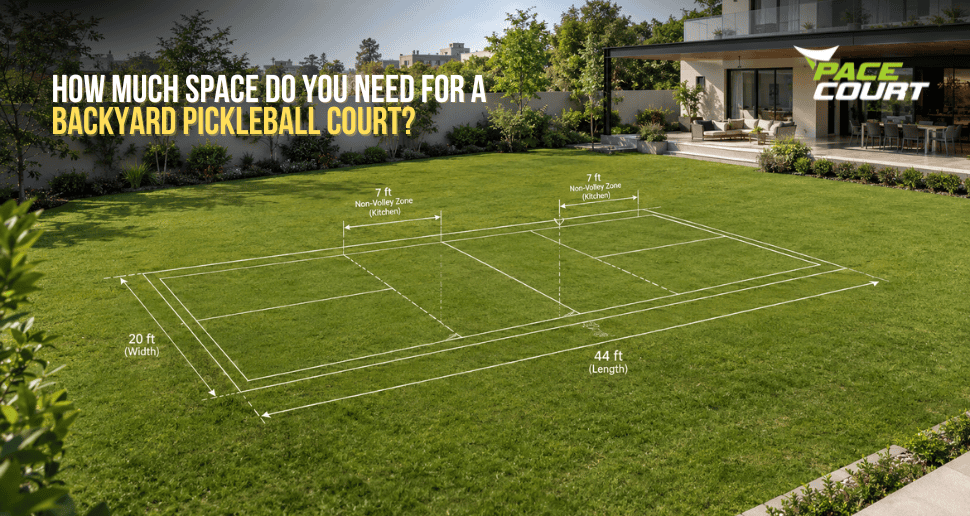
Court Length: 44 Feet
The total length of a standard badminton court is 44 feet from one baseline to the other. This length remains the same for both singles and doubles matches. The baselines are the outermost back lines on each side of the court. This consistent length is a critical factor for mastering shots like the high clear, where the goal is to push your opponent to the very back of their court.
Court Width: 20 Feet for Doubles, 17 for Singles
While the length is constant, the width of the playing area changes depending on the game type.
- Doubles Play: For doubles, the court is 20 feet wide, using the outermost side-lines. This wider space requires players to cover more ground horizontally and opens up different angles for shots.
- Singles Play: In singles, the court narrows to 17 feet. The boundaries for play are the inner side-lines. This makes the singles court a long, narrow rectangle, demanding precision and excellent footwork to cover the angles effectively.
Required Ceiling Height
Badminton is a game of height as much as it is of length and width. A high, looping clear or a towering serve can be a powerful strategic tool. Because of this, the vertical space above the court is an important consideration. For recreational play, a ceiling height of at least 20 feet is recommended. For competitive or professional play, the Badminton World Federation (BWF) recommends a minimum ceiling height of 30 feet, with 40 feet being ideal to ensure no shuttlecock is impeded during play.
Decoding the Lines: Court Layout Explained
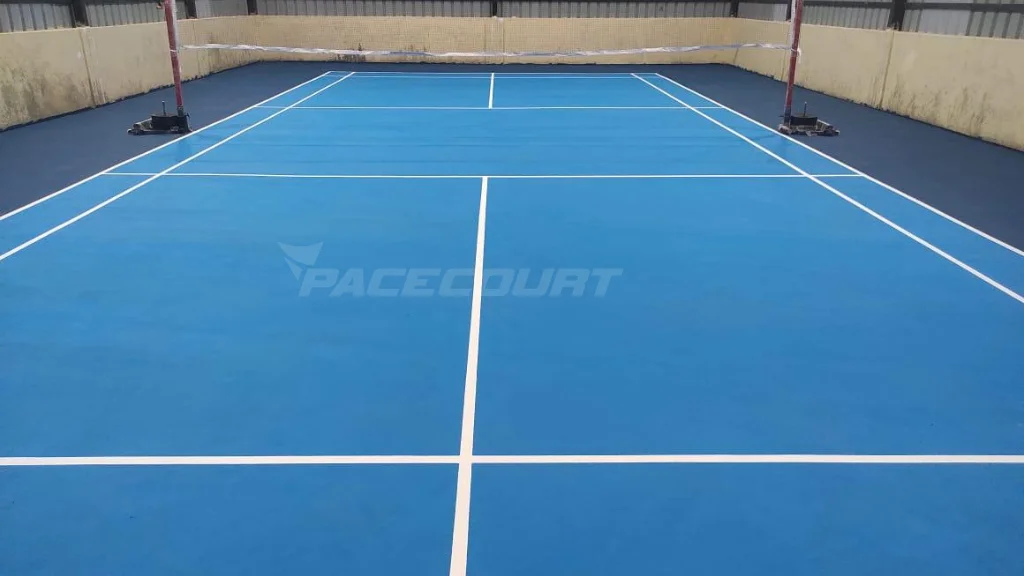
The lines on a badminton court are not random; they create specific zones for serving and rallying that define the rules of the game. Understanding this layout is essential for legal play and effective strategy.
The Service Areas
Serving in badminton has a unique set of rules governed by a specific set of lines. Each side of the court is divided into two service boxes: a right service box and a left service box.
- Short Service Line: This line is marked 6 feet 6 inches from the net on both sides. When serving, the shuttlecock must travel past this line to be considered a legal serve. It prevents players from serving too close to the net, which would create an unfair advantage.
- Center Line: Running from the short service line to the back baseline, the center line divides the court into the left and right service boxes.
- Long Service Line: This is where things get a bit different between singles and doubles.
- In singles, the long service line is the same as the back baseline (44 feet from the net). This gives singles players the full length of the court for their serves.
- In doubles, the long service line is 2 feet 6 inches inside the back baseline. This creates a shorter service area, making the serve a more tactical and precise shot rather than a pure power play.
The Net and Its Posts
The net is the physical barrier that separates the two halves of the court. According to official regulations:
- The top of the net from the court surface should be 5 feet high at the center.
- The net height over the doubles side-lines (where the posts are placed) must be 5 feet 1 inch. This slight sag in the middle is an intentional part of the court’s design.
The posts themselves are placed on the doubles side-lines, even during singles matches. This ensures the net’s tension and height are consistent for all forms of play.
Singles vs. Doubles Boundaries
To summarize the key differences in the playing area:
- Singles Rally: The court is long and narrow (44 feet by 17 feet).
- Singles Serve: The service area is also long and narrow, using the inner side-lines and the back baseline.
- Doubles Rally: The court is long and wide (44 feet by 20 feet).
- Doubles Serve: The service area is short and wide, using the outer side-lines but the shorter long service line.
Why Court Dimensions Are Crucial

Knowing these measurements is about more than just passing a rules quiz. This knowledge directly impacts how you play the game and how you prepare for it.
For Players: Enhancing Strategy and Precision
When you internalize the court’s dimensions, you can elevate your game from reactive to proactive.
- Shot Placement: You’ll know exactly how much space you have to land a clear in the back corner or how little room you need to drop a shot just over the net and past the short service line.
- Smarter Footwork: Understanding distances helps you develop more efficient footwork patterns. You learn to anticipate how many steps it takes to get from the center of the court to any corner, improving your speed and court coverage.
- Legal and Effective Serves: Knowing the service box dimensions allows you to serve with confidence. You can push the boundaries of the box to pressure your opponent while ensuring every serve is legal and counts.
For Organizers and Facility Managers
For anyone setting up a court, whether for a backyard game or a professional tournament, accuracy is key.
- Ensuring Fair Play: Using official dimensions guarantees that all players are competing under the same conditions. It upholds the integrity of the game.
- Space and Safety Planning: Beyond the court itself, there must be adequate runoff space around the perimeter for player safety. A minimum of 5 feet of clear space around the entire court is recommended to prevent players from colliding with walls or obstacles during intense rallies.
Use Your Knowledge to Master the Court
We have walked through the complete badminton court size in feet, from the 44 ft by 20 ft overall dimensions to the intricate lines governing singles and doubles play. We also covered the official net height and the importance of ceiling clearance.
This information is your blueprint for success. Mastering the physical space of the court is as important as mastering your racket skills. Use this knowledge to practice with purpose, develop smarter strategies, and gain a tangible competitive edge in your next match.
Now that you understand the layout, how will it change your approach to the game? Take this knowledge with you to the court, and let us know how it improves your play in the comments below
FAQ’s
A standard badminton court is a rectangle measuring 44 feet long by 20 feet wide. These outer dimensions are used for doubles play.
No, the playing area for singles is narrower. While the length remains 44 feet, the width is reduced to 17 feet. The boundaries for singles are the inner side-lines.
The short service line is the line closest to the net. It is positioned 6 feet 6 inches away from the net. A legal serve must land on or pass this line to be considered in play.
It is recommended to have at least 5 feet of clear, unobstructed space around the entire perimeter of the court. This “runoff” area ensures player safety during fast-paced rallies near the boundaries.
Yes, all official badminton court dimensions, including line markings and net height, are identical for men’s, women’s, and mixed-doubles play.
Stay Updated with Pacecourt
Discover expert insights, practical tips, and the latest industry updates from Pacecourt, covering sports flooring, tennis and multi-sport court construction, resurfacing, maintenance, court performance, and innovative sports infrastructure solutions.
Powered by Google's Preferred Sources feature