Author name: Rahul

Rahul is a sports flooring expert and a key contributor at Pacecourt, a leading brand in acrylic and synthetic sports court solutions. Passionate about creating world-class playing surfaces, Rahul shares insights on tennis courts, basketball courts, and multi-purpose sports flooring. His goal is to help facility owners and sports enthusiasts choose durable, high-performance solutions that enhance the game experience.

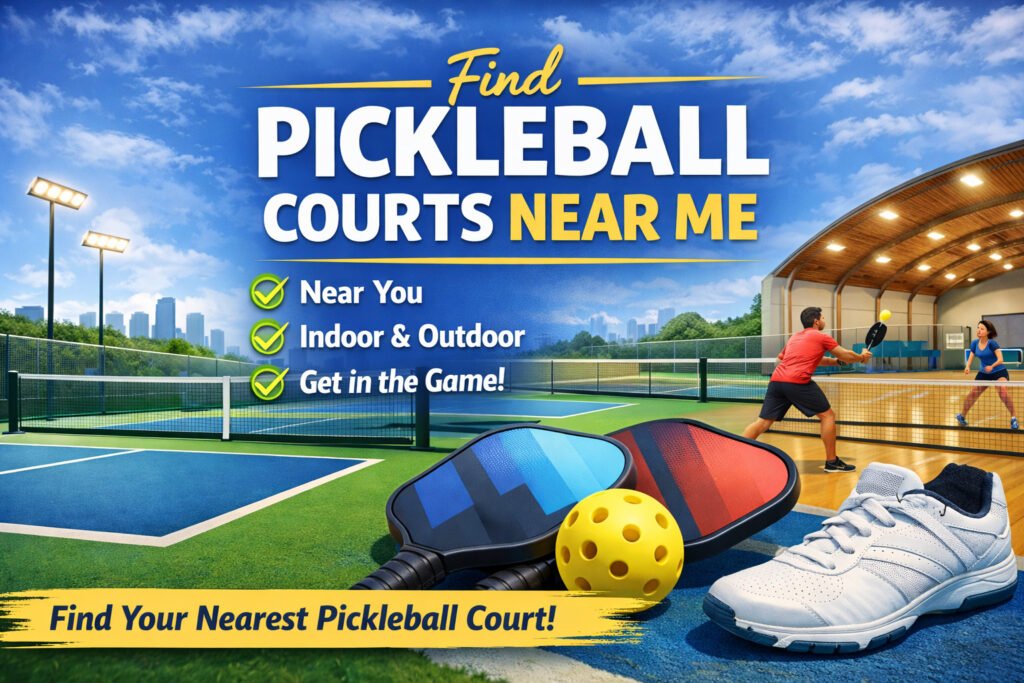
Pickleball Courts Near Me

Pickleball Courts Near Me: Find the Best Places to Play Pickleball Today

Pickleball is one of the fastest-growing sports worldwide, combining elements of tennis, badminton, and table tennis. If you’re searching for pickleball courts near me, you’re likely looking for well-maintained courts, nearby locations, and easy access for casual or competitive play. This guide will help you find nearby pickleball courts, understand court types, amenities to look for, and tips to choose the best pickleball facility in your area. Why Everyone Is Looking for Pickleball Courts Before we dive into the “where,” let’s quickly touch on the “why.” The demand for courts is skyrocketing because the community is incredibly welcoming. Unlike some sports that require years of training just to rally, you can often play a decent game of pickleball within an hour of stepping on the court. This low barrier to entry means parks and recreation departments are scrambling to keep up. Tennis courts are being converted, gymnasiums are being re-striped, and dedicated pickleball complexes are popping up in suburbs and cities alike. This is great news for you because it means there are likely more places to play near you than you realize. How to Find Pickleball Courts in Your Area Finding a court used to rely on word-of-mouth. Today, technology and community resources make it much easier. Here are the most effective ways to locate courts nearby. 1. Utilize Dedicated Apps and Websites The pickleball community is very active online. Several platforms are dedicated specifically to mapping courts across the country. 2. Check Your Local Parks and Recreation Department Your city’s Parks and Rec website is an often-overlooked resource. Many municipalities are actively converting underused tennis courts into pickleball courts. Visit their official website and look for the “Amenities” or “Facilities” section. Search for “pickleball” or “tennis courts with pickleball lines.” If the website isn’t clear, a quick phone call to the department can save you a lot of driving around. They can also tell you if the courts are lighted for evening play, which is crucial during the shorter days of winter. 3. Visit Community Centers and YMCAs If you prefer indoor play—especially during bad weather—community centers and YMCAs are your best bet. Many of these facilities tape temporary lines on their basketball or volleyball courts during specific hours. 4. Explore Private Clubs and Tennis Centers As the sport grows, private tennis and athletic clubs are adding pickleball to their roster. While this option usually costs money, the benefits often include better amenities. You might find pristine court surfaces, dedicated fencing (so you aren’t chasing balls into the next court), and on-site pro shops where you can demo paddles. Outdoor vs Indoor Pickleball Courts Feature Outdoor Courts Indoor Courts Surface Acrylic or concrete Wood or synthetic Weather Impact Yes No Lighting Natural / Floodlights Artificial Ideal For Casual play Competitive & training Choosing between indoor or outdoor pickleball courts near you depends on weather, availability, and skill level. What to Check Before You Go Once you’ve located a few potential spots, don’t rush out the door just yet. A little recon can ensure your first visit is a success. Verify Court Availability Public courts are often “first-come, first-served,” but they can get crowded. Peak times are usually weekday evenings and weekend mornings. If you are using a shared court (like a tennis court with pickleball lines), make sure you check the etiquette rules posted at the gate. Some courts use a paddle rotation system to ensure everyone gets a turn. Confirm the Setup Not all courts are created equal. You will encounter three main types: Understand the Fees While most public park courts are free, some high-demand locations have implemented reservation systems with a small hourly fee. Private clubs and indoor facilities almost always charge. Bring a credit card or cash just in case, or check their website to book a slot in advance. Making the Most of Your Local Courts Finding the court is step one. Step two is integrating into the local scene. When you arrive at a new court, don’t be shy. Introduce yourself. Pickleball culture is famous for its friendliness. If you see people playing doubles, wait for a break in the action and ask how their rotation system works. Most open play sessions are divided by skill level. Be honest about your experience level. If you are a beginner, look for the “recreational” or “novice” courts. This ensures the game is fun for everyone involved. Standard Pickleball Court Dimensions A regulation pickleball court follows official standards: Most nearby pickleball courts follow these official dimensions for fair and competitive play. What to Look for in Pickleball Courts Near Me Before choosing a court, consider these important factors: Pickleball Court Construction & Flooring Modern pickleball courts use synthetic acrylic flooring, which offers: High-quality flooring improves performance and reduces injury risk, making it a key feature in premium pickleball courts near you. Pickleball Coaching & Open Play Near Me Many pickleball facilities offer: If you’re new to the sport, choosing a court with coaching facilities can help you improve quickly. Best Time to Visit Pickleball Courts Near Me To avoid crowds: Peak hours are usually evenings and weekends. Conclusion Finding the best pickleball courts near me is easier than ever with growing facilities across cities and neighborhoods. Whether you prefer indoor or outdoor play, public parks or professional sports complexes, there’s a pickleball court nearby waiting for you. Choose a court with quality flooring, proper lighting, and convenient access to enjoy the game safely and comfortably.
Basketball Court Flooring in Delhi

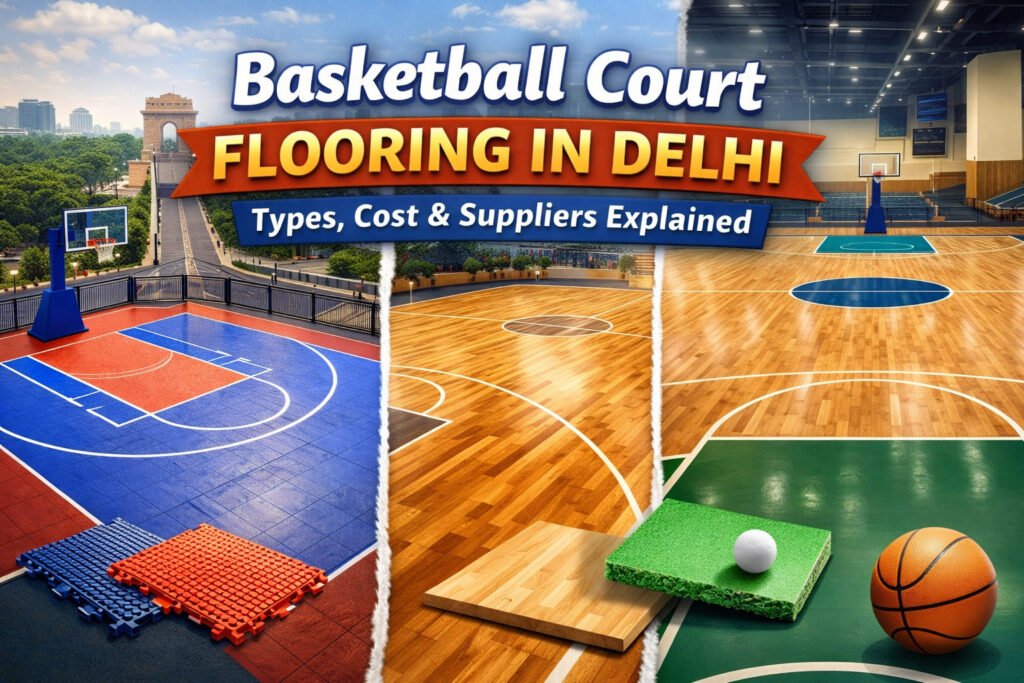
Basketball Court Flooring in Delhi

Looking for the best basketball court flooring in Delhi? Whether you’re planning to build a new court for a school, sports academy, society, or professional arena, choosing the right flooring is crucial for player safety, performance, and long-term durability. Delhi’s climate, heavy usage, and dust levels make it important to select high-quality, weather-resistant basketball court surfaces. Why Quality Basketball Court Flooring Matters in Delhi The quality of basketball court flooring is crucial, especially in a bustling city like Delhi, where sports facilities are in high demand. Here’s why investing in high-quality basketball court flooring matters: 1. Player Safety 2. Performance Enhancement 3. Durability and Longevity 4. Aesthetic Appeal 5. Versatility 6. Compliance with Standards 7. Cost-Effectiveness 8. Encourages Participation Types of Basketball Court Flooring in Delhi When it comes to basketball court flooring in Delhi, the type of flooring you choose can significantly impact the playing experience, durability, and maintenance. Here are the most common types of basketball court flooring available in Delhi: 1. Hardwood Flooring 2. Synthetic Flooring 3. Acrylic Flooring 4. Rubber Flooring 5. Concrete Flooring 6. Asphalt Flooring 7. Modular Tiles Factors to Consider When Choosing Flooring in Delhi Maintenance: Consider the ease and cost of maintaining the flooring over time. Weather Conditions: Outdoor courts need weather-resistant materials like acrylic, asphalt, or synthetic surfaces to handle Delhi’s heat and monsoons. Usage: For professional games, hardwood or synthetic flooring is ideal, while concrete or acrylic works well for recreational use. Budget: Options like concrete and asphalt are more affordable, while hardwood and modular tiles are premium choices. Basketball Court Flooring Cost in Delhi The cost of basketball court flooring in Delhi depends on material, area, and installation quality. Flooring Type Approx Cost (₹/sq ft) Synthetic Acrylic ₹120 – ₹250 Modular Sports Tiles ₹250 – ₹450 Wooden Flooring ₹600 – ₹1,200 PU Sports Flooring ₹350 – ₹700 Prices may vary based on court size, base preparation, and customization. Standard Basketball Court Dimensions The standard dimensions of a basketball court vary slightly depending on the level of play (NBA, FIBA, or high school). Here’s a breakdown of the official dimensions for a basketball court: 1. NBA (National Basketball Association) Court Dimensions 2. FIBA (International Basketball Federation) Court Dimensions 3. High School Basketball Court Dimensions (USA) 4. Key Features of a Basketball Court Comparison of Court Sizes Level of Play Length Width Three-Point Line (Top of Arc) Key Width NBA 94 ft (28.65 m) 50 ft (15.24 m) 23.75 ft (7.24 m) 16 ft (4.88 m) FIBA 91.86 ft (28 m) 49.21 ft (15 m) 22.15 ft (6.75 m) 16.08 ft (4.9 m) High School (USA) 84 ft (25.6 m) 50 ft (15.24 m) 19.75 ft (6.02 m) 12 ft (3.66 m) Why These Dimensions Matter Whether you’re building a court or just curious, understanding these dimensions ensures you’re aligned with the standards of the game! Installation Process for Basketball Court Flooring Site Inspection & Base Preparation Surface Leveling & Crack Treatment Application of Cushion Layers (if required) Top Coat & Color Layers Court Marking as per Standards Final Quality Check A professional installer ensures durability and smooth gameplay. Benefits of Professional Basketball Court Flooring Enhanced player comfort & safety Better grip and ball bounce Long lifespan (5–10+ years) Low maintenance costs Suitable for Delhi’s extreme weather Choosing the Right Basketball Court Flooring Supplier in Delhi When selecting a supplier, look for: Reliable suppliers ensure proper installation and long-term performance. Basketball Court Flooring in Delhi – Final Thoughts Investing in high-quality basketball court flooring in Delhi ensures safety, performance, and durability. Whether you need an outdoor synthetic acrylic court or an indoor wooden basketball court, choosing the right flooring and professional installation will help you get the best results. If you’re planning to build or upgrade a basketball court in Delhi, select a flooring solution that suits your space, budget, and usage needs.

volleyball courts near me

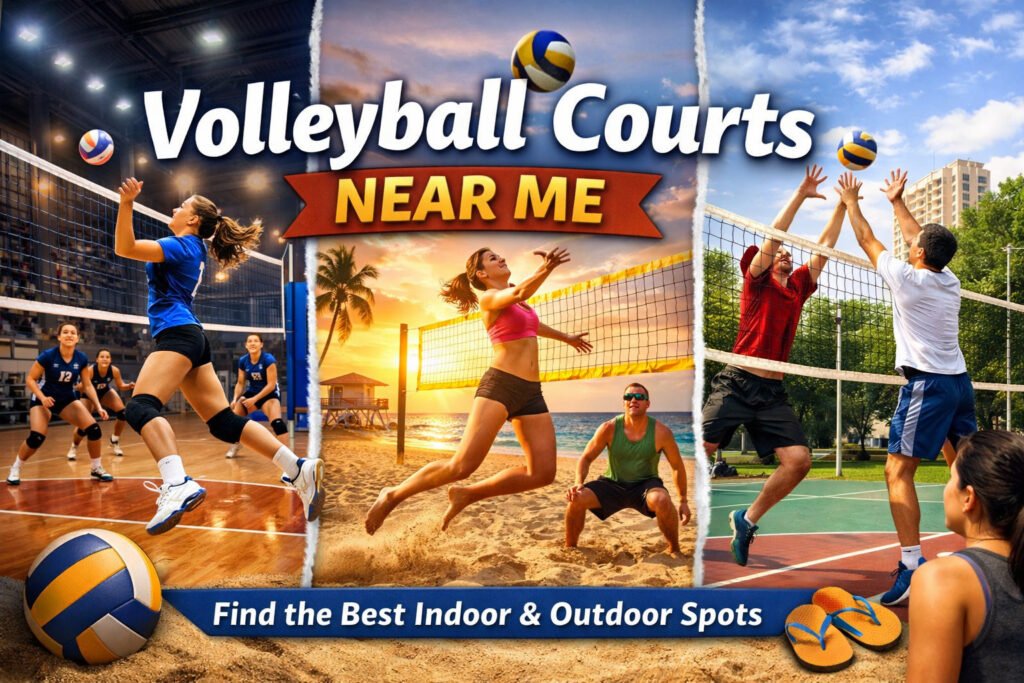
Volleyball Courts Near Me: Find the Best Indoor & Outdoor Courts in Your Area

Looking for volleyball courts near me to play, practice, or train? Whether you’re a beginner, a recreational player, or a competitive athlete, finding the right volleyball court nearby can make all the difference. From indoor stadiums to outdoor beach-style courts, this guide will help you locate the best volleyball courts, understand court types, facilities, costs, and tips to choose the perfect place to play. Why Search for Volleyball Courts Near Me? Searching for volleyball courts near you can be a great idea for several reasons: Whether you’re looking to play competitively or just for fun, finding a volleyball court near you is a step toward a more active and enjoyable lifestyle! Types of Volleyball Courts Near You When searching for volleyball courts near you, you’ll likely come across a variety of options. Each type of court offers a unique experience depending on your preferences and playing style. Here are the main types of volleyball courts you might find: 1. Indoor Volleyball Courts 2. Outdoor Sand Courts (Beach Volleyball) 3. Grass Volleyball Courts 4. Multi-Purpose Courts 5. Professional/Competition Courts 6. Backyard or Private Courts Each type of court caters to different needs, so whether you’re looking for a competitive environment or a casual game with friends, there’s likely a volleyball court nearby that fits your style! Where to Find Volleyball Courts Near Me? Finding volleyball courts near you is easier than ever, thanks to a variety of resources and locations that cater to players of all levels. Here are some of the best places to look: 1. Local Parks and Recreation Centers 2. Gyms and Sports Complexes 3. Beaches 4. Schools and Universities 5. Volleyball Clubs 6. Community Centers 7. Online Resources and Apps 8. Sports Leagues and Organizations 9. Hotels and Resorts 10. Backyard or Private Rentals Volleyball Court Size & Standards The size and standards of a volleyball court vary depending on the type of volleyball being played (indoor or beach). Here’s a breakdown of the official dimensions and key standards for both: Indoor Volleyball Court Beach Volleyball Court Key Standards for Both Types Facilities to Look for in Nearby Volleyball Courts When searching for volleyball courts near you, the facilities available can make a big difference in your overall experience. Here are some key features and amenities to look for: 1. Court Quality 2. Lighting 3. Accessibility 4. Seating and Spectator Areas 5. Restrooms and Changing Rooms 6. Water and Refreshments 7. Equipment Rentals 8. Safety Features 9. Additional Amenities 10. Organized Activities 11. Kid-Friendly Features 12. Cost and Availability Cost of Playing at Volleyball Courts Near Me The cost varies based on location and facilities: Court Type Approximate Cost Public outdoor courts Free – ₹200/hour Indoor courts ₹500 – ₹2,000/hour Beach volleyball courts ₹500 – ₹1,500/hour Coaching academies ₹2,000 – ₹5,000/month Prices may vary depending on city and amenities. Tips to Choose the Best Volleyball Court Near You Prefer indoor courts for serious training Check flooring quality to avoid injuries Visit during peak hours to assess crowd & availability Ask about membership plans for long-term play Look for courts that host local tournaments or coaching Benefits of Playing Volleyball Locally Improves fitness, agility, and coordination Builds teamwork and social connections Reduces stress and boosts mental health Provides opportunities for competitive growth Having a good volleyball court near you encourages consistency and skill improvement. Volleyball Courts Near Me – Final Thoughts Finding the right volleyball courts near me is easier than ever with online search tools and local sports infrastructure. Whether you’re playing for fun or training professionally, nearby volleyball courts offer convenience, quality facilities, and a great sporting environment. Start exploring your local options today and enjoy the thrill of volleyball right near your home!

Badminton Singles Court Rules

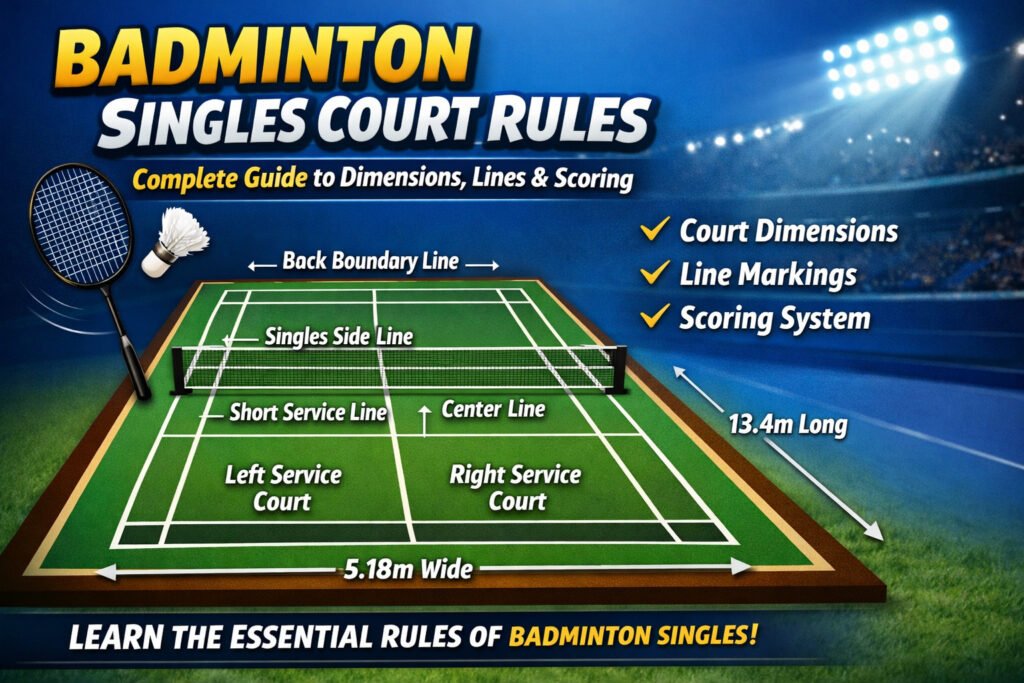
Badminton Singles Court Rules: Complete Guide to Dimensions, Lines & Scoring

Badminton singles court rules define how the court is marked, how points are scored, and how players must play during a singles match. Understanding these rules is essential for beginners, club players, and tournament-level athletes who want to play correctly and competitively. This ready-to-rank guide explains official BWF rules in simple language. What is Badminton court A badminton court is a rectangular playing area specifically designed for the sport of badminton. It is marked with lines that define the boundaries for singles and doubles play, as well as service areas. The court is divided into two halves by a net, which is suspended at a height of 5 feet in the center. Here are some key features of a badminton court: The court is where all the action happens, whether you’re playing a casual game or a competitive match! Let me know if you’d like more details about its layout or rules. Badminton Singles Court Rules: Official Court Dimensions Badminton singles court rules specify a smaller playing area compared to doubles to ensure fair play and balanced rallies. The singles court uses the inner side lines and the back boundary line as the baseline. Badminton Singles Court Rules: Court Lines Explained Badminton singles court rules clearly define which lines are active during singles play. All lines are considered in if the shuttle touches them. Badminton Singles Court Rules: Serving Regulations Badminton singles court rules require accurate serving technique and correct positioning. Incorrect service results in a fault. Badminton Singles Court Rules: Service Court Positioning Badminton singles court rules change service position based on the server’s score. Winning a rally gives the serving player one point and the right to serve again. Badminton Singles Court Rules: Scoring System Badminton singles court rules follow the rally point scoring system. Every rally results in a point, regardless of who serves. Badminton Singles Court Rules: Faults and Violations Badminton singles court rules identify actions that lead to faults. A fault awards a point to the opponent. Badminton Singles Court Rules: Lets and Interruptions Badminton singles court rules allow a let when play is interrupted. In a let, the rally is replayed without awarding a point. Badminton Singles Court Rules: Player Conduct and Equipment Badminton singles court rules also cover sportsmanship and equipment standards. Badminton Singles Court Rules: Key Differences from Doubles Badminton singles court rules differ from doubles in several important ways. Quick Tips for Beginners Learning the rules is one thing; playing is another. Here are a few tips to help you navigate your first singles match: Badminton singles is a fantastic workout and a brilliant game of chess played at high speed. Once you stop worrying about which line is which, you can focus on the fun part: outsmarting your opponent. Grab your racket, find a court, and remember: long and narrow Badminton Singles Court Rules: Final Thoughts Badminton singles court rules ensure fair play, accurate scoring, and proper court usage. Whether you are learning the game or preparing for competitive matches, understanding these rules helps improve performance and avoid unnecessary faults. Mastering the basics of singles court rules is the first step toward becoming a confident badminton player.



Lawn Tennis Court
Lawn Tennis Court

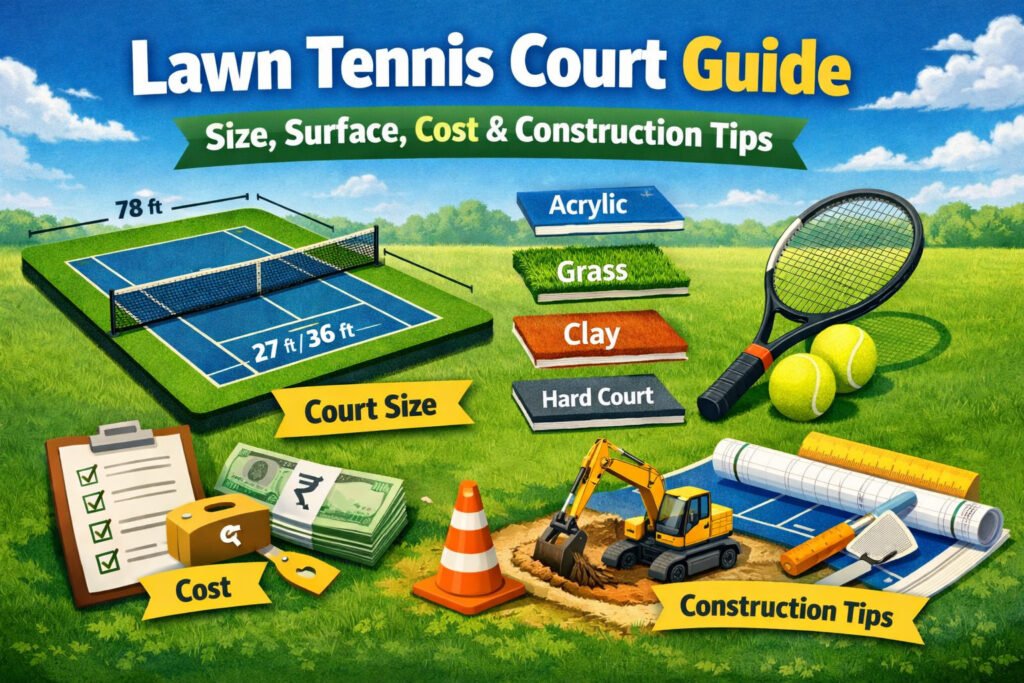
Lawn Tennis Court: Complete Guide to Size, Surface, Construction & Maintenance

A lawn tennis court is the foundation of the game, designed to deliver speed, precision, and consistent bounce. Whether you are planning to build a tennis court for a school, sports academy, club, or residential property, understanding the court dimensions, surface types, construction process, and maintenance is essential. This complete guide explains everything you need to know about a lawn tennis court in a simple and professional way. What Is a Lawn Tennis Court? A lawn tennis court is a rectangular playing area divided by a net, used for playing tennis in singles or doubles formats. While the original game was played on natural grass, modern lawn tennis courts are now built using synthetic, acrylic, clay, or hard court surfaces for better durability and lower maintenance. From Monasteries to Manicured Lawns: A Brief History The roots of tennis stretch back to 12th-century France, where monks played a game called jeu de paume (game of the palm). They used their hands to strike a ball against monastery walls. As the game gained popularity among nobility, gloves and eventually rackets were introduced. However, “Lawn Tennis” as we know it emerged much later. In 1873, Major Walter Clopton Wingfield patented a game called Sphairistikè (Greek for “ball playing”) in Wales. He designed it to be played outdoors on hourglass-shaped grass courts. His boxed sets, which included nets, posts, rackets, and balls, helped spread the game rapidly across Britain. The All England Croquet Club in Wimbledon adopted the sport in 1877, holding the first Lawn Tennis Championship. They rectified the court shape to a rectangle and established many of the rules still in use today. While “lawn” tennis originally referred specifically to grass courts, the term stuck even as surfaces diversified into clay, hard, and carpet courts over the 20th century. Surface Science: How The Ground Changes the Game The surface underfoot dictates the speed of the ball, the height of the bounce, and the movement of the player. Here are the three primary surfaces found in professional and recreational tennis. 1. Grass Courts This is the traditional surface, most famously used at Wimbledon. 2. Clay Courts Synonymous with the French Open (Roland Garros), clay is dominant in Europe and South America. 3. Hard Courts The most common surface in the US and Australia, used for the US Open and Australian Open. Lawn Tennis Court Dimensions (Official Size) Standard Tennis Court Measurements Area Measurement Court Length 23.77 meters (78 feet) Singles Court Width 8.23 meters (27 feet) Doubles Court Width 10.97 meters (36 feet) Total Playing Area (Doubles) 260.87 sq. meters Recommended Run-off Area 6.4 m (back), 3.66 m (sides) Net Height These measurements follow ITF (International Tennis Federation) standards. Lawn Tennis Court Surface Types Choosing the right surface impacts gameplay, player safety, and maintenance cost. 1. Synthetic Acrylic Tennis Court 2. Natural Grass Tennis Court 3. Clay Tennis Court 4. Hard Court Tennis Surface Lawn Tennis Court Construction Process Step 1: Site Preparation Step 2: Base Construction Step 3: Surface Installation Step 4: Line Marking Step 5: Net & Accessories Net posts, umpire chair, fencing, lighting Tennis net with center strap Lawn Tennis Court Flooring Cost in India The cost depends on surface type, base work, and location. Surface Type Approx Cost (₹ / sq. ft.) Synthetic Acrylic ₹300 – ₹600 Natural Grass ₹800 – ₹1500 Clay Court ₹400 – ₹700 Hard Court ₹350 – ₹650 Prices may vary based on site condition and material quality. Lawn Tennis Court Maintenance Tips Clean surface regularly to avoid dust buildup Repair cracks immediately Repaint lines every 2–3 years Ensure proper drainage during monsoon Check net height and tension regularly Proper maintenance increases the court’s lifespan and player safety. Benefits of a Lawn Tennis Court Encourages fitness and professional training Increases property and facility value Suitable for schools, clubs, and residential societies Can be used for national and international tournaments Long-term investment with high durability Lawn Tennis Court for Schools & Academies Schools and sports academies prefer synthetic acrylic lawn tennis courts because they: The Role of Courts in the Tennis Ecosystem Tennis courts are more than just playing fields; they are community hubs and stages for drama. In the professional realm, surface homogenization has been a hot topic. In the 1990s, the speed difference between grass and clay was massive. Today, grass courts have been slowed down (via soil composition changes), and hard courts have varying speeds, bringing the surfaces closer together. This has allowed players like Novak Djokovic and Rafael Nadal to dominate across all surfaces, something that was much harder in previous eras. For recreational play, public hard courts remain the backbone of the sport. They are accessible, durable, and free or cheap to use. However, the rise of “soft” courts (synthetic clay or cushioned hard courts) in private clubs reflects an aging demographic of players who want to protect their knees and hips while enjoying the game for a lifetime. Conclusion A lawn tennis court is more than just a playing area—it’s an investment in sports, fitness, and professional performance. By choosing the right court size, surface, construction method, and maintenance plan, you can ensure long-lasting performance and international-level play. If you are planning to build a lawn tennis court, always follow ITF standards and work with experienced professionals for best results.

Measurements for a Tennis Court

Measurements for a Tennis Court: Official Dimensions, Lines & Layout Guide

Understanding the correct measurements for a tennis court is essential for building a professional, safe, and tournament-ready playing surface. Whether the court is for schools, sports academies, clubs, or residential use, following official dimensions ensures consistent play and player safety. This complete guide explains tennis court measurements for singles and doubles, line markings, net height, and total area requirements. Official Tennis Court Dimensions A regulation tennis court is a rectangle with specific, internationally recognized dimensions. These measurements are set by the International Tennis Federation (ITF) and apply to all levels of play. The total length of the court is 78 feet (23.77 meters). This measurement is taken from the outside edge of one baseline to the outside edge of the opposing baseline. The width of the court varies depending on whether a singles or doubles match is being played. The space between the singles sideline and the doubles sideline on each side is known as the doubles alley. Each alley is 4.5 feet (1.37 meters) wide. Tennis Court Measurements for Singles Play Component Measurement Court Length 78 feet (23.77 m) Court Width 27 feet (8.23 m) Service Box Length 21 feet Service Box Width 13.5 feet Net Height at Center 3 feet (0.914 m) Tennis Court Measurements for Doubles Play Component Measurement Court Length 78 feet (23.77 m) Court Width 36 feet (10.97 m) Doubles Alley Width 4.5 feet on each side Service Box Length 21 feet Net Height at Posts 3.5 feet (1.07 m) The Layout: Lines and Zones Explained Every line on a tennis court serves a specific purpose, creating distinct zones that dictate the rules of play, particularly during serves. All lines on the court should be the same color, creating a sharp contrast with the playing surface. The width of most lines is between 1 and 2 inches (2.5 to 5 cm), while the baseline can be up to 4 inches (10 cm) wide. Baseline and Center Mark The baseline is the rearmost line on each side of the court, running parallel to the net. It marks the boundary for the length of the court. When serving, a player must stand behind the baseline. The center mark is a small line, 4 inches (10 cm) long, that divides the baseline in half. It helps players position themselves correctly for serves. Service Lines and Service Boxes The service line runs parallel to the net, located 21 feet (6.4 meters) away from it. This line marks the back of the service boxes. The center service line runs perpendicular to the net, connecting the midpoints of the two service lines. This line divides the area between the net and the service lines into two equal service boxes on each side of the court: the deuce court (right side) and the ad court (left side). A legal serve must land within the diagonally opposite service box. Each service box measures 21 feet (6.4 meters) by 13.5 feet (4.1 meters). Sidelines There are two sets of sidelines that define the width of the playing area. Net Height and Placement The net divides the court into two equal halves. It is stretched across the full width of the court, parallel to the baselines. The net is held up by two net posts located 3 feet (0.914 meters) outside the doubles sidelines. This slight drop in height at the center creates a strategic element, as players often aim for the lowest part of the net to increase their margin for error. Total Area and Run-Off Space While the playing lines define the court, additional space around the perimeter is crucial for player safety and movement. This “run-off” area allows players to chase down wide shots without risking injury. Therefore, the total recommended space for a single tennis court, including run-off areas, is 120 feet (36.57 meters) long by 60 feet (18.29 meters) wide. For multi-court facilities, additional spacing is needed between courts. Court Surfaces and Their Impact on Gameplay The material used for a tennis court surface has a significant effect on the ball’s speed and bounce, which in turn influences playing styles. There are three primary types of court surfaces. Hard Courts Hard courts are made from rigid materials, often acrylic layers over a concrete or asphalt base. This is the most common type of surface. Clay Courts Clay courts are made from crushed brick, shale, or stone. The French Open is famously played on this surface. Grass Courts Grass courts are the traditional surface of tennis, with Wimbledon being the premier grass-court tournament. They are made from natural grass grown on tightly packed soil. Importance of Accurate Tennis Court Measurements Correct measurements ensure: Incorrect dimensions can affect performance and disqualify the court from official matches. Maintaining Your Tennis Court Proper maintenance is essential to ensure a tennis court remains safe, playable, and compliant with official standards. Regular care preserves the surface and protects the investment. By following these guidelines, you can ensure your tennis court provides a high-quality playing experience for years to come.

Badminton Court Near Me

Badminton Court Near Me: Find The Best Indoor & Outdoor Courts Near Me

Badminton Court Near Me is a popular search among sports enthusiasts looking to stay active and competitive. Badminton is one of the most popular sports worldwide, loved for its fast pace, fitness benefits, and accessibility. Whether you’re searching for a badminton court near me for casual play, professional training, or competitive matches, this guide will help you find the best options close to your location. Why Search for a Badminton Court Near Me? Searching for a badminton court near you can be a great idea for several reasons: So, whether you’re looking to stay fit, have fun, or improve your skills, finding a badminton court near you is a step in the right direction! Types of Badminton Courts Near You When searching for badminton courts near you, you’ll likely come across a variety of options. Here are the main types of badminton courts you might find: 1. Indoor Badminton Courts 2. Outdoor Badminton Courts 3. Multipurpose Courts 4. Professional Badminton Courts 5. Private Badminton Courts 6. Temporary or Pop-Up Courts Each type of court offers a unique experience, so the best choice depends on your preferences, skill level, and the purpose of your game—whether it’s casual fun, fitness, or competitive play! How to Find the Best Badminton Court Near Me Finding the best badminton court near you can make a big difference in your playing experience. Here’s a step-by-step guide to help you locate the perfect court: 1. Use Online Search Tools 2. Check Reviews and Ratings 3. Visit Local Sports Complexes 4. Ask for Recommendations 5. Consider Your Needs 6. Visit the Court in Person 7. Look for Additional Features 8. Book in Advance Key Factors to Consider Before Choosing a Badminton Court Choosing the right badminton court can significantly enhance your playing experience. Here are the key factors to consider before making your decision: 1. Type of Court Flooring Tip: Choose a court with flooring that matches your playing style and minimizes the risk of injury. 2. Indoor vs. Outdoor Tip: Indoor courts are better for serious players, while outdoor courts are great for casual fun. 3. Court Maintenance and Cleanliness 4. Lighting and Ventilation 5. Location and Accessibility 6. Cost and Booking Options 7. Crowd Levels and Availability 8. Amenities and Facilities 9. Coaching and Training Programs 10. Community and Atmosphere 11. Safety Measures Ensure the court follows safety protocols, such as proper flooring, first aid availability, and clear emergency exits. Cost of Booking a Badminton Court Near Me The cost of badminton courts can vary depending on location and facilities: Court Type Average Cost (Per Hour) Outdoor Court Free – Low Cost Indoor Basic Court ₹300 – ₹600 Premium Indoor Court ₹700 – ₹1500 Membership plans often reduce hourly costs for regular players. Benefits of Playing at a Nearby Badminton Court Improves mental focus and coordination Burns calories and boosts metabolism Reduces stress and increases energy Encourages discipline and teamwork Playing regularly at a nearby court makes it easier to stay consistent and motivated. Tips to Get the Most Out of Your Badminton Court Experience Maximizing your time on the badminton court can make your experience more enjoyable, productive, and rewarding. Here are some tips to help you get the most out of your badminton court experience: 1. Warm Up Before You Play 2. Wear the Right Gear 3. Bring the Essentials 4. Practice Regularly 5. Play with Different Partners 6. Focus on Footwork 7. Learn the Rules and Scoring 8. Stay Hydrated 9. Take Breaks When Needed 10. Set Goals for Each Session 11. Respect the Court and Others 12. Cool Down After Playing 13. Join Tournaments or Events 14. Have Fun! Celebrate small wins and enjoy the process of improving your skills. Remember, badminton is not just about competition—it’s also about enjoying the game, staying active, and connecting with others. Conclusion Searching for a badminton court near me is the first step toward an active and healthier lifestyle. Whether you prefer indoor courts with professional facilities or outdoor courts for casual play, choosing the right nearby badminton court ensures comfort, safety, and enjoyment. Use online tools, local resources, and facility checks to find the perfect court and start playing today.

Length of Tennis Court

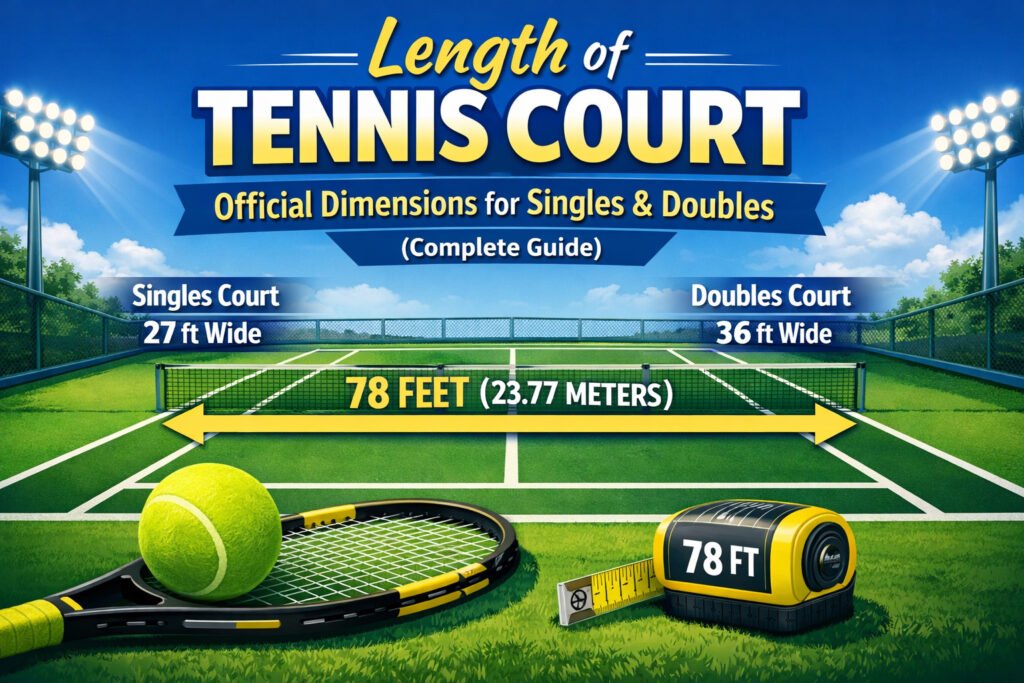
Length of Tennis Court: Official Dimensions for Singles & Doubles (Complete Guide)

Understanding the length of tennis court is essential for players, coaches, architects, sports authorities, and anyone planning to construct a professional or recreational tennis court. Whether you are building a court, learning the rules, or upgrading sports infrastructure, knowing the exact measurements helps ensure compliance with international standards. This guide covers official tennis court length, differences between singles and doubles courts, total playing area, and layout standards approved by the International Tennis Federation (ITF). What Is the Official Length of a Tennis Court? The official length of a tennis court is 78 feet (23.77 meters).This measurement is fixed and universal for all formats of tennis, including: Unlike width, the length of a tennis court remains the same for both singles and doubles. Length of Tennis Court in Different Units Measurement Unit Tennis Court Length Feet 78 feet Meters 23.77 meters Yards 26 yards This length is measured from one baseline to the opposite baseline. Singles vs. Doubles: Key Differences While the court’s length is constant, the width is the primary difference between singles and doubles matches. This distinction has a significant impact on strategy and player positioning. Singles Court Boundaries In a singles match, one player competes against another. The play is contained within the singles sidelines. If a player hits the ball into one of the doubles alleys during a rally, the ball is considered “out,” and they lose the point. The only time the full width of the court is relevant is for the net posts’ placement. Doubles Court Boundaries In a doubles match, two players team up against another pair. The game utilizes the full 36-foot width of the court. The doubles alleys, which are out of bounds in singles, are now in play. This extra space opens up new angles for shots and requires different court coverage strategies. Teamwork and communication become essential to effectively defend the wider area. Interestingly, the service boxes remain the same for both singles and doubles. Serves must still land within the same 21-foot by 13.5-foot area, regardless of how many players are on the court. How Court Dimensions Impact Gameplay The layout of a tennis court isn’t arbitrary. The dimensions directly influence how the game is played, from serving strategy to rally dynamics. Serving Strategy The 21-foot distance from the net to the service line creates a challenging target. Players must hit the ball with enough power to clear the net but with enough topspin or slice to bring it down into the service box. The 3-foot height at the center of the net offers a small but valuable target for flat, powerful serves. Serving out wide in the deuce court (the right side) or down the “T” (the center line) in the ad court (the left side) are common strategies that exploit the box’s geometry. Baseline Rallies The 78-foot length of the court provides ample space for powerful baseline exchanges. Players often stand a few feet behind the baseline to give themselves more time to react to deep, fast shots from their opponent. Hitting deep shots that land near the opponent’s baseline is a key tactic, as it can push them back and force a weaker return. The Importance of Angles In doubles, the addition of the alleys dramatically changes the game. Players can hit sharp-angled cross-court shots that pull their opponents wide, opening up the rest of the court for their partner to attack. The ability to defend these wide shots and counter-attack down the line is a hallmark of strong doubles play. Even in singles, using angles to move an opponent from side to side is a fundamental strategy for creating openings. Net Play and Court Coverage The distance from the baseline to the net is 39 feet. When a player decides to approach the net, they must cover this distance quickly to get into a good volleying position. A slow approach gives the opponent too much time to hit a passing shot or a lob. Understanding these distances helps players make better decisions about when to stay back and when to move forward. Total Area and Run-Off Space While the playing lines define the court’s boundaries, additional space around the court is necessary for player safety and movement. This is often called the “run-off” area. The International Tennis Federation (ITF) recommends the following minimum clearances: This extra room allows players to safely chase down wide shots or deep lobs without risking injury. For professional tournaments, these spaces are often even larger. The total recommended area for a single tennis court, including run-off, is 120 feet (36.57 meters) by 60 feet (18.29 meters). Why Tennis Court Length Is Fixed The tennis court length has remained unchanged for decades to ensure: All international tennis matches follow ITF-approved dimensions, making the game globally uniform. Line Markings Related to Court Length Important markings along the length include: All markings must follow ITF thickness standards (usually 5 cm or 2 inches). Common Mistakes While Measuring Tennis Court Length Measuring beyond run-off area instead of baseline to baseline Confusing total area length with playing length Incorrect net positioning affecting half-court distance Professional court installation avoids these errors using laser or precision tools. Tennis Court Length for Different Surfaces The length remains 78 feet regardless of surface type: Only surface materials and cushioning layers change—not the dimensions. Final Thoughts The length of a tennis court is always 78 feet (23.77 meters), regardless of singles or doubles play. This fixed dimension is a core rule of tennis and is followed worldwide for professional, recreational, and training courts. If you’re planning to build or renovate a tennis court, ensuring accurate length measurement is critical for performance, safety, and official compliance.

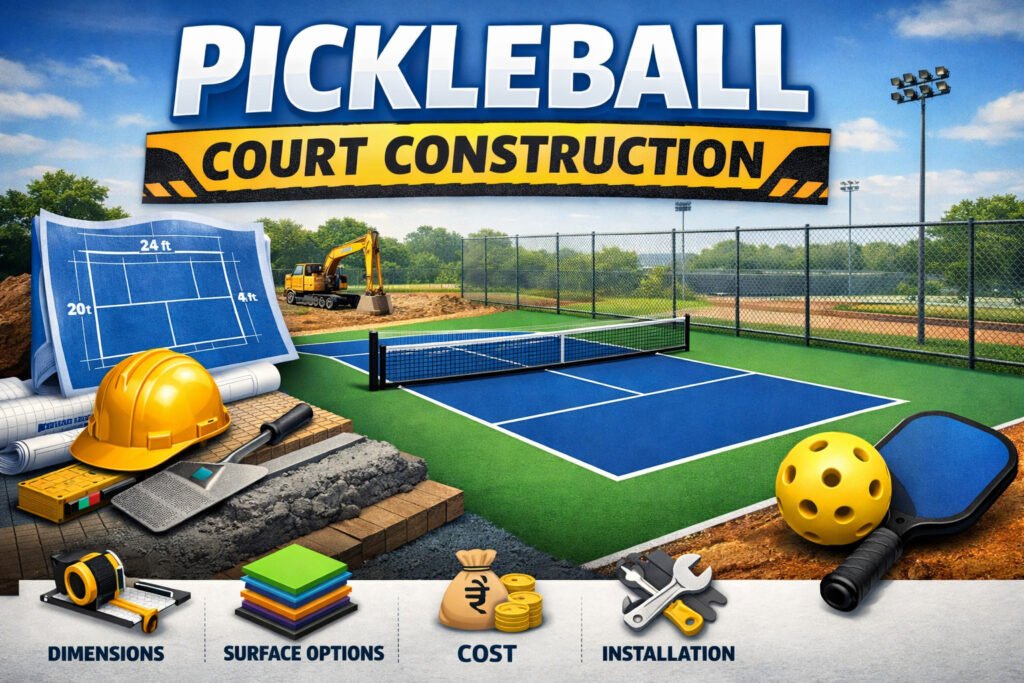
Pickleball Court Construction
pickleball court construction

Pickleball Court Construction: Complete Guide to Design, Cost, Dimensions & Installation

Pickleball is one of the fastest-growing sports worldwide, and its popularity in India is rising rapidly across schools, residential societies, clubs, and sports academies. With this growth, pickleball court construction has become a high-demand service for sports infrastructure developers and flooring contractors. This complete guide covers everything you need to know about pickleball court construction — from court dimensions, surface types, base preparation, fencing, lighting, cost, and maintenance — to help you build a professional, durable, and tournament-ready court. What Is Pickleball? Pickleball is a paddle sport that combines elements of tennis, badminton, and table tennis. It is played on a smaller court, making it ideal for urban spaces, schools, and residential projects. The sport is suitable for all age groups, which makes pickleball courts a long-term investment. Why Everyone Wants a Court in Their Backyard You see them popping up everywhere—in public parks, converted tennis courts, and increasingly, in private backyards. Pickleball isn’t just a fleeting trend; it’s the fastest-growing sport in America for a reason. It combines the strategy of tennis, the speed of ping pong, and the court size of badminton into a game that is accessible to all ages. But as the sport matures, so do the expectations of the players. A chalk line on a driveway doesn’t cut it anymore. Enthusiasts want the real deal. They want the consistent bounce, the traction, and the aesthetic appeal of a professional-grade surface. This guide explores the essentials of pickleball court construction. We will walk you through the critical steps of building a court that not only looks great but also ensures safe, high-level gameplay for years to come. The Foundation of Great Gameplay Why does professional construction matter? You might be tempted to just paint some lines on existing concrete and call it a day. While that works for a casual afternoon, dedicated players notice the difference immediately. Proper pickleball court construction is about safety as much as it is about performance. A professionally built court manages water drainage effectively, preventing dangerous puddles and slippery spots. It provides the right amount of “cushion” to protect players’ joints during long matches. Most importantly, it ensures a true ball bounce, which is critical for a sport that relies heavily on precision and spin. When you invest in quality construction, you aren’t just building a court; you are building an asset that adds value to your property and enhances the playing experience. Step-by-Step: Building Your Pickleball Court Correct dimensions are crucial for professional pickleball court construction. Official Pickleball Court Size Recommended Total Area Net Height Non-Volley Zone (Kitchen) Pickleball Court Surface Options Choosing the right surface is essential for player safety, ball bounce, and court longevity. 1. Acrylic Pickleball Court (Most Popular) Recommended for: Residential societies, clubs, schools, academies 2. Synthetic Modular Tiles Recommended for: Temporary courts, rooftops, indoor spaces 3. Concrete Base with Acrylic Coating Pickleball Court Construction Process (Step-by-Step) Step 1: Site Inspection & Planning Step 2: Ground Preparation Step 3: Base Construction Step 4: Acrylic Surface Installation Step 5: Accessories Installation Pickleball Court Color Combinations Popular color schemes include: Contrasting colors improve visibility and broadcast quality. Pickleball Court Construction Cost in India Approximate Cost Breakdown Component Cost Range (₹/sq. ft.) Base Construction ₹120 – ₹180 Acrylic Surface ₹80 – ₹150 Fencing & Net ₹1.5 – ₹3 lakh Lighting (Optional) ₹2 – ₹5 lakh Total Estimated Cost Indoor vs Outdoor Pickleball Court Construction Outdoor Courts Indoor Courts Lower maintenance Synthetic or wooden flooring Controlled environment Maintenance Tips for Pickleball Courts Regular surface cleaning Avoid water stagnation Inspect cracks annually Recoating every 4–6 years Net and line checks before tournaments Proper maintenance significantly extends court lifespan. Benefits of Professional Pickleball Court Construction International standard compliance Long-term durability Player safety and comfort Higher property value Low maintenance cost Why Pickleball Courts Are a Smart Investment Growing demand in India Requires less space than tennis Multi-age participation Ideal for schools, societies, resorts, and clubs High ROI with low operational cost Choosing the Right Pickleball Court Contractor Before finalizing a contractor, ensure: Conclusion Pickleball court construction is a future-ready investment for modern sports infrastructure. Whether you’re building a court for a school, residential society, club, or academy, following international standards, choosing the right surface, and working with experienced professionals ensures long-lasting performance and player satisfaction. With proper planning, quality materials, and expert execution, a professionally constructed pickleball court can deliver exceptional value for years to come.

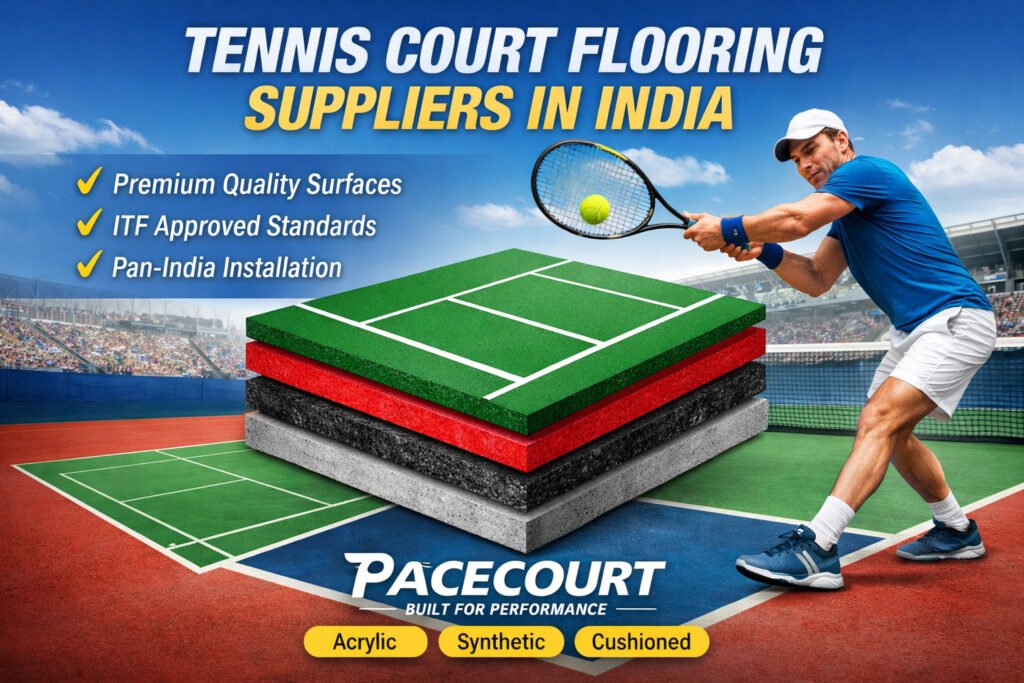
Tennis Court Flooring Suppliers in India

Tennis Court Flooring Suppliers in India: Complete Buyer’s Guide by Pacecourt

Choosing the right tennis court flooring supplier is critical for performance, safety, durability, and long-term maintenance. Whether you’re planning a professional tennis court, a school sports facility, a sports academy, or a private club, the quality of flooring directly impacts player experience and court lifespan. At Pacecourt, we specialize in premium tennis court flooring solutions designed for Indian climate conditions, international playing standards, and long-term value. This guide explains everything you need to know before selecting a tennis court flooring supplier. Why Choosing the Right Tennis Court Flooring Supplier Matters A reliable tennis court flooring supplier ensures: Poor-quality suppliers often lead to cracking, surface peeling, uneven play, and frequent repairs—costing more in the long run. Types of Tennis Court Flooring Offered by Pacecourt As one of the trusted tennis court flooring suppliers in India, Pacecourt offers multiple surface options to suit different playing styles and budgets. 1. Acrylic Tennis Court Flooring (Most Popular) Best for: Schools, academies, clubs & tournaments Key Benefits: Lifespan: 6–8 years with proper care Pacecourt’s acrylic tennis flooring is ideal for both outdoor and indoor courts. 2. Synthetic Tennis Court Flooring Best for: Multi-sport complexes & training facilities Advantages: 3. Cushioned Tennis Court Flooring Best for: Professional academies & high-usage courts Features: Tennis Court Flooring Specifications (Standard Dimensions) A professional tennis court requires precision installation: Pacecourt ensures accurate line marking, slope correction, and drainage planning for optimal court performance. Why Pacecourt is a Trusted Tennis Court Flooring Supplier Pacecourt stands out among tennis court flooring suppliers due to: ✔ High-Quality Materials We use international-grade acrylic resins, binders, and coatings tested for Indian weather conditions. ✔ End-to-End Project Execution From site inspection to base preparation, surface application, and final line marking—everything is handled by experts. ✔ Pan-India Service We supply and install tennis court flooring across Delhi, Bihar, UP, Rajasthan, Maharashtra, South India, and North East. ✔ Custom Court Speed Options Slow, medium, or fast courts based on your requirement. ✔ After-Sales Support Maintenance guidance and resurfacing solutions to extend court life. Tennis Court Flooring Installation Process by Pacecourt Our professional installation process ensures durability and performance: Each step follows strict quality control standards. Tennis Court Flooring Cost in India The cost depends on multiple factors: Flooring Type Approx Cost (₹/sq.ft) Acrylic Flooring ₹90 – ₹150 Synthetic Flooring ₹120 – ₹180 Cushioned Flooring ₹180 – ₹300 Note: Final pricing depends on base condition, location, court size, and customization. Pacecourt offers transparent pricing with no hidden costs. Ideal Clients for Tennis Court Flooring Suppliers Our tennis court flooring solutions are perfect for: Maintenance Tips for Long-Lasting Tennis Courts To extend the lifespan of your tennis court: Pacecourt also provides annual maintenance contracts (AMC). How to Choose the Best Tennis Court Flooring Supplier Before finalizing a supplier, check: Pacecourt meets all these criteria, making it a preferred choice across India. Why Tennis Academies Prefer Pacecourt Consistent playing quality Faster project turnaround Custom color & branding options Competitive pricing Long-term reliability Our courts are designed to train champions. Conclusion If you are searching for reliable tennis court flooring suppliers in India, Pacecourt offers the perfect balance of quality, performance, durability, and cost-efficiency. From grassroots courts to professional arenas, we deliver world-class tennis court flooring solutions tailored to your needs.

Scroll to Top
HOMEOWNERS
BUSINESS OWNERS
ARCHITECTS
MUNICIPALITIES

800+ Acrylic Colors

Get 10% off on sports flooring materials

ITF-certified acrylic flooring for Tennis, Basketball, Badminton, Pickleball & more shipped worldwide.

    ISO-Certificate