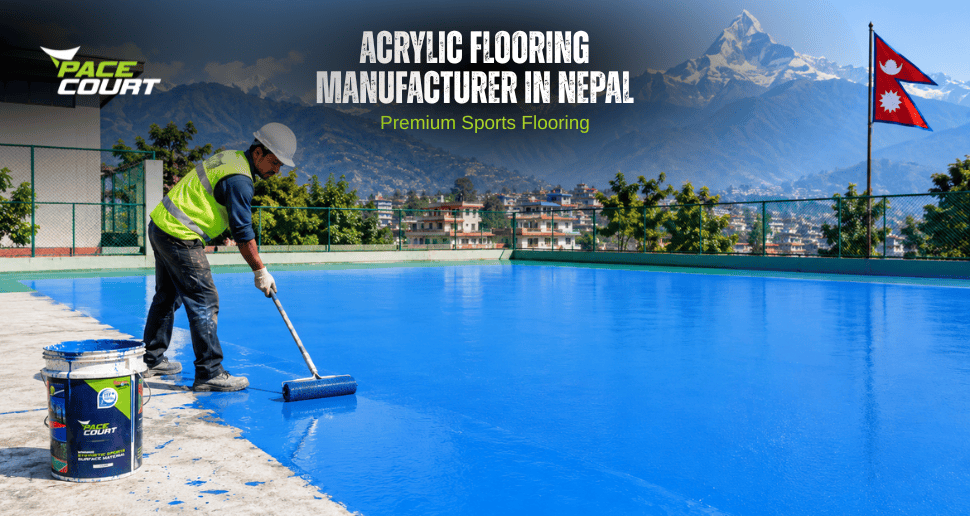
Premium Pickleball Court Flooring in Nepal
Pickleball Court Flooring in Nepal plays a major role in a court’s safety, speed, comfort, and overall playing experience. A well-built court is about more than the right dimensions and attractive colours. The surface needs to provide reliable grip, controlled ball response, comfortable movement, and enough durability to handle regular play. For clubs, hotels, schools, resorts, residential communities, sports facilities, and commercial developers, choose the right pickleball court surface in Nepal early in the project. Among outdoor sports surfaces, synthetic acrylic systems are widely used because they can be applied over suitable concrete or asphalt bases and can be designed with different levels of texture and cushioning. Pacecourt manufactures synthetic acrylic sports flooring systems for sports including pickleball, tennis, basketball, badminton, and multi-purpose courts. Its published system includes components such as primer, resurfacer, cushion coat, colour coat, silica sand, and line marking. If you’re planning a new pickleball facility in Nepal, this guide explains the flooring options, construction process, cost factors, maintenance requirements, and what to check before selecting a flooring manufacturer or contractor. What Is Pickleball Court Flooring? Pickleball court flooring is the finished playing surface installed over a properly prepared court base. The surface must provide enough traction for quick movement while allowing the ball to respond consistently during rallies. For many outdoor courts, a synthetic acrylic system is a practical choice. It is normally built as a multi-layer surface rather than a single coat of paint. A typical acrylic system may include: The exact number and specification of layers should depend on the project, existing base, required playing characteristics, and site conditions. Pacecourt describes its sports flooring as a multi-layer synthetic acrylic system designed for consistent play, grip, durability, and player comfort. Its published systems include 5-layer and 8-layer configurations. Why Acrylic Is a Popular Choice for Pickleball Courts in Nepal Pickleball requires frequent lateral movement, quick changes of direction, short sprints, and repeated stops. The playing surface therefore needs to balance traction and movement. A properly installed acrylic system can offer several useful characteristics: For an outdoor facility, the surface also needs to cope with sunlight, rain, dust, temperature changes, and regular foot traffic. The important point is that premium pickleball flooring is a complete system, not simply a coloured coating. Pickleball Court Flooring Nepal: What Should You Look For? Choosing flooring only by price can create problems later. A lower initial quotation may not include proper surface preparation, cushioning, crack treatment, drainage work, or quality line marking. Before selecting a system, check these factors. 1. Base Quality The acrylic surface cannot compensate for a poorly constructed base. The concrete or asphalt foundation should have suitable strength, slope, drainage, and surface condition. Existing cracks, depressions, loose areas, and drainage problems should be addressed before the flooring application. 2. Surface Texture Pickleball requires traction, but excessive roughness can affect player comfort and surface wear. The texture should be selected according to the intended use and flooring specification. 3. Cushioning A cushioned acrylic system can provide a more comfortable playing experience compared with a completely hard surface. Pacecourt’s published layer system includes cushion coats designed to improve impact absorption and underfoot comfort. The number of cushion layers should not be selected simply because more layers sound better. The correct specification depends on the project requirements and desired performance. 4. Weather Resistance Outdoor courts face direct sunlight and rainfall. The surface system should therefore be suitable for outdoor exposure. Acrylic colour and texture systems can be formulated for outdoor sports applications. Pacecourt states that its acrylic colour coat is UV-resistant and designed for sports surfaces including pickleball. 5. Maintenance Requirements Even a premium court requires maintenance. Dust, leaves, standing water, algae, stains, and surface damage should be dealt with before they become larger problems. Outdoor Pickleball Court Flooring vs Indoor Pickleball Court Flooring The right flooring approach changes according to the environment. Factor Outdoor Pickleball Court Indoor Pickleball Court Weather exposure High Very low UV exposure Direct sunlight Usually limited Rain protection Must be considered Not normally required Drainage Very important Usually less critical Surface system Outdoor acrylic is common Acrylic or other indoor systems may be considered Maintenance More frequent Generally easier Base preparation Critical Critical Cushioning Depends on use Often considered for player comfort Colour fading UV resistance matters Less of a concern Site planning Drainage and water flow matter Building floor condition matters For an outdoor facility in Nepal, the flooring decision should be made together with the drainage and base construction plan. For indoor facilities, the existing floor, moisture condition, building use, ventilation, and required sports specification should be assessed before installation. Pickleball Court Construction Nepal: The Base Comes First A common mistake in sports court projects is focusing on the final colour before checking the foundation. The acrylic surface is only as good as the base underneath it. A typical pickleball court construction in Nepal can involve the following stages: Step 1: Site Assessment The site should be checked for: Step 2: Court Base Preparation A new court may require a properly designed concrete or asphalt base. For an existing court, the surface should be inspected carefully. Areas with cracks, loose material, unevenness, or poor drainage may need repair before resurfacing. Step 3: Crack Repair and Priming Cracks and surface defects should be treated according to the flooring system specification. A primer can then help prepare the surface for subsequent acrylic layers. Step 4: Acrylic Resurfacing The resurfacing layer helps level and prepare the base for the playing surface. Pacecourt lists acrylic resurfacer as part of its sports flooring system and describes it as a layer used over concrete or asphalt to help fill surface imperfections and prepare the upper layers. Step 5: Cushion System Where a cushioned court is specified, rubberised cushion layers are applied according to the selected system. This can improve surface comfort and reduce the hardness of the finished court. Step 6: Colour and Texture The playing areas are finished with the selected acrylic colour and texture system. Silica