Author name: Rahul

Rahul is a sports flooring expert and a key contributor at Pacecourt, a leading brand in acrylic and synthetic sports court solutions. Passionate about creating world-class playing surfaces, Rahul shares insights on tennis courts, basketball courts, and multi-purpose sports flooring. His goal is to help facility owners and sports enthusiasts choose durable, high-performance solutions that enhance the game experience.

Pickleball Court Dimensions in India
Pickleball Court Dimensions

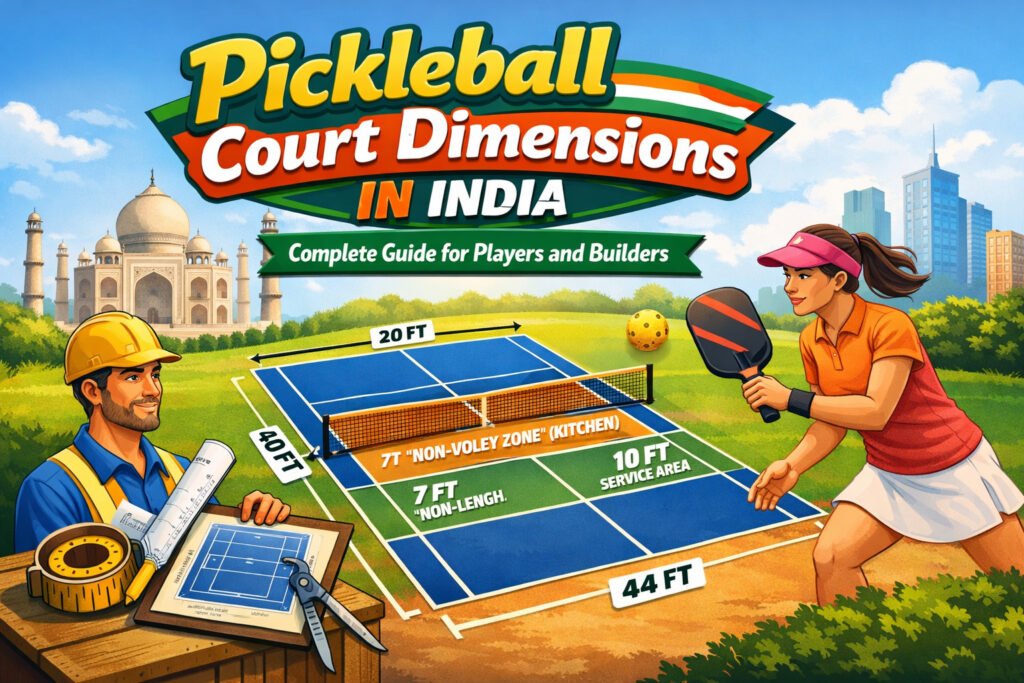
Pickleball Court Dimensions in India: Complete Guide for Players and Builders

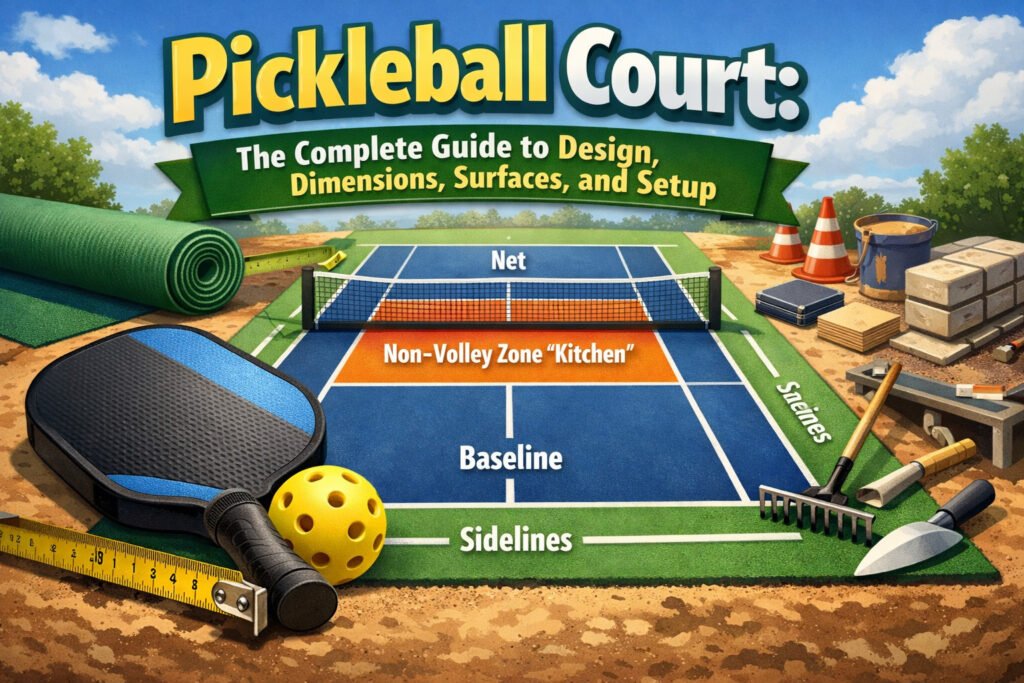
Pickleball is no longer just a backyard game played in retirement communities abroad. In India, it has quietly grown into one of the fastest-emerging sports, attracting everyone from school kids to corporate professionals and even former tennis players looking for something less taxing but equally competitive. If you’ve recently heard about pickleball and wondered, “How big is a pickleball court in India?” — you’re not alone. Here’s the interesting part: pickleball court dimensions in India are not different from international standards. The sport follows global guidelines, primarily governed by the International Federation of Pickleball (IFP) and USA Pickleball standards. So whether you’re building a court in Mumbai, Delhi, Bengaluru, or a small town club, the measurements remain consistent worldwide. Why does this matter? Because accurate dimensions ensure fair play, proper bounce, correct serving angles, and overall safety. Even a slight variation in measurements can affect the speed of rallies and player positioning. Imagine playing cricket on a pitch that’s two feet shorter—it changes everything, right? The same logic applies here. In India, the rise of residential societies converting badminton courts and sports clubs adding pickleball courts has increased demand for precise layout knowledge. Many builders still confuse it with mini-tennis, which leads to incorrect markings. That’s why understanding exact court dimensions is critical—not just for professional tournaments but even for recreational games. Let’s break it down step by step and understand every measurement, marking, and structural requirement you need to know about pickleball courts in India. Official Pickleball Court Dimensions Standard Court Size The official pickleball court dimensions in India are exactly the same as international standards: That’s it. Simple, precise, and universal. Now you might think, “That seems small.” And you’re right. A pickleball court is significantly smaller than a tennis court. But don’t mistake size for simplicity. The compact dimensions actually make the game faster, more strategic, and incredibly engaging. The 44-foot length includes both sides of the playing area from baseline to baseline. The 20-foot width spans from sideline to sideline. These measurements apply to both singles and doubles matches. Unlike badminton, where singles and doubles courts differ in width, pickleball keeps it consistent. One size fits all. Why is the size fixed this way? The answer lies in paddle-based gameplay. Since pickleball uses a paddle and a plastic ball with holes (similar to a wiffle ball), the smaller court balances the slower ball speed. It creates longer rallies without requiring the stamina of full-court tennis. In India, most new courts follow these dimensions strictly, especially in metro cities where tournaments are being organized regularly. However, recreational courts sometimes compromise due to space limitations. While that’s understandable, official dimensions should always be followed for competitive play. Let’s compare it quickly for perspective: Sport Length Width Pickleball 44 ft 20 ft Badminton 44 ft 20 ft (doubles) Tennis 78 ft 36 ft Notice something interesting? A badminton doubles court has the same length and width as a pickleball court. That’s why many Indian clubs convert badminton courts into pickleball courts—it’s practically a perfect fit. Understanding the Layout of a Pickleball Court Knowing the total dimensions is just the beginning. The internal layout is where things get interesting. A pickleball court is divided into several specific sections: Let’s visualize this. Imagine the 44×20 feet rectangle. A net runs across the width at the center, dividing the court into two equal halves (22 feet each). Each half is further divided into zones that determine how serves and volleys are played. Baselines and Sidelines The baselines run parallel to the net at the far ends of the court. They mark the boundary for serving and returning deep shots. If the ball lands beyond the baseline, it’s out. The sidelines run perpendicular to the net and define the width of the court. Shots landing outside these lines are also out of bounds. All boundary lines are typically 2 inches wide and are considered part of the court. That means if the ball touches the line—even slightly—it’s in. This rule often creates intense close-call moments during matches. Service Areas Each half of the court is split into two service courts by a centerline. These are: Serves must be delivered diagonally into the opponent’s service court. The serve has to clear the non-volley zone and land inside the correct service area. This diagonal serving adds a layer of strategy. Positioning becomes key, especially in doubles play where coordination matters. Understanding the layout isn’t just for builders—it’s crucial for players. Once you mentally map the zones, your gameplay automatically improves. The Non-Volley Zone (Kitchen) Explained If there’s one feature that makes pickleball unique, it’s the Non-Volley Zone, famously called the “Kitchen.” This area extends: So essentially, you have a 7×20 feet rectangle on each side of the net. Why does this zone exist? Simple—it prevents players from smashing the ball aggressively right at the net. Without the kitchen rule, taller players could dominate the game unfairly by volleying everything at close range. The non-volley zone adds finesse to the sport. It forces players to think, place soft shots (called dinks), and build rallies strategically. Here’s the key rule:You cannot volley (hit the ball in the air) while standing inside the kitchen. Not even if your toe touches the line. Remember, the kitchen line counts as part of the non-volley zone. However, you can enter the kitchen: This subtle rule changes everything. Many beginners in India struggle with kitchen faults because they instinctively step forward during volleys. But once mastered, kitchen play becomes the most exciting part of pickleball. From a construction standpoint, marking the kitchen line accurately at exactly 7 feet from the net is critical. Even a few inches off can disrupt tournament standards. The kitchen isn’t just a marked rectangle—it’s the heart of strategy in pickleball. Net Specifications for Pickleball Courts in India Let’s talk about the unsung hero of the pickleball court — the net. You can have perfect court markings, premium surface coating, and flawless lighting, but if the net
badminton court flooring manufacturer India
Badminton Court Flooring Manufacturer India

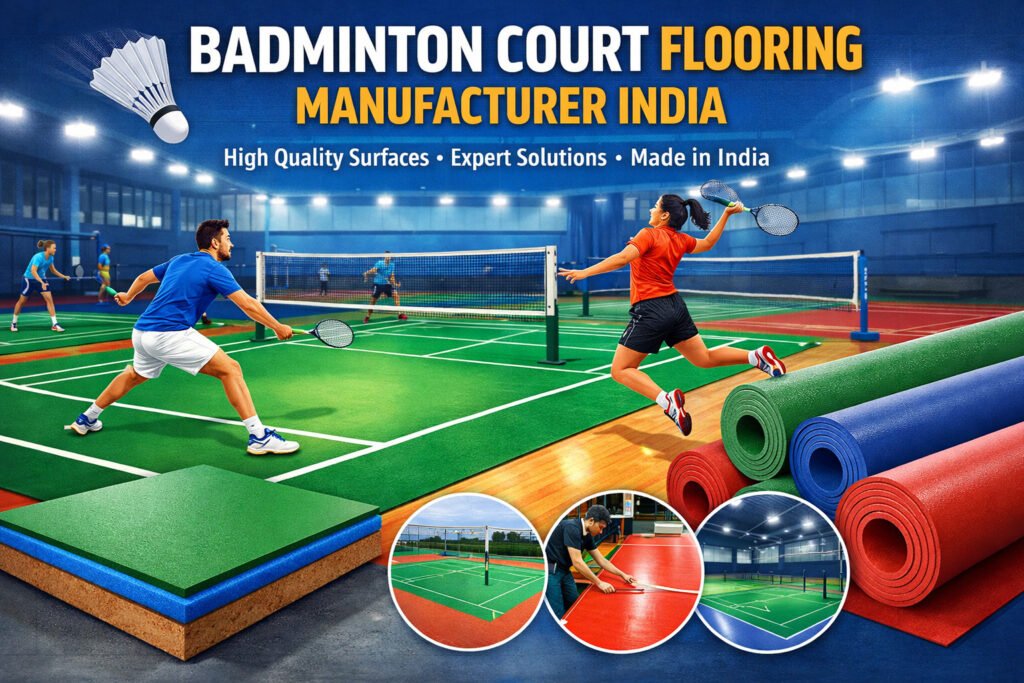
Badminton Court Flooring Manufacturer India

Badminton isn’t just a sport in India—it’s a passion. From local school tournaments to international championships, the game has carved a permanent space in Indian hearts. But here’s something many people overlook: the foundation of every great badminton match isn’t just the players—it’s the floor beneath their feet. That’s where a trusted badminton court flooring manufacturer India plays a crucial role, ensuring the surface delivers safety, performance, and durability for every level of play. A professionally designed badminton court flooring system plays a critical role in performance, safety, and durability. Whether it’s a school building its first sports facility or a stadium preparing for national tournaments, selecting the right badminton court flooring manufacturer in India makes all the difference. Think about it. Players jump, lunge, dive, and sprint across the court. Without proper flooring, injuries become common, movement slows down, and performance suffers. A good badminton floor absorbs shock, offers anti-slip properties, ensures consistent bounce, and supports long playing hours without fatigue. India has seen a surge in demand for high-quality sports infrastructure over the past decade. With government initiatives promoting sports and private academies mushrooming across cities, reliable badminton court flooring manufacturers are more important than ever. But what exactly should you look for? Is synthetic flooring better than wooden? How much does it cost? And which manufacturers truly deliver quality? Let’s break it down step by step. Why Choosing the Right Badminton Court Flooring Manufacturer Matters Choosing a badminton court flooring manufacturer in India isn’t like buying regular tiles for your home. This is a technical decision that directly affects athlete safety and long-term investment value. Imagine building a court with low-quality material. Within a year, the surface starts peeling. Players complain about slippery patches. Maintenance costs rise. Eventually, you’re forced to replace the entire floor. Sounds expensive, right? That’s because it is. A trusted manufacturer ensures: In India, weather conditions also play a big role. Humidity in coastal areas, extreme heat in northern regions, and dust accumulation can impact flooring performance. Experienced Indian manufacturers understand these conditions and design flooring accordingly. Moreover, established companies offer end-to-end services—from base preparation to final line marking. This reduces coordination hassles and ensures consistent quality. Here’s the truth: the cheapest option is rarely the smartest option. Instead, focus on long-term durability, player comfort, and manufacturer credibility. After all, a badminton court isn’t just flooring—it’s an investment in performance. Types of Badminton Court Flooring Available in India Synthetic PVC Flooring Synthetic PVC flooring is currently the most popular choice among badminton court flooring manufacturers in India. Why? Because it strikes a perfect balance between performance, durability, and cost. PVC vinyl sports flooring is designed with multiple layers. The top layer provides anti-skid properties, while the foam or cushion layer beneath absorbs shock. This reduces pressure on knees and ankles, which is crucial during long training sessions. One of the biggest advantages of PVC flooring is consistency. Players experience uniform shuttle bounce and smooth footwork. It’s especially suitable for indoor badminton courts in schools, academies, and stadiums. Another benefit? Easy maintenance. Unlike wooden floors that require polishing, PVC courts are relatively low-maintenance. Just regular cleaning keeps them in top shape. Indian manufacturers now produce BWF-approved PVC flooring, making it suitable even for professional tournaments. If you’re looking for a cost-effective yet high-performance solution, synthetic PVC flooring is often the go-to choice. Wooden Flooring There’s something classic about wooden badminton courts. Many international stadiums still prefer hardwood maple flooring because of its natural feel and excellent shock absorption. Wooden flooring offers superior resilience and player comfort. The slight elasticity reduces fatigue and provides controlled bounce. However, it requires proper sub-floor systems and regular maintenance. In India, wooden flooring is usually installed in premium sports complexes and multi-purpose indoor stadiums. It’s more expensive than synthetic options but delivers unmatched aesthetics and durability when maintained properly. However, humidity control is critical. Without proper ventilation and climate control, wood can expand or contract. This is why only experienced badminton court flooring manufacturers in India should handle such projects. Think of wooden flooring as a luxury sedan—high performance, but requires care. Acrylic Flooring Acrylic flooring is more common in outdoor sports courts but can also be used in certain badminton setups. It’s durable, weather-resistant, and offers decent grip. However, compared to PVC or wood, acrylic surfaces are harder and provide less cushioning. That makes them less ideal for professional indoor badminton courts. Still, for budget-conscious institutions looking to build multi-purpose courts, acrylic can be a practical choice. Polyurethane (PU) Flooring Polyurethane flooring is known for its seamless finish and high durability. It’s poured on-site, creating a smooth and joint-free surface. PU flooring offers excellent elasticity and shock absorption. It’s commonly used in multi-sport indoor arenas across India. Though slightly expensive, it’s long-lasting and requires minimal maintenance. Key Features of High-Quality Badminton Court Flooring When you walk onto a professional badminton court, you can feel the difference immediately. The grip feels right. Your steps are confident. Your knees don’t scream after an hour of play. That’s not accidental—it’s engineering. A high-quality badminton court flooring system is carefully designed to balance performance, safety, and durability. First, let’s talk about shock absorption. This is arguably the most critical feature. Players constantly jump, lunge, and change direction. Without proper cushioning, the impact travels straight to the joints. Over time, this leads to injuries. Premium flooring from leading badminton court flooring manufacturers in India includes layered cushioning systems that reduce stress on knees and ankles. Next is anti-slip performance. Too slippery? Players lose balance. Too sticky? Movement becomes restricted. The right flooring offers controlled friction—just enough grip to prevent slipping but smooth enough for quick footwork. Another key feature is consistent shuttle bounce. Uneven surfaces affect gameplay quality. Professional-grade floors ensure uniform bounce across the entire court. Durability also matters. A good floor should withstand: Finally, easy maintenance is a big plus. Quality flooring resists stains, dust buildup, and wear marks. Because let’s be honest—nobody wants to shut down a court every

Shuttle Court Size
Shuttle Court Measurements, Uncategorized

Shuttle Court Size – Complete Guide to Badminton Court Dimensions

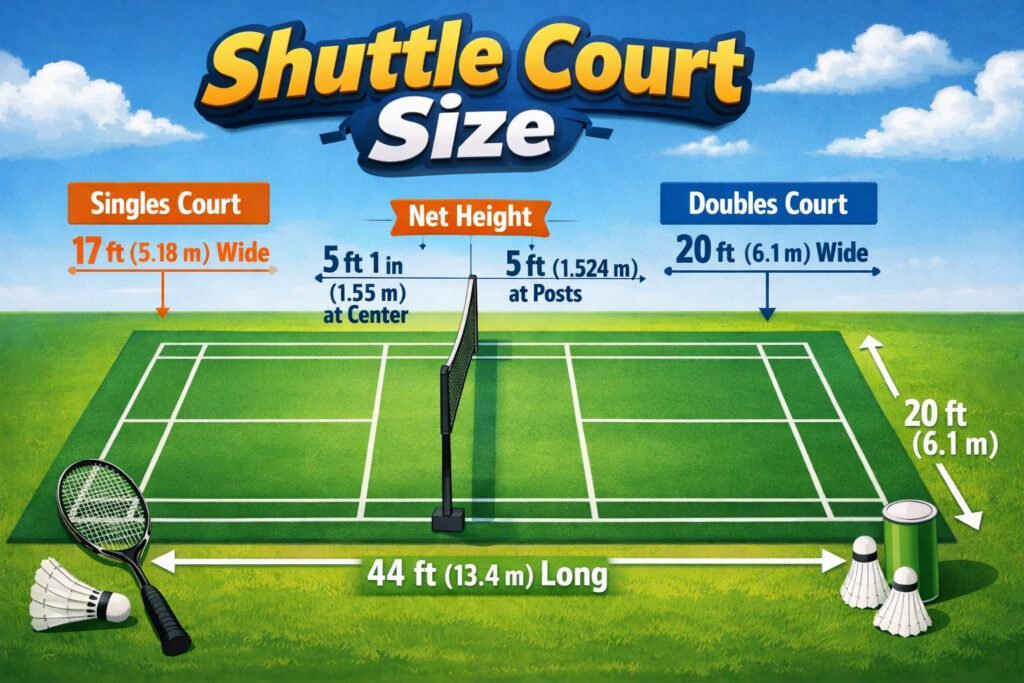
If you’ve ever stepped onto a badminton court and felt like the space was just perfectly balanced—not too big, not too small—you’re not imagining it. The shuttle court size is carefully designed to create a fast, strategic, and physically demanding game. Every inch matters. Whether you’re smashing from the baseline or rushing forward for a net kill, the dimensions of the court quietly shape every movement you make. Badminton may look simple at first glance. Two players. A net. A shuttlecock. But behind that simplicity lies precision. The court size is not random. It’s standardized by the Badminton World Federation (BWF), ensuring that whether you play in London, Tokyo, or your local sports hall, the dimensions remain consistent. That consistency keeps the sport fair and competitive. Why does this matter to you? Because playing on the correct shuttle court size affects everything—your footwork, stamina, shot placement, and even your strategy. A slightly shorter or wider court can completely change rally dynamics. It’s like driving on a road that’s either too narrow or too wide—it alters your rhythm. In this guide, we’ll break down every measurement, line, and requirement in detail. From singles and doubles differences to net height and marking techniques, you’ll get a crystal-clear understanding of shuttle court size. By the end, you won’t just know the dimensions—you’ll understand why they matter. Let’s start with the official numbers. Standard Badminton Court Dimensions When it comes to shuttle court size, precision is everything. The standard badminton court is rectangular and divided equally by a net running across the center. According to official regulations, the full court measures 13.4 meters (44 feet) in length and 6.1 meters (20 feet) in width for doubles matches. These numbers aren’t arbitrary—they’re carefully calculated to balance speed and endurance. Now here’s where it gets interesting. For singles matches, the length remains the same—13.4 meters (44 feet)—but the width changes. The singles court is narrower, measuring 5.18 meters (17 feet) wide. That difference of just under a meter dramatically changes gameplay. In singles, players don’t need to defend the wider doubles sidelines, but they must cover the entire court length alone. That demands exceptional footwork and stamina. Let’s look at it in a simple table: Match Type Length Width Singles 44 ft (13.4 m) 17 ft (5.18 m) Doubles 44 ft (13.4 m) 20 ft (6.1 m) The court lines are typically 40mm (1.6 inches) thick and must be clearly visible, usually painted white or yellow depending on the floor color. Think of the court as a chessboard for speed. The size forces players to think strategically. In doubles, wider angles create more attacking opportunities. In singles, narrower boundaries demand precision and patience. Understanding these standard dimensions is the foundation for everything else—court markings, net placement, and service areas all depend on these measurements. Get this wrong, and the entire game changes. Overall Length and Width Let’s zoom in further on the overall length and width of a shuttle court, because this is where the game truly takes shape. The full length of the court is 44 feet (13.4 meters) from baseline to baseline. This measurement remains constant whether you’re playing singles or doubles. That consistent length ensures rallies maintain their depth and intensity. When you clear the shuttle high to the back of the court, you’re sending it across the entire 44-foot stretch. That distance is what makes baseline rallies so physically demanding. Now, the width tells a different story. For doubles, the court spans 20 feet (6.1 meters) wide. That extra width opens up attacking angles. Smashes down the sideline become lethal weapons. Defensive formations also shift because two players share coverage responsibilities. For singles, however, the width shrinks to 17 feet (5.18 meters). That may not sound like a big difference, but in a fast-paced game like badminton, three feet is massive. It narrows cross-court shots and demands more accuracy. You can’t rely on wide-angle winners as much—you need smarter placement. Imagine the court like a battlefield. In doubles, you fight on a wider front. In singles, the battlefield narrows, but you’re alone. The unchanged length ensures stamina remains equally tested in both formats. Another important detail? The diagonal measurement of the doubles court is approximately 14.73 meters (48.3 feet). This affects how cross-court shots travel and explains why diagonal smashes feel longer and more dramatic. The overall dimensions are not just numbers—they’re the invisible framework shaping every rally. Once you internalize these measurements, your court awareness improves dramatically. Singles vs Doubles Court Dimensions This is where many beginners get confused. The shuttle court size changes depending on whether you’re playing singles or doubles—but not in the way most people expect. In singles, the court is long and narrow. You use the inner sidelines but the full baseline. That means shots must land within the 17-foot width but can travel the entire 44-foot length. Because you’re alone on your side, endurance becomes critical. Every drop shot pulls you forward. Every clear pushes you back. There’s no partner to save you. In doubles, the court is shorter for serves but wider overall. The width expands to 20 feet, including the outer sidelines. However, during service in doubles, players must serve within the shorter long service line (not the baseline). That subtle change adds a layer of tactical complexity. Here’s a quick comparison: Why does this matter so much? Because strategy shifts completely. In singles, you build rallies and exploit movement. In doubles, rallies are faster and more aggressive. The extra width creates sharper attacking angles, while teamwork reduces individual court coverage. Think of singles as a marathon with sprints, and doubles as a rapid-fire duel. Same court length. Different battlefield width. Different tactics. Understanding these differences ensures you mark the court correctly and adapt your game accordingly. Detailed Court Markings and Lines If the shuttle court size is the skeleton of the game, then the court markings are its nervous system. Every line has a purpose. Every boundary shapes a decision. A shuttle

Pickleball Court
Pickleball court

Pickleball Court: The Complete Guide to Design, Dimensions, Surfaces, and Setup

Pickleball courts are popping up everywhere — from neighborhood parks and school gyms to luxury resorts and backyard driveways. If you’ve noticed more people holding paddles and rallying over a smaller net, you’re not imagining things. Pickleball has exploded in popularity, becoming one of the fastest-growing sports in the world. And at the center of it all? The pickleball court. But what exactly makes a pickleball court different from a tennis or badminton court? Why are cities converting tennis courts into pickleball spaces? And what should you know if you’re thinking about building one yourself? A pickleball court may look simple at first glance, but every line, measurement, and surface detail serves a purpose. The court is carefully designed to encourage fast-paced rallies, strategic placement, and accessibility for players of all ages. Unlike tennis, the smaller size reduces excessive running, making it easier on the joints while still delivering intense competition. Whether you’re a beginner just learning the game, a homeowner considering a backyard setup, or a facility manager planning new installations, understanding pickleball court fundamentals is essential. Think of the court as the foundation of the game — like a stage for a performance. When it’s designed correctly, everything flows smoothly. When it’s not, frustration quickly sets in. In this guide, we’ll break down everything you need to know about pickleball courts — dimensions, surfaces, indoor vs outdoor differences, construction costs, and even common design mistakes. By the end, you’ll have a crystal-clear understanding of how a proper pickleball court should look, feel, and function. Let’s start with the most important piece of the puzzle: the official dimensions. Official Pickleball Court Dimensions When it comes to building or marking a pickleball court, precision matters. A few inches off might not seem like a big deal, but in competitive play, it can completely change the dynamics of the game. The good news? The official pickleball court dimensions are straightforward and standardized. A regulation pickleball court measures 20 feet wide by 44 feet long. That’s the same size whether you’re playing singles or doubles. Unlike tennis, where singles and doubles courts differ, pickleball keeps it simple. The compact size is one of the reasons the sport is so accessible — you don’t need massive space to play. However, the total recommended play area is larger than just the court lines. Ideally, you should allow at least 30 feet by 60 feet of space to provide safe movement around the court. For tournament settings, even more clearance is recommended. Why? Because players need room to chase lobs, reset points, and avoid collisions with fences or walls. The court is divided into distinct sections: The net stretches across the center, standing 36 inches high at the sidelines and 34 inches high in the middle. That slight dip in the center is intentional and plays a strategic role during rallies. Compared to a tennis court, a pickleball court is significantly smaller — roughly one-third the size. That smaller footprint allows multiple pickleball courts to fit inside a single tennis court area. It’s like turning a large open field into several smaller soccer pitches — maximizing space and increasing participation. If you’re planning to build a court, accuracy is non-negotiable. Even minor measurement errors can disrupt serving angles, kitchen play, and competitive balance. Next, let’s zoom in on the most talked-about section of the court — the non-volley zone. Non-Volley Zone (The Kitchen) Explained If there’s one area of the pickleball court that sparks debate, strategy, and sometimes frustration, it’s the non-volley zone — affectionately known as “the kitchen.” This seven-foot-deep area on both sides of the net changes everything about how pickleball is played. So, what exactly is the kitchen? The non-volley zone extends 7 feet from the net on both sides, spanning the entire 20-foot width of the court. Players are not allowed to volley the ball (hit it out of the air) while standing inside this zone. In fact, you can’t even step on the kitchen line during a volley. If your momentum carries you into the kitchen after hitting a volley, it’s a fault. Why does this rule exist? Simple. It prevents players from camping at the net and smashing every shot downward. Without the kitchen rule, pickleball would turn into a power-dominant game. Instead, it encourages finesse, control, and strategic placement. Players must rely on soft shots — known as “dinks” — to outmaneuver opponents. Think of the kitchen as a chessboard within the court. It forces patience. It rewards touch over brute force. It levels the playing field between younger, powerful players and older, more strategic ones. Interestingly, you can enter the kitchen anytime — just not to volley. If the ball bounces first, you’re free to step in and return it. This creates fast-paced exchanges where players hover near the line, ready to react. The kitchen line itself is part of the non-volley zone. That detail trips up many beginners. Step on the line during a volley? That’s a fault. Understanding the kitchen is crucial because most advanced pickleball rallies are won or lost in this seven-foot strip. Master it, and your entire game transforms. Up next, we’ll break down the net requirements and why its height plays a subtle but important role in strategy. Net Height and Placement Requirements The pickleball net might look simple, but don’t let that fool you. Its height, tension, and placement quietly shape every rally, every dink exchange, and every dramatic point-winning shot. If the court is the stage, the net is the main character dividing the action. Officially, a pickleball net stands 36 inches high at the sidelines and 34 inches high at the center. That two-inch dip in the middle isn’t random — it’s intentional. The lower center subtly encourages cross-court dinks and strategic placement shots. If the net were flat all the way across, the game would feel very different. The net should stretch fully across the 20-foot width of the court and extend at least 12 inches









Synthetic Sports Flooring
High-Quality Synthetic Sports Flooring

Rise of Synthetic Sports Flooring in India

India is witnessing a silent revolution beneath the feet of its athletes, driven by the rapid rise of synthetic sports flooring in India. Walk into a modern sports complex today—whether in Delhi, Mumbai, Bengaluru, or even tier-2 cities—and you’ll notice something different. The dusty, uneven grounds and cracked concrete courts are steadily being replaced with vibrant, cushioned, high-performance surfaces. This transformation isn’t accidental. It reflects a larger shift in how India perceives sports, fitness, and infrastructure. Synthetic sports flooring has emerged as a game-changer in this evolution. As sports culture expands beyond cricket into badminton, basketball, athletics, tennis, futsal, and more, the need for professional-grade surfaces has become undeniable. After all, would you expect athletes to deliver world-class performances on outdated grounds? Probably not. The rise of synthetic sports flooring in India is closely linked to urbanization, increased health awareness, private investments, and government-backed sports initiatives like Khelo India. Schools are upgrading their playgrounds. Residential societies are installing multi-sport courts. Even rural areas are slowly adopting modern flooring systems to support aspiring athletes. But what exactly is synthetic sports flooring, and why is it gaining so much traction? Is it just about aesthetics, or does it genuinely enhance performance and safety? Let’s break it down and explore how this industry is reshaping India’s sporting landscape—one court at a time. What Is Synthetic Sports Flooring? Synthetic sports flooring refers to specially engineered surfaces made from artificial materials like polyurethane, acrylic, PVC, rubber, or synthetic turf, designed specifically for sports activities. Unlike traditional mud, grass, or cement surfaces, these floors are built with performance, durability, and athlete safety in mind. Think of it as upgrading from a basic bicycle to a high-performance sports bike. Both can take you from point A to point B, but the experience, comfort, and efficiency are worlds apart. Synthetic flooring offers shock absorption, better grip, consistent bounce, and improved traction—all of which directly impact athletic performance. These floors are not one-size-fits-all. Different sports require different surface properties. For example: The materials are layered carefully. A typical system may include a base layer for stability, a cushioning layer for shock absorption, and a topcoat for grip and durability. This multi-layered construction ensures athletes can train longer and compete harder without excessive strain on their joints. In India, where climate conditions vary drastically—from humid coastal regions to dry northern plains—synthetic sports flooring offers adaptability. Many surfaces are UV-resistant, water-resistant, and designed to withstand heavy foot traffic. In simple terms, synthetic sports flooring transforms ordinary spaces into high-performance arenas. It bridges the gap between amateur play and professional standards, allowing athletes to train in conditions similar to international venues. Evolution from Traditional to Modern Surfaces Not too long ago, most sports activities in India took place on basic surfaces—mud fields, cemented courtyards, or natural grass grounds. While these surfaces served generations of athletes, they came with limitations. Uneven terrain led to injuries. Grass fields required constant maintenance. Cement courts were hard on knees and ankles. As India began producing more professional athletes competing at global platforms, the shortcomings of traditional surfaces became evident. Performance consistency matters. Injury prevention matters even more. The shift toward synthetic sports flooring began in metropolitan cities and elite institutions. Initially, it was considered a luxury—something only international schools or high-end sports clubs could afford. But over time, the narrative changed. It became less about luxury and more about necessity. Urbanization played a crucial role. With shrinking open spaces, multi-purpose courts became popular. Synthetic surfaces allowed multiple sports to be played on a single ground without damaging the base. This flexibility made them economically attractive. Another turning point was India hosting international tournaments. Exposure to global standards raised expectations. Athletes training on substandard surfaces found it difficult to adjust to professional tracks abroad. The solution? Upgrade the home infrastructure. Today, synthetic sports flooring is no longer confined to elite spaces. Tier-2 and tier-3 cities are investing in acrylic tennis courts, PU running tracks, and artificial turf football fields. Even government schools are slowly transitioning toward modern surfaces under sports development schemes. The journey from mud fields to high-tech flooring mirrors India’s broader development story—a nation stepping confidently toward global standards while nurturing grassroots talent. Why India Is Embracing Synthetic Sports Flooring If you pause for a moment and observe the sports ecosystem in India today, you’ll notice something remarkable—it’s no longer limited to cricket stadiums packed with fans. Badminton academies are flourishing, football leagues are expanding, marathons are filling city streets, and children are choosing basketball and skating alongside traditional games. This cultural shift is one of the strongest reasons behind the rapid rise of synthetic sports flooring in India. Sports are no longer just extracurricular activities; they’re careers, passions, and even lifestyle choices. Parents who once insisted on textbooks now encourage professional coaching. Schools compete in inter-state tournaments. Corporate houses sponsor leagues. With this surge in participation comes the demand for professional-grade infrastructure. And let’s be honest—no serious athlete wants to train on a cracked cement floor. Another driving factor is urban development. As cities expand vertically, open playgrounds shrink. Synthetic sports flooring allows multi-purpose courts to be installed in compact spaces like rooftops, basements, and residential complexes. A single synthetic court can host badminton in the morning, basketball in the afternoon, and futsal in the evening. That kind of flexibility is a game-changer. Moreover, awareness about injury prevention is growing. Coaches and fitness experts now emphasize the importance of shock-absorbing surfaces. Hard concrete can damage joints over time, especially for young athletes. Synthetic floors reduce impact stress, offering safer playing conditions. In short, India is embracing synthetic sports flooring because it aligns perfectly with its evolving sports culture—modern, ambitious, and performance-driven. Growing Sports Culture and Awareness India’s sports narrative is undergoing a powerful transformation. Gone are the days when cricket overshadowed every other sport. Today, athletes like PV Sindhu, Neeraj Chopra, Mary Kom, and Mirabai Chanu have inspired millions. Their success stories have ignited a nationwide realization: with the right training and infrastructure,

Running Track
running track

Running Track: The Complete Guide To Design, Benefits, And Performance

Have you ever stepped onto a running track early in the morning, felt the cool surface under your shoes, and sensed that electric possibility in the air? There’s something special about a running track. It’s not just a loop of rubber or asphalt—it’s a stage where personal records are broken, dreams are chased, and discipline is tested one lap at a time. A running track is a specially designed oval-shaped course built for competitive racing, training, and fitness activities. Whether it’s in a massive Olympic stadium or behind your local high school, the purpose remains the same: to provide a standardized, safe, and performance-optimized surface for runners. Unlike running on roads or trails, a track offers consistency. Every lap is measured. Every curve is engineered. Every lane tells a story of speed, stamina, and sweat. Running tracks have evolved significantly over time. What began as simple dirt or cinder paths has transformed into highly engineered synthetic surfaces designed for optimal grip and shock absorption. Today’s tracks are built using advanced materials that reduce injury risks while enhancing performance. But here’s the real question—why does it matter? Because the surface you run on shapes your performance. Think of a running track as the canvas and the athlete as the artist. The better the canvas, the more precise and powerful the masterpiece. In this guide, we’ll explore everything about running tracks—from their design and materials to their benefits and future innovations. Whether you’re an athlete, coach, school administrator, or fitness enthusiast, you’re about to discover why the running track remains one of the most important inventions in modern sports. The Evolution of Running Tracks Running tracks haven’t always been the smooth, springy surfaces we know today. In fact, their history is a fascinating journey of innovation, science, and athletic ambition. In ancient Greece, athletes competed on straight dirt tracks during the original Olympic Games. There were no synthetic materials, no precision measurements—just raw earth beneath their feet. Fast forward to the 19th and early 20th centuries, and cinder tracks became the standard. These were made from crushed brick, coal cinders, or clay. While they offered better traction than plain dirt, they were far from perfect. Rain could turn them into muddy messes, and dry conditions often made them dusty and uneven. Then came the revolution of synthetic tracks in the 1960s. The 1968 Mexico City Olympics introduced the world to a polyurethane track surface, forever changing the sport. Suddenly, athletes were running faster times. Records began falling. Why? Because the surface returned more energy to the runner, acting almost like a subtle springboard. Modern running tracks are now built with multiple layers—an asphalt or concrete base, followed by rubber granules and polyurethane coatings. These surfaces are designed to balance cushioning and responsiveness. Too soft, and you lose energy. Too hard, and you risk injury. The perfect track sits somewhere in between. The evolution didn’t stop there. Today, technology allows for custom surface tuning, improved drainage systems, and environmentally friendly materials. Tracks are no longer just functional—they are engineered for peak performance. When you run on a modern track, you’re benefiting from centuries of trial, error, and innovation. It’s amazing to think that every stride you take connects you to a long history of athletic progress. Why Running Tracks Matter in Modern Sports Let’s be honest—couldn’t athletes just run anywhere? Roads, parks, beaches? Technically, yes. But would they achieve the same consistency, safety, and measurable improvement? Probably not. Running tracks matter because they provide standardization. In competitive sports, fairness is everything. A 400-meter lap on one track must equal a 400-meter lap on another. This uniformity ensures that race times are accurate and comparable worldwide. Without standardized tracks, world records would mean very little. Beyond competition, tracks are essential for training precision. Coaches rely on exact distances to design workouts. Need to run 8 x 400 meters at race pace? On a track, that’s simple. No GPS guessing. No uneven terrain. Just pure, measurable effort. Safety is another major factor. Road running exposes athletes to traffic, potholes, and unpredictable surfaces. Trails introduce rocks and uneven ground. A running track, by contrast, is designed specifically for forward motion at high speeds. The surface reduces impact stress on joints while providing optimal grip. Running tracks also serve as community hubs. High school tracks host local meets. College stadiums bring crowds together. Public tracks offer a free fitness space for residents. They become gathering points where ambition meets opportunity. In modern sports science, marginal gains matter. A fraction of a second can separate gold from silver. Running tracks provide the controlled environment necessary to chase those tiny improvements. Think of them as laboratories for speed. Without running tracks, athletics wouldn’t look the same. Records would fluctuate wildly. Training would be less precise. Injuries might be more common. In many ways, the running track is the silent partner in every great race. Types of Running Tracks Not all running tracks are created equal. While they may look similar from a distance—an oval with lanes—their surfaces, structure, and purpose can vary significantly. Choosing the right type depends on usage, climate, budget, and level of competition. Broadly speaking, running tracks fall into two main categories: outdoor and indoor. Each has unique characteristics tailored to specific needs. Outdoor tracks are the most common. You’ll find them in schools, universities, and stadiums worldwide. They’re built to withstand weather conditions—rain, heat, wind, and even snow in some regions. Their materials are chosen for durability and drainage efficiency. Indoor tracks, on the other hand, are designed for climate-controlled environments. These are typically shorter—often 200 meters per lap—and may include banked curves to compensate for tighter turns. Surface materials also differentiate track types. Some are synthetic and high-performance. Others, especially in smaller communities, may still use older materials like cinder or even grass. Each type serves a purpose. A professional athlete training for international competition will likely prefer a high-quality synthetic track. A recreational runner may simply appreciate a well-maintained school track. Understanding

How to Maintain a Basketball Court
Basketball Courts

How to Maintain a Basketball Court: The Complete Practical Guide

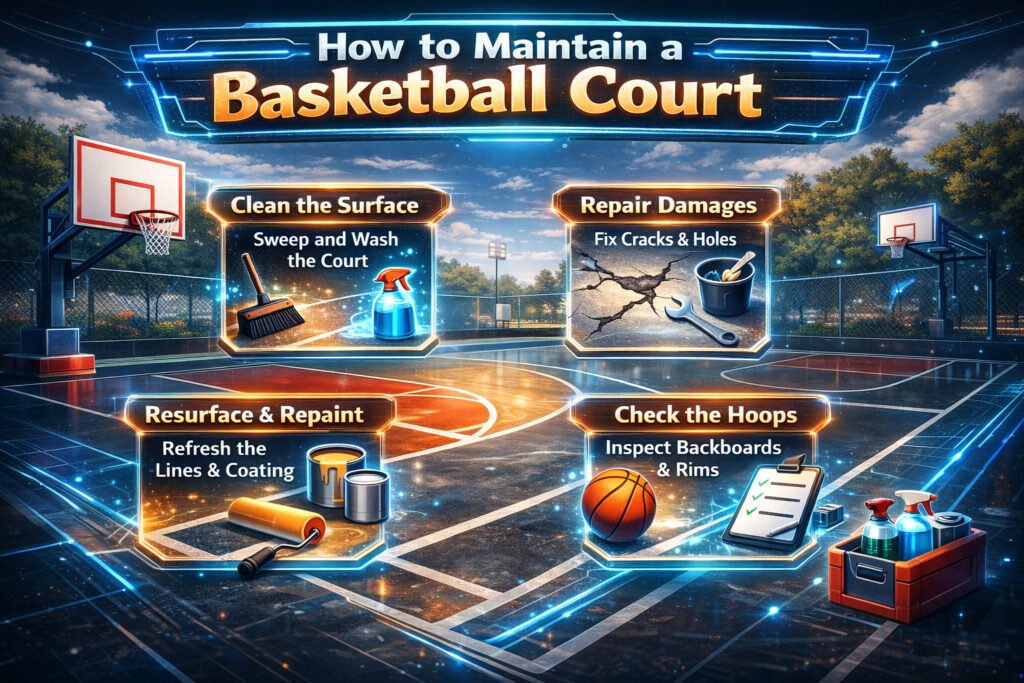
A basketball court isn’t just a slab of concrete or a shiny wooden floor with painted lines—it’s the heart of competition, community, and countless memories. Understanding How to Maintain a Basketball Court is essential if you want to preserve that heart for years to come. Whether it’s a school gym packed with cheering fans or a neighborhood outdoor court where pickup games never seem to end, the condition of the court directly affects how the game feels. Have you ever tried playing on a dusty floor where your sneakers slide like you’re on ice? Or on a cracked outdoor court where the ball bounces unpredictably? It’s frustrating—and more importantly, it’s dangerous. Maintaining a basketball court isn’t just about keeping it looking good. It’s about safety, performance, durability, and saving money in the long run. A well-maintained court provides consistent ball bounce, proper grip, and reduces injury risks. On the other hand, neglect leads to warped wood, widening cracks, faded lines, rusted rims, and eventually, expensive renovations. Think of your basketball court like a car. If you change the oil regularly and fix small issues early, it runs smoothly for years. Ignore it, and one day you’re stuck with a major repair bill. The same logic applies here. In this complete guide, we’ll walk step-by-step through everything you need to know about maintaining a basketball court—indoor or outdoor. From daily cleaning routines to resurfacing strategies, from crack repair to budgeting, this guide covers it all in practical, real-world terms you can actually use. Let’s start with understanding what type of court you’re dealing with—because maintenance always begins with knowing your surface. Understanding Different Types of Basketball Courts Before grabbing a broom or pressure washer, you need to know what kind of court you’re working with. Not all basketball courts are created equal, and maintaining a hardwood indoor floor is vastly different from caring for an outdoor asphalt surface. Treating them the same way can cause serious damage. Indoor Hardwood Courts Indoor courts are typically made of maple hardwood, prized for its durability and consistent bounce. These courts have a protective polyurethane finish that provides shine and grip. However, they are extremely sensitive to moisture. Even small amounts of water can seep into the wood, causing warping, cupping, or swelling. Humidity levels also play a major role. Too much moisture in the air? The wood expands. Too little? It contracts and cracks. That’s why climate control is critical in gyms. Outdoor Concrete Courts Concrete courts are tough and long-lasting, but they’re not indestructible. Weather is their biggest enemy. Rainwater can seep into small pores and freeze during winter, causing expansion and cracking. UV rays can fade paint and weaken surface coatings. Asphalt Courts Asphalt provides a slightly softer surface than concrete, but it requires more frequent maintenance. It’s more susceptible to cracking, potholes, and surface breakdown over time, especially in hot climates. Synthetic and Modular Tile Courts These are becoming increasingly popular. Made of interlocking plastic tiles or rubberized surfaces, they offer better shock absorption. Maintenance is easier, but tiles can loosen or shift if not regularly inspected. Understanding your court type is step one. Maintenance strategies depend entirely on what lies beneath your feet. Why Regular Maintenance Is Non-Negotiable You might think, “It’s just a court. How bad can it get?” The answer: very bad, very fast. Skipping routine maintenance is like ignoring a leaky roof—it might seem minor at first, but it compounds quickly. Player Safety Concerns Safety should always come first. Dusty indoor floors reduce traction, increasing the risk of slips and ankle injuries. Outdoor cracks can trip players mid-sprint. Loose rims or unstable backboards can cause catastrophic accidents. Small issues become hazards. A minor crack today can become a twisted ankle tomorrow. Regular maintenance minimizes these risks dramatically. Performance and Game Quality Basketball is a precision sport. Dribbling, passing, cutting—everything depends on reliable surface response. If the ball doesn’t bounce consistently because of surface damage, the entire game changes. It’s like trying to play soccer on a field full of potholes. Clean courts also improve grip. Players can pivot, stop, and explode with confidence. That consistency matters whether you’re hosting a competitive tournament or just enjoying weekend games. Long-Term Cost Savings Here’s the financial truth: preventive maintenance costs far less than full resurfacing or reconstruction. Filling small cracks costs a fraction of replacing an entire court. Regular cleaning protects protective coatings, extending the life of your investment. Think of maintenance as insurance. You’re protecting thousands—sometimes hundreds of thousands—of dollars in infrastructure. Skipping routine care almost always leads to larger expenses down the line. In short, regular maintenance isn’t optional. It’s the foundation of safety, performance, and smart budgeting. Daily Basketball Court Maintenance Routine Daily maintenance might sound excessive, but it’s actually simple—and incredibly effective. Just a small amount of attention each day can prevent long-term damage. Sweeping and Dust Removal Dust is the silent enemy of basketball courts, especially indoor hardwood. Every shoe that steps onto the floor brings dirt particles. Over time, those particles act like sandpaper, wearing down the protective finish. Use a microfiber dust mop daily. Avoid traditional brooms that simply push dust into the air. Microfiber traps particles effectively without scratching the surface. Outdoor courts should also be cleared of debris—leaves, small rocks, and trash. These not only affect ball bounce but can also stain surfaces if left too long. Spot Cleaning Spills Immediately Spilled water bottles, sports drinks, or rainwater tracked indoors must be cleaned immediately. Liquids left sitting on hardwood can seep into seams and cause swelling. Use a slightly damp mop with a manufacturer-approved cleaner. Never soak the floor. When it comes to hardwood, less water is always better. Inspecting for Damage Take five minutes daily to visually inspect the surface. Look for: Catching issues early prevents them from growing into expensive problems. Daily maintenance isn’t complicated—it’s about consistency. Like brushing your teeth, it’s a small daily habit that prevents major future headaches. Weekly Maintenance Checklist Daily care keeps the

What Surface Is Used at the US Open
tennis court

What Surface Is Used at the US Open?

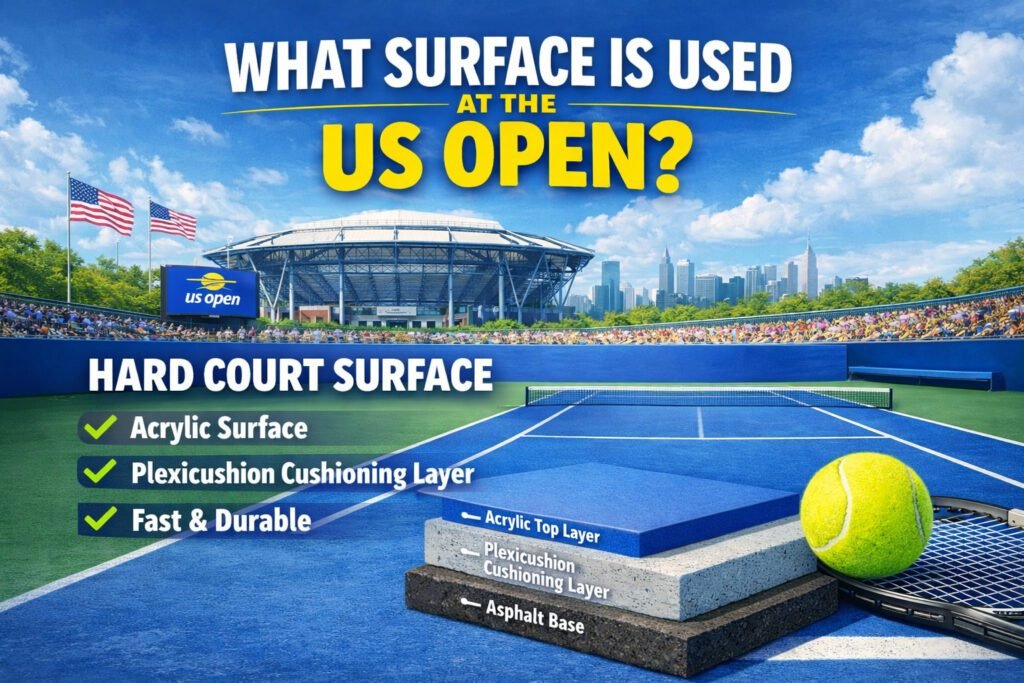
If you’ve ever watched a tennis match and wondered why some players glide across the court like dancers while others seem to struggle for balance, the answer often lies right beneath their feet. The surface of a tennis court isn’t just paint and pavement—it’s the silent architect of the game. That’s exactly why so many fans ask, “What Surface Is Used at the US Open?” And when it comes to the US Open, the surface plays a massive role in shaping how matches unfold. Tennis is unique among major sports because it’s played on different surfaces at the highest level. Imagine if basketball were sometimes played on concrete and other times on sand—it would completely change the way athletes perform. That’s exactly what happens in tennis. The court dictates the speed of the ball, the height of the bounce, the rhythm of rallies, and even how long points last. The US Open, one of the four Grand Slam tournaments, is known for its fast-paced, high-energy matches. But why? What’s under the players’ shoes that creates that intensity? The answer lies in its hard court surface—a carefully engineered system designed to balance speed, consistency, and durability. But here’s where it gets interesting: the US Open surface hasn’t always been the same. Over the decades, it has evolved from grass to clay to modern hard court technology. Each change has influenced champions, playing styles, and even the history of the sport itself. In this article, we’re going deep. Not just “it’s a hard court” deep—but layer-by-layer, history-by-history, strategy-by-strategy deep. By the end, you’ll understand exactly what surface is used at the US Open, why it matters, and how it shapes one of the biggest events in sports. Let’s start where it all began. A Brief History of the US Open Playing Surface The US Open didn’t always look like it does today. In fact, if you could travel back to its earliest days, you might not even recognize it. The tournament has undergone dramatic surface transformations, each marking a new era in tennis. Grass Era: The Early Years When the US Open first began in 1881—then called the U.S. National Championships—it was played on grass. Yes, the same surface Wimbledon uses today. Grass courts were the gold standard of tennis at the time. They were elegant, traditional, and incredibly fast. Grass produces a low, skidding bounce. That meant players who had strong serves and sharp volleys thrived. Points were shorter, rallies were quicker, and serve-and-volley tennis dominated. Imagine blink-and-you-miss-it exchanges—that was grass-court tennis. But grass came with challenges. It required meticulous maintenance. Rain could turn it slippery and dangerous. High foot traffic wore it down quickly, creating uneven bounces. For a growing tournament like the US Open, that became a serious issue. FAs tennis expanded in popularity, organizers realized they needed something more durable. Transition to Clay (Har-Tru) In 1975, the US Open made a bold move: it switched from grass to clay. But not the red clay used at the French Open. Instead, it adopted Har-Tru, a green clay surface made from crushed stone. This change dramatically altered the style of play. Clay slows the ball down and produces higher bounces. Suddenly, rallies lasted longer. Baseline players had more time to construct points. Patience and endurance became critical weapons. For three years—1975 to 1977—the US Open was a clay-court major. It’s a fascinating footnote in tennis history because it briefly aligned the US Open more closely with Roland Garros than with Wimbledon. However, clay also required heavy maintenance and was vulnerable to weather. Plus, American tennis culture was shifting toward hard courts, which were becoming increasingly popular across the country. So once again, change was on the horizon. The Move to Hard Courts In 1978, the US Open relocated to the USTA National Tennis Center (now the Billie Jean King National Tennis Center) in Flushing Meadows, New York. Along with the new venue came a new surface: hard court. This marked the beginning of the modern US Open era. Hard courts offered durability, consistency, and less maintenance compared to grass or clay. They provided a middle ground in terms of speed—not as fast as grass, not as slow as clay. For tournament organizers, it was practical. For players, it was a new challenge. And this is where the surface story really gets interesting. What Surface Is Used at the US Open Today? Today, the US Open is played on a hard court surface known as Laykold. But that simple answer barely scratches the surface—pun intended. A hard court isn’t just a slab of concrete painted blue. It’s a carefully engineered, multi-layered system designed for performance, consistency, and player safety. Let’s break it down. Understanding Hard Courts At its core, a hard court is built on an asphalt or concrete foundation. On top of that base are multiple layers of acrylic materials. These coatings determine how fast the ball travels and how high it bounces. Think of it like building a high-performance track for sprinters. The base provides structure, but the top layers control traction, shock absorption, and speed. Hard courts are considered “true bounce” surfaces. That means the ball reacts predictably. Unlike grass, which can produce bad bounces, or clay, which can be affected by loose material, hard courts are consistent. Players can trust the bounce. This predictability is one reason the US Open produces such high-quality shot-making. Players can swing confidently, knowing how the ball will respond. The Role of Acrylic Layers The acrylic layers on top of the concrete aren’t just for color. They’re engineered to control pace and cushioning. These layers include: The texture determines how much the ball grips the surface. More texture means more friction, which slows the ball down. Less texture means faster play. The US Open surface is generally categorized as medium-fast. That balance allows aggressive players to attack while still giving defenders a fighting chance. It’s like tuning a guitar—you adjust the tension until you get just the right sound. The Importance

Basketball Court Diagram

Basketball Court Diagram: A Complete Guide to Understanding Every Line and Marking

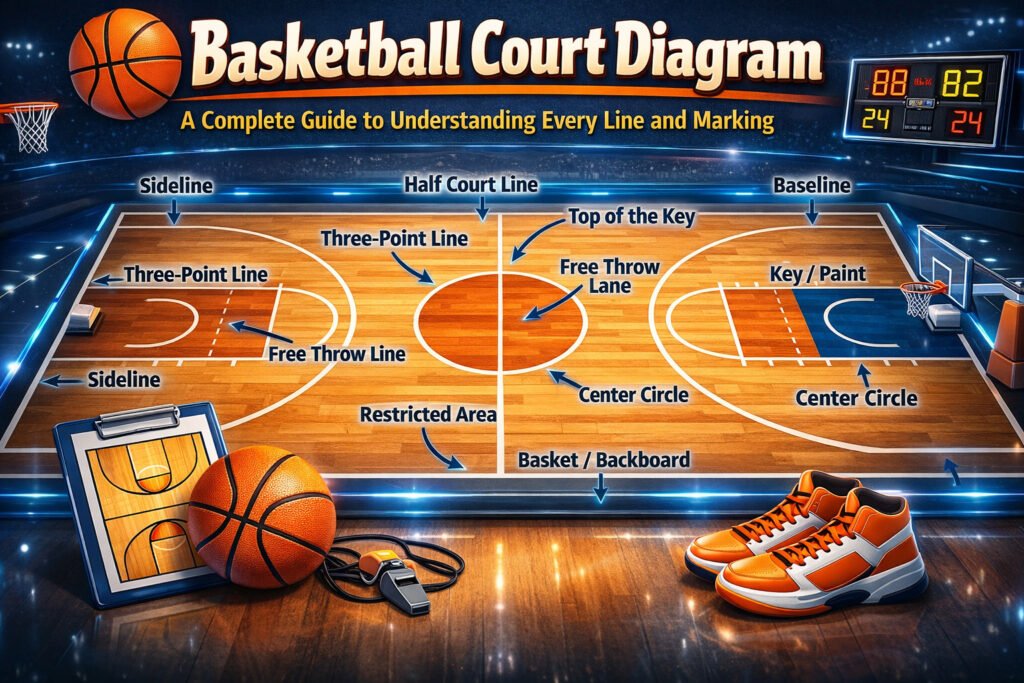
If you’ve ever looked at a basketball court diagram and thought, “Why are there so many lines?” — you’re not alone. At first glance, it might look like a maze of arcs, rectangles, and boundaries. But here’s the thing: every single line painted on that hardwood has a purpose. Nothing is random. Nothing is decorative. Each marking shapes how the game is played, how strategies unfold, and how referees enforce the rules. A basketball court diagram is essentially a blueprint of the game itself. It shows the precise layout of the playing surface — from the center circle where the game tips off, to the three-point arc that has transformed modern basketball into a fast-paced scoring spectacle. Whether you’re a player, coach, student, or simply a fan trying to understand the game more deeply, learning how to read a basketball court diagram gives you a completely new appreciation for the sport. Think of it like reading a map. If you don’t understand the symbols, you’re just staring at shapes. But once you know what they represent, suddenly you can navigate with confidence. The same goes for basketball. The diagram helps you understand spacing, positioning, rules, and tactics. In this guide, we’ll break down every major component of the basketball court diagram in detail. You’ll learn the measurements, the rules connected to each line, and how these markings influence gameplay. By the end, you won’t just recognize the lines — you’ll understand the story they tell. Let’s step onto the court. Official Basketball Court Dimensions Before diving into specific lines and markings, it’s crucial to understand the overall size of a basketball court. After all, every diagram is built around standardized measurements. And yes — those measurements vary depending on the league. In the NBA, the official court dimensions are 94 feet long and 50 feet wide. That’s about 28.65 meters by 15.24 meters. It’s a rectangular surface designed for speed, spacing, and high-level athletic performance. The length allows for fast breaks, while the width creates room for strategic movement and shooting angles. FIBA courts, which are used in international competitions, are slightly smaller. They measure 28 meters long by 15 meters wide (approximately 91.9 feet by 49.2 feet). The difference might seem minor, but even a few feet can affect spacing and defensive coverage. Players who compete internationally often notice these subtle changes. College (NCAA) courts in the United States use the same dimensions as NBA courts — 94 by 50 feet. High school courts are typically the same size as well, though some older gymnasiums may be slightly smaller. Why does size matter so much? Because basketball is a game of space. Spacing determines offensive flow, defensive pressure, and transition opportunities. A larger court demands more stamina. A slightly smaller one can feel more compact and physical. When you look at a basketball court diagram, the outer rectangle represents this full playing area. Everything else — the arcs, circles, and painted areas — fits within these boundaries. Understanding these base dimensions gives you context for every other marking we’ll discuss. It’s the foundation. And like any good blueprint, the details only make sense once you understand the frame. The Center Circle and Midcourt Line Right at the heart of the basketball court diagram sits the center circle — a simple yet symbolic marking. This is where the game begins. The opening tip-off happens here, setting the tone for everything that follows. The center circle has a radius of 6 feet in NBA courts. At the very middle lies the exact midpoint of the court, intersected by the midcourt line (also called the half-court line). This line divides the playing surface into two equal halves: the frontcourt and the backcourt. But this isn’t just about starting the game. The midcourt line plays a huge role in gameplay rules. Once the offensive team advances the ball past this line into the frontcourt, they cannot bring it back into the backcourt. Doing so results in a backcourt violation. This rule prevents teams from stalling and encourages continuous offensive action. There’s also the 8-second rule (in NBA and FIBA), which requires a team to move the ball across the half-court line within eight seconds of gaining possession. Miss that window? Turnover. Strategically, the midcourt line also influences defensive schemes. Full-court presses begin in the backcourt, aiming to trap opponents before they can cross the line. Meanwhile, offenses carefully design inbound plays to beat aggressive pressure. In a basketball court diagram, the center circle may look simple — just a circle bisected by a straight line. But don’t underestimate it. This is the dividing line between defense and attack, hesitation and commitment, control and chaos. Every possession crosses this threshold. And every game begins right here. The Three-Point Line If one line has revolutionized basketball more than any other, it’s the three-point line. On a basketball court diagram, it appears as a large arc stretching around the perimeter of the offensive half. But in reality, it represents one of the most strategic elements of modern basketball. In the NBA, the three-point line is 23 feet 9 inches from the basket at the top of the arc, and 22 feet in the corners. FIBA’s three-point line is slightly shorter at 22 feet 1.75 inches (6.75 meters). College basketball has its own measurement as well. That slight difference in distance dramatically affects gameplay. A shorter line increases shooting percentages. A longer one demands greater range and strength. Why is the three-point line so important? Because shots made beyond it are worth three points instead of two. That extra point changes everything. Teams now design entire offenses around spacing the floor to create open three-point shots. Players train specifically to extend their shooting range. Defensively, guarding the three-point arc requires quick rotations and awareness. Leave a shooter open for a split second, and you could give up three points in the blink of an eye. On the court diagram, the arc intersects with straight lines in

Tennis Court
tennis court

Why Summer is the Best Time to Resurface Your Tennis Court

If you’ve been staring at cracks on your tennis court or noticing that the bounce just doesn’t feel right anymore, you’re not alone. Every tennis court—whether it’s at a private residence, a school, or a country club—eventually reaches a point where resurfacing becomes necessary. And here’s the thing: timing matters more than most people realize. While resurfacing can technically be done in several seasons, summer stands out as the clear winner. Think of your tennis court like a car. You wouldn’t paint it during a rainstorm, right? The same logic applies here. The materials used in tennis court resurfacing—especially acrylic coatings—respond directly to environmental conditions. Heat, sunlight, and dry air play a huge role in how well those materials bond and cure. Summer offers the perfect blend of warmth and stability. There’s less moisture in the air, longer daylight hours, and more predictable weather patterns. All of that adds up to smoother application, faster drying times, and stronger, longer-lasting results. But that’s just scratching the surface. There are financial advantages, performance benefits, and safety improvements that make summer resurfacing a smart move. Whether you’re a homeowner looking to upgrade your backyard court or a facility manager planning ahead for tournaments, understanding why summer is ideal can save you time, money, and headaches. Let’s break it down step by step. Understanding Tennis Court Resurfacing Tennis court resurfacing isn’t just about making a court look pretty again. It’s about restoring playability, safety, and structural integrity. Over time, every court surface—especially hard courts like asphalt or concrete—begins to deteriorate. Exposure to UV rays, temperature fluctuations, foot traffic, and water penetration all take their toll. Resurfacing involves applying new layers of specialized coatings to repair damage and renew the playing surface. But it’s more than just rolling out paint. The process typically includes cleaning, crack repair, leveling low spots, and applying multiple layers of acrylic resurfacer and color coatings. Why does this matter? Because if these steps aren’t done under the right environmental conditions, the results won’t last. Improper curing can lead to peeling, bubbling, or premature cracking. That’s why choosing the right season is critical. When resurfacing is done in optimal weather—like in summer—the materials cure properly. They adhere better. They form a durable, even surface that enhances ball bounce and player movement. In short, resurfacing is an investment. And like any investment, you want the best possible return. Summer gives you that advantage. What Is Tennis Court Resurfacing? At its core, tennis court resurfacing is the process of restoring the top layer of a tennis court to improve its performance and extend its lifespan. Most hard courts are made of asphalt or concrete and finished with acrylic coating systems. Over time, these coatings wear down, fade, and crack. Resurfacing typically involves: It sounds straightforward, but each step requires precision. The coatings must be applied at the correct thickness. They must dry evenly. And they must bond tightly to the existing surface. Temperature plays a massive role here. Acrylic materials need warmth to cure correctly. If it’s too cold, they don’t set properly. If it’s too humid, moisture can interfere with adhesion. Summer conditions create the sweet spot—warm surfaces, consistent temperatures, and dry air. Resurfacing in summer isn’t just convenient; it’s scientifically advantageous. The chemistry behind the coatings works best when the environment cooperates. And when the chemistry works, your court performs better. The ball bounce becomes consistent. Players move confidently. The surface feels fresh and responsive. That’s what resurfacing is really about—bringing the court back to life. Signs Your Court Needs Resurfacing How do you know it’s time? Some signs are obvious. Others creep in slowly until one day you realize something feels “off.” Here are the most common indicators: Cracks are usually the first red flag. Small hairline fractures might not seem urgent, but they allow water to seep into the base. Once water penetrates, especially in colder months, freeze-thaw cycles can widen those cracks dramatically. Faded color isn’t just cosmetic either. UV damage weakens the surface over time. When coatings thin out, they lose their protective qualities. Water pooling is another serious issue. If puddles linger in certain areas, it means the surface has developed low spots. Those spots can worsen and create structural stress. If you’re noticing one or more of these problems, summer is your window of opportunity. Addressing them during warm, dry months prevents the damage from escalating during fall and winter. Resurfacing at the right time can mean the difference between a simple maintenance project and a costly reconstruction down the road. How Weather Impacts Tennis Court Surfaces Weather isn’t just a background factor—it’s one of the biggest influences on both the deterioration and restoration of a tennis court. Temperature swings, rainfall, humidity, and sunlight all interact with court materials in different ways. Asphalt expands in heat and contracts in cold. Concrete behaves similarly. Over months and years, these expansions and contractions create stress fractures. Add moisture into the equation, and the damage accelerates. When it comes to resurfacing, weather determines how well materials perform during application. Acrylic coatings require specific temperature ranges—typically above 50°F (10°C)—to cure properly. But optimal curing happens in warmer conditions. Humidity also plays a role. High moisture levels slow down drying times and can cause uneven finishes. That’s why spring and fall can be unpredictable. One unexpected rain shower can delay a project for days. Summer, however, offers consistency. Stable temperatures. Lower chances of prolonged rain. Faster evaporation. All of these factors contribute to a smoother resurfacing process. In simple terms, weather can either fight against your resurfacing project—or work with it. Summer ensures it’s working in your favor. The Role of Temperature in Surface Performance Temperature is more than just a comfort factor for players—it directly affects how resurfacing materials behave. Acrylic coatings are water-based systems. When applied, the water needs to evaporate evenly for the coating to cure and harden properly. In cooler weather, evaporation slows dramatically. The coating may remain soft longer than intended, increasing the risk

Scroll to Top
HOMEOWNERS
BUSINESS OWNERS
ARCHITECTS
MUNICIPALITIES

800+ Acrylic Colors

Get 10% off on sports flooring materials

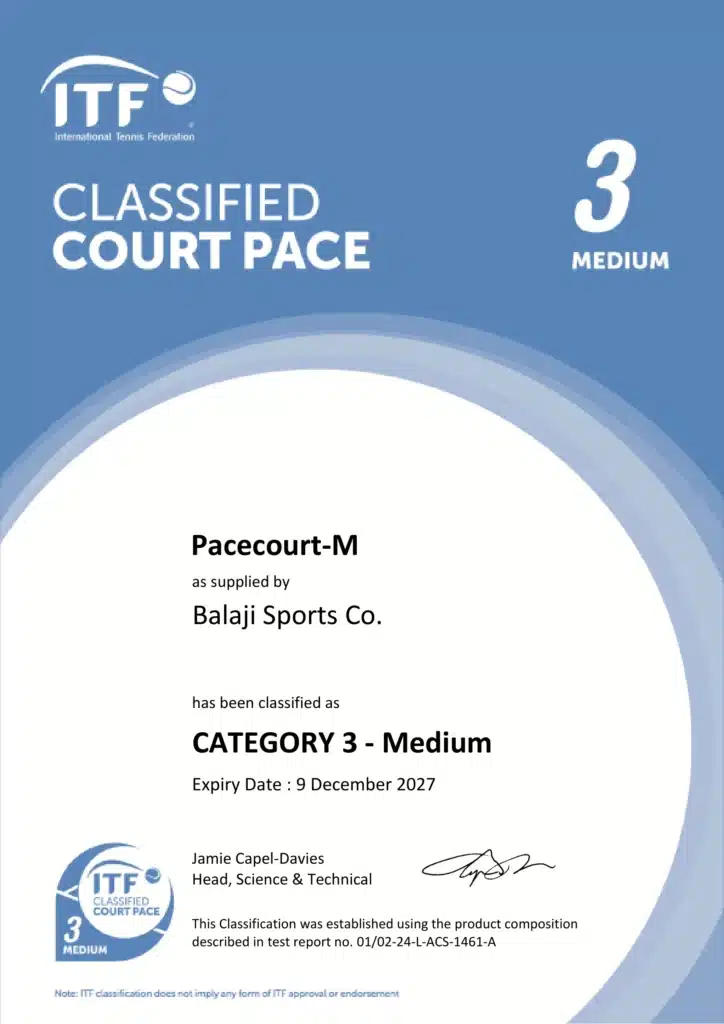
ITF-certified acrylic flooring for Tennis, Basketball, Badminton, Pickleball & more shipped worldwide.

    ISO-Certificate