Author name: Rahul

Rahul is a sports flooring expert and a key contributor at Pacecourt, a leading brand in acrylic and synthetic sports court solutions. Passionate about creating world-class playing surfaces, Rahul shares insights on tennis courts, basketball courts, and multi-purpose sports flooring. His goal is to help facility owners and sports enthusiasts choose durable, high-performance solutions that enhance the game experience.

Tennis Court Measurements

Tennis Court Measurements: The Complete Guide to Official Dimensions and Layout

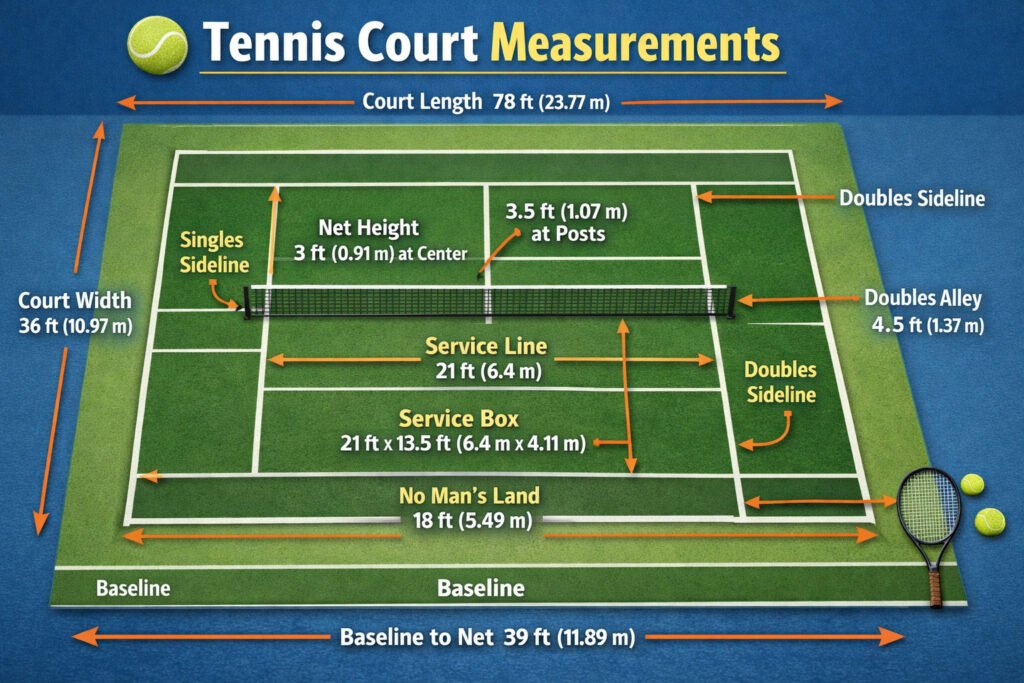
If you’ve ever stood on a tennis court and wondered why everything feels so perfectly aligned—the lines crisp, the net centered, the spacing symmetrical—there’s a reason. Tennis court measurements aren’t random. Every inch is regulated, calculated, and standardized to ensure fairness, consistency, and competitive integrity across the world. Think about it. Whether you’re playing at a local park, a private club, or watching Wimbledon on TV, the court dimensions remain the same. That consistency is what allows players to transition from recreational games to professional tournaments without relearning the geometry of the sport. Tennis is a game of precision. A ball landing just millimeters outside the baseline can change the outcome of a match. Because of that, court measurements must be exact. Even a slight miscalculation in line placement can disrupt gameplay and create disputes. That’s why governing bodies like the ITF (International Tennis Federation) strictly define every dimension—from baseline to net height. But tennis court measurements aren’t just about length and width. They also include service boxes, alleys, center marks, net height, and surrounding run-off space. Each measurement has a purpose. Each line influences strategy. Each boundary shapes how the game unfolds. Whether you’re planning to build a court, mark one for a school, or simply want to understand the layout better, this guide breaks it all down in clear, practical terms. By the end, you won’t just know the numbers—you’ll understand why they matter. Let’s step onto the court and explore every detail. Official Tennis Court Dimensions (Overview) At the heart of tennis lies a simple rectangle—but don’t let that simplicity fool you. The official tennis court dimensions are precise and universally standardized. The total length of a tennis court is 78 feet (23.77 meters). This measurement applies to both singles and doubles matches. No matter the level of play, the length from baseline to baseline remains constant. The width, however, changes depending on the format: Those extra 9 feet (4.5 feet on each side) are known as the doubles alleys. They’re used only during doubles matches. Now, imagine the court divided in half by the net. Each side measures 39 feet from net to baseline. This symmetry ensures balanced play on both ends. Here’s a quick breakdown: Measurement Type Feet Meters Total Length 78 ft 23.77 m Singles Width 27 ft 8.23 m Doubles Width 36 ft 10.97 m Net Height (Center) 3 ft 0.91 m Net Height (Posts) 3 ft 6 in 1.07 m These dimensions are mandated by the ITF and used worldwide. But the playing lines themselves are also regulated. Baselines can be up to 4 inches wide, while service and center lines are typically 2 inches wide. These seemingly small details matter—especially in competitive play. The beauty of tennis court measurements lies in their balance. The proportions allow aggressive baseline rallies, strategic net play, and precise serves. Every dimension supports the sport’s rhythm. Next, let’s break down the differences between singles and doubles courts in more detail. Singles vs Doubles Court Dimensions Here’s where things get interesting. While the length of the tennis court stays the same, the width changes depending on whether you’re playing singles or doubles. In singles, the court measures 27 feet wide. In doubles, it expands to 36 feet wide. That extra 9 feet comes from two 4.5-foot-wide alleys on either side of the singles court. Why does this matter? In singles, players must cover the entire 27-foot width themselves. That narrower layout encourages precision and stamina. Angles are sharper. Cross-court shots are tighter. There’s less room to exploit. In doubles, the wider court creates more opportunities for angled shots and strategic teamwork. The alleys suddenly become valuable real estate. A well-placed shot down the line can win the point instantly. Visually, the singles court is embedded inside the doubles court. When watching a match, you’ll notice inner sidelines—that’s the singles boundary. The outermost lines mark the doubles boundary. Here’s a simple comparison: Feature Singles Doubles Width 27 ft 36 ft Length 78 ft 78 ft Alleys Used No Yes Strategically, the extra width in doubles changes everything. Players often position themselves differently—one at the net, one at the baseline. The added space supports aggressive net play and angled volleys. If you’re building a court, you’ll almost always construct a full doubles court. Why? Because it allows both singles and doubles play. You simply ignore the alleys during singles matches. Understanding this distinction is crucial when marking lines or planning construction. Next, let’s talk about the baseline and service line measurements—the lines that shape rallies and serve placement. Baseline and Service Line Measurements The baseline is where most points begin—and often where they’re won or lost. Each baseline sits at the back of the court, marking the boundary between in and out. The total court length is 78 feet, meaning there are 39 feet from the net to each baseline. Baselines can be up to 4 inches wide, making them the widest lines on the court. Why wider? Because players frequently reference them for positioning during serves and rallies. Moving forward from the baseline, you’ll find the service line, located exactly 21 feet from the net on each side. This line is critical during serves. The serve must land in the service box, which is created by: The space between the net and service line forms the service court depth. Since the net-to-baseline distance is 39 feet, and the service line sits 21 feet from the net, that leaves 18 feet between the service line and baseline. This 18-foot zone is often called “no man’s land”—a tricky area to defend because you’re too far from the net to volley comfortably and too close to react to deep groundstrokes. These measurements shape strategy. Servers aim for precision within the 21-foot boundary. Returners position themselves near the baseline for maximum reaction time. Every inch matters here. A serve that lands just beyond the service line is out. A shot landing on the baseline? That’s in. The geometry of these lines
Cost of Badminton Court
Badminton

Cost of Badminton Court in India: Complete 2026 Pricing Guide

Badminton isn’t just a casual backyard sport in India anymore—it’s a full-blown movement. From Olympic medals to packed local academies, the demand for quality badminton courts is growing faster than ever. If you’ve ever considered building one—whether for personal use, a school, a sports academy, or a commercial rental space—you’re probably asking the most important question first: what is the Cost of Badminton Court, and how much does it actually cost to build one? Well, the answer isn’t as simple as throwing out a single number. The cost of building a badminton court in India depends on multiple moving parts—land, flooring type, lighting, structure, equipment, and even the city you’re building in. Think of it like building a house. You can build a basic one or a luxury villa. Both are “houses,” but the cost difference can be massive. In India today, the total cost of constructing a badminton court can range anywhere between ₹5 lakh for a basic outdoor setup to ₹1.5 crore or more for a professional indoor multi-court facility. That’s a wide range, right? But don’t worry. In this detailed guide, we’ll break everything down step by step so you can estimate your exact investment. Whether you’re an entrepreneur looking to start a sports business, a school planning a facility upgrade, or a passionate player dreaming of your own court—this guide will help you understand every rupee involved. Overview of Costs and Key Factors Before diving into exact numbers, let’s quickly look at what influences the overall cost. Because here’s the thing—two badminton courts in the same city can have drastically different budgets. Why? The details matter. Some of the major cost-driving factors include: For example, an indoor wooden court in Mumbai will cost significantly more than an outdoor acrylic court in a Tier-3 city. Labor charges, material transport, and local approvals also impact your budget. Here’s a rough starting estimate for 2026: Type of Court Estimated Cost (Single Court) Outdoor Acrylic Court ₹5 – ₹12 lakh Indoor Synthetic Court ₹25 – ₹60 lakh Indoor Wooden Court ₹35 lakh – ₹1.2 crore Multi-Court Commercial Setup ₹80 lakh – ₹1.5+ crore But these are just top-level numbers. In the next sections, we’ll dissect each component so you know exactly where your money goes—and where you can potentially save. Let’s move forward and understand the types of badminton courts available in India. Types of Badminton Courts in India Indoor Badminton Courts If you’re serious about badminton—whether as a business or a professional setup—indoor courts are the gold standard. Why? Because badminton is highly sensitive to wind, lighting, and weather conditions. Even a slight breeze can change the direction of a shuttlecock. That’s why almost all competitive and academy-level games happen indoors. An indoor badminton court typically includes: Now let’s talk numbers. The cost of constructing a single indoor badminton court in India generally starts at ₹25 lakh and can go up to ₹60 lakh for a mid-range setup. If you go premium—with wooden flooring, air conditioning, spectator seating, and changing rooms—the cost can easily cross ₹80 lakh to ₹1 crore. Here’s a rough cost breakdown for one indoor court: Component Estimated Cost Civil Work & Base ₹5 – ₹10 lakh Steel Structure/PEB ₹8 – ₹20 lakh Flooring (Synthetic/Wooden) ₹6 – ₹25 lakh Lighting ₹2 – ₹5 lakh Equipment ₹50,000 – ₹2 lakh Indoor courts are expensive upfront, no doubt. But here’s the catch—they generate better long-term revenue. Players prefer indoor facilities, tournaments require them, and memberships are easier to sell. If you’re planning a commercial badminton academy, going indoor isn’t a luxury—it’s practically a necessity. Outdoor Badminton Courts Outdoor courts are the budget-friendly option. They are simple, cost-effective, and quick to build. But they come with limitations. Most outdoor courts in India use: The cost? A single outdoor badminton court typically costs between ₹5 lakh and ₹12 lakh depending on the quality of materials and location. Here’s a simple breakdown: Component Estimated Cost Civil Construction ₹3 – ₹6 lakh Acrylic Surface ₹1.5 – ₹3 lakh Net & Poles ₹25,000 – ₹75,000 Lighting (Optional) ₹1 – ₹2 lakh Sounds affordable, right? But here’s the reality check. Outdoor courts are heavily dependent on weather. Rain, extreme heat, and wind can affect playability and maintenance. Over time, acrylic surfaces may crack or fade, especially in harsh climates. Outdoor courts work best for: If your goal is casual play or limited usage, outdoor is fine. But if you’re planning to build a revenue-generating sports facility, indoor still wins. Residential vs Commercial Courts Now this is where most people get confused. Are you building a personal dream court or a business asset? The answer changes everything. A residential badminton court is usually built in a farmhouse, bungalow, or private property. It may not need: Because of this, residential indoor courts can cost 20–30% less than commercial ones. A basic indoor residential court may cost around ₹20–40 lakh depending on flooring choice. On the other hand, commercial courts are a different ball game. You need: These additional requirements significantly increase the budget. Here’s a simple comparison: Type Average Cost (Single Court) Residential Indoor ₹20 – ₹40 lakh Commercial Indoor ₹40 – ₹1 crore Residential Outdoor ₹4 – ₹8 lakh Commercial Outdoor ₹8 – ₹15 lakh Commercial setups also need branding, marketing, and maintenance staff. But they bring recurring income. So ask yourself—are you building for passion or profit? Standard Badminton Court Dimensions and Space Requirements BWF Standard Measurements Before you calculate cost, you need to know the exact size. Because construction isn’t guesswork—it’s mathematics. According to the Badminton World Federation (BWF): But that’s just the playing area. You also need buffer space around the court for player movement. Recommended total space including run-off area: Why does this matter? Because flooring, roofing, lighting—all are calculated per square foot. If you’re building multiple courts, proper spacing between them is essential. Crowded layouts reduce playing comfort and professionalism. Ceiling Height and Clearance Guidelines This is one area people underestimate—and regret later. Minimum ceiling height recommended: 30 feetIdeal

Pickleball Court
Pickleball court

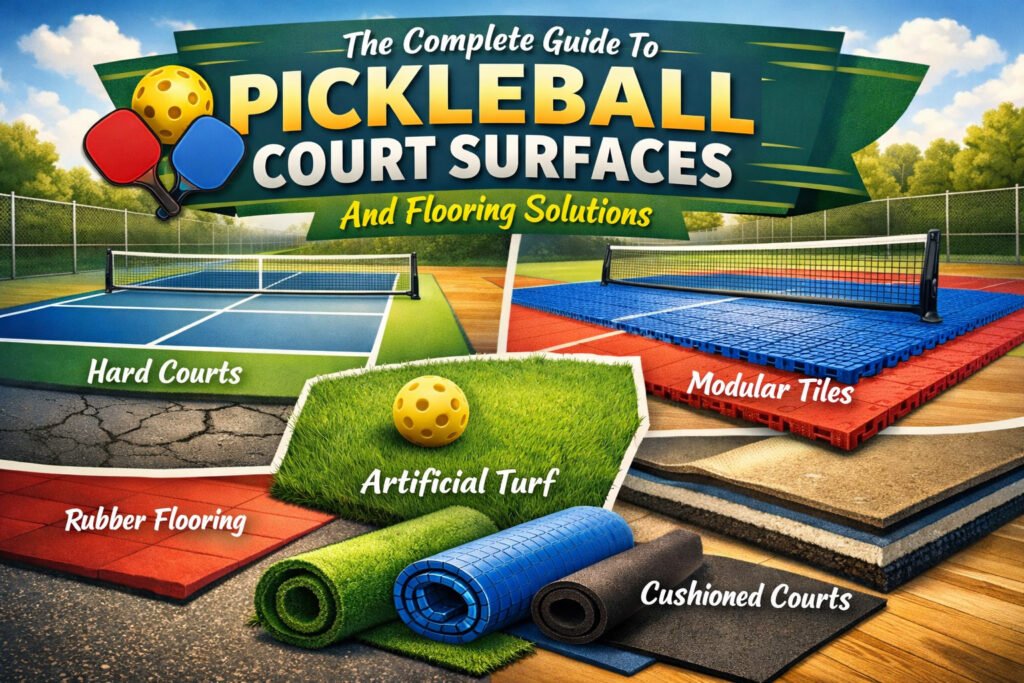
The Complete Guide To Pickleball Court Surfaces And Flooring Solutions

Pickleball looks simple at first glance. A paddle, a plastic ball, a net stretched across a painted pickleball court—what could be complicated about that? But here’s the truth most people only realize after playing on a few different pickleball courts: the surface beneath your feet changes everything. The type of pickleball court flooring directly affects how the ball bounces, how quickly players can pivot, and how much strain your knees absorb during a long rally. Think about it like driving different cars. They all get you from point A to B, but the ride? Completely different. The same goes for pickleball surfaces. A hard, uncoated concrete slab might feel fast and unforgiving. A cushioned acrylic court, on the other hand, offers a controlled bounce and softer impact. The difference isn’t subtle—it’s noticeable within minutes of play. Performance is only one piece of the puzzle. Safety matters just as much. Poor traction increases slip risks. Surfaces without shock absorption can aggravate joint pain. Uneven floors create unpredictable ball movement. When you combine all of these factors, flooring becomes the foundation of the entire playing experience. As pickleball continues to grow worldwide, demand for better courts is skyrocketing. Municipalities are upgrading parks. Schools are converting gym spaces. Homeowners are investing in backyard courts. And with that growth comes an important question: which flooring solution actually makes sense? The answer depends on environment, budget, usage frequency, and long-term goals. There’s no universal “best” surface—only the best fit for your specific situation. Before diving into materials like concrete, modular tiles, or cushioned systems, we need to understand what makes a proper pickleball court in the first place. Standard Pickleball Court Requirements If you’re serious about building or upgrading a pickleball court, you can’t just pour a slab and paint some lines. Official standards exist for a reason. They ensure consistent play, safety, and fairness. A regulation pickleball court measures 20 feet wide by 44 feet long. That’s the same for both singles and doubles matches. However, the recommended total playing area is much larger—typically 30 by 60 feet—to allow room for player movement and safe boundary space. But size is only part of the story. The surface itself must meet certain performance expectations. Here’s what a proper pickleball court surface needs: Unlike tennis balls, pickleballs are lightweight and perforated. That means they react differently to surface textures. Too rough? The ball slows down and behaves unpredictably. Too smooth? It may skid excessively. Surface slope also matters—especially outdoors. Courts typically include a subtle slope (around 1%) to allow water runoff. Without it, puddles form, and moisture weakens the base material over time. Indoor courts focus more on traction and shock absorption. Since weather isn’t a concern, emphasis shifts toward joint protection and multi-sport compatibility. Lighting, fencing, and net systems often get attention during planning—but flooring should be the top priority. Why? Because everything else depends on it. A well-built pickleball court starts from the ground up. Next, let’s explore the most common outdoor flooring solutions and what makes them reliable. Outdoor Pickleball Court Flooring Options When it comes to outdoor pickleball courts, durability is king. Sun, rain, temperature changes, and heavy foot traffic all test the strength of your surface. Choosing the right material means balancing longevity, performance, and budget. Concrete Foundations for Outdoor Courts Concrete is widely considered the premium base for outdoor pickleball courts. It offers exceptional structural stability and can last decades when installed properly. Once poured and cured, concrete forms a firm, level foundation that supports consistent ball bounce. One of concrete’s biggest advantages is its resistance to deformation. It doesn’t shift easily under pressure, which means the playing surface remains stable over time. That stability translates into reliable performance. However, plain concrete alone isn’t ideal for play. It’s too hard and can be abrasive. That’s why it’s typically coated with acrylic sports surfacing systems. These coatings add color, texture, traction, and protection. Pros of concrete courts: Cons: Asphalt Surfaces for Community Spaces Asphalt is another popular outdoor option, especially for parks and recreational facilities. It’s generally less expensive than concrete and quicker to install. Asphalt has slightly more flexibility than concrete, which can help in areas with minor ground movement. However, it tends to oxidize and deteriorate faster if not properly maintained. Just like concrete, asphalt requires an acrylic coating system for proper pickleball play. Without protective layers, the surface can fade, crack, and become brittle. Asphalt works well for: Choosing between concrete and asphalt often comes down to long-term goals. If you’re building for decades, concrete may be worth the investment. If budget constraints are tighter, asphalt provides a practical solution. But what about indoor courts? That’s a completely different conversation. Indoor Pickleball Court Flooring Systems Indoor pickleball brings a new set of considerations. Weather is no longer the enemy—but traction, acoustics, and multi-use flexibility become major factors. Hardwood Gym Floors Many indoor pickleball courts are set up on traditional hardwood gym floors. Schools and recreation centers frequently convert basketball courts into pickleball spaces using temporary nets and painted lines. Hardwood offers: However, hardwood lacks cushioning unless paired with subfloor systems. Extended play on hard wood surfaces can strain joints, especially for older players. Maintenance is another factor. Wood requires refinishing and protection from moisture. Heavy equipment or improper footwear can damage the finish. Synthetic and Polyurethane Flooring Synthetic sports flooring systems are becoming increasingly popular for dedicated indoor pickleball courts. These surfaces are typically layered over concrete and provide enhanced shock absorption. Benefits include: Polyurethane systems, in particular, offer seamless finishes that reduce tripping hazards. They’re also more forgiving on knees and ankles compared to hardwood. Indoor facilities that host leagues or tournaments often prefer synthetic systems for their balance of comfort and durability. Choosing indoor flooring depends on whether the court is multi-purpose or dedicated exclusively to pickleball. Next, we’ll explore acrylic sports coatings—the finishing layer that defines performance. Acrylic Sports Coatings for High-Performance Pickleball Courts If the base of your pickleball court is the skeleton,

badminton academy
Badminton

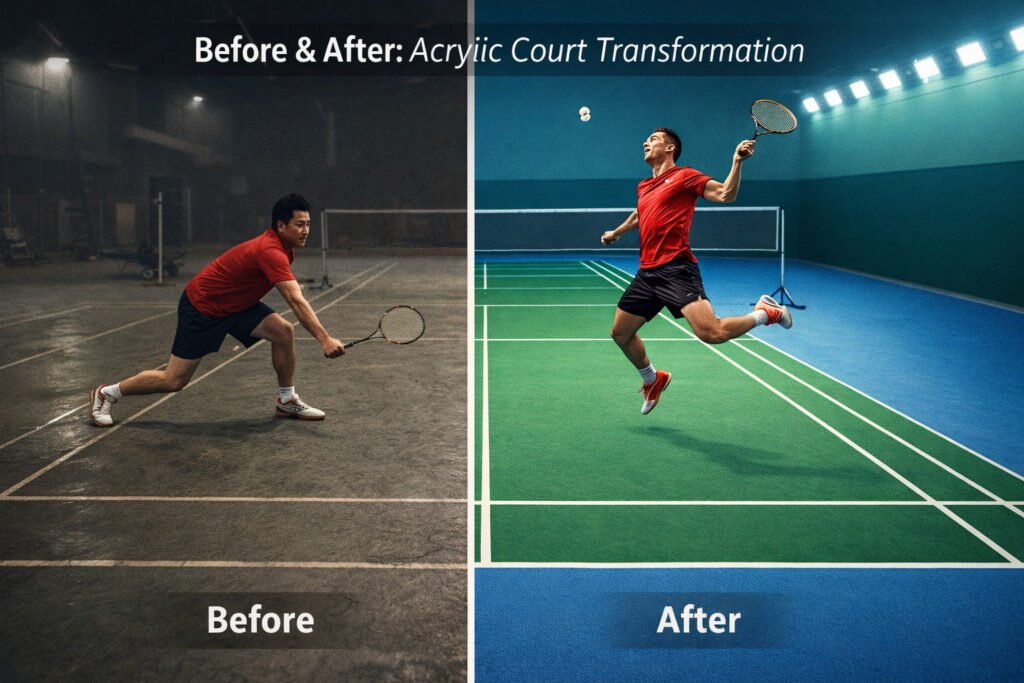
How a Badminton Academy Transformed Its Courts with Acrylic Flooring: Showcase Before/After Benefits

When you walk into a badminton academy, what’s the first thing you notice? The players? The coaches? The energy in the air? Maybe. But beneath every smash, every drop shot, and every lightning-fast rally lies something far more important—the court itself. It’s the silent foundation of the game. And for one badminton academy, that foundation was slowly becoming its biggest weakness. For years, the academy operated on aging, worn-out court surfaces that had seen better days. Cracks ran like spider webs across the floor. The grip was inconsistent. The bounce felt unpredictable. Players adjusted their footwork not to outsmart their opponents, but to avoid slipping. It wasn’t just inconvenient—it was holding them back. Then came a bold decision: replace the old flooring with high-performance acrylic sports flooring. It wasn’t just a cosmetic upgrade. It was a transformation that reshaped performance, safety, and even the academy’s reputation. In this article, we’ll take a deep dive into how this single change revolutionized the academy. We’ll explore the challenges they faced before, the installation journey, and the powerful before-and-after benefits that followed. If you’ve ever wondered whether flooring really makes that much of a difference, you’re about to find out. The Struggles of Worn-Out Courts Before the transformation, the academy’s courts told a story of years of heavy use—and neglect. At first glance, everything looked manageable. But spend a few minutes watching a match, and the issues became obvious. The surface had become uneven over time. Small cracks had formed due to constant impact and temperature changes. Some areas felt smoother than others, while certain patches had lost their texture entirely. Imagine running on a road that randomly switches from asphalt to ice and then to gravel. That’s how unpredictable it felt for the players. Injuries began creeping in. Minor ankle twists. Knee strain. Muscle fatigue. Coaches noticed that players weren’t moving as freely as they should. Instead of focusing on agility and explosive power, athletes hesitated. They second-guessed their lunges. They slowed their footwork. Maintenance was another nightmare. The old flooring required frequent patchwork repairs. Cleaning was difficult because dirt settled into tiny surface cracks. Over time, even the court markings began to fade, giving the entire facility a dull and unprofessional appearance. Morale took a hit too. Players want to train in an environment that feels inspiring. Walking into a worn-out space every day subtly affects motivation. It’s like trying to prepare for a championship in a crumbling gym. The ambition is there—but the environment doesn’t match it. The academy management realized something crucial: talent alone wasn’t enough. The foundation had to support the dream. Why Flooring Matters More Than You Think Let’s be honest—flooring doesn’t usually get the spotlight in sports discussions. We talk about rackets, shuttle quality, training techniques, and fitness routines. But the court surface? It’s often overlooked. And that’s a mistake. In badminton, footwork is everything. The sport demands explosive starts, sudden stops, rapid lateral movements, and constant directional changes. Every point can involve dozens of quick steps. If the surface lacks grip, players slide. If it’s too hard, joints absorb excessive shock. If it’s uneven, balance becomes a gamble. Think of the court as the engine oil in a car. You don’t see it. But without it functioning properly, everything else starts to break down. Good sports flooring provides: When these elements are missing, performance drops—even if the players are skilled. Over time, injuries increase, training intensity decreases, and confidence suffers. The academy realized that upgrading the flooring wasn’t just a facility improvement—it was an investment in athlete development. The right surface would allow players to move naturally, train harder, and compete without hesitation. And that realization changed everything. Understanding Acrylic Flooring for Badminton Courts So what exactly is acrylic sports flooring, and why did the academy choose it? Acrylic flooring is a multi-layer synthetic surface system designed specifically for sports applications. It’s commonly used in tennis, basketball, and increasingly, badminton courts. Unlike basic concrete or traditional coatings, acrylic systems are engineered to provide durability, grip, and cushioning. At its core, acrylic flooring consists of several carefully applied layers. Each layer serves a purpose—like a well-assembled sandwich where every ingredient matters. The system typically includes: One of the biggest advantages is customization. The surface texture can be adjusted to provide optimal grip for badminton movements. Cushion levels can be modified depending on whether the academy prioritizes high-performance training or recreational play. Acrylic surfaces are also known for their vibrant color options. The academy selected a bold two-tone design that clearly defined playing zones while enhancing visibility for players and spectators. But beyond aesthetics, what truly convinced the management was performance data. Acrylic flooring offers excellent traction without being sticky. It absorbs shock better than bare concrete. It resists cracking under heavy use. In short, it strikes the perfect balance between speed and safety—two essentials in badminton. Before the Transformation: The Challenges the Academy Faced If you had visited the academy before the renovation, you might have sensed something was off. The talent was undeniable. The coaches were dedicated. Yet the environment felt outdated. Players often complained about inconsistent grip. During intense rallies, their shoes squeaked unpredictably. Some areas felt slightly slippery, especially during humid days. Coaches had to remind players to be cautious, which is the last thing you want during high-speed drills. Injury reports were becoming more frequent. Nothing catastrophic—but enough to disrupt training schedules. Ankle soreness. Shin splints. Knee discomfort. Over time, these small issues compound. Athletes miss sessions. Momentum slows. Financially, the academy was stuck in a cycle of patch-and-repair. Instead of investing in a long-term solution, money kept going toward temporary fixes. It was like repeatedly fixing potholes instead of repaving the road. And then there was the image problem. Competing academies showcased modern facilities online. Prospective students toured multiple centers before enrolling. The worn-out courts subtly influenced their decisions. Management reached a turning point. They asked themselves a simple question: Are we building a future—or maintaining the past? That question

Pickleball Court Measurements
Pickleball Ball

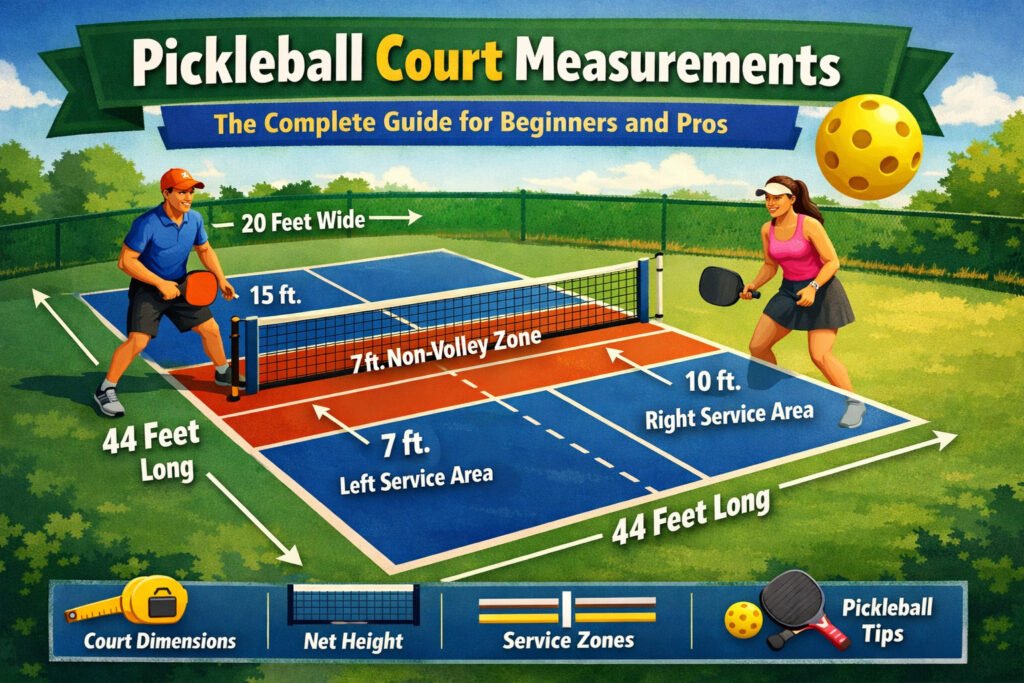
Pickleball Court Measurements: The Complete Guide for Beginners and Pros

Pickleball has exploded in popularity, and if you’ve been anywhere near a community park, gymnasium, or backyard gathering lately, you’ve probably heard that unmistakable “pop” of the ball. But before you grab a paddle and start smashing winners, there’s something crucial you need to understand—Pickleball Court Measurements. Whether you’re building a backyard court, converting a tennis court, or just curious about how it all fits together, understanding official Pickleball Court Measurements and knowing the exact dimensions makes all the difference. Think of the court as the foundation of the game. Just like you wouldn’t build a house without measuring the blueprint, you shouldn’t set up a pickleball court without understanding the proper layout. Every line, every inch, and even the height of the net influences how the game is played. The spacing determines strategy. The “kitchen” changes how you attack. The baseline keeps rallies honest. The beauty of pickleball lies in its simplicity. Unlike tennis, where courts feel massive and sometimes overwhelming, pickleball courts are compact and manageable. That’s part of why the game appeals to all ages. But don’t let the smaller size fool you—precision matters. A few inches off in measurement can change serve angles, rally positioning, and even player safety. In this comprehensive guide, we’ll break down every single dimension you need to know. We’ll cover official standards, backyard variations, tournament-level requirements, and practical tips for setting up your own court. By the end, you won’t just know the numbers—you’ll understand how they shape the game itself. Let’s start with the fundamentals: the standard court size. Understanding Standard Pickleball Court Dimensions At first glance, a pickleball court might look similar to a badminton court—and that’s no coincidence. In fact, the dimensions are exactly the same as a standard doubles badminton court. The official size of a pickleball court is 20 feet wide and 44 feet long. That measurement applies to both singles and doubles play. Unlike tennis, where singles and doubles use different widths, pickleball keeps it simple. Now, let’s visualize that. Imagine a rectangle that’s 20 feet across—roughly the width of a one-car garage—and 44 feet from baseline to baseline. Compact, right? That smaller footprint is one of the reasons pickleball is accessible to players of all ages and skill levels. You don’t need to sprint like a marathon runner to cover the court, but you still need agility and quick reflexes. Here’s how it compares to tennis: Feature Pickleball Court Tennis Court (Doubles) Width 20 feet 36 feet Length 44 feet 78 feet See the difference? A tennis court is nearly double the length. That smaller size in pickleball leads to faster exchanges and more strategic net play. The court is divided evenly by a net into two 22-foot halves. Each half contains specific zones, including service areas and the famous non-volley zone. These divisions aren’t random—they’re designed to encourage rallies and prevent overpowering serves from dominating the game. Accuracy here is key. Even a slight deviation in width or length can affect tournament eligibility and gameplay fairness. If you’re marking a court yourself, always measure twice. Use a reliable tape measure and mark clear straight lines to ensure regulation compliance. The 20-by-44-foot rectangle is the heart of pickleball. Everything else—the kitchen, service boxes, and net height—fits precisely within this framework. And that’s exactly what we’ll explore next. Detailed Breakdown of Pickleball Court Lines and Markings Now that we know the court measures 20 feet by 44 feet, let’s break down the lines that define how the game is played. These aren’t just random stripes painted on the ground. Each line has a purpose, and each one affects strategy. Baselines The baselines run along the 20-foot width at the back of each side of the court. They mark the boundary for serves and deep returns. When serving, both feet must remain behind the baseline until the ball is struck. Step on it too early? That’s a fault. Baselines also define the depth of rallies. A ball that lands beyond the baseline is out. Because the court is only 44 feet long, baseline placement becomes critical during fast exchanges. Skilled players often aim just inches inside this line to push opponents backward. Sidelines The sidelines stretch the full 44-foot length of the court. They define the left and right boundaries. Unlike tennis, singles and doubles share the same sidelines in pickleball, which simplifies setup and reduces confusion. Hitting sharp cross-court angles that kiss the sideline can be a powerful offensive strategy. That’s why accurate measurement is so important. If the sideline is even slightly misaligned, it changes how wide players can safely hit. Centerline The centerline divides each half of the court into two equal service areas. It runs from the non-volley zone line to the baseline. During serves, players must direct the ball diagonally into the opponent’s service court, defined by this centerline. Non-Volley Zone Line This line sits 7 feet from the net on each side and marks the beginning of the non-volley zone, also known as the kitchen. It stretches across the full 20-foot width. All lines on a pickleball court should measure 2 inches wide and must be clearly visible, typically in a contrasting color from the court surface. These lines create structure, fairness, and strategy. They turn a simple rectangle into a battlefield of angles, precision, and calculated risks. And among all these markings, none is more talked about than the kitchen. The Non-Volley Zone (The Kitchen): Measurements and Rules If pickleball had a personality trait, it would be the kitchen. Officially called the non-volley zone (NVZ), this 7-foot-deep area on both sides of the net changes everything about how the game is played. Let’s start with the measurement. The non-volley zone extends 7 feet from the net toward the baseline on both sides. It spans the entire 20-foot width of the court. So essentially, picture a 7-by-20-foot rectangle hugging the net on each side. Why 7 feet? That distance prevents players from camping at the net and smashing every

Why Acrylic Flooring Is Better Than EPDM
Acrylic Flooring VS EPDM

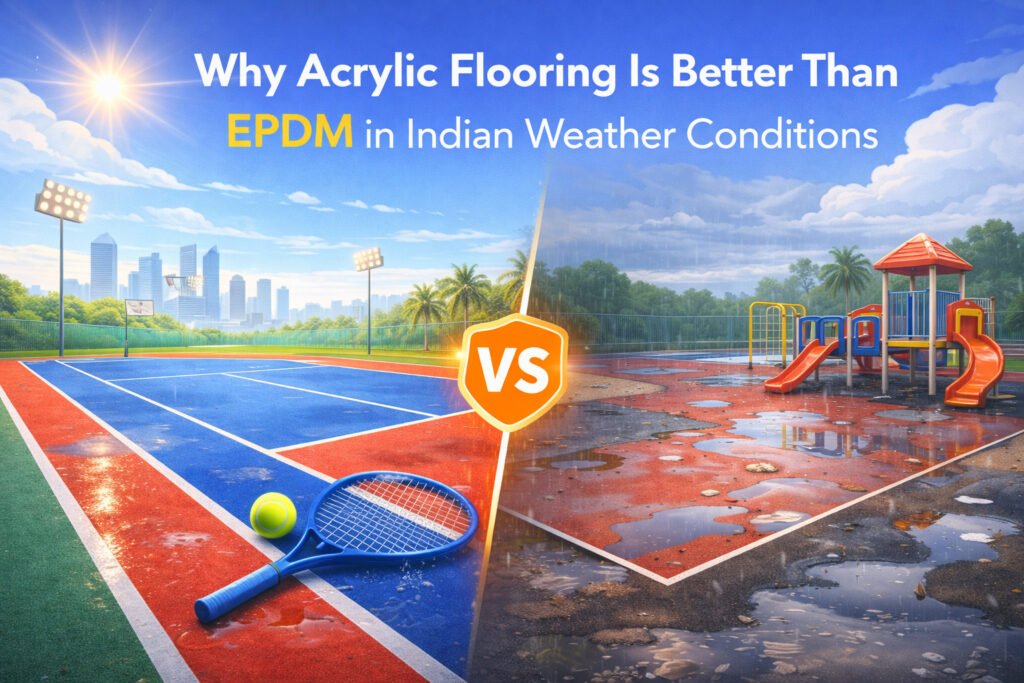
Why Acrylic Flooring Is Better Than EPDM in Indian Weather Conditions

When it comes to outdoor sports flooring in India, the weather isn’t just a background detail—it’s the main character. From scorching summers that can fry an egg on a metal surface to relentless monsoons that flood streets overnight, Indian climate conditions are intense, unpredictable, and often unforgiving. That’s exactly why Acrylic Flooring Is Better Than EPDM in such demanding environments. If you’re planning to build a tennis court, basketball court, skating rink, or multi-sport arena, the flooring choice you make isn’t just about appearance—it’s about survival. Two of the most popular options in the Indian market today are Acrylic Flooring VS EPDM (Ethylene Propylene Diene Monomer) Flooring. At first glance, both look impressive. Both promise durability. Both are marketed as ideal for sports surfaces. But here’s the real question: which one truly performs better under Indian weather conditions? Let’s think practically. In cities like Delhi, temperatures can cross 45°C in summer. In Mumbai or Chennai, humidity levels remain high almost all year. In Kerala and the Northeast, heavy rainfall is routine. Flooring that works perfectly in mild European climates may struggle in India’s aggressive environment. Acrylic flooring has steadily gained popularity across India, especially in schools, sports complexes, and residential communities. Why? Because it adapts better. It handles UV rays more efficiently. It dries faster after rain. It maintains color and texture even after years of sun exposure. EPDM, while useful in certain environments, often faces challenges under prolonged heat and heavy rainfall common in India. In this article, we’ll break down every critical factor—heat resistance, monsoon durability, maintenance, cost, safety, and long-term performance. By the end, you’ll clearly understand why acrylic flooring consistently proves to be the smarter, more weather-resilient choice for Indian conditions. Let’s dive deeper. Understanding Indian Weather Conditions India isn’t just one climate—it’s a collection of extremes. From desert-like heat in Rajasthan to coastal humidity in Goa, and from heavy monsoon zones in Kerala to cold winters in North India, flooring materials must endure a wide spectrum of environmental stress. Ignoring these realities can lead to costly repairs and premature surface failure. Let’s break down the major weather challenges that outdoor flooring faces in India. Extreme Heat and UV Exposure Indian summers are not mild. They are intense, prolonged, and often brutal. In northern and central regions, surface temperatures can rise dramatically under direct sunlight. UV radiation levels are also significantly high for extended periods of the year. Under such conditions, flooring materials can: Acrylic flooring is designed with UV-stable pigments and coatings that resist fading and degradation. EPDM, while somewhat UV resistant, can gradually harden or lose flexibility under consistent high temperatures. Think of it like sunscreen. Acrylic has a stronger protective layer against the sun’s harsh rays. Heavy Monsoon and Waterlogging India’s monsoon season is beautiful—but merciless. Sudden heavy rainfall can flood courts within minutes. Poor drainage combined with absorbent materials can cause swelling, surface lifting, and mold growth. Acrylic flooring is non-porous and dries quickly when properly installed over concrete or asphalt. EPDM surfaces, especially when used in certain installation formats, can trap moisture beneath layers, leading to long-term damage. Humidity and Moisture Challenges Coastal cities like Mumbai, Chennai, and Kolkata experience high humidity throughout the year. Moisture in the air continuously interacts with surface materials. Materials that absorb or retain moisture tend to degrade faster. Acrylic coatings are designed to resist moisture penetration, making them more suitable for humid climates. Dust, Pollution, and Temperature Fluctuations Indian cities deal with heavy dust and pollution. Add to that the temperature shift between scorching days and cooler nights. These constant expansions and contractions stress flooring materials. Acrylic systems are flexible enough to adapt to these micro-movements without cracking. In short, Indian weather is demanding. Flooring must be heat-resistant, water-resistant, UV-stable, and durable under constant stress. As we move forward, you’ll see why acrylic flooring aligns more closely with these requirements. What Is Acrylic Flooring? Before comparing, it’s important to understand what acrylic flooring actually is and why it has become a preferred option for outdoor sports surfaces across India. Acrylic flooring is a multi-layered synthetic surface system primarily used for sports courts. It is typically applied over a concrete or asphalt base and consists of several layers including primer, cushion (optional), base coat, and topcoat. But what makes it special? Composition and Material Structure Acrylic flooring is made using acrylic resins combined with silica sand and specialized pigments. These components work together to create a surface that is: Unlike rubber-based systems, acrylic coatings bond tightly with the base surface, forming a seamless and durable layer. Common Applications in India Across India, acrylic flooring is widely used in: Its popularity comes from its balance of performance, durability, and cost-effectiveness. Key Performance Features Acrylic flooring stands out because it offers: It’s like a reliable all-rounder in cricket—it may not always grab headlines, but it consistently performs under pressure. Most importantly, acrylic systems can be customized with cushioned layers for added shock absorption. This makes them suitable for professional-level play while still being practical for schools and recreational areas. As we move forward, we’ll compare this directly with EPDM to understand where the real differences lie. What Is EPDM Flooring? Before we continue the comparison, let’s clearly understand what EPDM flooring actually is. EPDM stands for Ethylene Propylene Diene Monomer—a type of synthetic rubber widely used in construction, playgrounds, and certain sports surfaces. At first glance, EPDM looks colorful, soft, and highly durable. It has a rubbery texture and is often associated with children’s play areas because of its shock-absorbing qualities. But is it truly ideal for Indian outdoor weather? Let’s break it down carefully. Composition and Material Structure EPDM flooring is made from synthetic rubber granules mixed with a polyurethane binder. These granules are typically installed over a concrete or asphalt base, and sometimes over a shock pad layer. The rubber particles are bonded together to create a seamless surface. The structure usually includes: The flexibility of rubber is what gives EPDM its cushioning effect. However,

Tennis Court Builder
tennis court

Tennis Court Builder – The Complete Guide to Designing and Constructing a Professional Court

If you’ve ever dreamed of stepping outside your home and walking straight onto your own tennis court, you’re not alone. Over the past decade, private homeowners, schools, clubs, and real estate developers have increasingly invested in building custom tennis courts. But here’s the thing—constructing a tennis court isn’t just about pouring concrete and drawing white lines. It’s a specialized process that demands expertise, precision, and long-term planning. That’s where a professional tennis court builder comes in. A tennis court builder doesn’t simply “build.” They evaluate soil conditions, analyze drainage, consider climate, and select materials that match both performance goals and budget. Think of it like building a house—you wouldn’t skip the foundation, right? The same logic applies here. The strength of your base determines how your court performs for years to come. Whether you’re planning a backyard court for family fun or a professional-grade facility for tournaments, understanding the construction process is essential. From choosing the right surface to installing lighting and fencing, every step influences durability, playability, and maintenance costs. And let’s be honest—tennis courts aren’t cheap. So if you’re going to invest, you want to get it right the first time. In this guide, we’ll break down everything you need to know about hiring a tennis court builder, understanding construction costs, choosing surfaces, and ensuring your court stands the test of time. By the end, you’ll have a clear roadmap—no guesswork, no surprises—just solid information to help you make confident decisions. What Does a Tennis Court Builder Do? You might be wondering, “Can’t a general contractor handle this?” Technically, maybe. But realistically? Not if you want professional results. A tennis court builder specializes in the technical details that most contractors overlook. First comes the site evaluation. This step is crucial. The builder assesses soil stability, slope, drainage patterns, and space availability. A poorly evaluated site can lead to cracks, water pooling, and uneven surfaces. And trust me—nothing ruins a match faster than a bad bounce caused by structural flaws. Next comes design planning. This isn’t just about dimensions. A tennis court builder considers: Each decision affects both gameplay and longevity. For example, improper court orientation can make evening matches nearly impossible due to sun interference. Then comes construction. This involves excavation, grading, laying the foundation base, installing the surface system, and applying acrylic coatings or clay layers. Precision matters down to the millimeter. Even slight elevation errors can lead to drainage issues or surface cracks. Finally, finishing touches include line striping, net installation, fencing, and optional features like windscreens or LED lighting. In short, a tennis court builder acts as engineer, designer, and project manager all rolled into one. Their expertise ensures that your investment performs beautifully for 20–30 years instead of deteriorating in five. Hiring a specialist isn’t an expense—it’s insurance against costly mistakes. Types of Tennis Courts You Can Build Not all tennis courts are created equal. In fact, the type of surface you choose dramatically changes how the game feels, how much maintenance you’ll handle, and how much money you’ll spend over time. Let’s break down the main options. Hard Courts Hard courts are the most common type worldwide—and for good reason. They’re durable, relatively low maintenance, and suitable for all skill levels. Typically constructed with asphalt or concrete bases and coated with acrylic layers, hard courts offer consistent ball bounce and moderate speed. They’re ideal for residential properties and commercial facilities because they hold up well under heavy use. Maintenance mainly involves cleaning, crack repairs, and resurfacing every 4–8 years. Clay Courts Clay courts, often associated with European tournaments like the French Open, offer a slower playing surface. The ball bounces higher, and rallies last longer. Many players find clay easier on the joints due to its softer surface. However, clay courts demand regular maintenance—watering, rolling, and resurfacing are routine tasks. They’re best suited for clubs or serious tennis enthusiasts willing to invest time and care. Grass Courts Grass courts are elegant and traditional but extremely high maintenance. They require constant mowing, irrigation, and leveling. Because of this, they’re rare outside professional tournaments. Synthetic and Hybrid Courts These modern surfaces mimic clay or grass but require far less maintenance. They’re gaining popularity in residential installations due to durability and performance balance. Choosing the right court type isn’t just about aesthetics—it’s about climate, usage frequency, and long-term maintenance commitment. Choosing the Right Surface for Your Tennis Court Let’s be honest—this is where most people get stuck. You’ve decided to build a court, you’ve found a tennis court builder, and now comes the big question: Which surface should I choose? It’s not just about looks. The surface you pick will shape the way the game feels, how much maintenance you’ll deal with, and how long your investment lasts. First, think about climate. If you live in an area with heavy rainfall, clay might become a constant maintenance headache. Hard courts with proper drainage systems tend to perform better in wet climates. On the other hand, extremely hot regions may cause certain acrylic coatings to expand and crack if not properly installed. A skilled tennis court builder will recommend materials designed specifically for your local weather conditions. Next, consider maintenance. Are you someone who enjoys hands-on upkeep? Or do you prefer something that requires minimal attention? Hard courts typically need occasional pressure washing and resurfacing every few years. Clay courts, however, demand daily care—watering, rolling, brushing. It’s almost like owning a garden; beautiful but demanding. Then there’s player experience. Fast-paced players often love hard courts because the ball moves quickly and rallies are aggressive. Clay slows the game down, allowing longer rallies and strategic play. Synthetic turf offers a softer feel, reducing joint strain. Step-by-Step Tennis Court Construction Process Building a tennis court isn’t a weekend DIY project. It’s a structured, multi-phase process that requires engineering precision. Let’s walk through what actually happens behind the scenes when a professional tennis court builder gets to work. Site Preparation and Excavation Everything begins with the land. Even if

synthetic sports flooring in UAE
Sports Flooring UAE

Synthetic Sports Flooring in UAE: The Complete Guide

The UAE has always been a place where ambition meets innovation. From towering skyscrapers to world-class sports infrastructure, the country doesn’t do things halfway. When it comes to athletic facilities, synthetic sports flooring in UAE has become the gold standard. Whether you’re stepping into a school gym in Sharjah, a professional sports complex in Dubai, or a community playground in Abu Dhabi, chances are the surface beneath your feet is synthetic—and for good reason. Synthetic sports flooring isn’t just about aesthetics. It’s about performance, safety, durability, and long-term value. In a country known for extreme temperatures, sand, humidity, and heavy usage, traditional sports surfaces simply can’t keep up. Synthetic solutions, on the other hand, are engineered to thrive in these conditions. They offer consistent performance, minimal maintenance, and adaptability across a wide range of sports. In this guide, we’re going deep. We’ll explore what synthetic sports flooring really is, why it dominates the UAE market, the types available, benefits, costs, installation, maintenance, and future trends. If you’re a facility owner, school administrator, sports enthusiast, or investor, this article will give you clarity—no fluff, just real insight. Understanding Synthetic Sports Flooring What Is Synthetic Sports Flooring? At its core, synthetic sports flooring refers to man-made surface systems specifically designed for athletic activities. Unlike natural grass, clay, or wooden surfaces, these floors are engineered using advanced materials like polyurethane, PVC, rubber, acrylic, and synthetic fibers. Each layer is carefully designed to serve a purpose—shock absorption, grip, durability, and comfort. Think of synthetic flooring like a high-performance running shoe. Every component works together to protect the athlete while enhancing performance. The base layer provides stability, the middle layers absorb impact, and the top layer offers traction and wear resistance. This layered construction is what makes synthetic sports flooring so reliable, especially in demanding environments like the UAE. In the UAE, synthetic sports flooring is used across indoor and outdoor facilities. From basketball courts and gym floors to football fields and jogging tracks, these surfaces are tailored to meet international sports standards. They’re not just surfaces; they’re performance platforms designed to reduce injuries and improve gameplay. Why Synthetic Flooring Is Replacing Traditional Surfaces Traditional sports surfaces have charm, but charm doesn’t survive 45°C heat, sandstorms, and year-round usage. Natural grass requires constant watering, trimming, and repair—luxuries that aren’t always practical in the UAE. Wooden floors warp under humidity. Clay courts crack under intense heat. Synthetic sports flooring solves these problems. It’s weather-resistant, durable, and requires significantly less maintenance. Facility managers no longer have to worry about daily upkeep or seasonal damage. Athletes get a consistent playing surface every time they step onto the court or field. Another big reason for the shift is safety. Synthetic floors are designed to absorb shock and reduce strain on joints. This is crucial for schools, training academies, and professional venues where injury prevention is a top priority. Add to that customization options, vibrant colors, and branding possibilities, and it’s easy to see why synthetic flooring has taken over the UAE sports industry. Evolution of Sports Flooring in the UAE Early Sports Surfaces in the Region Before the UAE became a global hub for sports and entertainment, athletic facilities were fairly basic. Early sports surfaces relied heavily on natural materials—sand courts, basic grass fields, and concrete playgrounds. While functional, these surfaces offered little in terms of safety or performance optimization. Concrete, in particular, was widely used due to its low cost and availability. But anyone who has played sports on concrete knows how unforgiving it can be. Injuries were common, surfaces cracked easily, and maintenance was a constant challenge. As the UAE’s population grew and sports participation increased, the limitations of these traditional surfaces became impossible to ignore. The turning point came when the country began hosting international tournaments and investing heavily in sports infrastructure. Global standards demanded better surfaces—ones that could support high-level performance while ensuring athlete safety. This demand paved the way for synthetic sports flooring solutions. Rise of Synthetic Sports Flooring in Modern UAE Fast forward to today, and synthetic sports flooring is everywhere in the UAE. The government’s push for healthy lifestyles, school sports programs, and international sporting events has fueled massive investment in modern facilities. Synthetic flooring became the obvious choice due to its reliability and long-term value. Dubai, Abu Dhabi, and Sharjah now boast world-class indoor arenas, Olympic-standard running tracks, and FIFA-approved football fields—all featuring synthetic surfaces. Schools and universities followed suit, recognizing the benefits of safe, low-maintenance sports flooring for students. What truly accelerated adoption was innovation. Modern synthetic flooring systems are no longer one-size-fits-all. They’re customized for specific sports, usage levels, and environmental conditions. In a country that values excellence and efficiency, synthetic sports flooring fits perfectly into the UAE’s vision. Types of Synthetic Sports Flooring Used in UAE Polyurethane (PU) Sports Flooring Polyurethane sports flooring is one of the most popular choices in the UAE, especially for indoor sports facilities. PU flooring is seamless, flexible, and highly durable. It’s commonly used in basketball courts, volleyball halls, gyms, and multipurpose sports arenas. One of the standout features of PU flooring is its shock absorption capability. It reduces stress on athletes’ joints, making it ideal for high-impact sports. In the UAE, where indoor sports facilities often operate year-round, PU flooring offers long-lasting performance without cracking or peeling. Another advantage is hygiene. PU floors are easy to clean and resistant to moisture, bacteria, and dust—an important factor in shared sports spaces. Add customizable colors and line markings, and PU flooring becomes both functional and visually appealing. PVC / Vinyl Sports Flooring PVC sports flooring, also known as vinyl sports flooring, is widely used in indoor courts across the UAE. It comes in roll or tile form and is known for its excellent grip, comfort, and durability. This type of flooring is commonly found in badminton courts, table tennis halls, and school gyms. PVC flooring performs exceptionally well in controlled indoor environments. It provides consistent ball bounce, slip resistance, and cushioning. For schools

Sports Flooring UAE
Sports Flooring UAE

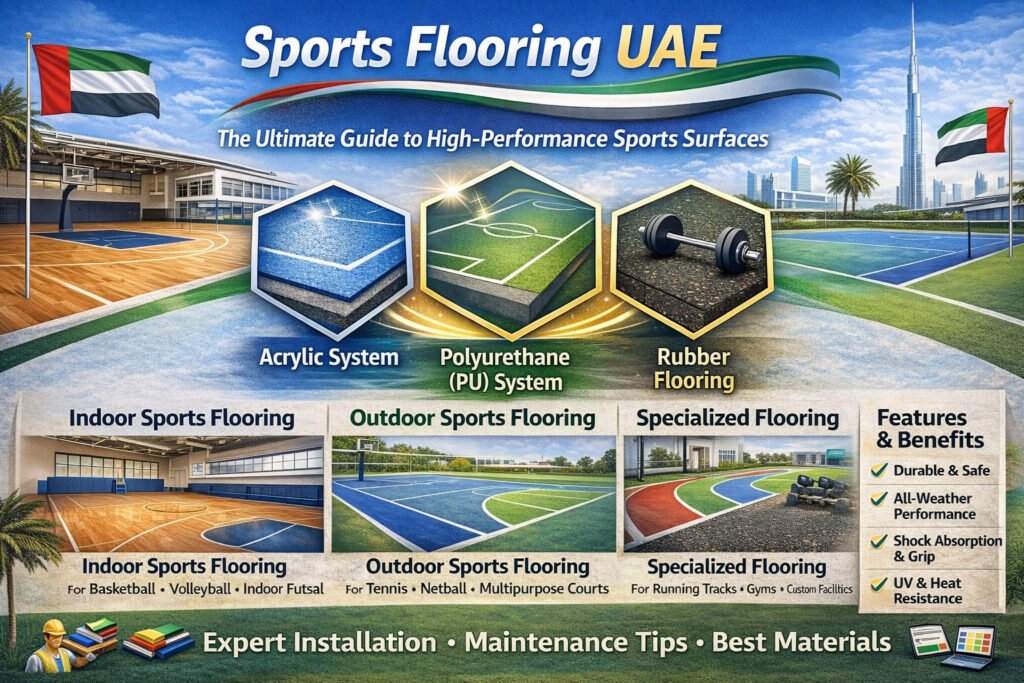
Sports Flooring UAE: The Ultimate Guide to High-Performance Sports Surfaces

Walk into any modern sports facility in the UAE and one thing becomes instantly clear—the floor is doing far more work than just sitting there. From professional arenas in Dubai to school gyms in Sharjah and outdoor courts in Abu Dhabi, sports flooring has become a critical part of athletic performance, safety, and facility reputation. The UAE’s rapid growth in sports infrastructure, fueled by international tournaments, fitness awareness, and government-backed wellness initiatives, has pushed sports flooring from an afterthought to a top priority. Unlike standard flooring, sports flooring in the UAE must handle extreme heat, heavy foot traffic, and intense athletic movement—all while meeting international standards. Think about it: a basketball player sprinting down the court, a tennis player sliding into a shot, or a gym enthusiast dropping heavy weights. The surface beneath them must absorb shock, provide grip, and reduce injury risks. In a country where temperatures can soar above 45°C, flooring materials must also resist UV damage, expansion, and wear. The UAE’s sports flooring market has matured significantly over the past decade. What once relied heavily on basic concrete or asphalt has evolved into a sophisticated industry offering advanced polyurethane systems, cushioned vinyl floors, engineered wood courts, and eco-friendly solutions. Whether it’s for a school, professional sports complex, residential community, or commercial gym, choosing the right sports flooring in the UAE is no longer optional—it’s essential. In this guide, we’ll walk through everything you need to know about sports flooring in the UAE, from types and materials to costs, standards, and future trends. If you’re planning a sports facility or upgrading an existing one, you’re in the right place. Understanding Sports Flooring Sports flooring isn’t just about aesthetics or durability—it’s about performance engineering. At its core, sports flooring is designed to support physical activity by enhancing comfort, safety, and efficiency. Unlike conventional tiles or marble floors commonly seen in UAE interiors, sports flooring systems are built with layers that serve specific purposes, such as shock absorption, energy return, and slip resistance. One of the biggest differences between regular flooring and sports flooring lies in impact management. When athletes jump, run, or fall, the floor must absorb and redistribute impact forces to reduce stress on joints and muscles. This is especially important in high-impact sports like basketball, volleyball, and indoor football. A poorly designed surface can increase the risk of injuries such as shin splints, knee pain, and ankle sprains. Another defining feature of sports flooring is traction. Too slippery, and athletes lose control. Too rough, and movement becomes restricted. Sports flooring in the UAE is carefully engineered to strike the perfect balance, allowing quick directional changes without compromising stability. This is particularly crucial in indoor, air-conditioned environments where humidity levels can fluctuate. Acoustics also play a role, especially in indoor facilities. Sports flooring materials often include sound-dampening layers that reduce noise caused by footsteps, bouncing balls, and equipment. This makes the environment more comfortable for both athletes and spectators. In short, sports flooring is a silent partner in athletic performance. It works behind the scenes, ensuring every movement feels natural, safe, and responsive—something that becomes even more critical in the demanding climate of the UAE. Evolution of Sports Flooring in the UAE The journey of sports flooring in the UAE mirrors the country’s rapid development. In the early days, sports facilities were functional but basic. Outdoor courts were often simple asphalt surfaces, while indoor spaces relied on concrete or generic tiles with minimal cushioning. These surfaces served their purpose but offered little in terms of athlete safety or performance optimization. As the UAE began hosting international sporting events and investing heavily in sports academies, the need for world-class facilities became apparent. Imported sports flooring systems from Europe and North America started making their way into the market. Wooden basketball courts, acrylic tennis surfaces, and polyurethane running tracks became more common, especially in professional venues. Over time, local expertise grew. UAE-based suppliers and installers began specializing in sports flooring, adapting international technologies to suit regional conditions. Materials were modified to withstand extreme heat, UV exposure, and sand infiltration—challenges unique to the Gulf region. This localization played a major role in improving the lifespan and performance of sports floors. Today, the UAE boasts some of the most advanced sports flooring installations in the Middle East. From Olympic-standard courts to multi-purpose community facilities, the evolution has been remarkable. The focus has shifted from merely building sports spaces to creating environments that enhance performance, reduce injuries, and reflect the UAE’s commitment to excellence. Types of Sports Flooring Available in the UAE Indoor Sports Flooring Indoor sports facilities dominate the UAE landscape, thanks to the hot climate that makes air-conditioned environments more practical for year-round use. Indoor sports flooring systems are designed to deliver consistent performance regardless of external weather conditions, making them ideal for schools, universities, gyms, and professional arenas. Indoor sports flooring typically prioritizes shock absorption, surface uniformity, and aesthetic appeal. These floors often consist of multiple layers, including a base mat, shock-absorbing layer, and wear-resistant top surface. The choice of material depends on the sport, usage intensity, and budget. Wooden Sports Flooring Wooden sports flooring, especially maple hardwood, is considered the gold standard for indoor courts. Commonly used in basketball, volleyball, and badminton courts across the UAE, these floors offer excellent ball bounce, natural grip, and superior energy return. Athletes often describe playing on wood as “alive” because of how responsive it feels underfoot. In the UAE, engineered wooden flooring systems are preferred over solid wood. These systems are designed to handle temperature fluctuations and humidity changes without warping. Advanced subfloor systems enhance shock absorption, reducing strain on athletes’ joints. While wooden sports flooring requires a higher initial investment, its performance and prestige make it a popular choice for professional venues. PVC and Vinyl Sports Flooring PVC and vinyl sports flooring have gained massive popularity in the UAE due to their versatility and cost-effectiveness. These floors are commonly used in school gyms, fitness studios, indoor courts, and multipurpose halls.

Basketball Court Size

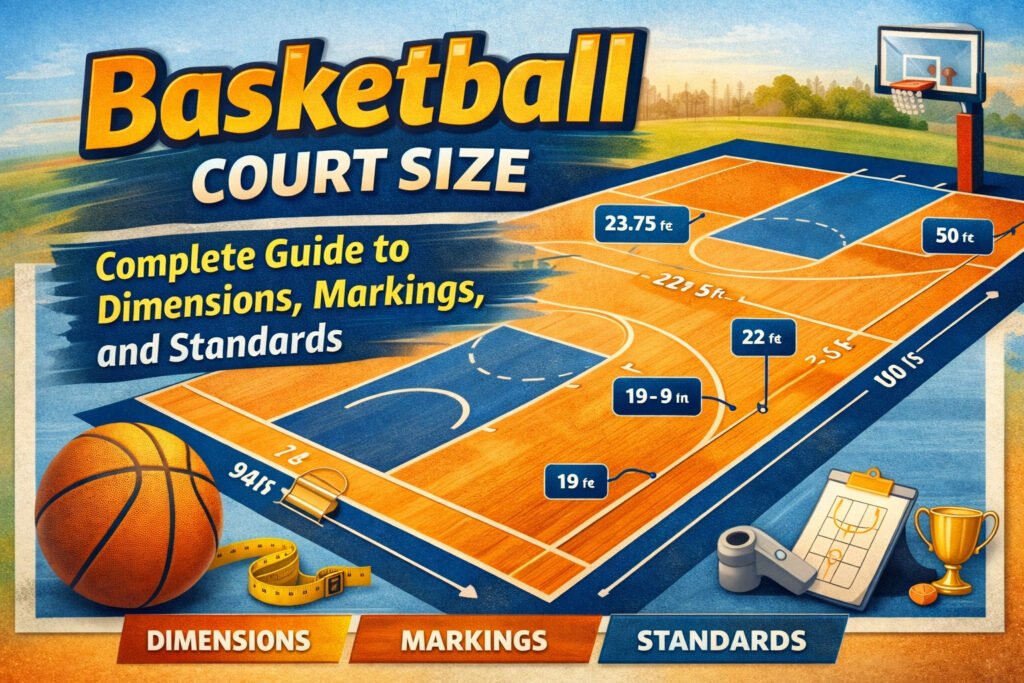
Basketball Court Size: Complete Guide to Dimensions, Markings, and Standards

Basketball court size plays a defining role in how the game is played, experienced, and enjoyed at every level. From professional arenas filled with roaring crowds to quiet backyard courts designed for family fun, court dimensions influence player movement, strategy, spacing, and overall performance. We often underestimate how much precision goes into designing a basketball court, yet every line, angle, and measurement exists for a reason. Standardization ensures fairness, safety, and consistency, whether the game is played in a global championship or a local school gymnasium. Understanding basketball court dimensions is essential for players, coaches, architects, facility managers, and enthusiasts alike. A correctly measured court supports proper gameplay, reduces injury risks, and aligns with official regulations. While casual players may focus on shooting hoops, professionals rely on exact court layouts to execute plays with pinpoint accuracy. Even a slight deviation in markings or spacing can change how the game flows. Basketball courts are governed by different organizations, each with its own standards. The NBA, FIBA, NCAA, and NFHS establish precise rules for court size and markings. These variations, though subtle, significantly impact gameplay. Knowing the differences helps in designing courts that meet specific competitive or recreational needs. As basketball continues to grow globally, understanding these standards becomes increasingly valuable for modern facilities and aspiring players worldwide. History and Evolution of Basketball Court Sizes The evolution of basketball court size reflects the growth and professionalization of the sport itself. When basketball was invented in 1891, games were played in small gymnasiums with improvised layouts. There were no standardized dimensions, and court sizes varied widely depending on available space. As basketball gained popularity, the need for consistent playing conditions became evident, prompting the establishment of formal measurements. Early courts were often smaller, leading to congested gameplay and limited movement. As athleticism increased and strategies evolved, larger courts became necessary to accommodate faster pacing and dynamic playstyles. The introduction of dribbling, fast breaks, and perimeter shooting influenced how courts were designed. Over time, governing bodies introduced precise regulations to maintain fairness and enhance the spectator experience. Professional leagues further refined court dimensions to showcase elite athletic performance. The NBA introduced wider lanes and longer three-point lines to balance scoring and defense. International organizations like FIBA adopted slightly different measurements to suit global play styles and facility constraints. These changes reflect ongoing efforts to optimize the game while preserving its core principles. Today’s basketball courts represent decades of refinement. Each measurement is the result of testing, feedback, and adaptation. Understanding this evolution helps us appreciate why modern basketball courts are designed with such exacting standards and why adherence to these dimensions remains critical for competitive integrity. Standard Basketball Court Size Overview A standard basketball court is rectangular, designed to provide ample space for movement, strategy, and fair competition. While dimensions vary slightly depending on governing bodies, the overall structure remains consistent. The court includes a playing area, boundary lines, and clearly defined zones that dictate gameplay rules. Professional courts are typically 94 feet long and 50 feet wide, offering maximum space for elite competition. Amateur and recreational courts may be smaller, but they still follow proportional layouts to maintain a balanced playing experience. These dimensions ensure players can perform fundamental actions such as passing, shooting, and defending without spatial limitations. Standardization benefits players at all levels by creating familiarity. When athletes transition from school-level play to professional leagues, consistent court layouts reduce adaptation time. Facility designers rely on these standards to build courts that meet regulatory approval and enhance usability. Beyond length and width, standard courts also specify distances for key markings, including the free throw line, three-point arc, and center circle. Each element contributes to the rhythm and structure of the game. A well-designed court supports smooth gameplay, accurate officiating, and an enjoyable experience for players and spectators alike. NBA Basketball Court Dimensions Explained NBA basketball courts represent the gold standard of professional play. The official NBA court size is 94 feet long and 50 feet wide, providing the largest playing surface among major basketball organizations. This expansive layout supports fast-paced gameplay, spacing for perimeter shooting, and dynamic offensive strategies. The free throw lane, commonly known as the key, measures 16 feet wide, allowing room for post play and rebounding battles. The three-point line extends 23 feet 9 inches from the basket at the top of the arc, while the corners measure 22 feet, creating strategic shooting zones. These measurements influence shot selection and defensive coverage. The center circle has a 12-foot diameter, facilitating fair jump ball situations. The restricted area, marked by a semicircle under the basket, helps officials determine charging and blocking fouls. Every line on an NBA court is precisely measured and painted to exact specifications. NBA courts also feature consistent line widths, typically 2 inches, ensuring visibility and uniformity. These details may seem minor, but they contribute to the professional polish and fairness expected at the highest level of basketball competition. FIBA Basketball Court Size and Specifications FIBA basketball courts serve as the international standard, used in global competitions and most countries outside North America. A FIBA court measures 91.86 feet long and 49.21 feet wide, slightly smaller than an NBA court. These dimensions accommodate international facilities while maintaining competitive integrity. The three-point line in FIBA competitions is set at 22 feet 1.75 inches, encouraging balanced scoring between perimeter and interior play. The free throw lane remains 16 feet wide, similar to NBA standards, ensuring consistency in post play. The center circle measures 11.81 feet in diameter, slightly smaller but functionally equivalent. FIBA courts emphasize versatility and accessibility. Their dimensions allow for efficient use of space in multi-purpose arenas and community facilities. Despite minor differences, FIBA courts uphold the same principles of fairness, safety, and performance optimization. Understanding FIBA specifications is crucial for international tournaments, training facilities, and players competing across borders. These standards ensure seamless transitions between domestic and global competitions. NCAA and High School Basketball Court Dimensions College and high school basketball courts are designed to




Scroll to Top
HOMEOWNERS
BUSINESS OWNERS
ARCHITECTS
MUNICIPALITIES

800+ Acrylic Colors

Get 10% off on sports flooring materials

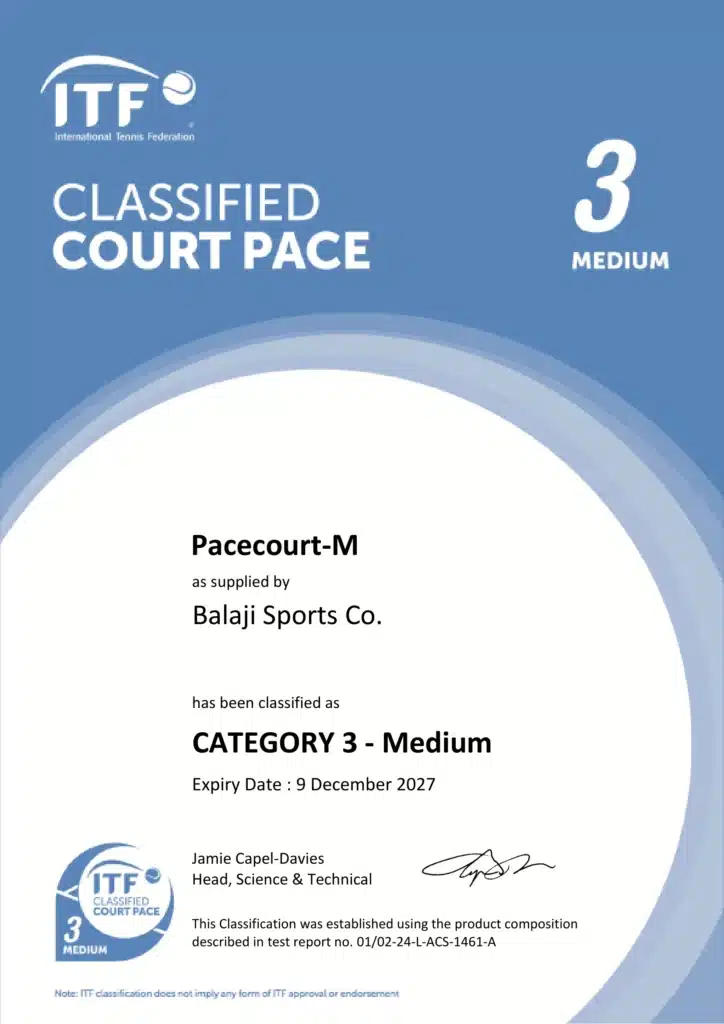
ITF-certified acrylic flooring for Tennis, Basketball, Badminton, Pickleball & more shipped worldwide.

    ISO-Certificate