Author name: Rahul

Rahul is a sports flooring expert and a key contributor at Pacecourt, a leading brand in acrylic and synthetic sports court solutions. Passionate about creating world-class playing surfaces, Rahul shares insights on tennis courts, basketball courts, and multi-purpose sports flooring. His goal is to help facility owners and sports enthusiasts choose durable, high-performance solutions that enhance the game experience.

Pickleball Court Flooring Cost in India
Pickleball court cost

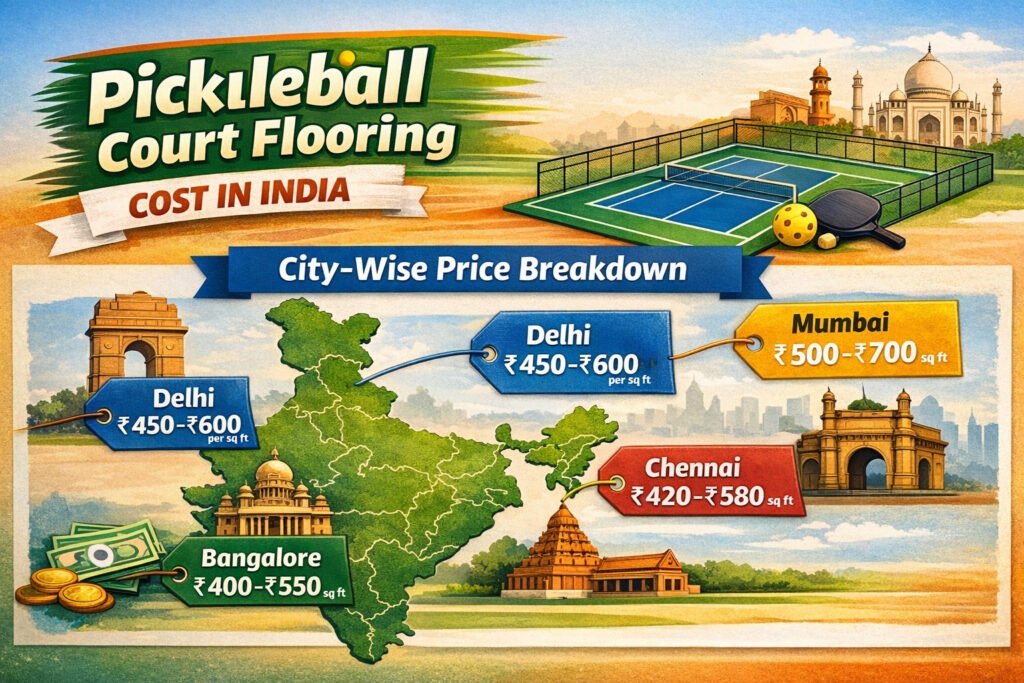
Pickleball Court Flooring Cost in India (City-Wise Price Breakdown)

Pickleball might sound like a quirky name, but don’t let that fool you—this sport is quietly becoming one of the fastest-growing recreational games in India. Blending elements of tennis, badminton, and table tennis, pickleball is easy to learn, light on the joints, and incredibly addictive once you start playing. Over the past few years, residential societies, sports clubs, schools, and even luxury villas have begun adding pickleball courts to their facilities. And with that surge in interest comes one big question everyone asks first: how much does pickleball court flooring cost in India? The answer isn’t as straightforward as quoting a single number. Pickleball court flooring costs vary widely depending on the city, type of flooring material, installation method, and whether the court is indoor or outdoor. A pickleball court in Mumbai will naturally cost more than one in a tier-3 city due to labor rates, logistics, and land preparation costs. Similarly, acrylic flooring will have a different price point compared to modular tiles or synthetic surfaces. If you’re planning to build a pickleball court—whether for personal use, a housing society, or a commercial sports facility—understanding the city-wise price breakdown can save you from nasty budget surprises later. This guide is designed to walk you through everything: from types of pickleball flooring available in India to detailed city-wise cost estimates, hidden expenses, and practical tips to optimize your budget. Think of it as your roadmap before you pour that first layer of concrete or snap in your first tile. Understanding Pickleball Court Flooring: What Makes It Different? At first glance, a pickleball court may look similar to a badminton or tennis court, but the flooring requirements are surprisingly specific. Pickleball is played with a perforated plastic ball and paddles, which means the surface must offer consistent bounce, adequate grip, and just the right amount of cushioning. Too hard, and players risk joint strain. Too soft, and ball behavior becomes unpredictable. A standard pickleball court measures 20 feet by 44 feet, the same for both singles and doubles. However, the total area required is usually larger when you factor in run-off space, fencing, and player movement. Flooring systems are typically installed over a concrete or asphalt base, especially for outdoor courts. Indoor courts may use wooden subfloors or existing slabs. What really sets pickleball court flooring apart is the balance it must strike. It needs to be durable enough to handle Indian weather conditions—heat, rain, dust—while also providing player comfort. That’s why most professional installations in India rely on acrylic coatings or modular tiles rather than plain concrete. These specialized surfaces enhance grip, reduce slips, and maintain consistent playability across seasons. Key Factors That Influence Pickleball Court Flooring Cost in India Before diving into city-wise numbers, it’s important to understand what actually drives the cost of pickleball court flooring in India. Think of the total cost as a puzzle made up of several pieces—miss one, and your budget estimate falls apart. Type of Flooring Material This is the biggest cost driver. Acrylic flooring is generally more affordable than cushioned or synthetic systems, while modular tiles can vary widely based on brand and quality. City and Location Labor charges, transportation costs, and local contractor rates differ significantly between metro cities and smaller towns. A court in Bengaluru or Mumbai will almost always cost more than one in Indore or Trichy. Indoor vs Outdoor Installation Outdoor courts require weather-resistant materials, proper drainage, and UV-stable coatings, which add to the cost. Indoor courts may save on weatherproofing but might need additional subfloor work. Base Preparation and Civil Work If the ground is uneven or poorly prepared, costs can shoot up quickly. Leveling, concrete laying, and curing time all add to the final bill. Accessories and Finishing Court markings, nets, poles, fencing, lighting, and seating are often overlooked during budgeting but can account for a significant portion of the total expense. Understanding these factors upfront helps you read cost estimates more intelligently—and negotiate better with contractors. Types of Pickleball Court Flooring Used in India India offers a surprisingly wide range of pickleball court flooring options, each catering to different budgets, usage levels, and playing conditions. Choosing the right one isn’t just about cost; it’s about how the court will be used and who will be playing on it. Acrylic Pickleball Court Flooring This is the most commonly used option in India. Acrylic surfaces are layered systems applied over concrete or asphalt bases. They offer excellent grip, consistent ball bounce, and are relatively easy to maintain. Modular Interlocking Tiles These are snap-fit tiles made from high-impact polypropylene. They’re popular for temporary courts or spaces that need quick installation. They work well both indoors and outdoors. Synthetic Sports Flooring Often used in multi-sport facilities, synthetic flooring provides added cushioning and shock absorption. It’s more expensive but ideal for player comfort. Concrete with Acrylic Coating This is a budget-friendly option where a basic concrete slab is finished with a thin acrylic layer. It’s functional but less forgiving on the joints. Cushioned Pickleball Court Systems These are premium systems with rubber or foam layers beneath the acrylic surface. They significantly reduce impact stress and are popular in high-end clubs. Each of these options comes with its own cost structure, lifespan, and maintenance needs, which we’ll break down in detail as we move forward. Acrylic Pickleball Court Flooring Cost in India Acrylic pickleball court flooring is often considered the sweet spot between performance and affordability in India. It’s the go-to choice for outdoor courts in residential societies, schools, and sports academies—and for good reason. Acrylic systems are weather-resistant, provide excellent traction, and offer a predictable ball bounce that players love. Cost Breakdown On average, acrylic pickleball court flooring in India costs between ₹250 to ₹450 per square foot, depending on the quality of materials and the city. This price usually includes surface preparation, primer coats, acrylic layers, and line markings. However, it may not include major civil work like new concrete laying. Durability and Maintenance A well-installed acrylic court
Basketball Court Flooring
Basketball Court Construction

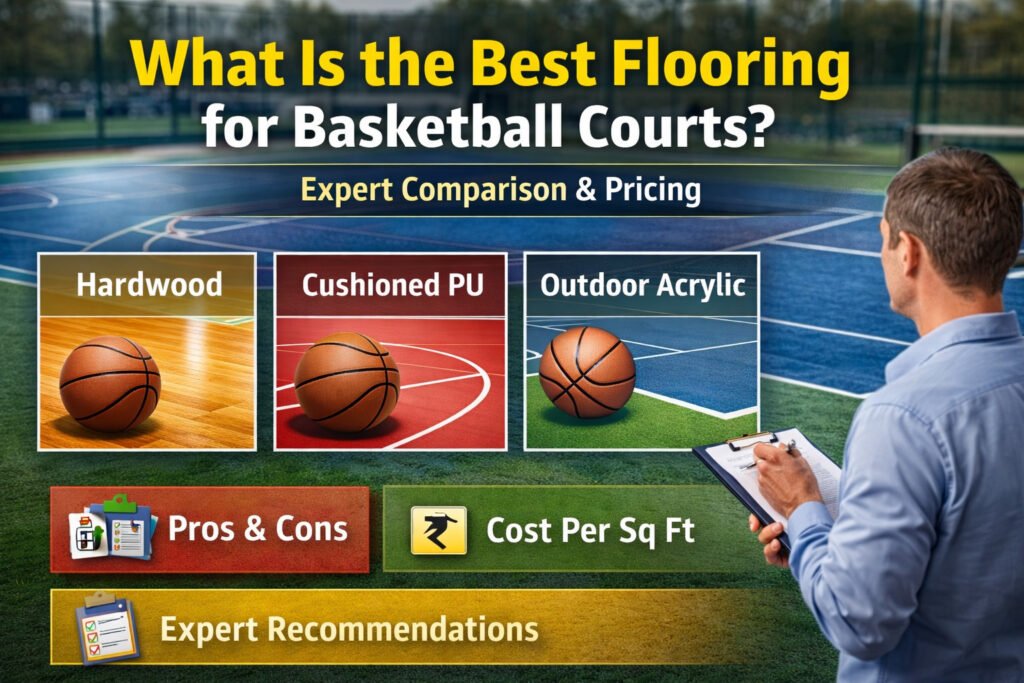
What Is the Best Flooring for Basketball Courts? Expert Comparison & Pricing

Basketball court flooring isn’t just something you play on—it’s something that plays with you. Every sprint, jump, pivot, and hard landing sends force straight through your feet, ankles, knees, and hips. The type of surface beneath you decides whether that force is absorbed safely or fired right back into your joints like a loaded spring. That’s why flooring is one of the most overlooked yet critical aspects of basketball performance and long-term health. For beginners, the wrong flooring can turn learning the game into a painful experience. Slippery surfaces kill confidence, while rock-hard courts punish joints and muscles that aren’t conditioned yet. Intermediate players start to feel the difference more clearly. As speed increases and movements become sharper, flooring quality starts influencing reaction time, balance, and even shooting rhythm. Advanced players? They demand perfection. A slight inconsistency in bounce or grip can throw off elite-level play. There’s also the injury factor. Poor flooring contributes to ankle sprains, knee stress, shin splints, and lower back pain. Over time, these issues stack up. A good basketball floor reduces fatigue, improves movement efficiency, and allows players to train longer without breaking down physically. It’s like wearing the right shoes versus running barefoot on gravel—same athlete, wildly different outcome. In short, basketball flooring isn’t a background detail. It’s a silent teammate that either supports your game or slowly sabotages it. Understanding this is the first step toward choosing the best basketball court flooring for your skill level. The Science Behind Basketball Court Flooring At first glance, a basketball court might just look flat and hard. But beneath that surface lies a carefully engineered system designed to manage energy, friction, and impact. Good basketball flooring is a blend of physics, biomechanics, and material science working together. Shock absorption is the big one. Every time a player jumps and lands, several times their body weight crashes into the floor. High-quality flooring absorbs a portion of that impact, reducing stress on joints and muscles. Hardwood and polyurethane systems excel here, while concrete does almost nothing to protect the body. Over time, that difference can mean healthy knees—or chronic pain. Ball bounce consistency is another critical factor. Basketball is a rhythm-based game. Dribbling relies on predictable rebound height and speed. Uneven or overly soft surfaces kill that rhythm, forcing players to adjust constantly. Professional-grade flooring ensures uniform ball response across the entire court, allowing players to focus on skill instead of compensation. Traction is where things get interesting. Too little grip and players slip, risking injury. Too much grip and the foot sticks while the body twists, which is a recipe for knee injuries. The best basketball flooring finds that sweet spot—enough traction for explosive movement without locking the foot in place. All these elements—shock absorption, ball response, and traction—must work together. When they do, the floor almost disappears from the player’s awareness. And that’s exactly the goal: a surface that supports performance without demanding attention. Types of Basketball Court Flooring Before choosing the best flooring, it helps to understand the full landscape of basketball court surfaces. Think of this section as zooming out and looking at the map before picking a route. Not all basketball courts are built for the same purpose, environment, or player level, and flooring options reflect that diversity. The first major divide is indoor vs outdoor basketball flooring. Indoor courts prioritize performance, comfort, and consistency. They’re protected from weather, which allows for materials like hardwood, vinyl, and polyurethane that would never survive rain or UV exposure. Outdoor courts, on the other hand, are built to endure heat, cold, moisture, and constant wear. Durability often wins over comfort outside, which is why concrete and asphalt are still common—despite their drawbacks. Next comes permanent vs modular flooring systems. Permanent flooring is installed once and intended to stay for decades. Hardwood courts and poured polyurethane systems fall into this category. They require professional installation and higher upfront costs but offer elite performance. Modular systems, usually interlocking tiles, are more flexible. They can be installed, removed, and relocated, making them popular for home courts, schools, community centers, and temporary events. Finally, there’s natural vs synthetic surfaces. Natural wood, especially maple, has been the gold standard for decades. Synthetic materials like vinyl, rubber, acrylic, and PU are engineered alternatives designed to mimic or enhance certain properties of wood while reducing maintenance or cost. Understanding these categories helps narrow your options fast. A beginner setting up a driveway hoop doesn’t need the same surface as a competitive indoor league. Once you know where and how the court will be used, the “best” flooring choice becomes much clearer. Hardwood Basketball Flooring: The Gold Standard When people picture a “real” basketball court, they almost always imagine polished hardwood. That’s not an accident. Hardwood—specifically maple wood—has earned its reputation through decades of elite-level play. Maple is dense, durable, and incredibly consistent. It provides excellent ball bounce, controlled traction, and natural shock absorption. This is why professional leagues, including the NBA and NCAA, rely on maple hardwood courts. The surface responds predictably, which allows players to move instinctively without hesitation. The pros are hard to ignore: But hardwood isn’t perfect. It’s expensive—not just to install, but to maintain. Regular cleaning, refinishing, humidity control, and occasional repairs are part of the deal. Moisture is its enemy, which makes hardwood unsuitable for outdoor courts or poorly ventilated spaces. So who should choose hardwood? Advanced players, competitive leagues, professional training facilities, and schools with long-term budgets. For beginners or casual users, hardwood is often overkill. It’s like buying a race car to learn how to drive. Incredible—but not always practical. Synthetic Basketball Court Flooring Options Synthetic flooring has come a long way. Today’s materials aren’t cheap knockoffs of hardwood—they’re purpose-built solutions designed to solve specific problems like cost, maintenance, or multi-sport use. Polyurethane (PU) flooring is one of the most popular indoor alternatives to hardwood. It’s poured or layered over a prepared subfloor, creating a seamless surface with excellent shock absorption. PU floors are forgiving






Tennis Court Flooring
Tennis court flooring

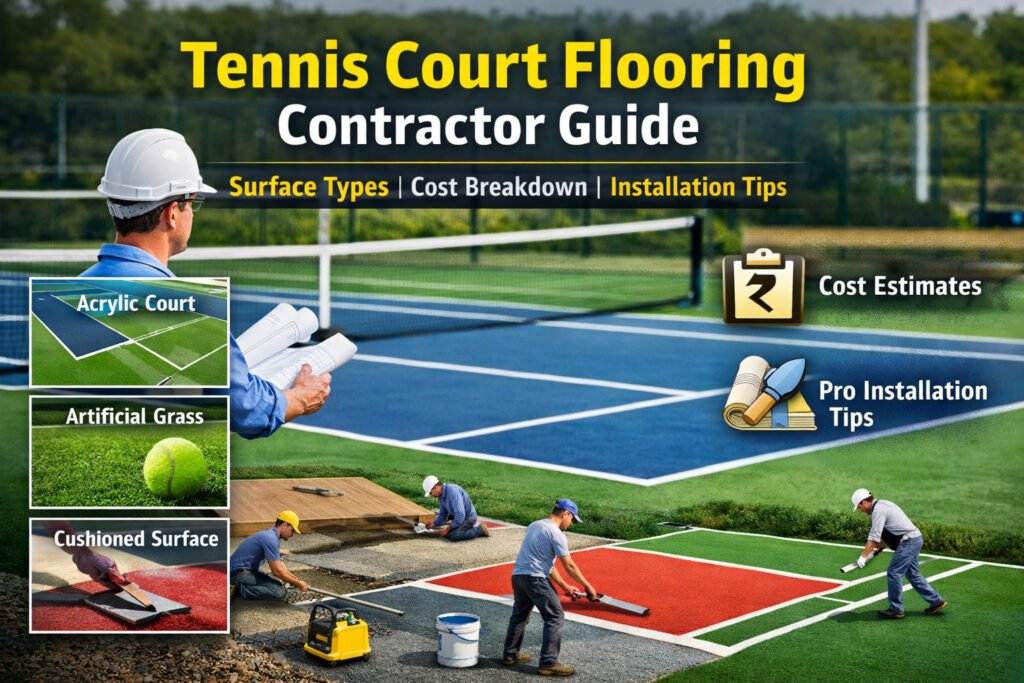
Tennis Court Flooring Contractor Guide – Surface Types, Cost & Installation Tips

Tennis court flooring isn’t just about looks—it’s the backbone of the entire playing experience. Think of it like the foundation of a house. You can have the most expensive rackets, professional-grade nets, and bright stadium lights, but if the surface beneath your feet isn’t right, everything else falls apart. Whether you’re building a private backyard court, a school facility, or a professional sports complex, choosing the right tennis court flooring can shape how the game is played, how safe players feel, and how long the court will actually last. The surface determines ball speed, bounce consistency, player movement, and even injury risk. A fast hard court encourages aggressive play, while a softer clay court slows the game and reduces stress on joints. On top of that, tennis court flooring directly impacts maintenance costs and long-term budgets. Some surfaces demand constant care, watering, and resurfacing, while others are almost “set it and forget it.” This is where a professional tennis court flooring contractors becomes essential. Flooring isn’t a DIY weekend project. It requires precise grading, drainage planning, material selection, and expert installation techniques. One small mistake during installation—like improper slope or poor base preparation—can lead to cracks, puddles, uneven bounce, and expensive repairs down the road. In this guide, we’ll walk through everything you need to know: different tennis court surface types, realistic cost expectations, and practical installation tips straight from the contractor’s playbook. Whether you’re a facility manager, property owner, or just exploring your options, this guide will help you make informed, confident decisions. Understanding the Role of a Tennis Court Flooring Contractor A tennis court flooring contractor does far more than just lay down a surface and walk away. They’re part engineer, part sports consultant, and part problem solver. Their role begins long before the first layer of material is installed and continues well after the court is finished. First, a contractor evaluates the site. This includes soil conditions, drainage patterns, slope, and available space. For outdoor courts especially, understanding how water moves across the land is critical. Poor drainage is one of the fastest ways to destroy a tennis court. A qualified contractor knows how to design a base that channels water away efficiently without affecting playability. Next comes material selection. Not all surfaces are suitable for every climate or usage pattern. A contractor helps match the right flooring system to your needs—whether that’s a low-maintenance acrylic hard court, a cushioned synthetic surface for player comfort, or a clay system for traditional play. They’ll also factor in budget constraints and long-term maintenance costs. During installation, precision is everything. Contractors manage base construction, leveling, surface application, line marking, and curing times. They use specialized equipment and follow strict tolerances to ensure consistent ball bounce and proper traction. After installation, many contractors offer maintenance plans, resurfacing services, and inspections to extend the court’s lifespan. In short, hiring an experienced tennis court flooring contractor isn’t an expense—it’s an investment in performance, safety, and durability. Key Factors to Consider Before Choosing Tennis Court Flooring Before selecting a tennis court surface, it’s important to step back and look at the bigger picture. The “best” surface doesn’t exist in isolation—it depends on how, where, and by whom the court will be used. Climate and Weather Conditions Weather plays a massive role in surface performance and longevity. In hot climates, surfaces must withstand UV exposure and extreme temperatures without cracking or fading. In rainy regions, drainage becomes a top priority. Freeze-thaw cycles in colder climates can wreak havoc on poorly designed bases, leading to cracks and uneven areas. Player Skill Level and Usage Frequency Is the court for casual recreational play, training beginners, or hosting competitive matches? Beginner-friendly courts often prioritize comfort and slower ball speeds, while advanced players may prefer faster, more responsive surfaces. High-traffic courts need durable materials that can handle constant play without excessive wear. Indoor vs Outdoor Courts Indoor courts have more flexibility in surface choice since they’re protected from weather. Outdoor courts, on the other hand, must be designed to handle environmental stressors. A contractor helps balance these factors to ensure optimal performance year-round. Taking time to assess these considerations upfront can save thousands of dollars in future repairs and resurfacing costs. Types of Tennis Court Surfaces Explained Tennis court surfaces generally fall into five main categories: hard courts, clay courts, grass courts, synthetic surfaces, and modular tile systems. Each surface has unique characteristics that influence gameplay, maintenance, and cost. Understanding these differences is crucial when working with a tennis court flooring contractor. The surface you choose will shape how the game feels, how much upkeep is required, and how long the court remains playable without major renovations. Below, we’ll break down each surface type in detail, highlighting what makes them unique and where they perform best. Hard Court Tennis Flooring Hard courts are the most common tennis surfaces worldwide, especially in public parks, schools, and professional tournaments. Typically constructed using asphalt or concrete bases with acrylic surface coatings, hard courts strike a balance between speed and control. One of the biggest advantages of hard court flooring is consistency. The ball bounce is predictable, which makes it ideal for training and competitive play. Players can rely on uniform response across the court, allowing skill—not surface quirks—to determine outcomes. From a contractor’s perspective, hard courts are durable and cost-effective. Once properly installed, they require relatively low maintenance compared to clay or grass. Occasional cleaning, crack repair, and resurfacing every 5–8 years can keep a hard court in excellent condition. However, hard courts are less forgiving on the body. The rigid surface can increase impact stress on knees, ankles, and hips. To address this, many modern installations include cushioned acrylic systems that add shock absorption without sacrificing performance. Hard courts work well in a wide range of climates, making them a versatile choice for both indoor and outdoor facilities. Clay Court Tennis Flooring Clay courts are known for their slower pace, higher bounce, and player-friendly characteristics. Traditionally made from crushed brick

Why Synthetic Acrylic Flooring Is the Best Choice for Outdoor Sports Courts
Synthetic Sports Flooring

Why Synthetic Acrylic Flooring Is the Best Choice for Outdoor Sports Courts in India

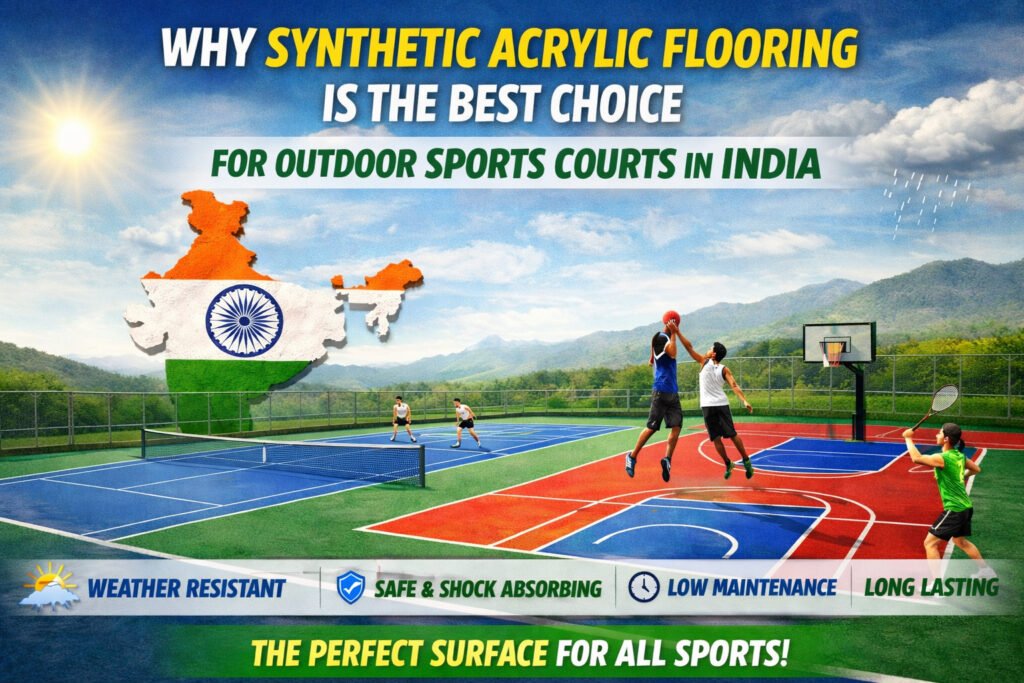
Sports are an integral part of India’s culture. From neighbourhood basketball games and school sports days to community tennis and badminton, outdoor courts are everywhere. But one question that often stumps planners, architects, and facility managers is: What is the ideal surface for outdoor sports courts in Indian weather conditions? The answer gaining overwhelming consensus among sports flooring experts and engineers is:Synthetic acrylic flooring. This article explores why acrylic flooring is the best choice for outdoor sports surfaces in India — backed by performance metrics, climatic suitability, cost-effectiveness, and player experience. What Is Synthetic Acrylic Sports Flooring? Synthetic acrylic flooring is a multi-layer polymer coating system applied over concrete or asphalt bases. It consists of: This combination creates a durable, flexible, and weather-resistant surface ideal for various sports like: ✔ Tennis✔ Basketball✔ Volleyball✔ Badminton✔ Roller skating✔ Multi-purpose play courts Weather Toughness — Built for Indian Climate Extremes India’s climate ranges from sizzling heat in summer (~45°C+) to monsoon humidity and winter fog in northern regions. Synthetic acrylic flooring thrives in such conditions because: 👉 Bottom line: Acrylic flooring can withstand the rigours of Indian weather better than paints, tiles, or untreated concrete. 2. Excellent Shock Absorption and Player Safety Synthetic acrylic systems can be installed with cushioning layers that provide: These are critical for high-intensity sports like basketball and volleyball, where frequent jumping and abrupt movements are common. Health Benefits:✔ Reduced knee and ankle stress✔ Better grip and reduced slipping✔ Controlled ball bounce for fair play 3. Low Maintenance — Less Hassle, More Play Time Unlike timber, interlocking tiles, or natural stone, acrylic flooring is remarkably low maintenance: Maintenance Tip: A yearly check and light recoating can extend the surface life by years. 4. Cost-Effective Over the Long Run Initial installation costs are moderate, but the lifecycle cost makes acrylic flooring highly economical: Feature Acrylic Flooring Other Options Initial cost ✔ Moderate High (tiles/mats) Maintenance ✔ Low Moderate to High Durability ✔ Up to 8–12+ yrs Variable Repair cost ✔ Low High 💡 For government projects, schools, clubs, and residential societies, this translates to significant long-term savings. 5. Customisable & Aesthetically Pleasing Synthetic acrylic systems offer vibrant colour options and design flexibility, which means: Plus, the non-glare finish improves player visibility on sunny days. 6. Multi-Sport Versatility One of acrylic flooring’s strongest advantages is its adaptability. A single court surface can be marked and used for: This versatility means better utilisation and greater return on investment. 7. Sustainability & Environmental Benefits While acrylic is a synthetic material, modern systems are designed with: Plus, the long service life means fewer replacements and resource consumption. 8. Professional Installation Is Key To maximise performance: ✔ The base (asphalt or concrete) must be level and free of cracks✔ Primer and base coats must be applied uniformly✔ Weather conditions matter during installation (avoid extreme rain) A certified installer ensures longevity, warranty adherence, and warranty support. Why Competitors Fall Behind Let’s compare briefly: Concrete Only Rubber Tiles Modular Plastic Tiles Synthetic acrylic flooring strikes the balance between affordability, performance, durability, and safety. Acrylic Flooring Performance Across Different Sports Synthetic acrylic flooring is not a one-size-fits-all solution—it adapts exceptionally well to different sports requirements. Its layered system allows customisation of texture, cushioning, and grip based on the sport being played. Tennis Courts Acrylic flooring is widely preferred for outdoor tennis courts due to its: It also meets international play standards when installed correctly, making it suitable for both training and competitive matches. Basketball Courts For basketball, acrylic flooring offers: This makes it ideal for schools, sports academies, and residential complexes. Badminton & Volleyball Courts Though traditionally indoor sports, acrylic flooring works well for outdoor badminton and volleyball courts when: The surface ensures player stability and consistent movement without excessive joint strain. Multi-Purpose Community Courts Acrylic flooring allows multiple sports to coexist on a single surface. This is particularly beneficial for: Drainage & Water Management Advantages One of the major concerns for outdoor courts in India is water accumulation during monsoons. Synthetic acrylic flooring addresses this through: Unlike tiles or concrete, acrylic surfaces dry evenly, allowing play to resume sooner after rain. Surface Texture Options for Better Control Acrylic sports flooring systems come with multiple texture grades: This flexibility ensures the court surface matches player skill levels and safety requirements. Ideal Applications for Synthetic Acrylic Flooring in India Acrylic flooring is widely used across multiple sectors due to its adaptability and reliability: Educational Institutions Residential & Commercial Projects Government & Public Infrastructure Its durability and low upkeep make it ideal for high-usage environments. Common Mistakes to Avoid During Installation Even the best materials can fail if installed incorrectly. Some common mistakes include: Choosing experienced installers and quality-certified materials is essential to ensure long-term performance. Maintenance Best Practices for Long-Lasting Courts While acrylic flooring is low maintenance, following simple care routines extends its life: These practices help retain grip, colour, and overall court quality. Why Acrylic Flooring Is a Smart Investment for India’s Growing Sports Culture With increasing focus on: The demand for durable, safe, and cost-effective sports surfaces is growing. Synthetic acrylic flooring supports this growth by delivering professional-grade performance at an affordable cost. It bridges the gap between elite sports infrastructure and community-level accessibility—making sports safer and more enjoyable for everyone. Final Takeaway Synthetic acrylic flooring continues to prove itself as the most reliable outdoor sports court solution in India. Its adaptability across sports, resilience against harsh weather, minimal maintenance needs, and long-term value make it the preferred choice for modern sports infrastructure. As India’s sports ecosystem evolves, acrylic flooring stands out as a surface that supports performance, safety, and sustainability—year after year.

Indoor Pickleball Courts
Pickleball Ball

Indoor Pickleball Courts: The Ultimate Guide for Players, Builders & Facility Owners

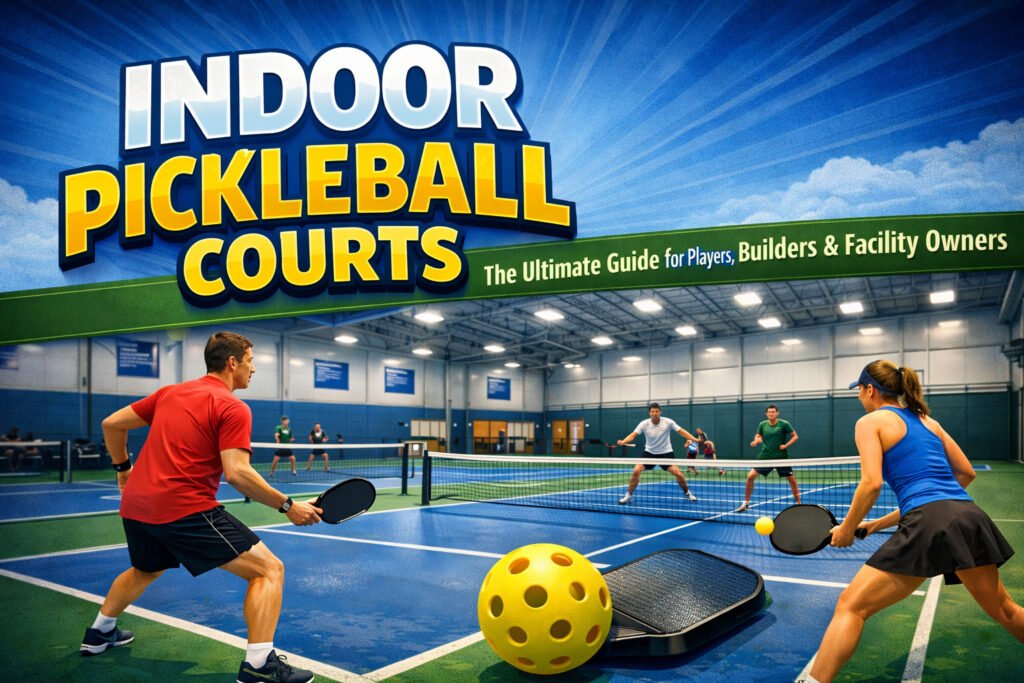
Indoor pickleball courts are no longer just a backup plan for rainy days—they’ve become the gold standard for year-round play. If you’ve ever had a great outdoor game ruined by wind, heat, or uneven surfaces, you already understand why indoor pickleball courts are winning hearts across the globe. These courts offer consistency, comfort, and control, which is exactly what players crave as the sport continues its meteoric rise. What makes indoor pickleball courts especially appealing is their ability to cater to everyone. Beginners love the predictable ball behavior, intermediate players appreciate the cleaner footwork, and competitive athletes thrive in a controlled environment where skill—not weather—decides the outcome. Facility owners are also catching on, realizing that indoor courts provide steady revenue without seasonal downtime. Think of indoor pickleball courts as the “home kitchen” of the sport. Everything is where it should be. The lighting is right, the floor feels dependable underfoot, and distractions are kept to a minimum. Whether you’re a casual player, a tournament organizer, or someone considering building a facility, understanding indoor pickleball courts is the first step toward leveling up your pickleball experience. What Is Pickleball and Why It’s Exploding Indoors Pickleball is a fast-paced paddle sport that blends elements of tennis, badminton, and ping-pong into one addictive game. Played on a smaller court with a perforated plastic ball, pickleball is easy to learn but surprisingly deep once you get hooked. The rules are simple, rallies are engaging, and the social aspect keeps players coming back for more. So why is pickleball exploding indoors? The answer is consistency. Indoor environments remove unpredictable factors like wind gusts, sun glare, and temperature extremes. That means better rallies, more accurate shots, and fewer excuses. Players can focus on strategy, reflexes, and teamwork rather than fighting the elements. Indoor pickleball courts also open the door to structured programming. Leagues, lessons, clinics, and tournaments thrive indoors because schedules aren’t at the mercy of weather forecasts. This reliability has made indoor pickleball courts especially popular in urban areas, colder climates, and regions with extreme summers. In many ways, indoor pickleball courts are fueling the sport’s professional and competitive growth. As players improve faster indoors, the overall skill level rises. It’s like switching from dirt roads to smooth highways—everything just moves better. Benefits of Indoor Pickleball Courts Over Outdoor Courts Indoor pickleball courts offer a long list of advantages that go far beyond convenience. First and foremost is weather protection. Rain, wind, snow, and heat waves simply don’t matter indoors. You show up, warm up, and play—no cancellations, no delays. Another major benefit is surface consistency. Indoor pickleball courts typically use professional-grade flooring designed for sports performance. This reduces joint strain, improves traction, and lowers the risk of slips and falls. For older players or those recovering from injuries, this alone can be a game-changer. Sound control and lighting also play a huge role. Indoor courts use uniform lighting systems that eliminate harsh shadows and glare. Acoustics can be managed with sound-absorbing materials, making games more enjoyable and less chaotic. Anyone who’s played in a noisy gym knows how valuable this can be. From a community standpoint, indoor pickleball courts create a social hub. They encourage year-round participation, foster leagues and clubs, and support skill development at every level. In short, indoor pickleball courts don’t just improve the game—they elevate the entire pickleball lifestyle. Types of Indoor Pickleball Courts Dedicated Indoor Pickleball Facilities Dedicated indoor pickleball facilities are purpose-built spaces designed exclusively for the sport. These are the dream venues for serious players. Every detail—from court spacing to lighting and acoustics—is optimized for pickleball performance. These facilities often feature multiple courts, professional flooring, permanent nets, and spectator seating. Many also include locker rooms, pro shops, lounges, and even cafés. Because the space is dedicated, scheduling is smooth, and court availability is reliable. For facility owners, dedicated indoor pickleball courts offer strong branding opportunities. You’re not just renting space—you’re creating an experience. This makes it easier to host tournaments, attract sponsors, and build a loyal player community. Multi-Purpose Gymnasiums Multi-purpose gymnasiums are a common home for indoor pickleball courts, especially in schools, community centers, and YMCAs. These spaces typically use temporary nets and taped or painted court lines. While they may lack the polish of dedicated facilities, gymnasiums are accessible and cost-effective. They allow organizations to introduce pickleball without major renovations. The trade-off is shared scheduling and less specialized flooring. Converted Warehouses and Recreation Centers Converted warehouses are becoming increasingly popular for indoor pickleball courts. High ceilings, open layouts, and flexible design make them ideal for multiple courts. With the right flooring and lighting upgrades, these spaces can rival purpose-built facilities. Standard Indoor Pickleball Court Dimensions Court Size and Layout An indoor pickleball court follows the same official dimensions as an outdoor one: 20 feet wide by 44 feet long. This includes both singles and doubles play. The non-volley zone, or “kitchen,” extends 7 feet from the net on both sides. However, the real difference indoors is spacing. Ideally, indoor pickleball courts should have at least 5 to 10 feet of clearance around each side and baseline. This extra space allows for safe movement and competitive play. Ceiling Height and Clearance Ceiling height is a critical factor for indoor pickleball courts. A minimum of 18 to 20 feet is recommended, especially for lobs. Low ceilings can disrupt play and limit shot variety, which can be frustrating for advanced players. Flooring Options for Indoor Pickleball Courts Hardwood Flooring Hardwood floors are common in gymnasiums and offer a familiar feel. They provide good ball bounce and aesthetic appeal but can be slippery if not properly maintained. Synthetic Sports Flooring Synthetic flooring is becoming the top choice for indoor pickleball courts. It offers excellent traction, shock absorption, and consistent ball response. This type of flooring is designed to reduce joint stress and fatigue. Modular Court Tiles Modular tiles are easy to install and maintain. They’re ideal for facilities that want flexibility or temporary setups. While they may not

tennis court flooring manufacturer in Dubai

Ultimate Guide to Tennis Court Flooring Manufacturers in Dubai (2026)

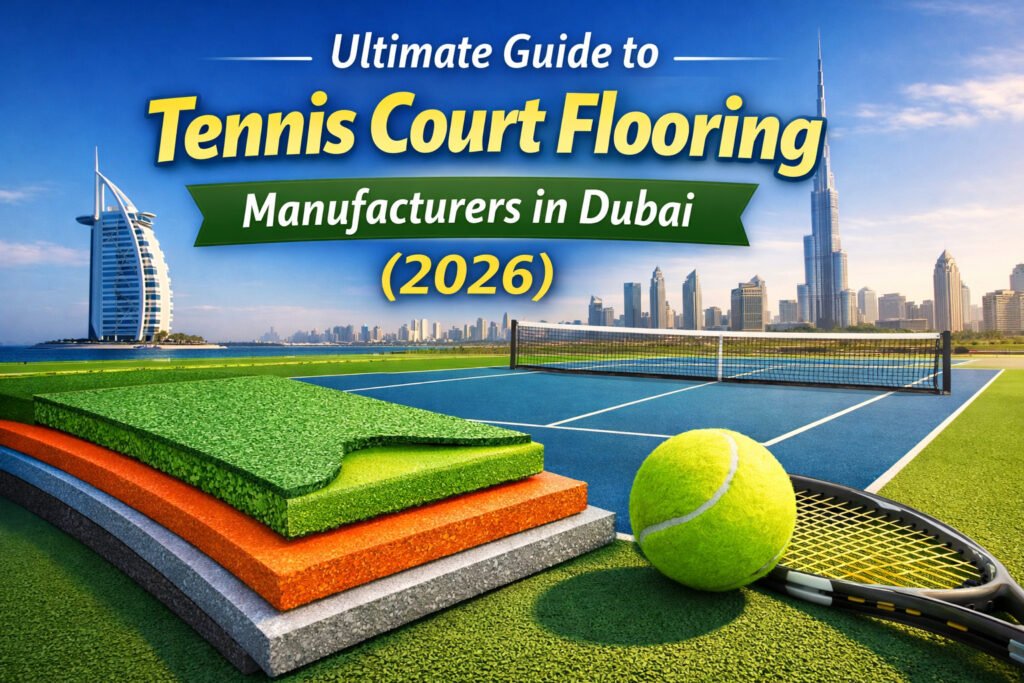
Dubai has rapidly emerged as a global hub for professional sports infrastructure, luxury residential developments, and premium recreational facilities. As a result, the demand for high-quality tennis court flooring has grown significantly across academies, clubs, schools, hotels, and private villas. Choosing the right tennis court flooring manufacturer in Dubai is critical, as the surface must withstand extreme heat, intense UV exposure, and year-round usage while delivering consistent performance and player safety. This comprehensive guide covers surface types, manufacturing standards, climate considerations, costs, and how to choose the right tennis court flooring supplier in Dubai. Why Flooring Matters for Tennis Courts in Dubai A quality tennis court surface is not just an aesthetic choice — it directly impacts: ✅ Player comfort & safety (shock absorption, slip resistance)✅ Consistent ball bounce & speed✅ Weather resilience (UV resistance for Dubai’s climate)✅ Maintenance & lifespan performance Dubai’s extreme heat and occasional humidity make it essential to choose materials and install systems that resist cracking, fading, and accelerated wear. Most Common Court Surface Types ✔ Acrylic Hard Courts – Durable, provides consistent bounce, and suitable for all player levels.✔ Cushioned Acrylic Systems – Enhanced shock absorption to reduce joint strain.✔ PU (Polyurethane) Flooring – Great for indoor show courts or multi-purpose venues.✔ Synthetic Turf – Ideal for lower-maintenance community or recreational courts. Each surface type comes with benefits and trade-offs. For instance, acrylic systems provide high-performance ball response, while PU coatings excel in indoor cushioning and comfort. Manufacturing Standards for Tennis Court Flooring in Dubai Reputable tennis court flooring manufacturers in Dubai follow international performance benchmarks, including: High-quality manufacturers also provide custom surface speeds, allowing courts to be classified as slow, medium, or fast. Tennis Court Construction Process Professional tennis court flooring systems typically follow these stages: Correct installation is as important as the flooring material itself. Tennis Court Flooring Cost in Dubai While costs vary depending on surface type and project size, typical pricing factors include: Approximate Cost Factors: Long-term durability should always take priority over the lowest initial cost. How to Choose the Right Tennis Court Flooring Manufacturer in Dubai Before finalizing a supplier or manufacturer, evaluate the following: ✔ Climate Compatibility Ensure materials are designed specifically for hot and UV-intensive regions. ✔ Installation Experience Experienced manufacturers provide correct base preparation and surface layering. ✔ Customization Options Court color, cushioning levels, surface speed, and line markings should be adjustable. ✔ Maintenance Support Periodic resurfacing, recoating, and repair services extend court lifespan. ✔ Compliance & Warranty Look for material warranties and performance guarantees. Best Tennis Court Flooring Applications Facility Type Recommended Surface Professional Academies Cushioned Acrylic Sports Clubs Acrylic or PU Hotels & Resorts Acrylic or Synthetic Turf Schools & Colleges Multi-purpose Acrylic Residential Villas Acrylic or Turf Maintenance & Lifespan A professionally installed tennis court flooring system in Dubai can last 8–12 years with proper care. Basic Maintenance Includes: Preventive maintenance significantly reduces long-term costs. Advanced Surface Performance Factors for Tennis Courts in Dubai When selecting tennis court flooring in Dubai, surface performance goes beyond basic durability. Professional-grade courts are designed to balance speed, comfort, and safety, especially under extreme heat conditions. Surface Speed Classification Tennis court flooring systems are typically classified into three speed categories: Manufacturers adjust surface speed through acrylic layer thickness, texture, and cushioning density, allowing customization based on the intended level of play. Heat & UV Resistance Technology in Tennis Court Flooring Dubai’s climate requires specialized engineering to prevent surface failure. Key Heat-Resistant Features: These technologies ensure the surface remains playable even during peak summer months. Drainage & Water Management Systems Although Dubai experiences low rainfall, sudden showers can impact outdoor courts. Modern tennis court flooring systems include: Proper drainage prevents water accumulation and reduces downtime after rain. Sustainability & Eco-Friendly Tennis Court Flooring Sustainability is becoming increasingly important in sports infrastructure projects across the UAE. Environmentally Responsible Features: Eco-conscious tennis court flooring contributes to green building certifications and reduces long-term environmental impact. Tennis Court Flooring for High-Traffic Facilities Sports academies, schools, and clubs require flooring systems that can handle continuous daily use. Recommended Features for High Usage: High-traffic courts benefit from slightly higher upfront investment but offer significantly lower maintenance costs. Indoor vs Outdoor Tennis Court Flooring in Dubai Outdoor Tennis Courts Indoor Tennis Courts Choosing the correct flooring system depends on facility type, usage frequency, and budget. Common Mistakes to Avoid When Choosing Tennis Court Flooring Avoiding these mistakes can save time and money: ❌ Choosing flooring based on price alone❌ Ignoring base construction quality❌ Skipping cushioning layers for high-use courts❌ Using indoor materials for outdoor courts❌ Not planning for long-term maintenance Expert consultation during the planning stage prevents these costly errors. Tennis Court Flooring Trends in Dubai (2026 & Beyond) The tennis court flooring industry in Dubai continues to evolve with innovation and demand. Emerging Trends: These trends reflect the region’s focus on premium sports infrastructure. Final Expansion Summary Adding advanced features such as heat resistance, cushioning, sustainability, and drainage systems significantly improves tennis court performance in Dubai’s climate. By selecting the right flooring technology and planning for long-term maintenance, facilities can ensure safe, high-quality play for years.

Outdoor Badminton Court Size

Outdoor Badminton Court Size: Complete Dimensions, Layout & Construction Guide (2026)

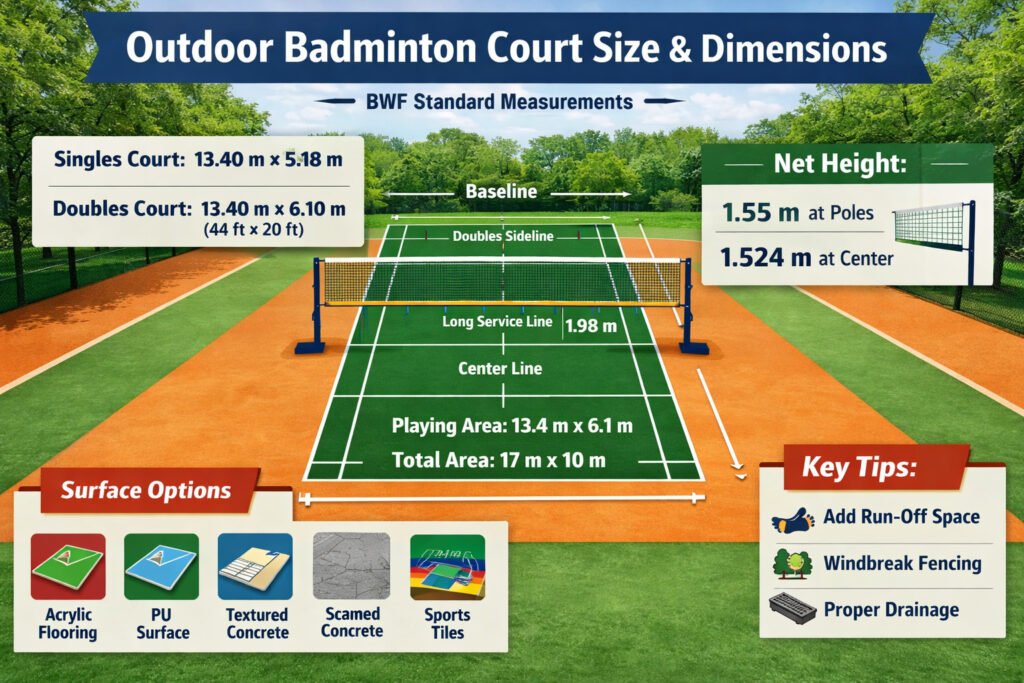
Outdoor badminton courts are becoming increasingly popular in schools, residential societies, parks, and sports academies. However, outdoor badminton court size and layout differ slightly from indoor courts due to wind conditions, safety zones, and badminton court flooring requirements designed for outdoor durability. This in-depth guide explains everything you need to know about Outdoor Badminton Court Size, including official dimensions, court markings, run-off space, net height, badminton court flooring options, and construction best practices—all aligned with BWF standards and real-world outdoor playing conditions. Standard Outdoor Badminton Court Size (BWF Approved) Badminton court dimensions remain the same for indoor and outdoor play. However, extra clearance is strongly recommended outdoors for safety and environmental factors. Court Dimensions (In Meters & Feet) Category Length Width Singles Court 13.40 m (44 ft) 5.18 m (17 ft) Doubles Court 13.40 m (44 ft) 6.10 m (20 ft) ✅ These measurements are measured to the outer edge of boundary lines Outdoor Badminton Court Layout & Markings Key Court Lines Explained Line Marking Specifications Feature Standard Line Width 40 mm (4 cm) Line Color White or Yellow Surface Contrast High visibility required Recommended Total Area for an Outdoor Badminton Court While the playing area is fixed, outdoor courts require additional run-off space for safety and comfort. Ideal Outdoor Court Area Area Type Size Playing Court 13.40 m × 6.10 m Minimum Run-Off (All Sides) 1.5 – 2.0 m Total Recommended Area 17 m × 10 m 🟢 This extra space helps prevent injuries and allows free movement in windy conditions. Outdoor Badminton Net Height & Specifications Location Height Net at Poles 1.55 m Net at Center 1.524 m Net Details Orientation & Wind Considerations (Outdoor-Specific) Outdoor badminton is affected by wind and sunlight, so orientation matters. Best Court Orientation Best Surface Options for Outdoor Badminton Courts Choosing the right surface is crucial for durability and player safety. Recommended Outdoor Surfaces Surface Type Suitability Lifespan Acrylic Sports Flooring ⭐⭐⭐⭐⭐ 6–8 years Synthetic PU Flooring ⭐⭐⭐⭐ 5–7 years Concrete (Textured) ⭐⭐⭐ 8–10 years Interlocking Sports Tiles ⭐⭐⭐ 5–6 years Lighting Requirements for Outdoor Badminton Courts For evening play, proper lighting is essential. Parameter Recommendation Lux Level 200–300 lux Pole Height 6–8 meters Light Position Outside court boundary Light Type LED sports lights Outdoor vs Indoor Badminton Court Size Comparison Feature Indoor Outdoor Playing Area Same Same Run-Off Space 1–1.5 m 1.5–2 m Surface Wooden / PVC Acrylic / Concrete Wind Impact None High Roof Clearance Required Not required Common Mistakes to Avoid in Outdoor Badminton Court Construction ❌ Ignoring wind direction❌ No drainage slope❌ Using glossy or slippery surfaces❌ Insufficient run-off space❌ Poor line contrast Badminton Court Flooring for Outdoor Courts Choosing the right badminton court flooring is one of the most important decisions when building an outdoor court. Unlike indoor courts, outdoor surfaces must withstand UV rays, rain, temperature changes, and heavy foot traffic while still providing proper grip and shock absorption. Key Requirements for Outdoor Badminton Court Flooring An ideal outdoor badminton court flooring system should offer: Best Badminton Court Flooring Options for Outdoor Use 1. Acrylic Badminton Court Flooring (Most Recommended) Acrylic flooring is the most widely used badminton court flooring for outdoor courts worldwide. Advantages: Average Lifespan: 6–8 yearsMaintenance: Low 2. Synthetic PU Flooring (Semi-Outdoor Areas) PU flooring is suitable for covered outdoor courts or areas with partial roofing. Pros: Cons: 3. Concrete Base with Anti-Skid Coating This is a budget-friendly badminton court flooring solution for parks and community areas. Pros: Cons: 4. Interlocking Sports Tiles Modular tiles are often used in temporary or multipurpose courts. Best For: Limitations: Ball bounce consistency may vary Not ideal for professional badminton Ideal Thickness for Outdoor Badminton Court Flooring Flooring Type Recommended Thickness Acrylic System 3–5 mm PU Flooring 5–8 mm Concrete + Coating Surface textured Sports Tiles As per manufacturer ⚠️ Thicker flooring does not always mean better performance. Grip and surface consistency matter more. Color Guidelines for Outdoor Badminton Courts Proper color selection improves visibility and player focus. Recommended Color Combinations Avoid glossy finishes as they cause glare under sunlight. Maintenance Tips for Outdoor Badminton Court Flooring To increase the lifespan of your badminton court flooring: Cost Factors for Outdoor Badminton Court Construction Several factors affect the final cost: A professionally built outdoor badminton court offers better safety, lower maintenance, and longer durability. Safety Standards for Outdoor Badminton Courts Anti-skid surface with proper friction value Rounded edges around court area Adequate run-off space (minimum 1.5 m) Proper lighting without glare Shock-absorbing layers where possible Who Should Build an Outdoor Badminton Court? Outdoor badminton courts are ideal for: Conclusion: Outdoor Badminton Court Size & Flooring Go Hand in Hand While following the correct outdoor badminton court size is essential, selecting the right badminton court flooring ensures safety, performance, and durability. A well-designed court with proper drainage, surface quality, and layout provides a professional playing experience even in outdoor conditions. For long-term value, acrylic badminton court flooring remains the most trusted choice for outdoor installations.

Acrylic Tennis Court Flooring
Acrylic tennis court flooring

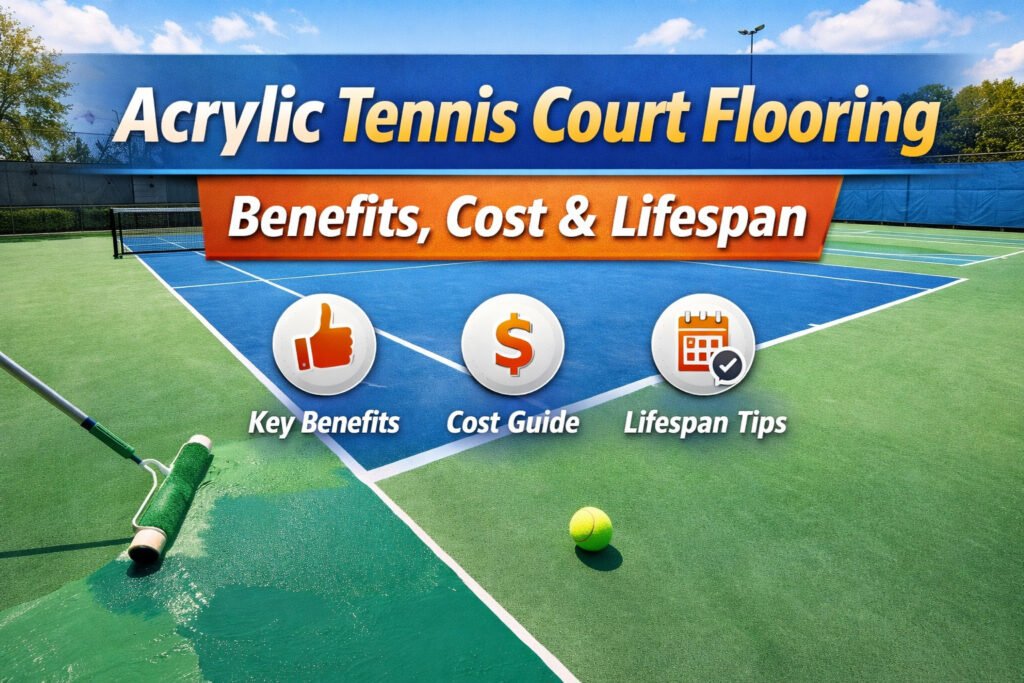
Acrylic Tennis Court Flooring: Benefits, Cost & Lifespan

Choosing the right surface for a tennis court isn’t just about aesthetics—it’s about performance, durability, cost-efficiency, and long-term playability. Acrylic tennis court flooring has become one of the most popular choices worldwide due to its balance of value, performance, and weather resistance. What Is Acrylic Tennis Court Flooring? Acrylic tennis court flooring is a surface system made from multiple coats of acrylic resin coatings applied over a suitable base (usually asphalt or concrete). These layers create a flat, cushioned, UV-resistant playing surface with controlled ball bounce and traction characteristics tailored for tennis. It’s commonly used for: ✔ Outdoor tennis courts✔ Club and community courts✔ School and university facilities✔ Recreational and professional play How Acrylic Tennis Court Flooring Is Constructed Before the top acrylic surface is applied, the base must be properly prepared: This multilayer system provides a consistent playing surface and ensures longevity when installed correctly. Benefits of Acrylic Tennis Court Flooring 1. Superior UV & Weather Resistance Acrylic tennis court surfaces are inherently resistant to UV degradation, which prevents yellowing, fading, and brittleness due to sun exposure. This makes them ideal for outdoor installation in sunny climates. 2. Excellent Playability Acrylic surfaces provide predictable ball bounce, consistent speed, and good traction—attributes endorsed by tennis governing bodies such as the ITF (International Tennis Federation). These features make it suitable for both recreational and competitive play. 3. Customizable Color Options Manufacturers offer a wide range of colors—not just classic green and blue. This helps courts blend with surroundings or match club branding. 4. Cost-Effective for Mid-Tier Use Compared to other surfaces like synthetic or cushioned systems, acrylic tennis court flooring is generally more affordable while delivering solid performance. 5. Quick Installation & Fast Curing Acrylic coatings dry faster than many alternatives, which reduces downtime for courts needing rapid turnaround. 6. Moderate Cushioning for Player Comfort While not as cushioned as specialized shock-absorbing systems, acrylic surfaces offer a comfortable amount of give that reduces player fatigue and lowers the risk of ankle strain. 7. Easy Maintenance Keeping an acrylic surface in good shape requires regular cleaning and periodic resurfacing—simple tasks for facility owners. Performance Attributes Attribute Acrylic Surface Ball Bounce Consistency ⭐⭐⭐⭐ Traction & Grip ⭐⭐⭐⭐ Weather Resistance ⭐⭐⭐⭐ Chemical Resistance ⭐⭐⭐ Impact Absorption ⭐⭐⭐ Installation Time ⭐⭐⭐⭐ Acrylic Tennis Court Flooring Cost Guide The cost of acrylic tennis court flooring depends on several factors: 1. Court Size A standard tennis court usually measures 78 ft x 36 ft (singles/doubles). Larger courts for tournaments or multiple courts will increase material and labor costs. 2. Base Condition If the concrete or asphalt base already exists and is in good condition, costs decrease. If extensive leveling or repair is required, costs go up. 3. Materials & Coats Higher quality acrylic coatings and multiple protective layers increase longevity but also raise upfront costs. Typical Cost Range (2026 Estimates) Item Estimated Cost (USD) Basic Acrylic Coating $6 – $10 per sq. ft. Mid-Tier System (with Primer + Multiple Coats) $10 – $12 per sq. ft. Premium System (with cushioning + advanced finish) $12 – $16+ per sq. ft. Note: Prices vary by region, base condition, and contractor. Always request a detailed quote. Lifespan: How Long Does Acrylic Flooring Last? Acrylic tennis court floors are known for their long service life when properly maintained. ✔ Expected Lifespan: 6–10 years✔ Resurfacing Interval: Every 4–6 years on average Factors that affect lifespan include: Acrylic Tennis Court Maintenance Tips Proper maintenance ensures maximum performance and longevity: Daily/Weekly Monthly Annually Resurfacing Every 4–6 years, a fresh acrylic topcoat may be needed to renew appearance and performance. Pros and Cons Summary Pros ✔ Affordable compared to other court surfaces✔ UV resistant and suitable for outdoor use✔ Quick installation and return to play✔ Consistent ball response✔ Wide color choice Cons ⚠ Less shock absorption than cushioned systems⚠ Not ideal for indoor professional tennis⚠ Must be resurfaced periodically Acrylic vs Other Tennis Court Surfaces Acrylic vs Hard Court (Concrete/Asphalt Alone) Acrylic has better traction, consistent bounce, and is less dusty. Acrylic vs Synthetic Cushioned Surfaces Cushioned systems are easier on knees but cost more and may have higher maintenance. Acrylic vs Clay Courts Clay offers slower ball speeds and higher maintenance. Acrylic is faster and easier to manage. Acrylic Tennis Court Flooring as per ITF Standards Acrylic tennis court flooring systems are widely accepted and used for ITF-recognized courts when installed according to proper technical specifications. Key ITF Considerations When installed by experienced manufacturers, acrylic flooring systems meet both professional and recreational tennis standards. Indoor vs Outdoor Acrylic Tennis Courts Outdoor Acrylic Tennis Courts Indoor Acrylic Tennis Courts Verdict: Acrylic flooring performs best outdoors but can also be adapted for indoor environments. Climate Impact on Acrylic Tennis Court Flooring Climate plays a critical role in surface performance and lifespan. Hot & Sunny Regions Rainy & Humid Areas Cold Regions Proper installation tailored to local climate ensures long-term durability. Importance of Base Preparation for Acrylic Courts The performance of acrylic flooring depends heavily on the quality of the base. Preferred Base Types Key Base Preparation Steps Skipping base preparation is the most common cause of surface failure. Acrylic Tennis Court Flooring Thickness Guide Layer Typical Thickness Primer Coat 0.5–1 mm Cushion Layer (Optional) 2–4 mm Acrylic Color Coats 1–2 mm Total System Thickness 3–6 mm Thicker systems improve comfort and durability but increase project cost. Player Comfort & Injury Prevention Acrylic tennis court flooring offers: For academies and training centers, cushioned acrylic systems are strongly recommended. Acrylic Tennis Court Flooring for Different User Segments Schools & Colleges Clubs & Academies Government & Public Courts Easy to refurbish Durable Weather-resistant Common Problems & Solutions in Acrylic Tennis Courts Issue Cause Solution Cracks Poor base Crack repair & membrane Fading Low-quality material UV-stable coatings Slippery surface Dust buildup Regular cleaning Water pooling Poor slope Drainage correction Resurfacing vs New Acrylic Tennis Court Construction Choose Resurfacing If: Choose New Construction If: Resurfacing can restore performance at 40–60% of new construction cost. Expert Tips to Maximize Acrylic Court

Pickleball Paddles
Pickleball Paddles

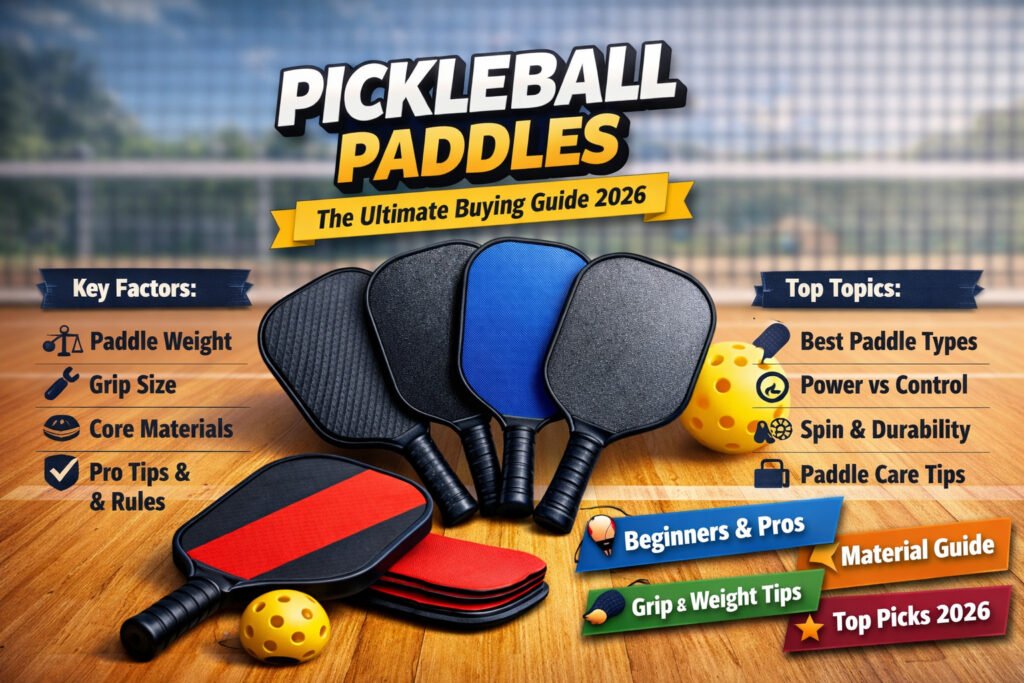
Pickleball Paddles: Complete Buying Guide, Types, Materials & Best Picks (2026)

Pickleball is one of the fastest-growing sports worldwide, and choosing the right pickleball paddle can significantly impact your performance, comfort, and control on the court. Whether you’re a beginner, intermediate player, or competitive athlete, understanding paddle materials, weight, grip size, and core technology is essential. This in-depth guide covers everything you need to know about pickleball paddles, including types, materials, how to choose the best one, and maintenance tips. What Is a Pickleball Paddle? A pickleball paddle is a solid hitting surface used to strike the pickleball. Unlike tennis racquets, pickleball paddles are string-free and made from composite or polymer materials. Modern paddles are engineered to balance power, control, spin, and durability. Standard Pickleball Paddle Dimensions According to USA Pickleball regulations: Using regulation-approved paddles is mandatory for tournament play. Types of Pickleball Paddles 1. Beginner Pickleball Paddles Best for: New players learning control and technique 2. Intermediate Pickleball Paddles Best for: Regular players improving shot placement 3. Professional / Advanced Pickleball Paddles Best for: Tournament and advanced players Pickleball Paddle Materials Explained Paddle Face Materials Graphite Pickleball Paddles Ideal for: Control-focused players Carbon Fiber Pickleball Paddles Ideal for: Competitive players Fiberglass (Composite) Pickleball Paddles Ideal for: Power hitters Paddle Core Materials Core Type Characteristics Polymer Core Quiet, soft feel, most common Nomex Core Loud, powerful, very durable Aluminum Core Lightweight, control-oriented Pickleball Paddle Weight Guide Weight Category Paddle Weight Lightweight 6.5 – 7.5 oz Midweight 7.6 – 8.4 oz Heavyweight 8.5+ oz Grip Size & Handle Length Grip Size Tip: Smaller grips allow more wrist action and spin. Handle Length Long handles: Two-handed backhands Short handles: Better control How to Choose the Best Pickleball Paddle Consider these factors before buying: Choosing the right paddle improves accuracy, reduces injury risk, and boosts confidence. Pickleball Paddle Shape Types Wide-Body Paddles: Larger sweet spot, more forgiveness Elongated Paddles: Extended reach, more power Standard Shape: Balanced performance Best Pickleball Paddles by Player Type For Beginners For Control Players For Power Players Pickleball Paddle Price Range Category Price Range Beginner $30 – $70 Intermediate $70 – $120 Professional $120 – $250+ Higher price often reflects better materials and performance consistency. Pickleball Paddle Maintenance Tips Clean surface regularly Avoid extreme heat Store in paddle cover Replace grip when worn Proper care extends paddle lifespan significantly. Common Mistakes to Avoid When Buying Pickleball Paddles ❌ Choosing wrong grip size❌ Buying too heavy paddle❌ Ignoring core material❌ Not checking tournament approval Pickleball Paddle vs Tennis Racquet Feature Pickleball Paddle Tennis Racquet Strings No Yes Size Smaller Larger Court Pickleball Tennis Weight Lighter Heavier Pickleball Paddle Technology Trends (2026) Raw carbon fiber surfaces Spin-enhancing textures Vibration-dampening cores Edge-less paddle designs These innovations are shaping modern gameplay. Pickleball Paddle Sweet Spot Explained The sweet spot is the area on the paddle face that delivers maximum power with minimal vibration. A larger sweet spot improves forgiveness and consistency, especially on off-center hits. How Sweet Spot Size Affects Performance Wide-body paddles typically offer a larger sweet spot, making them ideal for beginners and doubles players. Pickleball Paddle Edge Guard vs Edgeless Design Edge Guard Paddles Edgeless Paddles Choosing between the two depends on playing style and durability preference. Indoor vs Outdoor Pickleball Paddles While most paddles work for both environments, performance can vary. Indoor Play Outdoor Play For outdoor play, carbon fiber and fiberglass paddles offer better durability. Pickleball Paddle Noise Levels Noise can be an important factor, especially in residential areas and clubs. Quiet Paddles Loud Paddles Many facilities now prefer quiet-approved paddles. Paddle Thickness and Control Paddle thickness typically ranges from 13mm to 20mm. Control-focused players usually prefer thicker paddles. How Pickleball Paddle Texture Affects Spin Surface texture plays a major role in spin generation. Tournament-approved paddles have regulated surface roughness. Pickleball Paddle Certifications & Rules Always check certification before tournament play. Using uncertified paddles may result in disqualification. Pickleball Paddle Lifespan & Durability Average Paddle Lifespan Carbon fiber paddles tend to last longer with consistent performance. How to Test a Pickleball Paddle Before Buying If possible: A paddle that feels good in hand often performs better. Pickleball Paddle Accessories Worth Buying Overgrips for comfort Paddle covers for protection Edge guard tape Cleaning erasers Accessories help extend paddle life and maintain performance. Best Pickleball Paddle Setup for Doubles vs Singles Doubles Play Singles Play Choosing based on play format improves effectiveness. Environmental Factors Affecting Paddle Performance Heat: Can soften paddle materials Cold: Reduces responsiveness Humidity: Affects grip quality Storing paddles in temperature-controlled environments is recommended. Pickleball Paddle Buying Tips for 2026 Choose raw carbon fiber for spin Avoid overly heavy paddles Match grip size carefully Prioritize comfort and control Always check certification Conclusion: Is Upgrading Your Pickleball Paddle Worth It? As technology evolves, modern pickleball paddles offer better control, spin, and durability than older models. Upgrading your paddle can improve consistency, reduce fatigue, and enhance overall enjoyment of the game.

Bitumen vs Concrete
Bitumen vs Concrete Flooring

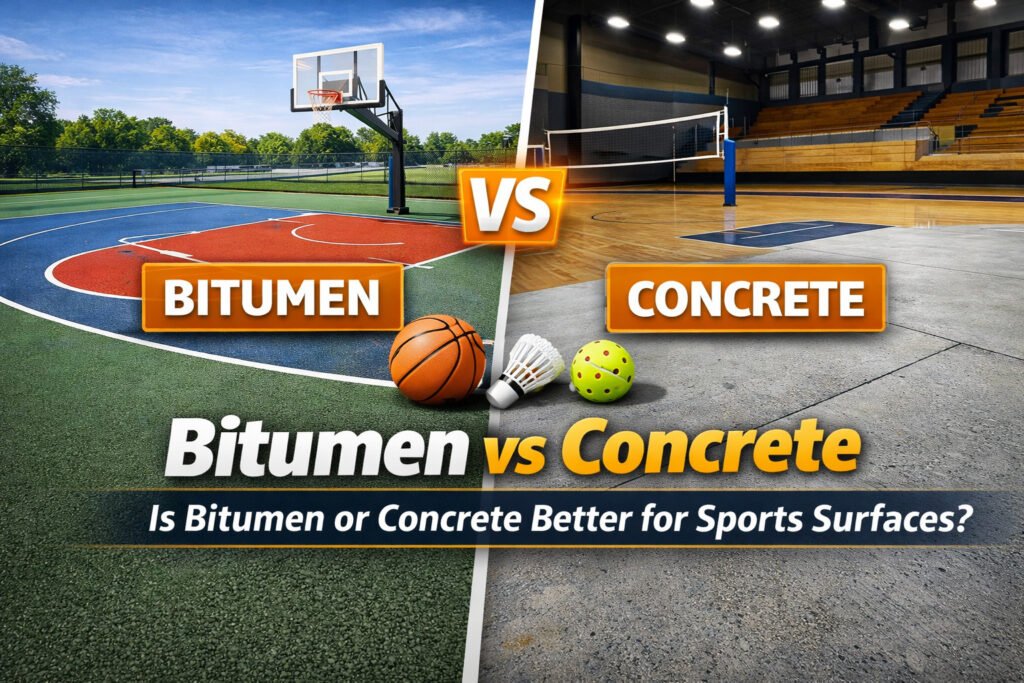
Bitumen vs Concrete: Which Is the Better Surface in 2026?

Choosing the right surface material is critical sports courts. Two of the most commonly used materials worldwide are bitumen (asphalt) and concrete. Each has its own strengths, limitations, cost implications, and performance characteristics. In this detailed guide, we compare bitumen vs concrete across durability, cost, maintenance, climate suitability, installation, and best-use scenarios—helping you make the right decision in 2026. What Is Bitumen? Bitumen is a black, sticky, petroleum-based material commonly mixed with aggregates to create asphalt. It is flexible, cost-effective, and widely used for roads, highways, and outdoor sports courts. Key Characteristics of Bitumen What Is Concrete? Concrete is a mixture of cement, sand, aggregates, and water that hardens into a rigid surface. It is known for its long lifespan, strength, and minimal deformation. Key Characteristics of Concrete Bitumen vs Concrete: Key Differences at a Glance Feature Bitumen Concrete Initial Cost Lower Higher Installation Time Fast Slow Durability Medium High Flexibility High Low Maintenance Frequent Minimal Heat Resistance Moderate Excellent Crack Resistance Better Can crack under stress Lifespan 10–20 years 30–40+ years Cost Comparison: Bitumen vs Concrete Bitumen Cost Approximate Cost (India):₹120 – ₹250 per sq. ft. (depending on thickness and location) Concrete Cost Approximate Cost (India):₹300 – ₹600 per sq. ft. 👉 Winner for affordability: Bitumen👉 Winner for long-term value: Concrete Durability & Lifespan Comparison Bitumen Durability Bitumen performs well under: However, it is prone to: Average lifespan: 10–20 years Concrete Durability Concrete offers: But it may: Average lifespan: 30–40 years or more Maintenance Requirements Bitumen Maintenance Concrete Maintenance 👉 Winner for low maintenance: Concrete Climate & Weather Performance Bitumen in Different Climates Concrete in Different Climates 👉 Hot climates: Concrete👉 Cold climates: Bitumen Installation Time & Process Bitumen Installation Concrete Installation 👉 Winner for quick installation: Bitumen Environmental Impact Bitumen Sustainability Concrete Sustainability Both materials have environmental trade-offs depending on usage. Bitumen vs Concrete for Sports Courts Bitumen for Sports Courts Concrete for Sports Courts 👉 Best base for acrylic courts: Bitumen👉 Best for indoor rigid flooring: Concrete Common Problems & Limitations Bitumen Limitations Concrete Limitations Longer downtime during curing Higher upfront cost Cracking risk if poorly installed When Should You Choose Bitumen? Choose bitumen if: When Should You Choose Concrete? Choose concrete if: Bitumen vs Concrete for Roads & Highways Bitumen Roads Bitumen is the most widely used material for roads and highways due to its flexibility and smooth driving experience. Advantages: Disadvantages: Concrete Roads Concrete roads are increasingly adopted for long-life highway projects. Advantages: Disadvantages: More complex repairs Higher construction cost Longer curing time Bitumen vs Concrete for Driveways & Parking Areas Bitumen Driveways Best suited for residential homes and commercial parking lots with moderate traffic. Concrete Driveways Ideal for high-end residential properties and commercial complexes. Performance Under Heavy Traffic Loads Bitumen Performance Bitumen adapts well to: However, prolonged heavy loads may cause surface deformation. Concrete Performance Concrete excels under: This makes concrete ideal for bus lanes, freight corridors, and industrial zones. Safety & Skid Resistance Comparison Bitumen Safety Concrete Safety Requires surface grooving for skid resistance High visibility due to light color Can become slippery if not textured properly Noise Reduction & Driving Comfort Bitumen Concrete 👉 Winner for noise reduction: Bitumen Construction Time & Traffic Disruption Bitumen Projects Concrete Projects Requires careful planning Longer construction periods Extended traffic diversions Repair & Rehabilitation Comparison Bitumen Repairs Concrete Repairs Often requires slab replacement More complex processes Higher repair costs Bitumen vs Concrete in Urban Infrastructure Urban planners must consider: Urban Preference: Government & Industry Trends (2026) Recent infrastructure trends show: This balanced approach optimizes cost, performance, and durability. Bitumen vs Concrete: Life-Cycle Cost Analysis Cost Factor Bitumen Concrete Initial Cost Low High Maintenance Cost High Low Repair Frequency High Low Life-Cycle Cost Medium Low 👉 Best short-term solution: Bitumen👉 Best long-term investment: Concrete Common Myths About Bitumen & Concrete Myth 1: Concrete roads never crack 👉 Reality: Concrete can crack due to thermal stress and poor joints. Myth 2: Bitumen roads are low quality 👉 Reality: High-grade bitumen performs exceptionally well when maintained properly. Myth 3: Concrete is always expensive 👉 Reality: While initial cost is high, lifetime cost is often lower. Final Verdict: Bitumen vs Concrete – Which Is Better? There is no one-size-fits-all answer. The best choice depends on your project goals, budget, climate, and usage. Both materials continue to dominate infrastructure and sports construction projects in 2026 due to their proven performance.

Scroll to Top
HOMEOWNERS
BUSINESS OWNERS
ARCHITECTS
MUNICIPALITIES

800+ Acrylic Colors

Get 10% off on sports flooring materials

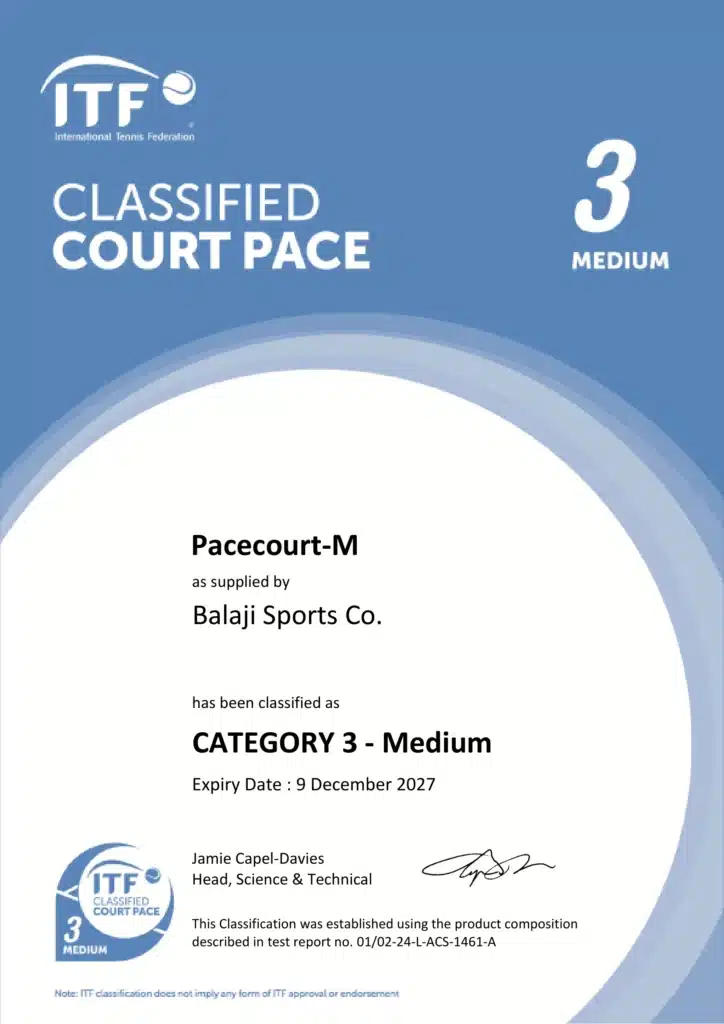
ITF-certified acrylic flooring for Tennis, Basketball, Badminton, Pickleball & more shipped worldwide.

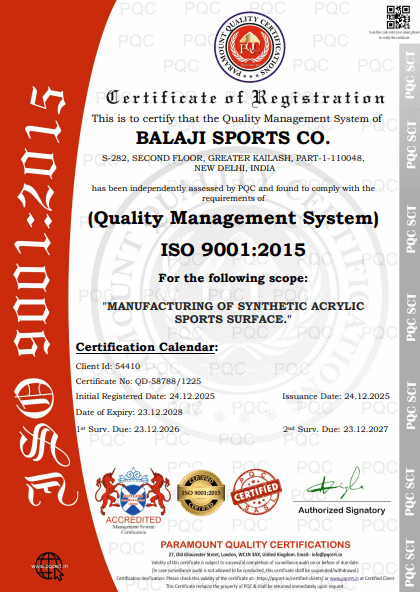
    ISO-Certificate