Author name: Rahul

Rahul is a sports flooring expert and a key contributor at Pacecourt, a leading brand in acrylic and synthetic sports court solutions. Passionate about creating world-class playing surfaces, Rahul shares insights on tennis courts, basketball courts, and multi-purpose sports flooring. His goal is to help facility owners and sports enthusiasts choose durable, high-performance solutions that enhance the game experience.

basketball court dimensions in meters
Basketball Court Dimensions in Meters

Basketball Court Dimensions in Meters (Complete Guide 2026)

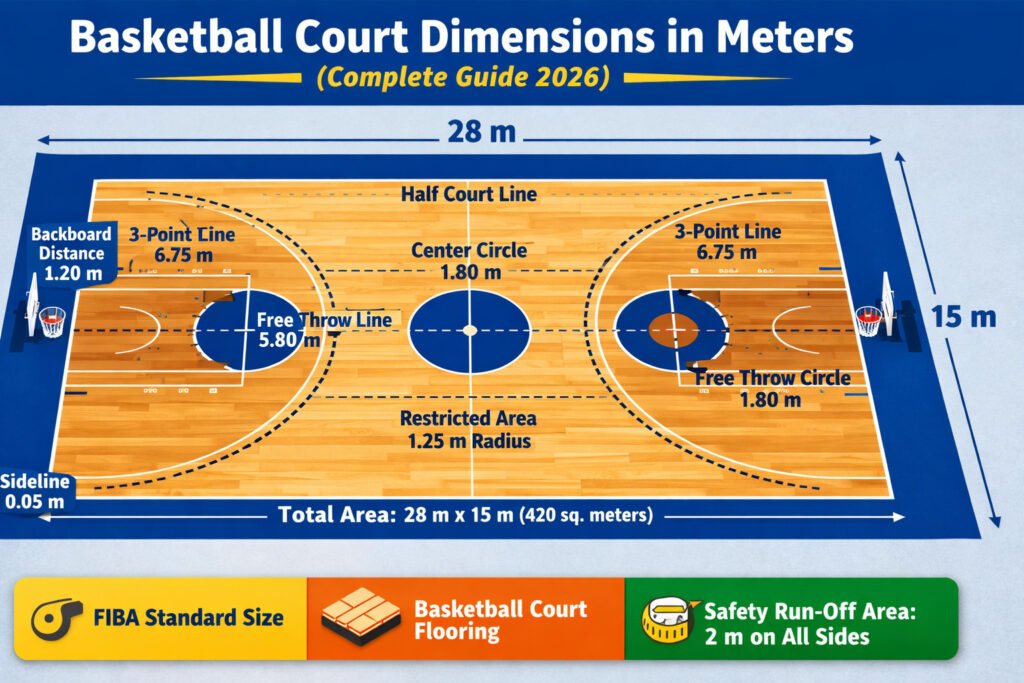
Basketball is one of the most popular sports worldwide, and whether you’re building a professional arena, school playground, or indoor sports facility, understanding basketball court dimensions in meters is essential. Accurate court size ensures fair play, safety, and compliance with international standards. This detailed guide explains FIBA, NBA, and school-level basketball court dimensions, markings, and important construction considerations. Standard Basketball Court Dimensions in Meters FIBA Basketball Court Dimensions (International Standard) FIBA (International Basketball Federation) standards are followed in most countries, including India. Feature Dimension (Meters) Court Length 28 meters Court Width 15 meters Total Playing Area 420 sq. meters Centre Circle Radius 1.80 meters Free Throw Line Distance 5.80 meters Free Throw Circle Radius 1.80 meters Backboard Distance from Baseline 1.20 meters 📌 Best suited for: International tournaments, professional academies, and advanced training facilities. NBA Basketball Court Dimensions (USA Standard) Feature Dimension (Meters) Court Length 28.65 meters Court Width 15.24 meters Centre Circle Radius 1.83 meters Free Throw Line Distance 5.79 meters 📌 Slightly larger than FIBA courts and mainly used in the United States. School & Recreational Basketball Court Dimensions For schools and community courts, smaller dimensions are often used: Level Length (m) Width (m) School Level 24 – 26 13 – 14 Recreational Custom Custom These courts are easier to fit into limited spaces while maintaining gameplay quality. Key Basketball Court Markings (Meters) Three-Point Line (FIBA): 6.75 meters from the basket Restricted Area Radius: 1.25 meters No-Charge Semi-Circle Radius: 1.25 meters Sideline Width: 0.05 meters Proper markings are critical for official matches and training accuracy. Basketball Court Flooring Requirements Choosing the right basketball court flooring is just as important as correct dimensions. Flooring impacts player safety, ball bounce, and long-term durability. Best Flooring Options: 📌 Always ensure flooring provides anti-skid surface, shock absorption, and consistent bounce. Space Required Beyond the Court For safe movement and official play: This space accommodates referees, player benches, and audience movement. Indoor vs Outdoor Basketball Court Dimensions Type Dimension Standard Indoor Court FIBA / NBA exact size Outdoor Court Same size but flexible based on space Outdoor courts may allow minor size adjustments, but markings should remain accurate. Basketball Court Dimensions for India In India, FIBA dimensions (28 × 15 meters) are widely accepted for: These dimensions ensure compatibility with national and international tournaments. Basketball Court Construction Guidelines Building a basketball court requires more than just correct dimensions. Proper planning, material selection, and execution ensure long-term performance and safety. Step-by-Step Basketball Court Construction Process Basketball Court Flooring Thickness & Layers A professional basketball court usually consists of multiple layers: Layer Purpose Base Layer Structural strength Cushion Layer Shock absorption Surface Layer Grip & ball bounce Top Coat UV & wear resistance This layered system protects players from injuries and increases flooring life. Basketball Court Flooring Cost in India (Approximate) Flooring Type Price Range (₹/sq ft) Acrylic Flooring ₹150 – ₹250 Synthetic PU Flooring ₹300 – ₹600 Modular Tiles ₹350 – ₹700 Wooden Flooring ₹700 – ₹1,500 💡 Cost depends on location, surface preparation, and total court area. Drainage & Slope Requirements for Outdoor Courts Outdoor basketball courts must have proper water flow: Ignoring drainage can damage basketball court flooring within a few seasons. Lighting Requirements for Basketball Courts Proper lighting is essential for visibility and professional play. Recommended Lighting Levels: LED sports lights are preferred due to energy efficiency and uniform illumination. Basketball Court Maintenance Tips Regular maintenance keeps the court safe and visually appealing. Maintenance Best Practices: High-quality basketball court flooring requires minimal maintenance but delivers maximum durability. Common Mistakes to Avoid While Building a Basketball Court ❌ Incorrect court dimensions❌ Poor base leveling❌ Low-quality flooring materials❌ Improper line marking❌ No drainage planning Avoiding these mistakes saves repair costs and ensures better play experience. Indoor Basketball Court Ventilation Requirements Indoor courts need: Poor ventilation can damage wooden and synthetic basketball court flooring over time. Why Professional Installation Matters Hiring experienced sports flooring contractors ensures: Professional installation directly impacts performance and player safety. Conclusion A perfectly designed basketball court combines accurate dimensions, proper markings, high-quality basketball court flooring, and expert installation. Whether you are building a school court, academy, or professional sports arena, following international standards ensures durability, safety, and better gameplay. Investing in the right flooring and construction approach not only enhances performance but also reduces long-term maintenance costs.
Sports Court Flooring Materials
best sports court flooring manufacturer

Sports Court Flooring Materials: Types, Benefits & Applications

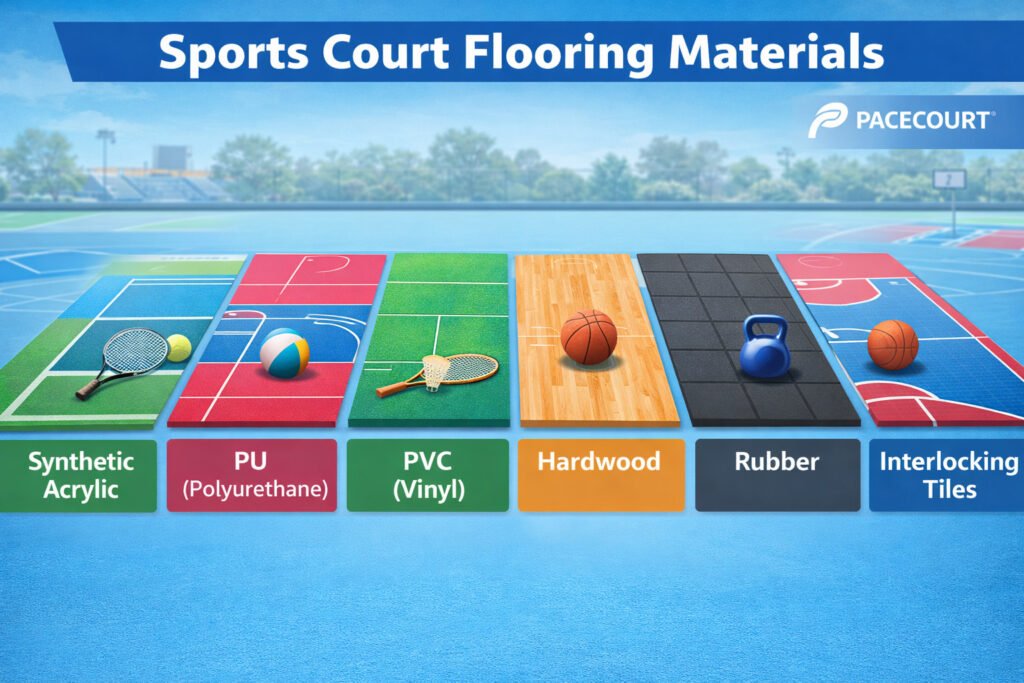
Choosing the right sports court flooring materials is one of the most critical decisions when building or renovating a sports facility. The flooring affects player safety, performance, durability, maintenance, and overall experience. This comprehensive guide explains the types of sports court flooring, their benefits, and how they are best applied across different sports. What Are Sports Court Flooring Materials? Sports court flooring materials are engineered surfaces designed to support athletic activity. They must provide: ✔ Shock absorption✔ Non-slip traction✔ Consistent ball behavior✔ Durability against wear and tear✔ Safety for athletes These materials are used in indoor and outdoor courts for sports such as tennis, basketball, volleyball, badminton, pickleball, and multipurpose activity areas. Types of Sports Court Flooring Materials 1. Synthetic Acrylic Sports Flooring Overview Sinthetic acrylic is one of the most widely used surfaces for outdoor and semi-covered sports courts.It consists of multiple layers of acrylic resin, silica sand, and stabilizers applied over a concrete or asphalt base. Benefits ✔ Weather-resistant and UV-stable✔ Excellent traction and grip✔ Low maintenance✔ Cost-effective solution✔ Durable with a long lifespan Best Applications 👉 Ideal for Indian weather conditions, where rain, heat, and UV exposure are common. 2. PU (Polyurethane) Sports Flooring Overview Polyurethane (PU) flooring is a premium performance surface commonly used for indoor courts. It offers superior shock absorption and comfort. Benefits ✔ Excellent shock absorption✔ Smooth ball bounce✔ Comfortable for athletes✔ Easy to clean Best Applications 👉 Best suited for professional indoor courts where performance and safety are top priorities. 3. PVC (Vinyl) Sports Flooring Overview PVC (polyvinyl chloride) is a versatile and durable synthetic surface used mostly for indoor multipurpose areas. Benefits ✔ Flexible and resilient✔ Non-slip surface✔ Easy to install✔ Lower cost compared to PU Best Applications 👉 A great economical option with good performance for multiple sports. 4. Hardwood (Timber) Flooring Overview Hardwood is a traditional and premium indoor surface, especially for professional basketball and indoor volleyball courts. Benefits ✔ Beautiful aesthetic appeal✔ Excellent ball bounce consistency✔ Good shock absorption Best Applications 👉 Requires controlled indoor environments and regular maintenance. 5. Rubber Sports Flooring Overview Rubber flooring is made from compressed rubber and offers high shock absorption. Benefits ✔ Superior impact protection✔ Slip-resistant✔ Easy to maintain✔ Comfortable underfoot Best Applications 👉 Best for areas where high impact practices like plyometrics and drills occur. 6. Interlocking Tile System Overview These are modular tiles that lock together to form a playing surface. They can be made from polypropylene, PVC, or other composites. Benefits ✔ Quick installation✔ Replaceable sections✔ Good shock absorption✔ Water drainage in outdoor versions Best Applications 👉 Great for quick setups and flexible court layouts. Benefits of Good Sports Court Flooring Choosing the right flooring provides these benefits: 🏆 1. Enhanced Player Safety Proper traction and shock absorption reduce the risk of injuries such as sprains, falls, and joint strain. 🏃 2. Better Athletic Performance Consistent ball bounce, stability, and grip improve play quality and athlete confidence. 🧼 3. Low Maintenance & Durability High-quality materials last longer and resist weathering, foot traffic, and impact. 💰 4. Cost Efficiency Longer-lasting surfaces deliver greater ROI compared to frequent repairs or replacements. 🌦 5. Weather Resistance Outdoor surfaces like synthetic acrylic handle sun, rain, and temperature changes without degrading quickly. How to Choose the Right Flooring Material Selecting the best material depends on several factors: 📌 1. Location 📌 2. Sport Type 📌 3. Budget 📌 4. Maintenance Capacity Applications of Sports Court Flooring 🏐 Indoor Sports Facilities 🏀 Outdoor Sports Areas 🏫 Schools & Colleges 🏘 Residential & Community Spaces Flexible design options Recreational courts for estate amenities Maintaining Your Sports Court Flooring Proper maintenance ensures longevity and performance: ✔ Regular cleaning with neutral detergent✔ Inspect for cracks or damage✔ Apply recoating as needed✔ Avoid sharp objects and heavy machinery on surface✔ Address drainage issues on outdoor courts Why Choose Pacecourt Sports Flooring When it comes to sports court flooring solutions in India, Pacecourt stands out for: 🌟 High-quality synthetic acrylic systems🌟 Customized flooring options for tennis, basketball, volleyball, and multipurpose courts🌟 Weather-resistant and durable installations🌟 Expert flooring design and technical support🌟 Competitive pricing and long-lasting performance Whether you’re building a school court, outdoor facility, or professional arena, Pacecourt delivers flooring that meets performance, safety, and longevity requirements. Conclusion Understanding sports court flooring materials helps you choose the right surface for your specific needs — whether it’s cost-effective outdoor play or high-performance indoor competition. Each material has unique properties, benefits, and ideal applications. By selecting the best flooring and maintaining it properly, you enhance safety, athletic performance, and the lifespan of your sports facility. For reliable installations and expert flooring solutions in India, Pacecourt provides a range of flooring systems crafted for durability, athlete comfort, and superior performance.

volleyball court size
Uncategorized

Volleyball Court Size: Official Dimensions, Measurements & Complete Guide

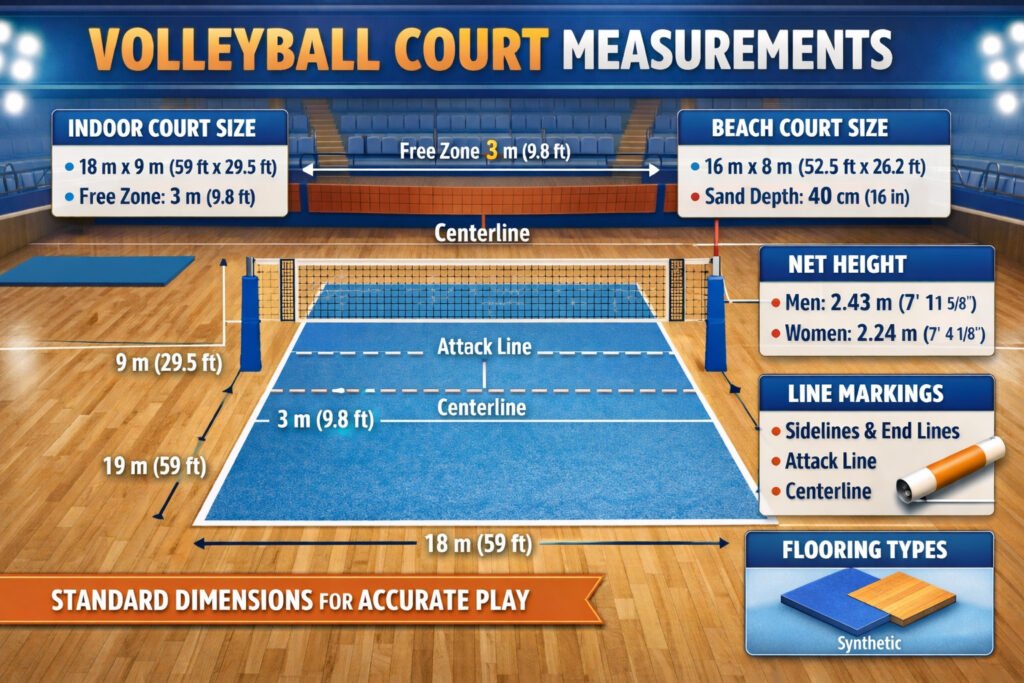
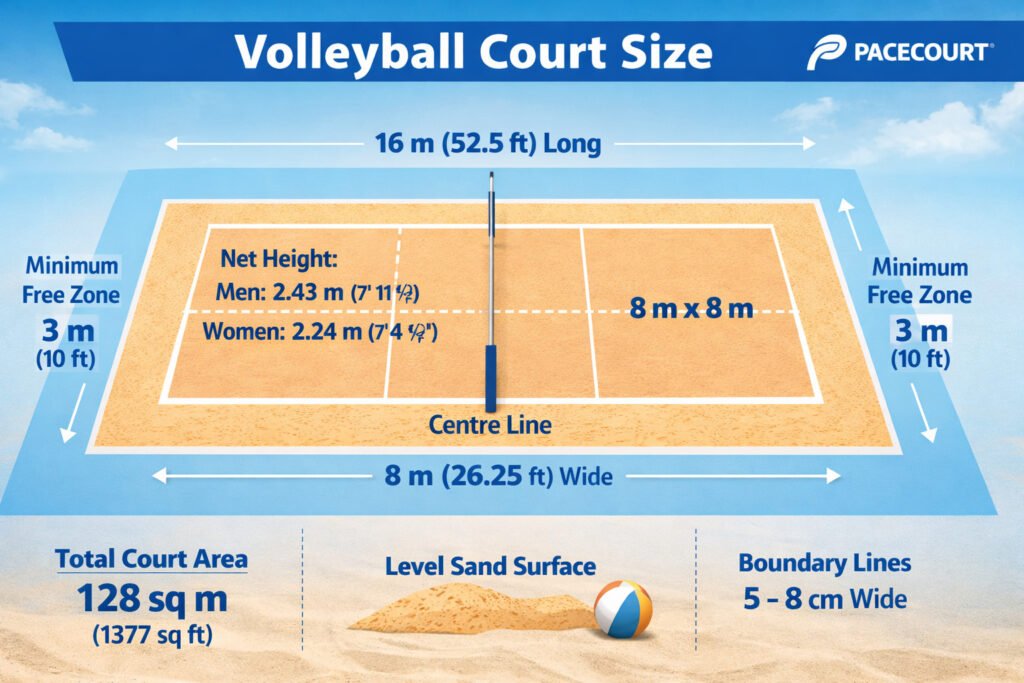
Understanding the volleyball court size is essential for players, coaches, schools, sports academies, and facility owners. Whether you are planning a professional indoor court, an outdoor recreational court, or a training facility, using the official volleyball court dimensions ensures fair play, safety, and compliance with international standards. This guide covers official volleyball court measurements, layouts, markings, and flooring requirements. Understanding Standard Volleyball Court Dimensions Standard volleyball court dimensions are defined by the FIVB (Fédération Internationale de Volleyball) to ensure fair and consistent gameplay worldwide. These measurements apply to both indoor and outdoor volleyball courts. The official volleyball court measures 18 meters in length and 9 meters in width, creating a total playing area of 162 square meters. The court is divided into two equal halves of 9 × 9 meters by a center line, with a net placed directly above it. A key feature of the court layout is the attack line, which is drawn 3 meters from the center line on each side. This line separates front-row and back-row players and plays an important role in game rules and player positioning. Around the playing area, a free zone is required to allow players to move safely while chasing the ball. The minimum recommended free zone is 3 meters on all sides, although professional matches often use larger safety areas. While the court size remains the same for indoor and outdoor volleyball, the flooring material differs. Indoor courts typically use wooden, PVC, or PU sports flooring, while outdoor courts often use synthetic acrylic flooring due to its durability and weather resistance. Overall, understanding standard volleyball court dimensions helps ensure proper court construction, safe play, and compliance with official volleyball regulations. Court Segments Explained Court Section Size Purpose Playing Surface 18 m × 9 m Active match area Half-Court 9 m × 9 m Each team’s side Attack Zone 3 m from center Determines front/back row play Free Zone ≥ 3 m all around Safety and movement Clearance Height ≥ 7 m No overhead obstructions Comparison: Indoor vs Outdoor Volleyball Court Feature Indoor Court Outdoor Court Court Dimensions 18 m × 9 m 18 m × 9 m Surface Wooden / PU / PVC Acrylic / Cement / Grass Free Zone Requirements Stricter Flexible (but recommended) Weather Impact Controlled Sun, wind, rain The playing dimensions are identical — but outdoor courts require more attention to surface choice, drainage, and weather resistance. Volleyball Court Surface & Material The surface affects traction, safety, and performance. Standard materials include: 🔹 Indoor Courts 🔹 Outdoor Courts Why proper flooring matters:Good surface reduces injuries, improves ball bounce consistency, and enhances player comfort. Common Measurement Mistakes to Avoid Mistake Why It’s a Problem Incorrect court length or width Invalid for competition Incomplete free zone Player injuries Faded lines Referee mistakes Wrong net height Unfair play Always use measuring tools, flat surfaces, and certified installers for accuracy. Beach Volleyball Court Dimensions Beach volleyball court dimensions are different from indoor or standard volleyball courts and are regulated by the FIVB (Fédération Internationale de Volleyball) to ensure uniform play worldwide. The official beach volleyball court size is 16 meters long and 8 meters wide, creating a total playing area of 128 square meters. This court is slightly smaller than an indoor volleyball court and is designed specifically for two-player teams. The court is divided into two equal halves of 8 × 8 meters by a center line, with the net placed at the center. Unlike indoor volleyball, there is no attack line in beach volleyball, as all players can attack from anywhere on their side of the court. A free zone surrounds the court to allow safe movement. The minimum free zone required is 3 meters on all sides, though professional tournaments often provide larger safety areas. The playing surface must be level sand, with a minimum depth of 40 cm, free from stones or hard objects to prevent injuries. Court boundary lines are usually 5–8 cm wide and made of flexible material, secured to the sand. Net Height for Beach Volleyball In summary, beach volleyball court dimensions are carefully designed to support fast, athletic play while ensuring player safety and fairness in both recreational and professional matches. Why Dimensions Differ Across Formats Volleyball court dimensions differ across formats such as indoor volleyball, beach volleyball, and recreational or school-level play to match the playing environment, number of players, surface type, and game dynamics. These variations are intentional and help maintain fairness, safety, and competitive balance. 1. Playing Surface and Environment Indoor volleyball is played on hard, smooth surfaces like wooden or synthetic flooring, allowing faster movement and controlled jumps. Beach volleyball is played on sand, which slows movement and increases physical effort. To balance this, beach volleyball courts are smaller in size, reducing the distance players must cover. 2. Number of Players Indoor volleyball is played with six players per team, requiring more space for rotations, positioning, and coordinated attacks. Beach volleyball is played with two players per team, so a smaller court suits the reduced number of players while keeping rallies competitive. 3. Style and Pace of the Game Indoor volleyball focuses on structured rotations, quick sets, and fast attacks, which benefit from a larger playing area. Beach volleyball emphasizes endurance, ball control, and adaptability, and a smaller court keeps the game intense despite slower movement on sand. 4. Safety Considerations Court size and free-zone requirements are designed to reduce injury risk. On sand, players dive and fall more frequently, so the court is compact and cushioned. Indoor courts require more space around the playing area to allow safe movement at higher speeds. 5. Skill and Accessibility Levels Recreational, school, or training courts may slightly adjust dimensions to fit available space and skill levels. This makes the sport more accessible without changing the core rules of play. 6. Standardization by Governing Bodies Organizations like the FIVB set different standards to preserve the unique identity of each volleyball format, ensuring consistency in competitions while adapting to environmental and gameplay

Tennis Court Flooring in Goa

Tennis Court Flooring in Goa

Goa is not just a tourist paradise—it’s also emerging as a growing hub for sports infrastructure. With rising demand from resorts, schools, sports clubs, villas, and government projects, the need for high-quality tennis court flooring in Goa has increased significantly. Whether you’re planning a new tennis court or upgrading an old surface, choosing the right flooring system and professional installer is critical for performance, safety, and long-term durability. This guide explains everything about tennis court flooring in Goa, including surface types, construction process, costs, and why professional installation matters Why Goa Needs Specialized Tennis Court Flooring Goa’s coastal climate brings high humidity, heavy rainfall, strong sunlight, and saline air. Because of this, tennis court surfaces in Goa must be: Professional tennis court flooring systems are specially designed to withstand these environmental conditions while delivering international-standard playability. Standard Tennis Court Dimensions A professional tennis court follows ITF guidelines: Accurate layout planning is a key part of expert tennis court flooring in Goa. Tennis Court Flooring & Construction Process 1️⃣ Site Inspection & Planning 2️⃣ Base Construction A strong base ensures crack-free, long-lasting tennis court flooring. 3️⃣ Tennis Court Surface Installation Depending on the project requirement, professional flooring systems are applied in multiple layers. 4️⃣ Line Marking & Accessories 5️⃣ Final Quality Testing Best Tennis Court Flooring Options in Goa ✔️ Acrylic Tennis Court Flooring (Most Preferred) ✔️ Cushioned Acrylic Systems ✔️ Synthetic / PU Flooring (Indoor) ✔️ Modular Sports Tiles Professional brands like Pacecourt Tennis Court Flooring Cost in Goa Approximate project cost depends on area, base condition, and flooring system. Typical price ranges: Cost factors include: Materials Used in Professional Tennis Court Flooring High-quality materials ensure a surface life of 8–10 years with periodic maintenance. Outdoor vs Indoor Tennis Court Flooring in Goa Feature Outdoor Courts Indoor Courts Climate handling Rain & UV resistant Climate controlled Surface type Acrylic systems PU / Vinyl Maintenance Periodic cleaning & recoating Low-dust upkeep Cost Medium Higher Application Resorts, schools, clubs Academies, stadiums Benefits of Professional Tennis Court Flooring Professionally installed tennis court flooring also ensures correct slope, uniform texture, and accurate ball response. Why Choose a Professional Tennis Court Flooring Company in Goa? A trusted tennis court flooring contractor provides: Pacecourt delivers customized tennis court flooring solutions across India, including resort projects, sports academies, educational institutions, and government developments. Conclusion With sports tourism, luxury real estate, and school infrastructure growing rapidly, investing in professional tennis court flooring in Goa ensures long-term durability, superior performance, and higher facility value. Choosing the right materials and an experienced sports flooring company makes all the difference.

Synthetic Badminton Court

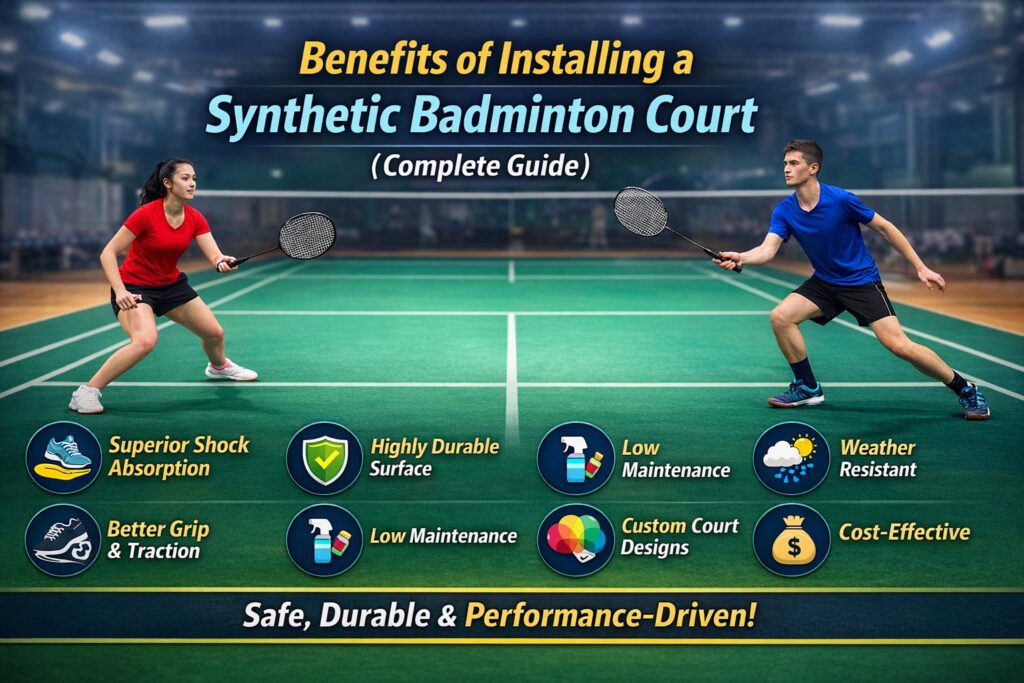
Benefits of Installing a Synthetic Badminton Court (Complete Guide)

Synthetic badminton courts have become the top choice for schools, sports academies, gyms, stadiums, and private facilities. With excellent durability, superior grip, and low maintenance, synthetic flooring has transformed the badminton experience for both beginners and professional players. In this guide, we will explore the top benefits of installing a synthetic badminton court and why it is one of the smartest investments for any sports facility. Superior Shock Absorption for Player Safety One of the biggest advantages of synthetic badminton flooring is its ability to absorb shocks effectively.This cushioning feature helps in: This is why most modern sports academies prefer synthetic courts over concrete or vinyl options. Excellent Grip & Traction for Better Performance A synthetic court offers consistent grip and traction, which is essential for quick footwork, lunges, and directional changes.Better traction means: This leads to better overall performance, especially during competitive matches. Highly Durable & Long-Lasting Surface Synthetic flooring is built to withstand heavy usage without losing performance quality.Its durability ensures: This makes synthetic badminton courts a cost-effective, long-term solution. Low Maintenance & Easy Cleaning Maintaining a synthetic court is simple and budget-friendly. It does not require polishing, varnishing, or frequent repairs.Maintenance includes: This low-maintenance advantage makes it ideal for schools, commercial facilities, and multi-sport complexes. Weather-Resistant & Suitable for Indoor or Outdoor Courts Synthetic badminton courts perform well in all weather conditions.Key advantages include: Whether you plan to install the court indoors or outdoors, synthetic flooring ensures stable performance year-round. Customizable Color Options & Court Designs Synthetic flooring allows you to create visually appealing, professional-quality badminton courts.You can customize: This gives the court a premium, tournament-style appearance. Better Ball Bounce & Overall Gameplay Quality A synthetic badminton court ensures consistent ball bounce, which helps players adjust to high-level gameplay.Benefits include: This makes training more effective and match conditions more predictable. Cost-Effective Installation Compared to Wooden Courts Synthetic courts are more affordable than traditional wooden courts while offering equal—or even better—performance.Cost benefits include: This makes synthetic flooring an excellent investment for new sports facilities. Eco-Friendly Flooring Options Available Modern synthetic flooring is designed to be environment-friendly with recyclable materials.Eco benefits include: This aligns well with green building practices and sustainable sports infrastructure. Conclusion Installing a synthetic badminton court provides unmatched advantages in terms of safety, performance, durability, and cost-effectiveness. Whether you own a sports academy, gym, school, or private facility, synthetic flooring ensures excellent gameplay quality and long-lasting value.

Volleyball Court Measurements

Complete Guide to Volleyball Court Measurements: Dimensions, Markings & Standards

Volleyball Courts Near Me is one of the most searched phrases today as players, coaches, and sports enthusiasts look for standard-quality volleyball facilities. But before choosing any court, it’s important to understand how proper volleyball court measurements ensure fair play, safety, and the best performance. This in-depth guide explains everything you need to know about official court dimensions, markings, net height, flooring, and more. What Is a Volleyball Court? A volleyball court is a rectangular playing area divided by a net into two equal halves. Every dimension—from the sidelines to the net height—is set according to international rules. These measurements ensure consistency and fairness during matches. When checking Volleyball Courts Near Me, make sure the facility follows correct standards to guarantee a professional playing experience. Importance of accurate measurements for gameplay Accurate volleyball court measurements are essential for maintaining the fairness, safety, and overall quality of the game. Every line, net height, and boundary is designed to create equal opportunities for both teams and ensure consistent performance. Even small deviations can affect how players move, jump, and strategize during a match. Correct court dimensions ensure: ✔ Fair Play Standardized measurements guarantee that both teams compete under the same conditions. Proper line placement, net height, and court size prevent any player from gaining an unfair advantage. ✔ Consistent Ball Behavior A well-measured court with proper surface markings ensures predictable ball bounce and movement. This consistency is crucial for setting, spiking, serving, and defensive play. ✔ Enhanced Player Safety Accurate free zones, correct flooring, and properly marked boundaries reduce the risk of collisions, slips, and injuries. Safe spacing allows players to dive and move freely. ✔ Professional-Level Training Players practicing on correctly measured courts develop skills that translate accurately to competitive environments. Proper measurements help athletes train under real match conditions. ✔ Smooth Tournament Hosting Events require strict adherence to official dimensions. Correct measurements ensure matches are conducted smoothly, with fewer disputes and improved referee accuracy. In short, accurate measurements create the foundation for high-quality gameplay, consistent player performance, and safe, enjoyable volleyball experiences. How people search for Volleyball Courts Near Me to find standard courts When players, coaches, and sports enthusiasts want to practice or compete on a quality court, they often rely on location-based searches—especially the keyword “Volleyball Courts Near Me.” This search term is widely used because it helps people find nearby facilities that meet official volleyball standards. 1. Searching for Courts with Proper Measurements Users type “Volleyball Courts Near Me” specifically to find courts that follow correct dimensions, net height, and line markings. They want courts that offer a professional playing experience rather than makeshift or irregular setups. 2. Finding Indoor and Outdoor Options Searches often include: These variations help players locate facilities suitable for their preferred style of play. 3. Locating Well-Maintained Sports Complexes People use this keyword to identify sports centers, schools, academies, and gyms that maintain courts with: This ensures the court meets official standards. 4. Discovering Training-Friendly Locations Athletes and coaches often look for courts that support proper training. A standard-sized court allows players to practice realistic serves, spikes, and defensive movements. 5. Checking Court Reviews & Ratings After searching “Volleyball Courts Near Me,” users compare reviews to ensure the facility: 6. Comparing Costs, Availability, and Amenities People also search this keyword to quickly find: Official Volleyball Court Dimensions (Indoor & Outdoor) Understanding the official volleyball court dimensions is essential for maintaining fair play and ensuring a high-quality playing experience. Whether the game is played indoors or outdoors, specific measurements must be followed to meet international standards set by bodies like FIVB. 1. Indoor Volleyball Court Dimensions Indoor volleyball courts follow strict and uniform measurements worldwide. These standard dimensions ensure the game remains consistent at every level—from school competitions to international championships. ✔ Court Size ✔ Free Zone (Safety Area) To allow safe movement outside the boundary lines: Professional tournaments may require even larger free zones and higher ceilings. ✔ Centerline & Attack Line These lines help regulate spiking and player positioning during gameplay. ✔ Boundary Lines 2. Outdoor Volleyball Court Dimensions Outdoor play includes two main types—recreational outdoor courts and competitive beach volleyball courts. A. Standard Outdoor (Non-Sand) Volleyball Court Outdoor hard-surface courts often follow the same measurements as indoor volleyball: B. Beach Volleyball Court Dimensions Beach volleyball uses slightly different measurements to accommodate sand gameplay and two-player teams. ✔ Court Size Beach courts are smaller because sand movement is slower and the game typically features two players on each side. ✔ Free Zone ✔ Net Height ✔ Sand Requirements Why Standard Court Measurements Matter Standard court measurements are essential for maintaining fairness, consistency, and player safety in volleyball. Whether it’s a school court, a professional arena, or a facility discovered through a search like “Volleyball Courts Near Me,” accurate dimensions ensure the game is played the way it was intended. Here’s why these measurements matter: 1. Ensures Fair and Competitive Gameplay Standardized measurements create an equal playing field for all teams. 2. Predictable Ball Behavior Players rely on predictable ball bounce and movement.Accurate court dimensions and properly marked lines ensure the ball reacts consistently: Any deviation affects the entire rhythm of the game. 3. Enhances Player Safety Incorrect court size or poorly marked lines increase the risk of collisions, slips, and injuries.Standard measurements ensure: Safety is one of the most important reasons to follow official measurements. 4. Supports Skill Development Players improve faster when they practice on regulation-sized courts.Skills like serving, blocking, and spiking depend on accurate spatial awareness.A standard court helps players: This is why training academies and top-rated Volleyball Courts Near Me maintain official dimensions. 5. Required for Tournaments and Professional Matches Local, national, and international competitions require strict adherence to measurement standards.Correct court dimensions ensure: Without these standards, tournaments would be inconsistent and unfair. 6. Improves Overall Playing Experience Players enjoy the game more when the court feels natural and accurately built.Standard measurements provide: A well-designed court enhances both recreational and competitive play. Flooring Requirements for Volleyball Courts

Badminton Standard Court Size

Badminton Standard Court Size

Badminton is one of the fastest racket sports in the world, and to play it correctly, understanding the badminton standard court size is essential. Whether you are building a new badminton court, upgrading an existing one, or simply learning the game, knowing the official measurements helps ensure accuracy, performance, and compliance with BWF (Badminton World Federation) rules. In this guide, we break down the standard badminton court size, dimensions for singles and doubles, markings, and flooring considerations—everything you need to get started. What Is the Standard Badminton Court Size? According to BWF guidelines, the standard badminton court size is: These measurements include the full playing area, excluding run-off zones. A regulation court is rectangular and divided by a net placed at the center. Singles vs. Doubles Court Size Although the length remains the same for both formats, the width varies. 1. Singles Court Size 2. Doubles Court Size Badminton Net Height and Width A standard badminton net must follow BWF dimensions: The net divides the court equally into left and right service courts. Markings of a Standard Court A regulation court must include: All lines should be 40 mm wide and ideally white or yellow. Space Outside the Court (Run-off Area) To ensure safety and proper movement, additional clearance is recommended: This extra space prevents player collisions and supports high-level rallies. Ideal Badminton Court Flooring The court surface plays a major role in performance and injury prevention. The most recommended options include: 1. PVC Vinyl Sports Flooring 2. Wooden Flooring With Synthetic Mat 3. Synthetic Acrylic Flooring Why Standard Court Size Matters Maintaining proper court measurements ensures: A properly measured court enhances performance for beginners and professionals alike. Conclusion Understanding the standard badminton court size is crucial for building or playing on a regulation-friendly court. Whether it’s for sports academies, schools, residential projects, or tournament facilities, following BWF dimensions ensures consistent quality and professional-level gameplay. If you need help with badminton court construction, flooring materials, or turnkey installation, feel free to ask—I can create content, layouts, or images to support your project.

badminton court measurements in feet

Badminton Court Measurement in Feet: Complete Guide for Players & Court Builders

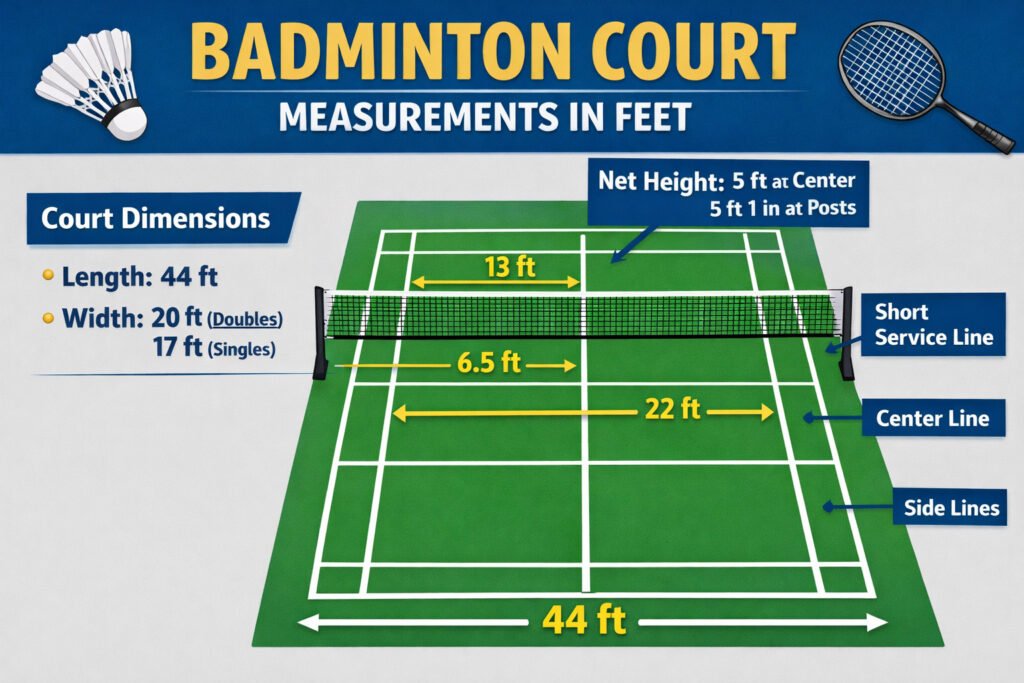
Badminton is one of the fastest and most widely played racket sports in the world. Whether you are a player, a coach, or planning to build a court, understanding the badminton court measurements in feet is essential. The correct dimensions ensure fair play, safety, and compliance with international standards set by the Badminton World Federation (BWF). In this guide, we break down every measurement of a badminton court in feet, along with diagrams, rules, and construction tips. What is Badminton Badminton is a fast-paced indoor sport played with a racket and a shuttlecock. It can be played between two players (singles) or four players (doubles). The goal of the game is to hit the shuttlecock over the net and land it inside the opponent’s court so they cannot return it. Key Features of Badminton Objective of the Game Each rally starts with a serve. Players score a point when the opponent: The first player (or team) to reach 21 points wins a game, and matches are usually best of 3 games. Why People Love Badminton Industry-Leading Synthetic Acrylic Flooring System Pacecourt specializes in premium multi-layer synthetic acrylic systems that offer: This makes Pacecourt courts suitable for professional training, tournaments, and recreational play. Built for Indian Weather Conditions Indian climates can be harsh — extreme heat, monsoons, dust, and UV exposure.Pacecourt’s surfaces are engineered to withstand: The result? A long-lasting, fade-resistant, and weather-proof tennis court floor. Long-Lasting Durability (8–10+ Years) Pacecourt surfaces use high-quality acrylic resins, rubberized cushioning, and UV-stable pigments.These materials help ensure: This durability makes Pacecourt a cost-efficient investment over time. Customisable Speed & Cushioning Every facility has different needs.Pacecourt offers customisation in: This ensures players enjoy an ideal blend of comfort, speed, and control. Professional Installation Team A tennis court is only as good as its installation.Pacecourt provides: You get a perfectly level, tournament-quality surface every time. Used by Leading Academies & Clubs Across India Pacecourt has earned trust nationwide with successful installations at: Their strong portfolio proves the performance and reliability of their flooring systems. Safe, Player-Friendly, and Non-Toxic Materials Pacecourt surfaces are made using eco-friendly, non-toxic, and low-VOC materials, ensuring: This makes Pacecourt a perfect choice for schools and residential communities. Excellent After-Sales Support Pacecourt provides comprehensive support, including: Their support ensures your tennis court stays in top condition for years. Better Value Than Generic Flooring Brands Many generic or low-cost tennis flooring products compromise on: Pacecourt delivers premium performance at affordable pricing, making it a superior long-term investment. Conclusion If you’re building or renovating a tennis court, Pacecourt is one of the best choices for flooring due to its: Whether it’s for competitive sports, coaching, or recreational play, Pacecourt ensures a safe, durable, and high-performance tennis court surface that delivers exceptional value for years.

floor of a tennis court
Tennis court flooring

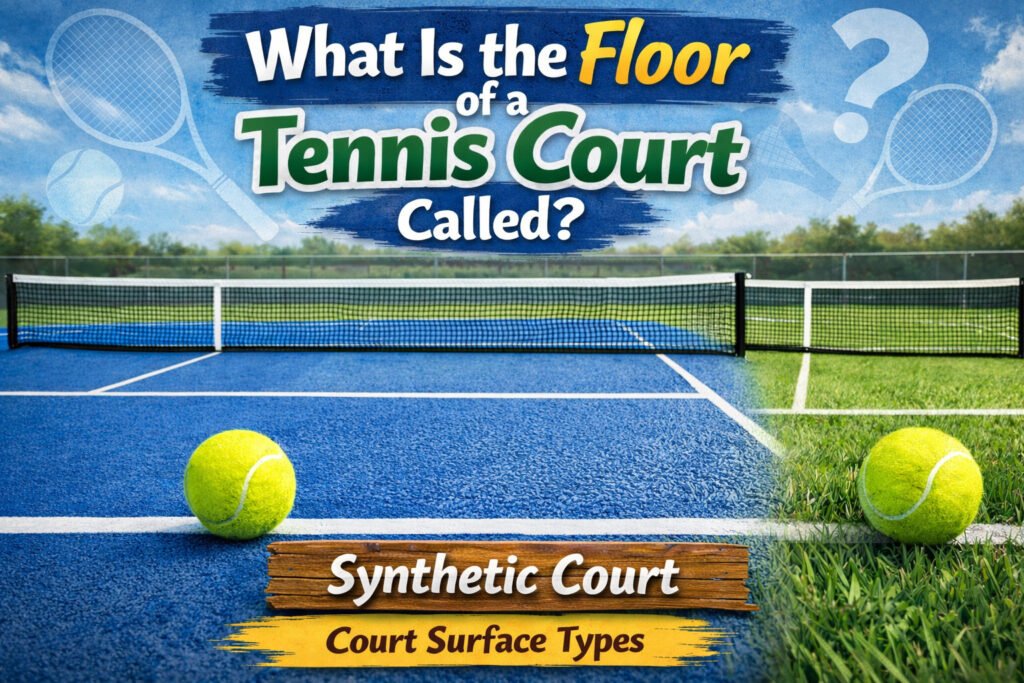
What Is the Floor of a Tennis Court Called?

When people talk about the floor of a tennis court, they are usually referring to the playing surface or the court surface. This surface plays a major role in how the game feels, how fast the ball moves, and how safe the players are. Each surface type has unique characteristics, and knowing the correct terms helps players, coaches, and court builders understand the game better. Types of Tennis Court Flooring Materials Tennis court flooring materials come in various types, each offering unique characteristics that affect the speed of play, maintenance requirements, and player comfort. Here are the most common types of tennis court flooring materials: 1. Hard Courts 2. Clay Courts 3. Grass Courts 4. Carpet Courts 5. Acrylic or Synthetic Courts 6. Artificial Turf Courts 7. Rubberized Courts Each type of tennis court flooring has its pros and cons, and the choice often depends on factors like climate, budget, and the level of play (recreational or professional). Why Synthetic Acrylic Flooring Stands Out Synthetic acrylic flooring is a popular choice for tennis courts, and it stands out for several reasons. Here’s why it’s a preferred option for both recreational and professional use: 1. Versatility 2. Durability 3. Low Maintenance 4. Consistent Playability 5. Player Comfort 6. Aesthetic Appeal 7. Cost-Effectiveness 8. Eco-Friendly Options Where It’s Used In summary, synthetic acrylic flooring stands out because it combines performance, durability, and cost-effectiveness, making it a top choice for tennis courts worldwide. Whether for casual play or professional tournaments, it delivers a consistent and enjoyable playing experience. Tennis Court Floor Surface Matters The tennis court surface influences: ✔ Player performance Some players perform better on clay, others on grass or hard courts. ✔ Ball behaviour Speed, bounce height, and spin reaction vary by surface. ✔ Player safety High-quality flooring reduces injuries and improves support during quick movements. ✔ Maintenance needs Hard courts need less maintenance compared to clay or grass. How Synthetic Acrylic Courts Compare To Other Surfaces Tennis court surfaces significantly impact performance, safety, and maintenance. Among all modern flooring options, synthetic acrylic courts have become one of the most popular choices for clubs, academies, residential spaces, and professional players. But how do they actually compare to other surfaces like clay, grass, turf, and concrete? This guide breaks down the differences clearly so you can understand why synthetic acrylic courts stand out. 1. Synthetic Acrylic vs Clay Courts Acrylic Court Advantages Clay Court Advantages Which Is Better? Synthetic acrylic is better for training efficiency and match consistency, while clay is preferred for long rallies and technical players. 2. Synthetic Acrylic vs Grass Courts Acrylic Court Advantages Grass Court Advantages Which Is Better? Grass is enjoyable but impractical due to high maintenance. Acrylic courts are more economical, durable, and predictable. 3. Synthetic Acrylic vs Concrete Courts Acrylic Court Advantages Concrete Court Advantages Which Is Better? Concrete without acrylic coating is too hard, leading to injuries. Acrylic-coated concrete courts are the modern standard. 4. Synthetic Acrylic vs Artificial Grass/Turf Courts Acrylic Court Advantages Artificial Turf Advantages Which Is Better? Acrylic courts are better for serious tennis training & tournaments, while turf is ideal for recreational multi-sport use. 5. Synthetic Acrylic vs Carpet Courts (Indoor) Acrylic Court Advantages Carpet Court Advantages Which Is Better? Carpet courts are niche; acrylic is far more versatile and widely used. Summary Table: Acrylic vs Other Court Surfaces Surface Type Speed Bounce Maintenance Durability Best For Synthetic Acrylic Medium-Fast Consistent Low High Training, clubs, tournaments Clay Slow High High Medium Baseline play, technique training Grass Fast Low Very High Low-Medium Premium clubs, tournaments Concrete (Uncoated) Fast Hard Very Low Very High Budget courts Artificial Turf Medium Moderate Medium Medium Recreational play Carpet Very Fast Low Low Medium Indoor facilities Why Choose Pacecourt for the Floor of Your Tennis Court? Choosing the right flooring for a tennis court is one of the most important decisions for any academy, sports complex, school, club, or homeowner. The quality of the surface directly affects performance, safety, durability, and long-term maintenance costs. Among all tennis flooring brands in India, Pacecourt stands out as a trusted and highly preferred name. Here’s why Pacecourt is the ideal choice for the floor of your tennis court. Industry-Leading Synthetic Acrylic Flooring System Pacecourt specializes in premium multi-layer synthetic acrylic systems that offer: This makes Pacecourt courts suitable for professional training, tournaments, and recreational play. Built for Indian Weather Conditions Indian climates can be harsh — extreme heat, monsoons, dust, and UV exposure.Pacecourt’s surfaces are engineered to withstand: The result? A long-lasting, fade-resistant, and weather-proof tennis court floor. Long-Lasting Durability (8–10+ Years) Pacecourt surfaces use high-quality acrylic resins, rubberized cushioning, and UV-stable pigments.These materials help ensure: This durability makes Pacecourt a cost-efficient investment over time. Conclusion The “floor” of a tennis court is properly known as the tennis court surface. It can be made of hard acrylic, clay, grass, artificial turf, or carpet, and each type creates a different playing experience.Understanding the court surface helps players, builders, and clubs choose the best option for performance, durability, and safety.

Pickleball Court Flooring in Mumbai

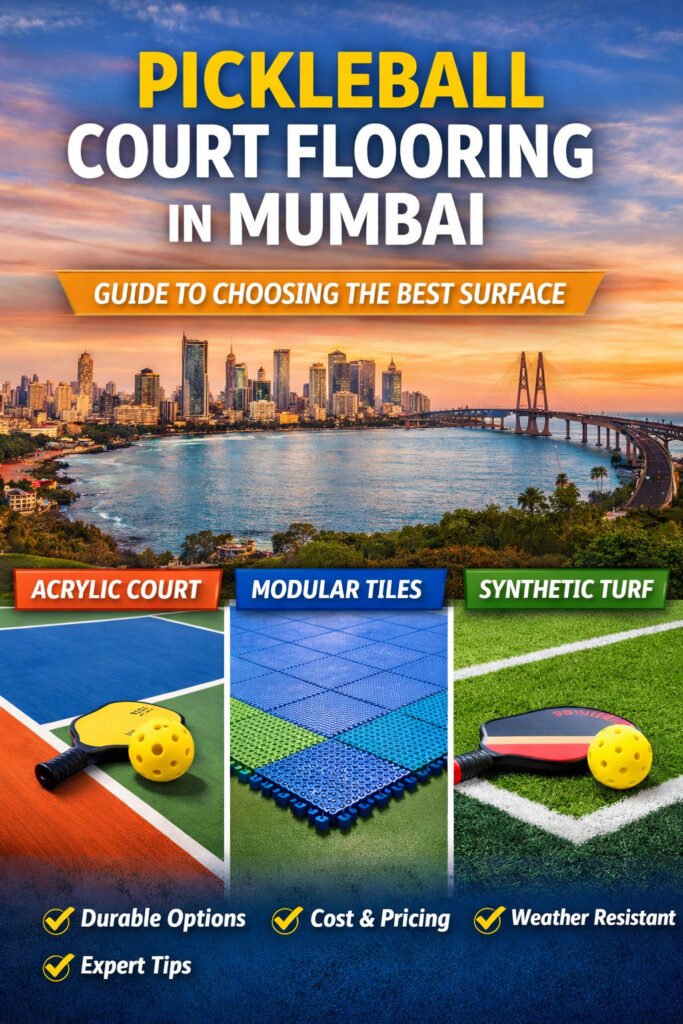
Pickleball Court Flooring in Mumbai

Pickleball is rapidly becoming one of the fastest-growing sports in India, and Mumbai is witnessing a huge rise in community clubs, private courts, and sports complexes investing in professional pickleball courts. Whether you’re building a residential court, a commercial sports academy, or upgrading an existing court, choosing the right pickleball court flooring in Mumbai is crucial for performance, durability, and player safety. This comprehensive guide covers everything you need to know before installing a pickleball court in Mumbai. Why Is Pickleball Court Flooring Important? The flooring plays a key role in: With Mumbai’s climate—high humidity, heavy monsoons, and salt-laden air—flooring material selection becomes even more important. Types of Pickleball Court Flooring in Mumbai Below are the most reliable and commonly used flooring systems ideal for Mumbai’s weather and usage patterns. 1. Acrylic Hard Court Flooring Acrylic surfacing is one of the most popular choices for pickleball courts in Mumbai due to its durability and cost-efficiency. Benefits Best For Housing societies, academies, schools, and recreational clubs. 2. Synthetic Turf Flooring (Padded Turf) Although not used for professional tournaments, synthetic turf works well for multi-purpose recreational courts. Benefits Best For Indoor recreation centers, multipurpose play areas. 3. Interlocking Modular Tiles These tiles are made from high-impact polypropylene and designed for fast installation and strong durability. Benefits Best For Sports complexes, rented spaces, clubs needing quick court setup. 4. PU (Polyurethane) Flooring A seamless, cushioned indoor flooring option that is increasingly popular for premium pickleball courts. Benefits Best For Indoor arenas, sports academies, commercial spaces. Factors to Consider Before Installing Pickleball Court Flooring in Mumbai 1. Climate Durability Mumbai’s weather can be harsh. Choose materials that can handle: 2. Player Footfall High-traffic courts require heavy-duty materials like acrylic or modular tiles. 3. Budget Acrylic courts are budget-friendly, while PU and modular tile courts fall into a premium category. 4. Maintenance Needs If you want low-maintenance, modular tiles or acrylic flooring are the best choices. 5. Indoor vs Outdoor Usage Pickleball Court Dimensions (Standard Guide) You asked before to remove dimensions in some blogs—if you want to include or exclude them, let me know.I have not included them here. Cost of Pickleball Court Flooring in Mumbai (2026 Estimate) Flooring Type Approx. Cost per Sq. Ft. Best Use Acrylic Flooring ₹70 – ₹120 Outdoor standard courts Modular Tiles ₹140 – ₹250 Premium outdoor courts PU Flooring ₹250 – ₹350 Indoor high-level courts Synthetic Turf ₹80 – ₹150 Recreational spaces Costs vary based on brand, cushioning layers, base work, and site conditions. Why Choose Professional Pickleball Court Installers in Mumbai? Professional installation ensures: DIY courts often face issues like bubbles, cracks, uneven bounce, and water logging—especially during Mumbai monsoons. Benefits of Installing a Pickleball Court in Mumbai Perfect for residential societies Low-maintenance sport Suitable for mixed-age groups Fastest-growing sport globally Great for fitness & recreation High ROI for commercial spaces Maintenance Tips for Pickleball Court Flooring To extend the life of your court: Conclusion Installing the right pickleball court flooring in Mumbai ensures better gameplay, reduced injuries, and long-term value. Whether you prefer acrylic surfacing, modular tiles, PU flooring, or synthetic turf, choosing high-quality materials and trained professionals will give you the best results.



Scroll to Top
HOMEOWNERS
BUSINESS OWNERS
ARCHITECTS
MUNICIPALITIES

800+ Acrylic Colors

Get 10% off on sports flooring materials

ITF-certified acrylic flooring for Tennis, Basketball, Badminton, Pickleball & more shipped worldwide.

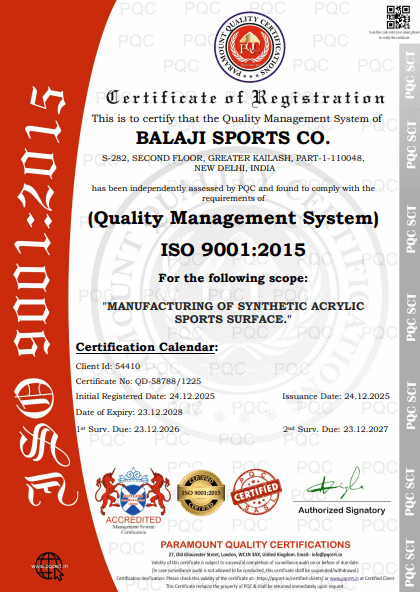
    ISO-Certificate