Author name: Rahul

Rahul is a sports flooring expert and a key contributor at Pacecourt, a leading brand in acrylic and synthetic sports court solutions. Passionate about creating world-class playing surfaces, Rahul shares insights on tennis courts, basketball courts, and multi-purpose sports flooring. His goal is to help facility owners and sports enthusiasts choose durable, high-performance solutions that enhance the game experience.

Synthetic Acrylic Sports Flooring
Advantages of Acrylic Sports Flooring

Synthetic Acrylic Sports Flooring: Benefits, Types & Applications

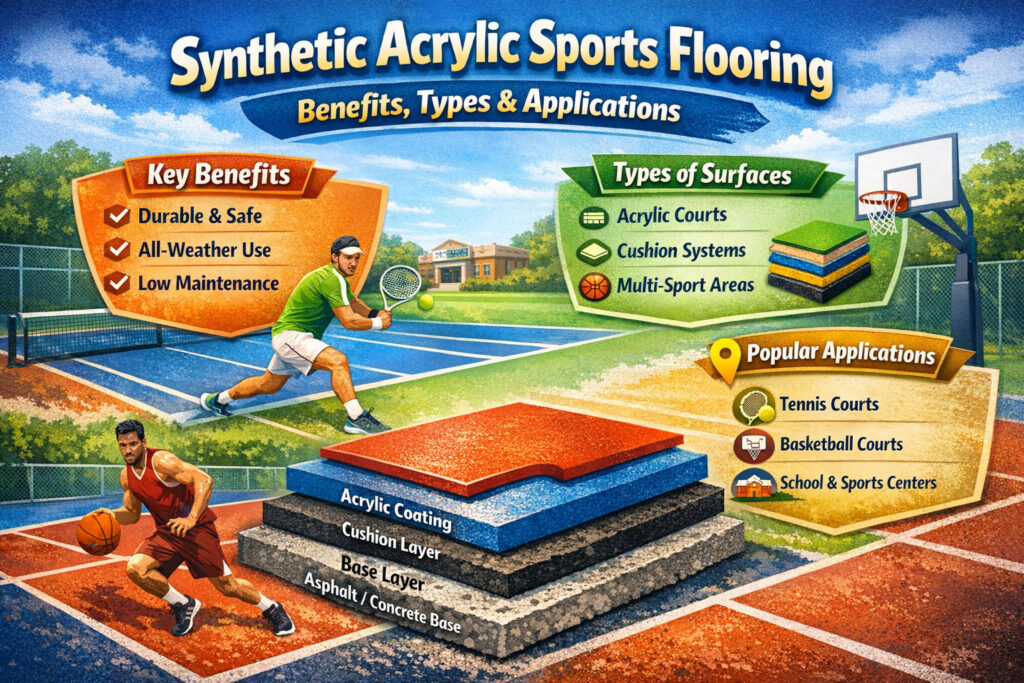
Synthetic acrylic sports flooring is one of those innovations that quietly transformed the way modern sports surfaces are built, yet many people don’t fully realize its impact until they step onto a court that feels “just right.” At its core, this type of flooring is a multi-layered surface system made from acrylic resins, silica sand, and specialized coatings applied over a stable base like asphalt or concrete. The result? A seamless, durable, and performance-driven surface designed to meet the demands of athletes across various sports. What makes synthetic acrylic flooring stand out is its adaptability. Whether it’s a high-intensity tennis match or a casual basketball game in a community park, this surface delivers consistent bounce, grip, and comfort. Unlike traditional surfaces that may crack, warp, or degrade over time, acrylic systems are engineered to maintain their integrity even under heavy use. Think of it like a well-built running shoe—it absorbs impact, provides traction, and supports movement without slowing you down. Another important aspect is customization. Synthetic acrylic flooring can be tailored in terms of color, texture, and cushioning level. This flexibility allows facility owners to design courts that not only meet international standards but also reflect branding or aesthetic preferences. From professional stadiums to school playgrounds, acrylic surfaces are everywhere—and for good reason. In today’s sports infrastructure landscape, where performance and safety go hand in hand, synthetic acrylic flooring has become a go-to solution. It’s not just about creating a playing surface; it’s about enhancing the entire athletic experience, from the first step to the final whistle. Evolution of Sports Flooring Materials If you rewind a few decades, sports flooring looked very different from what we see today. Early courts were often made from natural materials like clay, grass, or untreated wood. While these surfaces had their charm, they came with significant limitations—uneven play, high maintenance, and vulnerability to weather conditions. As sports grew more competitive and global, the demand for reliable, high-performance surfaces became impossible to ignore. This is where synthetic materials began to enter the scene. The introduction of asphalt and concrete courts marked a turning point, offering greater durability and consistency. However, these hard surfaces lacked the flexibility and shock absorption needed to protect athletes from injuries. That gap led to the development of advanced coatings, eventually giving rise to synthetic acrylic systems. By the late 20th century, acrylic sports flooring had started gaining traction, especially in tennis. Major tournaments began adopting acrylic surfaces because they provided predictable ball bounce and could be customized for speed. Over time, technological advancements improved the formulation of acrylic resins, making them more resistant to UV rays, temperature fluctuations, and wear. Today, synthetic acrylic flooring represents the perfect blend of science and sport. It incorporates decades of research, athlete feedback, and material innovation. Modern systems are not only more durable but also environmentally conscious, with many manufacturers focusing on low-VOC formulations and sustainable practices. The journey from grass courts to high-tech acrylic surfaces is a testament to how far sports infrastructure has come. And as technology continues to evolve, one thing is clear—synthetic acrylic flooring is here to stay, constantly adapting to meet the ever-changing demands of athletes and facility owners alike. Key Features of Synthetic Acrylic Sports Flooring Durability and Longevity Durability isn’t just a nice-to-have feature in sports flooring—it’s a necessity. Synthetic acrylic sports flooring excels in this area, making it one of the most reliable choices for both indoor and outdoor applications. Imagine a surface that can withstand thousands of footfalls, intense gameplay, and varying weather conditions without losing its structural integrity. That’s exactly what acrylic flooring offers. The secret lies in its layered construction. Each layer, from the base coat to the top finish, is designed to handle specific stresses. The inclusion of silica sand enhances abrasion resistance, while the acrylic binders ensure flexibility and adhesion. This combination creates a surface that resists cracking, peeling, and fading over time. From a financial perspective, this longevity translates into significant savings. While the initial installation cost might seem higher compared to basic concrete or asphalt surfaces, the reduced need for repairs and replacements makes acrylic flooring a cost-effective solution in the long run. According to industry estimates, well-maintained acrylic courts can last anywhere from 8 to 15 years before requiring major resurfacing. Another factor contributing to durability is resistance to environmental factors. Whether it’s scorching heat, heavy rainfall, or freezing temperatures, synthetic acrylic surfaces maintain their performance characteristics. This resilience makes them ideal for regions with unpredictable climates. Facility managers often describe acrylic flooring as a “set it and forget it” solution—not because it requires no maintenance, but because it doesn’t demand constant attention. With periodic cleaning and minor touch-ups, these surfaces can retain their quality for years. In a world where downtime equals lost revenue and dissatisfied users, durability becomes a competitive advantage. Synthetic acrylic sports flooring delivers that advantage consistently, making it a trusted choice across schools, clubs, and professional arenas. Weather Resistance and UV Stability Outdoor sports surfaces face a relentless enemy: the elements. Sunlight, rain, wind, and temperature fluctuations can wreak havoc on poorly constructed courts. This is where synthetic acrylic sports flooring truly shines, offering exceptional weather resistance and UV stability that keep surfaces looking and performing like new. One of the standout features of acrylic flooring is its ability to resist UV degradation. Prolonged exposure to sunlight can cause many materials to fade, crack, or become brittle. Acrylic coatings, however, are formulated with UV-resistant pigments and stabilizers that protect the surface from these effects. This means vibrant court colors remain intact for years, enhancing both aesthetics and visibility during gameplay. Water resistance is another critical advantage. Acrylic surfaces are non-porous, preventing water from seeping into the underlying layers. This reduces the risk of mold growth, structural damage, and surface warping. After rainfall, these courts dry relatively quickly, minimizing downtime and allowing players to get back into action sooner. Temperature fluctuations can also be a challenge, especially in regions with extreme climates. Synthetic

Types of Volleyball Court Surfaces
volleyball court surface

Types of Volleyball Court Surfaces (Sand, Concrete, Synthetic)

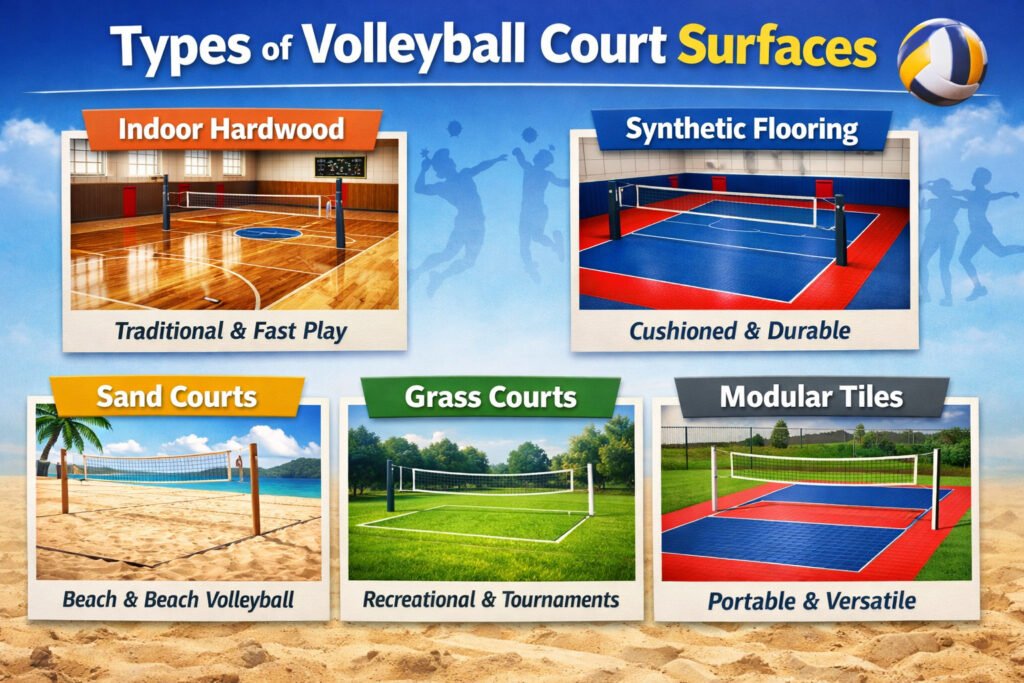
Volleyball might look like a simple game of hitting a ball over a net, but when you start exploring the Types of Volleyball Court Surfaces, you realize the surface you play on quietly shapes everything—from how high you jump to how safely you land. If you’ve ever switched from beach volleyball to an indoor court, you already know it feels like playing two entirely different sports. That’s not your imagination; it’s physics, traction, and shock absorption all working behind the scenes. Court surfaces are more than just a foundation—they influence speed, agility, endurance, and even injury risk. Professional organizations like the FIVB (Fédération Internationale de Volleyball) have strict standards for surfaces used in competitions, highlighting just how critical the ground beneath your feet really is. Whether it’s soft sand, unforgiving concrete, or engineered synthetic flooring, each surface comes with its own personality. Think of it like driving different cars on different terrains. A sports car thrives on smooth asphalt but struggles on gravel. Similarly, volleyball players adapt their movements based on the surface. On sand, every step sinks slightly, demanding more energy. On concrete, the bounce is predictable but harsh on joints. Synthetic courts aim to strike a balance, offering consistency with some level of cushioning. Choosing the right surface isn’t just about preference—it’s about purpose. Are you playing recreationally at the beach, practicing at school, or competing at a professional indoor arena? Each scenario demands a different type of court. Understanding these surfaces in depth helps players, coaches, and facility owners make smarter decisions that enhance both performance and safety. Why Surface Type Matters in Volleyball The type of surface you play on doesn’t just change how the game feels—it directly affects how the game is played. Imagine trying to sprint on loose sand versus a polished indoor court. Your muscles, balance, and timing all adjust automatically, often without you realizing it. That adjustment is exactly why surface type matters so much in volleyball. Different surfaces influence ball behavior, which can completely alter gameplay. On a synthetic indoor court, the ball rebounds quickly and predictably, allowing for fast-paced rallies and precise sets. On sand, however, the ball slows down slightly due to environmental factors like wind and softer footing, leading to longer, more strategic rallies. This is why beach volleyball often emphasizes endurance and tactical placement over sheer power. Another critical factor is player movement and energy expenditure. Studies suggest that moving on sand can require up to 1.6 times more energy compared to hard surfaces. That means players fatigue faster, which changes substitution strategies and pacing during matches. On concrete, movement is faster and more efficient, but the trade-off is increased stress on joints like knees and ankles. Safety is where surface choice becomes even more important. Hard surfaces like concrete offer little to no shock absorption, increasing the risk of injuries such as stress fractures or ligament damage. In contrast, sand provides a natural cushion that reduces impact but introduces instability, which can lead to sprains if players aren’t careful. Synthetic surfaces attempt to balance these factors by offering controlled cushioning and grip. Ultimately, the surface defines the rhythm of the game. Fast or slow, explosive or endurance-based, safe or risky—it all starts from the ground up. Once you understand this, you start to see volleyball not just as a sport, but as an interaction between athlete and environment. How Surface Impacts Player Performance and Safety If you’ve ever wondered why some players dominate indoors but struggle on the beach, the answer often lies beneath their feet. The surface plays a huge role in determining how efficiently a player can perform basic actions like jumping, diving, and changing direction. It’s almost like the surface becomes an invisible opponent—or ally—depending on how well you adapt to it. On sand courts, performance is heavily tied to strength and endurance. Because the surface shifts with every step, players must engage stabilizing muscles constantly. This leads to improved lower-body strength over time but also reduces jump height compared to harder surfaces. A spike that would normally be explosive indoors may feel slightly muted on sand. However, this same softness significantly reduces impact forces, making it easier on the joints during dives and falls. Concrete courts tell a completely different story. They offer maximum stability and allow for quick, explosive movements. Players can jump higher and move faster because there’s no energy loss from surface deformation. But here’s the catch: the lack of shock absorption means your body absorbs nearly all the impact. Over time, this can lead to chronic injuries, especially if proper footwear and conditioning are ignored. Synthetic courts aim to combine the best of both worlds. With engineered layers designed for shock absorption and grip, these surfaces support high-performance play while minimizing injury risks. Many indoor professional leagues use synthetic flooring because it provides consistent bounce and traction, which are essential for competitive gameplay. According to sports flooring experts, high-quality synthetic courts can reduce injury risk by up to 30% compared to hard concrete surfaces. Safety also depends on how predictable the surface is. Uneven sand or poorly maintained concrete can increase accident risks. Synthetic courts, on the other hand, are designed for uniformity, ensuring players can trust every step they take. At the end of the day, performance and safety are two sides of the same coin. The better the surface supports your movement, the more confidently—and safely—you can play. Sand Volleyball Courts Characteristics of Sand Courts Sand volleyball courts are probably the most iconic version of the game, instantly bringing to mind sunny beaches, diving saves, and long rallies under open skies. But beyond the aesthetics, sand courts have very specific physical characteristics that define how the game is played. Unlike hard surfaces, sand is loose, granular, and constantly shifting, which makes movement both challenging and dynamic at the same time. A standard beach volleyball court uses sand that is carefully selected and maintained. It’s not just any sand you find on a random beach. Professional

Tennis Court Construction
tennis court

ITF Standards for Tennis Court Construction and Flooring

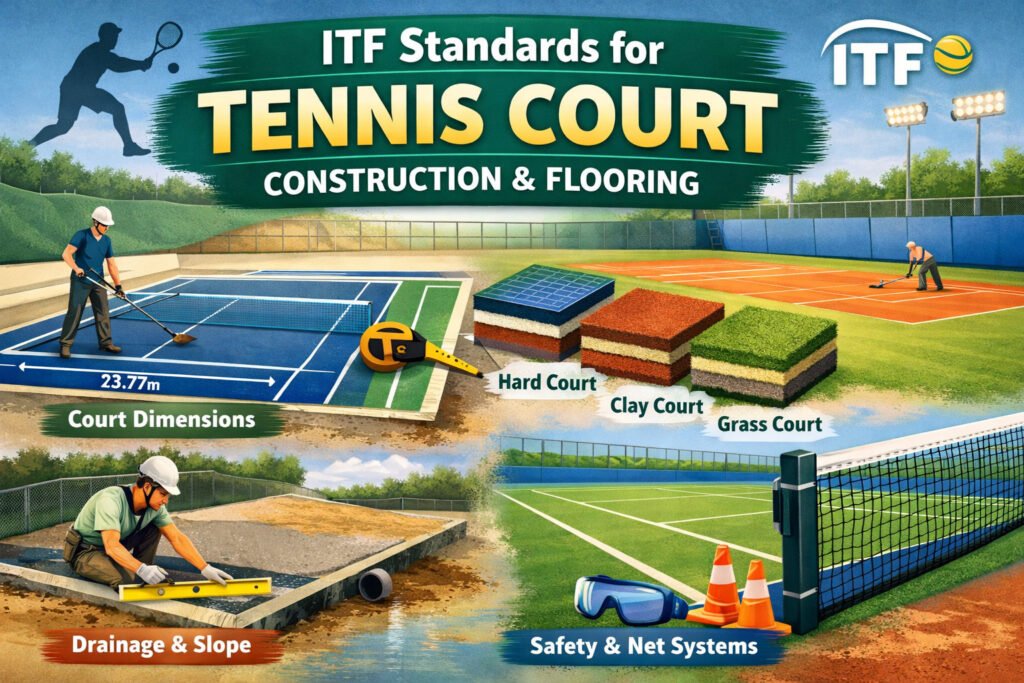
If you’ve ever wondered who actually sets the rules for tennis courts across the globe, the answer lies with the International Tennis Federation (ITF). Think of the ITF as the invisible architect behind every professional and many recreational tennis courts you see. It doesn’t just regulate tournaments—it plays a crucial role in Tennis Court Construction by defining how the game is physically played, right down to the surface beneath your feet. That includes dimensions, materials, and even how the ball should bounce after hitting the court. Founded in 1913, the ITF has evolved into the global governing body for tennis, overseeing more than 200 member nations. But its role goes far beyond organizing competitions like the Davis Cup or Billie Jean King Cup. One of its most impactful contributions is setting standardized guidelines for court construction and flooring, ensuring consistency whether you’re playing in New York, Paris, or a local club in your town. Why does that matter so much? Imagine playing tennis on a court where the ball behaves unpredictably—bouncing too high, skidding too fast, or slowing down unevenly. That’s not just frustrating; it disrupts the integrity of the game. The ITF ensures that every certified court provides a predictable and fair playing experience, regardless of surface type. Another interesting aspect is how the ITF bridges professional and amateur play. Even if you’re not competing at Wimbledon, the court you practice on may still follow ITF-inspired guidelines. This creates a universal language of play, making transitions between courts and competitions seamless. In essence, the ITF acts like a quality control system for tennis infrastructure. Without it, the sport would lack uniformity, and players would constantly struggle to adapt to inconsistent conditions. Whether you’re a seasoned pro or a weekend enthusiast, the ITF’s influence shapes every rally you play. Why ITF Standards Matter in Court Construction At first glance, tennis court construction might seem like a straightforward process—flatten some land, add a surface, draw lines, and you’re good to go. But the reality is far more intricate, and this is exactly where ITF standards become essential. These guidelines ensure that courts are not only playable but also safe, durable, and consistent across different environments. One of the biggest reasons ITF standards matter is performance consistency. Players train for years to perfect their timing, footwork, and shot precision. If the court behaves unpredictably, all that training can feel useless. ITF standards ensure that factors like ball rebound, surface friction, and speed are within controlled ranges, allowing players to perform at their best without second-guessing the surface. Safety is another critical factor. A poorly constructed court can lead to injuries, especially if the surface lacks proper shock absorption or has uneven areas. ITF guidelines specify materials and construction techniques that minimize impact stress on joints, which is particularly important given that tennis involves rapid lateral movements and sudden stops. There’s also a financial angle to consider. Building a tennis court is a significant investment, often ranging from $25,000 to over $100,000 depending on the surface and location. Following ITF standards ensures that this investment pays off in the long run by reducing maintenance costs and extending the court’s lifespan. Skipping these guidelines might save money upfront but often leads to costly repairs later. Another underrated benefit is global recognition and usability. Courts built according to ITF standards can be used for official matches and tournaments, opening up opportunities for clubs and facilities to host events. This can significantly boost visibility and revenue. Ultimately, ITF standards act like a blueprint for excellence. They bring together science, engineering, and sport to create courts that not only look professional but also perform flawlessly. Ignoring them is like building a car without following safety regulations—it might work, but it won’t take you far. Classification of Tennis Court Surfaces Overview of Surface Categories When you step onto a tennis court, the surface beneath your shoes does more than just support your movement—it completely shapes how the game unfolds. The ITF classifies tennis court surfaces into distinct categories, each offering a unique playing experience. These categories aren’t random; they’re based on how the ball interacts with the surface and how players move across it. Broadly speaking, tennis surfaces fall into four main types: hard courts, clay courts, grass courts, and artificial/synthetic courts. Each one brings its own personality to the game. Hard courts, for example, are the all-rounders—offering a balance of speed and bounce that suits a wide range of playing styles. Clay courts, on the other hand, slow the game down, creating longer rallies and demanding patience and strategy. Grass courts are the speed demons, producing low, fast bounces that reward aggressive, attacking play. Synthetic surfaces are where things get interesting. These are engineered to mimic traditional surfaces while offering enhanced durability and lower maintenance. They’ve become increasingly popular, especially in regions where maintaining natural surfaces like grass or clay is challenging due to climate or cost constraints. What’s fascinating is how these categories influence player development. A player who grows up on clay courts often develops exceptional endurance and defensive skills, while someone trained on grass might excel in quick reflexes and net play. The ITF recognizes these differences and ensures that each surface type meets specific performance benchmarks, so no matter where you play, the game retains its core identity. In a way, choosing a court surface is like choosing a personality for your tennis facility. It determines not just how the game is played, but also who it attracts and how it’s experienced. That’s why understanding these categories is the first step toward building a court that aligns with your goals. ITF Court Pace Rating System Explained Not all tennis courts are created equal—and the ITF Court Pace Rating (CPR) system is proof of that. This system is essentially the science behind how fast or slow a tennis court plays, and it’s one of the most critical standards in modern court construction. Instead of relying on vague descriptions like “fast” or “slow,” the

Types of Pickleball Court Surfaces
Pickleball Court Flooring

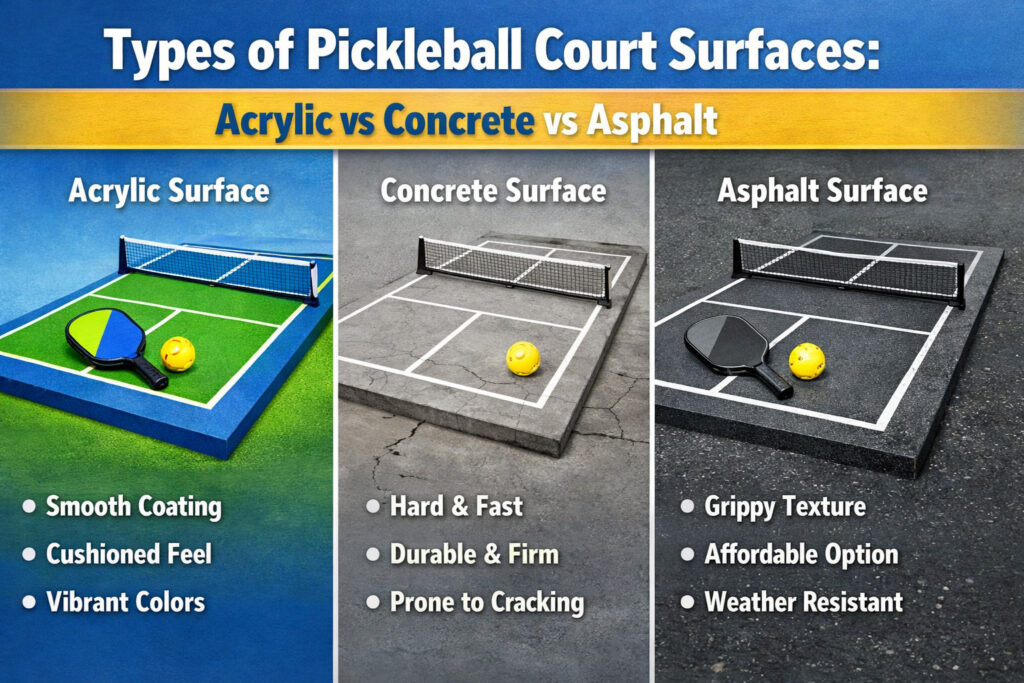
Types of Pickleball Court Surfaces: Acrylic vs Concrete vs Asphalt

Pickleball might look like a simple paddle sport at first glance, but once you step onto a court, you quickly realize how much the playing surface shapes the entire experience. When exploring Types of Pickleball Court Surfaces: Acrylic vs Concrete vs Asphalt, it becomes clear that each option brings a unique impact on gameplay. The bounce of the ball, the speed of rallies, and even how your joints feel after a long match all depend heavily on what’s beneath your feet. Choosing the right court surface isn’t just a construction decision—it’s a performance decision, a budget decision, and in many cases, a long-term investment in player satisfaction. You’ve probably noticed that not all courts feel the same. Some are smooth and responsive, allowing for quick footwork and consistent ball bounce, while others feel rougher, slower, or even slightly unpredictable. That difference comes down to the material used—most commonly acrylic, concrete, or asphalt. Each of these surfaces brings its own personality to the game, influencing how players move, react, and strategize. What makes this topic especially interesting is that there’s no one-size-fits-all answer. A recreational backyard court might benefit from a completely different surface than a tournament-level facility. Climate, budget, usage frequency, and maintenance expectations all play a role in determining the best fit. Think of it like choosing tires for a car—you wouldn’t use the same ones for a racetrack and a snowy mountain road, right? As pickleball continues to explode in popularity—with USA Pickleball reporting millions of active players nationwide—the demand for high-quality courts has surged. That means more people are asking the same question: Which surface should I choose? Let’s break it down step by step so you can make a confident, informed decision. Why Surface Choice Matters in Pickleball When it comes to pickleball, the surface isn’t just something you stand on—it actively shapes how the game unfolds. Imagine trying to play on a surface where the ball bounces unpredictably or where your shoes struggle to grip. Frustrating, right? That’s exactly why the choice of court surface matters so much. First, there’s ball behavior. A consistent bounce is critical for fair play and skill development. Acrylic-coated surfaces, for instance, are known for their uniformity, while raw concrete or asphalt might produce slight inconsistencies over time. Even minor variations can affect reaction time and shot accuracy, especially during fast-paced rallies. Then comes player safety and comfort. Hard surfaces like concrete can be tough on joints, especially during long matches. Asphalt, while slightly more forgiving, can soften in extreme heat, potentially altering footing. Acrylic coatings often add a layer of cushioning and grip, reducing the risk of slips and minimizing impact stress. For older players or those playing frequently, this factor becomes incredibly important. Another major consideration is speed of play. Some surfaces allow for faster games with quick ball rebounds, while others slow things down, giving players more time to react. Competitive players often prefer faster courts, while beginners may benefit from slower, more forgiving surfaces that help them develop control. Weather resistance also plays a huge role. Outdoor courts face constant exposure to sun, rain, and temperature fluctuations. A poorly chosen surface can crack, fade, or degrade quickly, leading to costly repairs. Acrylic coatings, for example, are designed to withstand UV rays and moisture, making them a popular choice in many regions. Ultimately, the surface you choose sets the tone for every match played on it. It’s not just about aesthetics or cost—it’s about creating an environment where players can perform at their best while staying safe and comfortable. Key Factors That Define a Good Court Surface So what exactly makes a pickleball court surface “good”? It’s not just about looking nice or being affordable. A truly great surface strikes a balance between performance, durability, safety, and maintenance—and getting that balance right is where things get interesting. One of the most important factors is surface consistency. Players rely on predictable ball behavior, and that only happens when the surface is smooth and even. Tiny cracks or uneven patches might seem insignificant, but during gameplay, they can completely throw off a shot. That’s why professional courts invest heavily in high-quality finishes, often using acrylic coatings to ensure uniformity. Another critical element is traction. You need enough grip to move confidently without slipping, but not so much that it strains your joints. It’s a delicate balance. Too little traction can lead to falls, while too much can increase the risk of injuries like ankle twists. Acrylic surfaces tend to offer the best middle ground, which is why they’re commonly used in competitive settings. Durability is also a big deal, especially for outdoor courts. Surfaces are constantly exposed to weather conditions, from scorching sun to heavy rain. Materials like concrete are incredibly durable but can crack over time, while asphalt may soften in high heat. Acrylic coatings help protect the underlying material, extending the court’s lifespan. Maintenance requirements shouldn’t be overlooked either. Some surfaces require regular sealing, cleaning, or resurfacing to stay in top condition. If you’re building a court for personal use, you’ll want something that doesn’t demand constant upkeep. On the other hand, commercial facilities might prioritize performance over maintenance costs. Lastly, there’s cost efficiency. The initial installation cost is just one part of the equation. Long-term expenses like repairs, resurfacing, and maintenance can add up quickly. A cheaper surface upfront might end up costing more in the long run if it requires frequent fixes. When all these factors come together—consistency, traction, durability, maintenance, and cost—you get a surface that not only looks great but also enhances the overall playing experience. And that’s exactly what every pickleball court should aim for. Acrylic Pickleball Courts What Is an Acrylic Surface? If you’ve ever played on a high-quality pickleball or tennis court, chances are you’ve already experienced an acrylic surface—even if you didn’t realize it at the time. Acrylic isn’t a standalone base material like concrete or asphalt. Instead, it’s a specialized coating system applied on top of a

Basketball Court Measurement
Basketball Court Dimensions in Meters

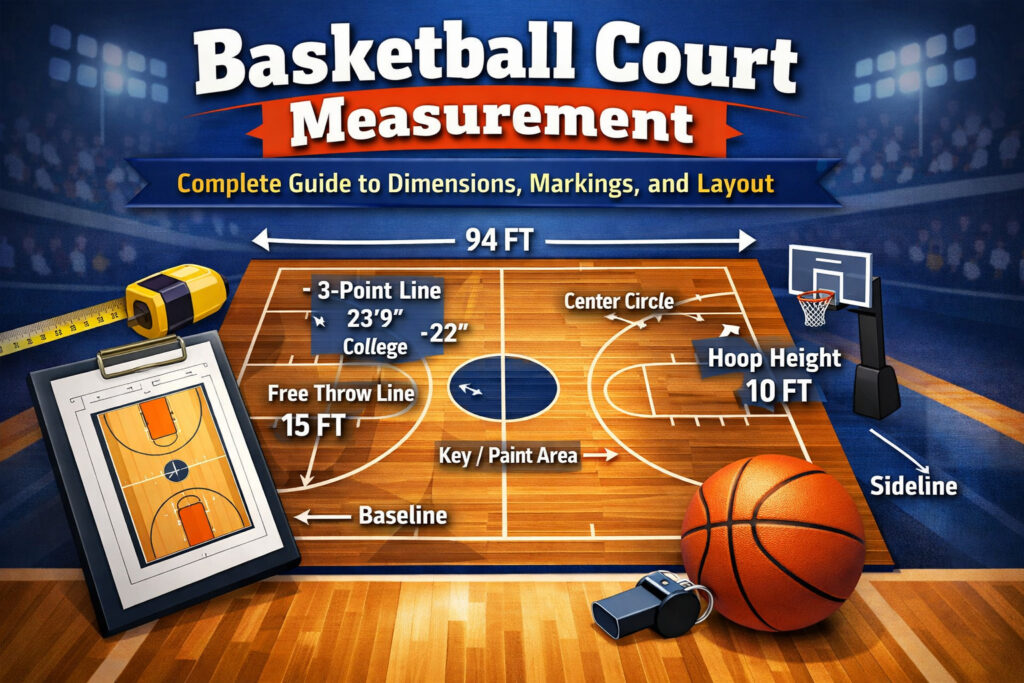
Basketball Court Measurement: Complete Guide to Dimensions, Markings, and Layout

Basketball is one of the most widely played sports in the world, from neighborhood playgrounds to massive professional arenas filled with thousands of cheering fans. While the fast-paced gameplay often steals the spotlight, the basketball court measurement itself plays a crucial role in how the game is played. Every line, arc, and boundary has a specific dimension that influences strategies, player movement, and even scoring patterns. Think of a basketball court like a carefully designed blueprint. Just as architects rely on precise measurements to build a safe structure, basketball organizations depend on standardized court dimensions to maintain fairness and consistency across games. Whether you’re watching the NBA Finals, a college tournament, or a local high school matchup, the court follows strict guidelines set by governing bodies like the NBA, FIBA, and NCAA. These measurements are not random. The distance from the three-point line, the width of the free-throw lane, and the height of the basketball rim are all carefully calculated to balance skill, athleticism, and strategy. For example, extending the three-point line even slightly can dramatically change offensive tactics, forcing teams to adjust their shooting ranges and spacing. Understanding basketball court dimensions is valuable for many reasons. Coaches use this knowledge to design effective plays, facility managers rely on it to build regulation courts, and players benefit from knowing how spacing affects their performance. Even casual fans gain a deeper appreciation of the sport when they understand how the layout shapes the game. This guide explores every important detail about basketball court measurements, including official sizes used in the NBA, FIBA, college, and high school leagues. It also breaks down court markings, hoop dimensions, surface materials, and practical tips for measuring and building a court. By the time you finish reading, you’ll have a clear understanding of how every inch of a basketball court contributes to the rhythm and excitement of the game. Understanding Standard Basketball Court Dimensions When people think about basketball court measurement, they often imagine a large rectangular floor with two hoops at opposite ends. While that description is technically correct, the reality is far more detailed. A standard basketball court includes precise measurements that regulate everything from player positioning to shooting distances. The most widely recognized court dimension comes from professional leagues such as the NBA and FIBA, where courts are designed to provide enough space for fast-paced gameplay while maintaining competitive balance. In general, a full basketball court is rectangular and divided into two equal halves by the center line. Each half contains identical markings such as the three-point arc, free-throw lane, and key area. The typical professional basketball court measures 94 feet long and 50 feet wide (28.65 × 15.24 meters) in the NBA. This size allows ten players to move freely while executing offensive and defensive plays without excessive crowding. The length of the court is especially important because it determines transition speed during fast breaks, one of the most thrilling elements of the game. Beyond the outer boundaries, several internal markings help define gameplay areas. For instance, the center circle marks where the opening tip-off occurs. The three-point arc determines which shots count for three points instead of two. The free-throw lane, often called “the paint,” is where players line up during foul shots. Here is a quick comparison of typical professional basketball court dimensions: League Court Length Court Width NBA 94 ft (28.65 m) 50 ft (15.24 m) FIBA 28 m (91.9 ft) 15 m (49.2 ft) NCAA 94 ft 50 ft High School 84 ft 50 ft Even though the differences may seem small, they significantly affect gameplay. For example, FIBA courts are slightly shorter than NBA courts, which can influence defensive spacing and offensive flow. Another interesting detail is the clearance space around the court. Professional arenas usually include additional out-of-bounds space—often several feet beyond the sidelines and baselines—to protect players when diving for loose balls. Understanding these dimensions is essential for anyone involved in basketball facility planning, coaching strategy, or sports education. Every measurement contributes to the balance between offense and defense that makes basketball such an exciting sport to watch and play. NBA Basketball Court Size The NBA basketball court is considered the global reference point for professional basketball measurements. While other leagues may adopt slightly different standards, the NBA’s dimensions are often viewed as the benchmark for elite-level competition. An official NBA court measures 94 feet in length and 50 feet in width. These dimensions create a playing surface large enough to support the incredible speed and athleticism of professional players. With athletes capable of sprinting the full court in just a few seconds, the extra length helps maintain spacing and allows for dynamic offensive plays such as fast breaks and transition scoring. The court is divided exactly in half by the midcourt line, creating two identical playing areas. At the center of this line lies the center circle, which has a diameter of 12 feet. This circle is where the game begins with the opening jump ball, one of the most iconic moments in basketball. One of the most famous features of the NBA court is the three-point line, which sits farther from the basket compared to most other leagues. In the NBA: This slight difference exists because the court width would otherwise make the corner three excessively long. Interestingly, the corner three has become one of the most strategically valuable shots in modern basketball due to its shorter distance. The free-throw lane, also known as “the key,” measures 16 feet wide in the NBA. This rectangular area sits directly under the basket and plays a crucial role in rebounding, post moves, and defensive positioning. Another critical element is the restricted area arc, which sits directly beneath the basket with a radius of 4 feet. Defenders standing inside this arc cannot draw a charging foul, encouraging more aggressive drives to the rim and reducing dangerous collisions. Altogether, the NBA court layout is carefully designed to balance shooting range, interior play, and defensive strategy. Every

indoor vs outdoor volleyball court flooring
Volleyball Court Flooring

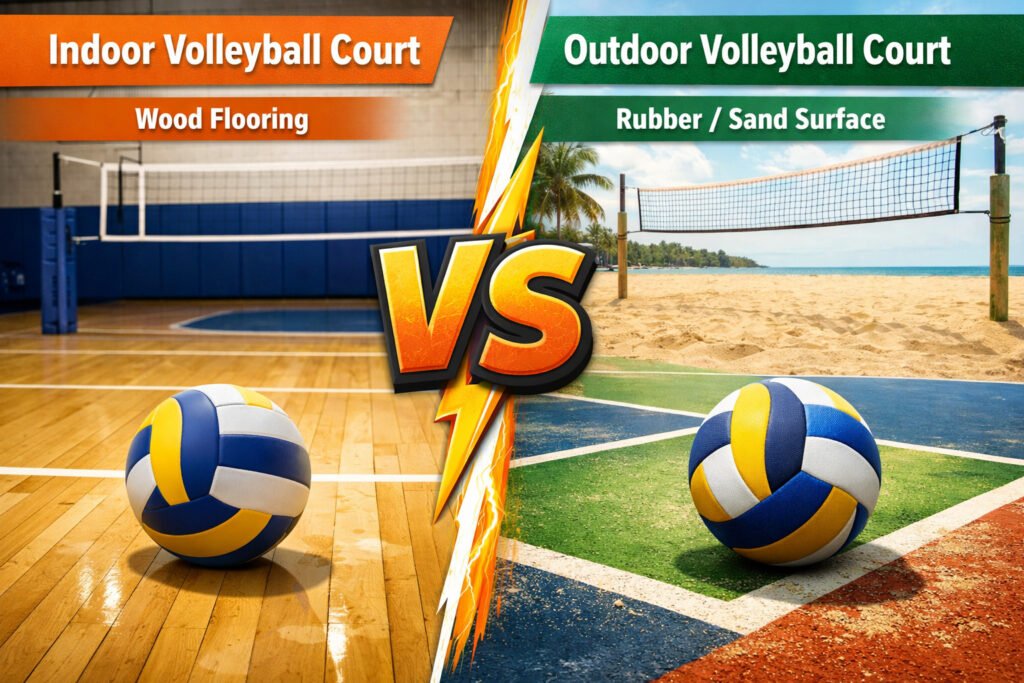
Indoor vs Outdoor Volleyball Court Flooring: Which Is Right for You?

Volleyball may look simple—just a net, a ball, and players ready to spike—but the surface beneath your feet plays a massive role in how the game feels, performs, and even how safe it is. Choosing between indoor vs outdoor volleyball court flooring isn’t just about location; it affects athlete performance, maintenance costs, durability, and long-term usability. Whether you’re building a court for a school, sports facility, backyard, or professional club, the flooring decision will shape the entire playing experience. Think about it for a moment. The way players jump, land, dive, and sprint all depends heavily on the surface they play on. A hardwood indoor floor offers shock absorption and smooth movement, while sand courts reduce impact and allow dramatic dives. Meanwhile, outdoor modular tiles or concrete courts can provide durability in all weather conditions. Each flooring type comes with its own strengths and limitations, and the right choice depends on how and where the court will be used. Another factor that often surprises people is maintenance and longevity. Indoor courts may look pristine and professional, but they require climate control, cleaning routines, and refinishing over time. Outdoor courts, on the other hand, must handle rain, sunlight, and temperature changes. Some surfaces thrive in those conditions, while others degrade quickly if not designed for outdoor exposure. Cost also enters the conversation quickly. A professional indoor hardwood volleyball court can cost significantly more than a sand court or modular outdoor tiles. But price alone doesn’t tell the whole story. Installation complexity, long-term repairs, and player safety should all influence your decision. This guide breaks down everything you need to know about indoor vs outdoor volleyball court flooring. From surface types and performance characteristics to cost comparisons and real-world applications, you’ll learn exactly how to decide which option fits your needs. By the end, you’ll have a clear picture of which flooring system will give players the best experience—whether they’re competing in a gymnasium or under the open sky. 🏐 Understanding Volleyball Court Flooring Basics Before comparing indoor and outdoor volleyball courts directly, it helps to understand what sports flooring is actually designed to do. Volleyball flooring isn’t just about aesthetics or durability. It’s engineered to support movement mechanics, athlete safety, and consistent ball behavior. Without the right surface, even the best volleyball facility can feel uncomfortable or unsafe to play on. At its core, a volleyball floor must balance three essential qualities: traction, shock absorption, and durability. Traction ensures players can change direction quickly without slipping. Shock absorption reduces the stress placed on joints during jumps and landings. Durability ensures the surface can withstand repeated impacts from players and equipment over many years of use. Indoor and outdoor courts approach these requirements differently. Indoor flooring systems are engineered for controlled environments, meaning they don’t need to handle rain, extreme temperatures, or UV exposure. Because of this, manufacturers can focus heavily on performance features like bounce consistency and shock absorption. That’s why indoor volleyball courts often feel smoother and more responsive. Outdoor courts face a completely different set of challenges. Surfaces must withstand sunlight, moisture, and seasonal weather changes. Materials used outdoors must resist cracking, fading, or warping. This is why outdoor volleyball surfaces often include sand, concrete, asphalt, or modular polypropylene tiles rather than traditional hardwood flooring. Another important aspect of volleyball flooring is player interaction with the surface. Volleyball involves explosive movements—jumping for blocks, diving for saves, and quick lateral movements. If a surface is too hard, injuries become more likely. If it’s too soft, players may lose speed and stability. Finding the right balance is the entire goal of sports flooring engineering. Modern volleyball courts also incorporate layered construction systems. Indoor courts often include subfloor cushioning layers beneath the hardwood, while outdoor modular courts may use interlocking panels that allow drainage and airflow. These hidden structural elements dramatically influence how the surface performs during gameplay. Understanding these fundamentals makes it much easier to evaluate indoor and outdoor options. Once you recognize how flooring affects performance, comfort, and maintenance, the decision becomes less about preference and more about choosing the right surface for your specific environment and players. Why Flooring Matters in Volleyball Performance and Safety If you watch professional volleyball matches, one thing becomes clear almost immediately: the game is incredibly dynamic. Players constantly jump, land, sprint, slide, and dive. Every one of those movements transfers force directly through the flooring surface. That’s why volleyball flooring isn’t just a structural element—it’s an integral part of the sport itself. One of the biggest performance factors influenced by flooring is energy return. High-quality indoor sports floors are designed to absorb impact and then return energy back to the athlete. This subtle rebound effect helps players jump higher and move faster without putting excessive strain on their knees and ankles. Without proper energy return, players may feel fatigue much more quickly during long matches. Safety is another critical consideration. Studies in sports medicine have shown that poor flooring surfaces significantly increase injury risk, particularly for knee ligaments and ankle joints. A surface that’s too hard may cause stress fractures or joint pain over time. On the other hand, a surface with inconsistent traction can cause slips that lead to sprains or falls. Indoor volleyball courts, especially maple hardwood sports floors, are widely considered the gold standard for competitive play. These floors offer excellent traction and controlled friction, allowing athletes to stop quickly without sticking to the surface. This controlled sliding effect is important because it reduces the sudden force placed on joints. Outdoor courts prioritize safety differently depending on the surface type. Sand volleyball courts, for example, reduce injury risk by providing a soft landing area for dives and jumps. Sand naturally disperses impact forces, which is why beach volleyball players can perform dramatic defensive plays without the same injury concerns seen on hard surfaces. Weather resistance also affects safety. Outdoor surfaces must maintain traction even after rain or under intense sunlight. Slippery or overheated surfaces can quickly become dangerous for

Top Most Famous Tennis Courts in History
tennis court

Top Most Famous Tennis Courts in History

Tennis is often described as a sport of precision, endurance, and elegance. Yet behind every legendary rally or championship point stands a silent hero: the tennis court itself. Over the past century, certain venues have become far more than simple playing surfaces. They’ve evolved into historic stages where athletes carve their names into sporting history. When exploring the Top Most Famous Tennis Courts in History, it becomes clear that these iconic venues represent much more than locations—they embody the traditions, rivalries, and unforgettable moments that shaped the sport. From the lush grass of Wimbledon to the red clay of Roland Garros, each court tells a story about tradition, innovation, and the unique influence of tennis court flooring and tennis court dimensions. When fans remember epic matches—Roger Federer’s graceful dominance at Wimbledon, Rafael Nadal’s clay-court mastery in Paris, or Serena Williams electrifying crowds in New York—they’re not just remembering players. They’re remembering places. The architecture, the roar of the crowd, the surface beneath the athletes’ feet, and the precise measurements of the court all shape how the game unfolds. Even subtle variations in tennis court flooring can dramatically affect ball speed, bounce, and player strategy. Professional courts around the world follow standardized tennis court dimensions, typically measuring 78 feet in length and 27 feet in width for singles play. Yet the environment surrounding those measurements—surface material, altitude, humidity, and stadium design—creates dramatically different playing experiences. A clay court encourages long, strategic rallies, while a grass court rewards quick reflexes and aggressive serving. Hard courts sit somewhere in the middle, offering a balanced style of play. What makes certain courts famous isn’t only their design or surface. It’s the unforgettable moments that happened on them. These courts have witnessed championship points, historic rivalries, dramatic comebacks, and the rise of tennis legends. They’ve also shaped the evolution of the sport itself, influencing how players train, compete, and adapt their strategies. In this article, we’ll explore the top most famous tennis courts in history, examining what makes each venue legendary. Along the way, we’ll also uncover how tennis court flooring and standardized tennis court dimensions play a critical role in shaping the modern game. Some courts are iconic because of tradition, others because of innovation, and a few because of the breathtaking locations that make them unforgettable. Whether you’re a passionate tennis fan, a player considering building a court, or simply someone fascinated by the world’s most iconic sports venues, these courts represent the very heart of tennis history. Why Iconic Tennis Courts Matter in the Sport’s Legacy Tennis is one of the few sports where the venue itself becomes almost as famous as the athletes competing on it. Think about the way fans talk about Wimbledon’s Centre Court or Roland Garros’ Philippe-Chatrier. These names instantly evoke images of roaring crowds, championship points, and unforgettable rivalries. Iconic tennis courts matter because they act as living museums of the sport, preserving decades—sometimes more than a century—of tennis history. Every line painted on the surface, every seat in the stadium, and every inch of carefully designed tennis court flooring contributes to the story. One reason these courts carry such weight in the sport’s legacy is consistency. Professional tennis follows standardized tennis court dimensions, which measure 78 feet long and 27 feet wide for singles play, expanding to 36 feet wide for doubles. These measurements ensure fairness across tournaments worldwide. However, while the dimensions remain consistent, the playing experience varies dramatically depending on the surface. Grass, clay, and hard courts each influence how the ball moves and how players strategize their game. That subtle difference can transform an ordinary match into a tactical masterpiece. Historic courts also shape the personalities of tournaments. Wimbledon, with its pristine grass courts, encourages lightning-fast serves and quick volleys. Roland Garros’ clay courts slow the game down, forcing players into long endurance battles. Meanwhile, the hard courts of the US Open and Australian Open strike a balance between speed and bounce. This variety keeps the sport dynamic and ensures that different styles of players have opportunities to shine throughout the season. Atmosphere also plays a massive role. When 20,000 spectators erupt in cheers during a match point, the energy can change the outcome of the game. Some stadiums are famous specifically because of their electric crowd environment. Arthur Ashe Stadium in New York, for example, is known for its loud and passionate fans, creating an almost theatrical atmosphere during night matches. Historic courts also drive innovation in stadium design and tennis court flooring technology. Over the years, surfaces have evolved to improve player safety, durability, and performance. Early grass courts required intense maintenance, while modern hard courts incorporate layered materials designed to reduce joint impact. These improvements show how tennis venues continue to evolve while still respecting the sport’s traditions. Ultimately, famous tennis courts are more than sporting venues—they’re cultural landmarks. They host the moments that define careers and inspire generations of players. When a young athlete dreams of winning Wimbledon or lifting the French Open trophy, they’re dreaming not only about the title but also about standing on one of the world’s most iconic courts. The Role of Surface, Tennis Court Flooring, and Atmosphere If tennis were played on identical surfaces everywhere, the sport would look very different today. The diversity of tennis court flooring is one of the main factors that keeps professional tennis exciting and unpredictable. Different surfaces create different styles of play, forcing athletes to adapt their strategies depending on where they compete. That’s why winning Grand Slam titles on multiple surfaces is considered one of the greatest achievements in tennis. There are three primary types of tennis court flooring used in professional tournaments: grass, clay, and hard courts. Each surface dramatically changes how the ball behaves after it hits the ground. Grass courts, such as those at Wimbledon, produce a fast, low bounce. This encourages aggressive play, quick serves, and rapid net approaches. Clay courts, on the other hand, slow the ball down significantly. The high

Basketball Ground
Basketball Ground

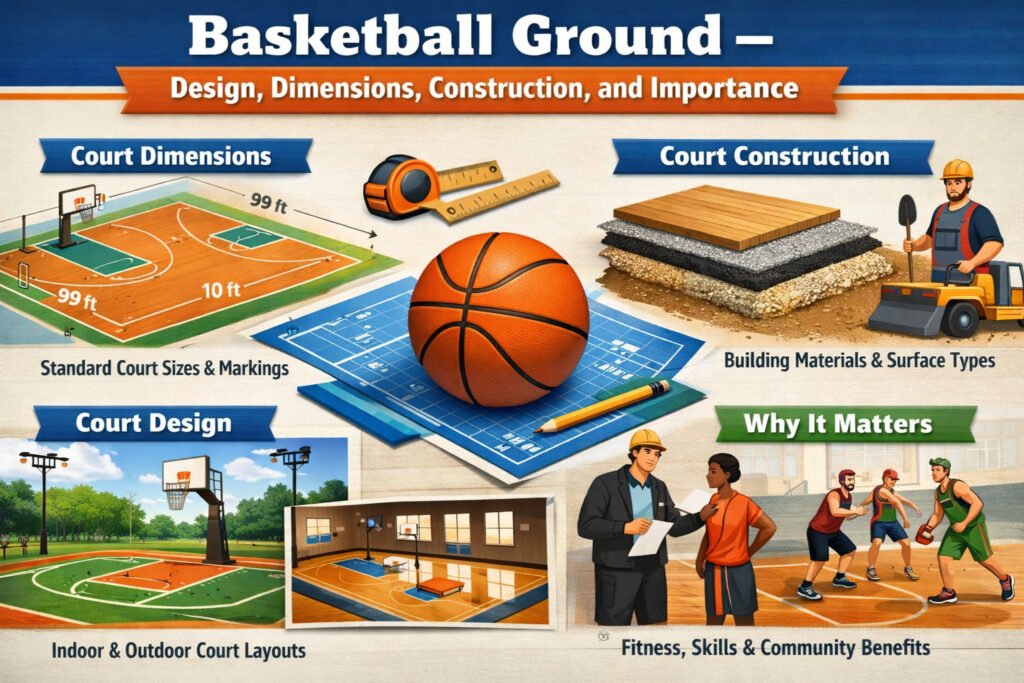
Basketball Ground – Design, Dimensions, Construction, and Importance

What Is a Basketball Ground? A basketball ground, often called a basketball court, is the dedicated playing area where the sport of basketball takes place. At first glance, it might seem like just a flat surface with two hoops at opposite ends. In reality, a properly designed basketball ground is a carefully planned sports facility with specific dimensions, markings, equipment, and safety features. Every line painted on the court has a purpose, every measurement influences gameplay, and every surface material affects performance. Think of a basketball ground as the stage for one of the fastest and most exciting sports in the world. Whether it’s a neighborhood pickup game, a school tournament, or an NBA playoff match, the court is where strategy, skill, and athleticism collide. The design of the ground ensures fair play, smooth movement, and consistent gameplay for everyone involved. Basketball grounds can exist in many environments. Some are indoor courts, usually located in gyms, arenas, or sports complexes. These courts often feature polished wooden floors that provide excellent grip and ball bounce. Others are outdoor courts, commonly found in parks, schools, and residential communities. Outdoor courts typically use materials like asphalt or concrete to withstand weather conditions. Beyond simply hosting games, basketball grounds serve an important role in community engagement and youth development. Many young athletes take their first shots on a local outdoor court, dreaming of becoming professional players one day. Public basketball courts often become social hubs where friendships form and communities connect through sport. Another interesting aspect of a basketball ground is how it balances precision and simplicity. The game itself is easy to understand—put the ball through the hoop—but the court’s layout ensures fairness and structure. Specific zones like the free-throw lane, three-point arc, and key area guide the flow of the game. In short, a basketball ground is far more than a playing surface. It is a carefully structured environment that supports athletic performance, competitive fairness, and community interaction. Without the proper design and layout of a basketball court, the sport simply wouldn’t function the way fans and players expect. Basic Concept of a Basketball Playing Area At its core, the basketball playing area is a rectangular court with a hoop at each end, designed to allow two teams to compete by scoring points through baskets. While that sounds simple, the concept of a basketball ground actually revolves around creating a balanced space where offense and defense can interact smoothly. Imagine the court as a strategic battlefield where every inch of space matters. Players sprint across the floor, pivot, pass, and shoot within clearly defined zones. The boundaries ensure the ball remains in play, while the various lines help referees enforce rules and guide player positioning. A standard basketball ground is divided into two equal halves by a center line, with a center circle marking the starting point of the game. Each team defends one basket while attempting to score on the opposite one. This symmetrical design ensures fairness because both teams have equal opportunities on the same playing surface. One of the most distinctive areas on a basketball ground is the key, also known as the paint. This rectangular or trapezoidal area near the basket is where many crucial plays occur. Players often drive into this zone to attempt close-range shots or draw fouls. Because it’s such a high-traffic area, strict rules govern how long offensive players can remain there. Another defining feature is the three-point arc. This curved line creates an exciting dynamic in modern basketball. Shots made from beyond this line are worth three points instead of two, encouraging players to develop long-range shooting skills. Over the past decade, this area has become increasingly important as teams emphasize perimeter shooting. The concept of a basketball playing area also involves player safety and performance. Courts must provide proper traction to prevent slipping, and the bounce of the basketball must remain consistent across the entire surface. Even small variations in flooring can affect how the ball moves or how athletes land after jumping. From professional arenas to simple neighborhood courts, the basic concept remains the same: a structured space that enables fast-paced competition while maintaining fairness and safety. The beauty of basketball lies in how this relatively simple court design supports an incredibly complex and thrilling game. Why a Proper Basketball Ground Matters A properly designed basketball ground is essential for both performance and safety. While casual players might enjoy shooting hoops on almost any flat surface, the difference between an improvised playing area and a well-constructed basketball court is enormous. The quality of the ground can directly influence how the game is played and how athletes perform. First and foremost, a professional basketball ground ensures consistent ball bounce. Basketball relies heavily on dribbling, and if the surface is uneven or poorly constructed, the ball may bounce unpredictably. This not only disrupts gameplay but can also make it difficult for players to develop proper ball-handling skills. Safety is another critical factor. A good basketball ground is built with shock-absorbing materials that reduce the impact on players’ joints when they run, jump, and land. According to sports medicine research, athletes in high-impact sports like basketball experience significant stress on their knees and ankles. Quality court surfaces help minimize injuries by providing the right combination of grip and cushioning. A well-maintained basketball ground also ensures clear visibility of court markings. Lines such as the three-point arc, free-throw line, and boundary lines guide both players and referees during the game. Without accurate markings, enforcing rules becomes difficult and gameplay loses its structure. There is also a psychological element. Playing on a proper court often boosts motivation and confidence. When athletes step onto a clean, professionally marked basketball ground, it signals that the game is serious and competitive. This environment encourages players to perform at their best. For schools, universities, and community centers, basketball grounds offer additional benefits. They become multi-purpose sports facilities that host tournaments, training sessions, and recreational games. These courts often serve

Badminton Court Size In Feet
Badminton

Badminton Court Size in Feet

Badminton might look like a simple backyard sport when people casually rally a shuttlecock over a net, but the official game is built around extremely precise measurements. The badminton court size in feet follows strict standards defined by the Badminton World Federation (BWF), and these measurements ensure fairness, consistency, and competitive balance in tournaments around the world. Whether you are setting up a court at home, marking lines in a school gym, or simply trying to understand the rules of the sport better, knowing the exact court dimensions is essential. A standard badminton court is rectangular and divided into different zones by a series of lines. Each line has a specific function, such as defining service areas, singles boundaries, and doubles boundaries. The fascinating part is that singles and doubles matches actually use slightly different court widths, even though the overall court is marked on the same surface. That means one court accommodates both game formats simply by using different boundary lines. If you have ever watched professional badminton, you may have noticed players hitting incredibly precise shots that land just inches inside a line. Those lines matter because every foot and inch of the court is carefully designed to influence gameplay strategy. A deeper court allows for long clears, while narrower singles sidelines encourage precision and tactical placement. Another interesting detail is that badminton courts must maintain consistent proportions regardless of location. From Olympic arenas to community recreation centers, the standard badminton court size remains 44 feet long. This uniformity allows athletes to compete anywhere without needing to adapt to new court dimensions. This guide explores everything you need to know about badminton court dimensions in feet, including singles and doubles measurements, line markings, net height, service zones, and recommended space around the court. By the end, you will have a clear picture of how a badminton court is structured and how each measurement affects gameplay strategy. Understanding the Standard Badminton Court Dimensions A badminton court may appear simple at first glance, but its design is carefully structured to support the fast-paced nature of the sport. Every measurement—from the total court length to the spacing of service lines—has been standardized by the Badminton World Federation (BWF). These regulations ensure that matches played in local gyms follow the same dimensions used in international championships. The overall badminton court size in feet is 44 feet long and 20 feet wide. This full width is used during doubles matches, while singles matches use a narrower portion of the same court. Because both formats share the same court surface, additional boundary lines are drawn inside the doubles lines to define the singles playing area. The rectangular court is split into two equal halves by a net that stretches across the center. Each side of the court measures 22 feet from the net to the baseline, meaning both players have identical playing space. This symmetry is crucial because badminton relies heavily on positioning, shot placement, and strategic movement. Several other lines divide the court into specific zones. These include the short service line, center line, doubles long service line, and sidelines. Each of these markings determines where serves must land and how rallies are judged during play. Without these markings, it would be impossible to enforce the precise rules that govern professional badminton. One fascinating aspect of badminton court design is how it balances offense and defense. The court is long enough to allow powerful clears and smashes but narrow enough to reward accuracy. Elite players often aim shots within inches of the sidelines or baseline, turning the court’s dimensions into a tactical battlefield. In professional tournaments, courts are also surrounded by additional safety space so players can chase shots without colliding with walls or spectators. Lighting, ceiling height, and flooring type are also carefully considered to ensure consistent playing conditions. Understanding these standard dimensions gives players a deeper appreciation of the sport. The next step is examining the two key measurements that define every badminton court: its official length and width in feet. Official Court Length in Feet The official badminton court length is 44 feet, and this measurement applies to both singles and doubles matches. Regardless of the level of play—from amateur leagues to the Olympic Games—this length never changes. The consistency ensures that players can develop their skills without needing to adjust to different court sizes when they compete in new venues. The 44-foot length is divided evenly by the net, creating two halves that measure 22 feet each. Each half extends from the net to the back boundary line known as the baseline. During rallies, any shuttlecock landing beyond this baseline is considered out of bounds. Because badminton shuttles slow down rapidly in the air, players must judge their shot power carefully to keep the shuttle within this limited distance. This length plays a significant role in shaping badminton strategy. For example, defensive players often use high clears, sending the shuttle deep toward the opponent’s baseline. These shots force opponents to move backward quickly, giving the defender time to recover positioning near the center of the court. On the other hand, offensive players use steep smashes that land closer to the midcourt area, making it difficult for opponents to react. The court length also affects footwork patterns. Professional players train extensively to cover the full 22-foot distance from the net to the baseline in just a few quick steps. Efficient movement across this space allows them to return shots that might otherwise seem unreachable. Interestingly, the 44-foot length has remained unchanged for decades despite many other aspects of badminton evolving. Racket materials, shuttlecock technology, and training methods have improved dramatically, but the court dimensions remain rooted in tradition. This stability allows historical comparisons between players and ensures that the fundamental nature of the game stays intact. Because the entire sport revolves around speed and precision, the exact length of the court influences every rally. A shot landing just a few inches past the baseline can mean the difference between

Rules and Regulations of Basketball

Rules and Regulations of Basketball

Basketball is one of the most popular sports in the world, played by millions of people across schools, professional leagues, and recreational courts. At first glance, the game may seem simple: two teams trying to score points by putting a ball into a hoop. Yet behind that simple idea lies a carefully designed set of Rules and Regulations of Basketball that keep the game fair, fast, and exciting. These Rules and Regulations of Basketball govern everything—from how players move with the ball to how long a team has to shoot. 🏀 Think of basketball rules as the invisible framework holding the sport together. Without them, the game would quickly turn chaotic. Players might run endlessly with the ball, block the basket physically, or stall the game indefinitely. Instead, structured rules ensure strategy, skill, teamwork, and athleticism are the deciding factors. Modern basketball rules are standardized by organizations such as the National Basketball Association (NBA), the International Basketball Federation (FIBA), and the National Collegiate Athletic Association (NCAA). While minor variations exist between these organizations, the core principles remain remarkably consistent. Whether you’re watching an NBA finals game, a college tournament, or a pickup match at a neighborhood court, the essential rulebook is the same. The regulations cover several critical aspects of the game: court dimensions, player positions, scoring methods, time restrictions, fouls, and referee authority. Each component plays a specific role in shaping how the game unfolds. For example, the shot clock forces teams to attack rather than stall, while foul limits discourage overly aggressive defense. Basketball is often described as a game of rhythm. The rules act like the tempo of a song, guiding the pace and flow. Once players understand these rules, they can fully appreciate the beauty of the sport—quick passes, clever plays, and dramatic last-second shots. Understanding the rules and regulations of basketball isn’t just important for referees or professional athletes. Fans, coaches, and casual players all benefit from knowing how the game truly works. It deepens appreciation for every play and decision on the court. Introduction to Basketball Rules If you’ve ever watched a basketball game and wondered why the referee suddenly blows the whistle, chances are a specific rule has been broken. The rules of basketball are designed to create balance between offense and defense while ensuring player safety and fair competition. They provide a clear framework that allows the game to move quickly while preventing unfair advantages. Basketball is played between two teams of five players each on a rectangular court with a hoop at each end. The main objective is simple: score more points than the opposing team by shooting the ball through the opponent’s basket. However, achieving that objective requires players to follow numerous guidelines related to movement, time, contact, and gameplay structure. For example, players cannot simply run across the court holding the ball. They must dribble, which means bouncing the ball continuously while moving. If they stop dribbling and start again, it results in a violation called double dribble. Similarly, players must avoid taking too many steps without dribbling, or they’ll be called for traveling. Another important aspect of the rules involves time management. Basketball is a fast-paced sport, and rules such as the 24-second shot clock (NBA and FIBA) ensure teams attempt a shot within a limited time. Without this rule, a team could simply hold the ball and avoid scoring opportunities. Safety is also a major focus. Basketball is a physical game, but excessive contact leads to personal fouls. If a player commits too many fouls in a game, they are disqualified. This discourages rough play and protects athletes from unnecessary injuries. Beyond the technical aspects, the rules also shape the strategy of the game. Coaches design plays based on the rule structure—how long they have to shoot, how substitutions work, and how fouls accumulate. Understanding these rules transforms basketball from a random flurry of movement into a structured, tactical sport where every action has meaning. Origins of the Basketball Rulebook The basketball rulebook has a fascinating history that dates back to 1891. The sport was invented by Dr. James Naismith, a Canadian physical education instructor working at the YMCA Training School in Springfield, Massachusetts. He was tasked with creating an indoor activity to keep students active during the winter months. Naismith developed a simple concept: players would throw a soccer ball into peach baskets nailed to a gym balcony. To organize the game, he created the original 13 rules of basketball, which formed the foundation of the modern rulebook. Those early rules were surprisingly straightforward. Players were not allowed to run with the ball, physical contact was limited, and goals were scored by throwing the ball into the basket. However, the game was quite different from today’s version. For instance, after each score, someone had to climb a ladder to retrieve the ball from the peach basket. As basketball spread across schools and athletic clubs in the United States, the rules gradually evolved. By the early 1900s, organizations began formalizing standardized regulations. Backboards were introduced to prevent spectators from interfering with shots, and dribbling became an essential part of gameplay. Over time, governing bodies such as FIBA (founded in 1932) and the NBA (founded in 1946) introduced additional rules to improve the sport’s pace and fairness. One of the most revolutionary changes was the shot clock, introduced in the NBA in 1954. Before this rule, teams could stall the game by holding the ball indefinitely. The introduction of the three-point line in 1979 also transformed basketball strategy. Suddenly, long-distance shooting became a powerful scoring weapon, forcing defenses to adapt. Today’s basketball rulebook is far more detailed than Naismith’s original 13 rules. It includes guidelines covering everything from player conduct and replay reviews to equipment specifications and officiating mechanics. Yet despite all these changes, the spirit of Naismith’s invention remains the same: a dynamic team sport built on skill, speed, and strategy. Why Rules Matter in Basketball Imagine a basketball game without rules. Players could shove opponents

Scroll to Top
HOMEOWNERS
BUSINESS OWNERS
ARCHITECTS
MUNICIPALITIES

Acrylic Flooring

Get 10% off on sports flooring materials

ITF-certified acrylic flooring for Tennis, Basketball, Badminton, Pickleball & more shipped worldwide.

    ISO-Certificate